
Cost of AI Agents for Amazon Seller Operations: 2026 Guide
Discover the cost of AI agents for Amazon seller operations in 2026. A clear breakdown of pricing and value for your business.

The total cost of AI agents for Amazon seller operations combines a connector subscription, model API and token usage, data-sync and rate-limit engineering, and human review for audited writes. The practical benchmark is not a software fee alone, because Amazon selling costs can absorb roughly 30% to 50% of gross revenue before product cost and overhead.
An agent only creates economic value when it helps operators detect or prevent avoidable leakage in advertising, fulfillment, inventory, fees, pricing, or catalog work. Agent Central connects Claude, ChatGPT, OpenClaw, Cursor, and other MCP clients to Amazon Seller Central and Amazon Ads through a hosted MCP server, returning structured facts, metrics, source-provided fields, and guarded write tools. The user's agent or team still decides what to do.
Table of Contents
- What the Real Cost of AI Agents Looks Like for Amazon Sellers
- Understanding Agent Central Pricing and the Hosted MCP Model
- Building an SP-API Integration Versus Using a Hosted Connection
- How Model API Costs and Token Usage Add Up
- The Hidden Cost of Governance, Guarded Writes, and Audits
- Example Cost Scenarios by Seller Size
- How to Calculate ROI and Optimize Agent Operating Costs
- Final Checklist for Budgeting AI Agents in Amazon Operations
What the Real Cost of AI Agents Looks Like for Amazon Sellers
Amazon's fee structure makes efficiency more important than a simple software comparison. Referral fees apply to every item sold and vary by category. Amazon's selling guidance says most referral fees in major marketplaces generally fall between 8% and 15%, while FBA adds fulfillment charges based on product weight and dimensions, covering picking, packing, shipping, customer service, and returns. Amazon's official selling-cost guidance provides the relevant fee framework.
A separate marketplace-fee summary places referral fees, fulfillment, storage, and advertising at approximately 30% to 35% of revenue for a typical FBA seller, with pay-per-click advertising potentially pushing total selling costs toward 40% to 50% of gross revenue. On $100,000 in monthly sales, a 30% to 35% operating-cost burden represents $30,000 to $35,000 before product cost and overhead. A one-percentage-point improvement in avoidable operating leakage would equal roughly $1,000 at that sales level.
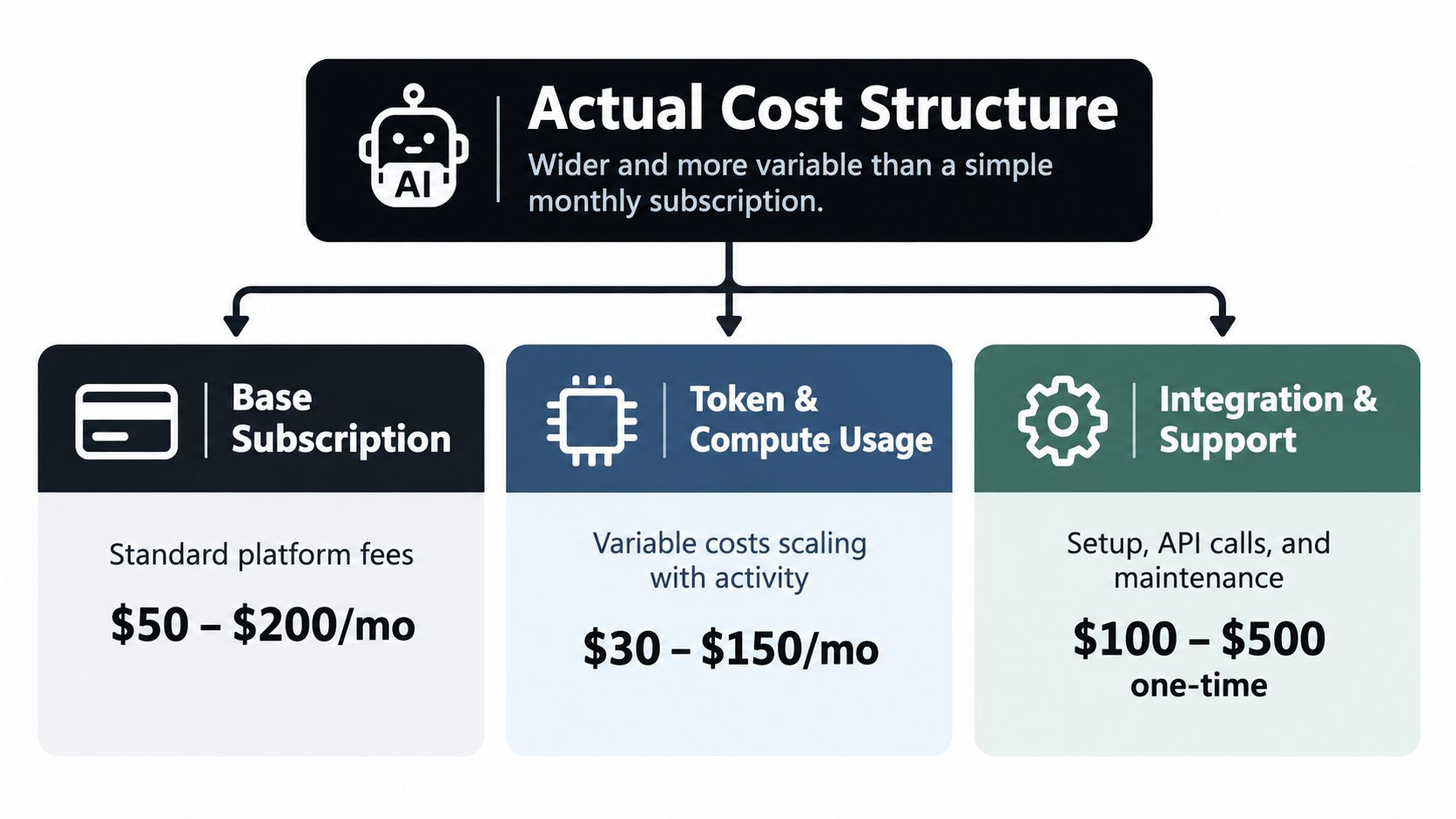
Four cost layers operators should budget
- Hosted connection subscription. This pays for the service that handles authorization, Amazon data access, and the MCP interface.
- Model and token consumption. The AI client may incur model charges based on prompts, context, tool calls, and response length.
- Data synchronization and API management. Amazon reports, pagination, retries, rate limits, and marketplace schemas create technical work even when the user sees a simple chat interface.
- Human review and governance. Operators must inspect high-impact changes, investigate exceptions, and retain evidence of what an agent proposed or executed.
The useful unit is therefore cost per completed operational task, not cost per connected account. A seller should compare the combined expense with ad waste avoided, stockouts prevented, fee exceptions recovered, storage exposure identified, and pricing or catalog errors caught before execution. Teams comparing broader AI software categories can also use this guide to selecting AI for ecommerce to frame connector, workflow, and governance trade-offs.
Understanding Agent Central Pricing and the Hosted MCP Model
Agent Central's fixed connection cost is priced by monthly Amazon order volume, with plans from $39 to $159 per month and custom Enterprise pricing available. A 14-day free trial requires no card, according to the Agent Central pricing documentation. Order-volume pricing gives sellers a predictable connection budget without requiring them to estimate every individual read before connecting an account.
The hosted MCP model handles the connection between the AI client and Amazon accounts. Setup consists of signing up at agentcentral.to, connecting Seller Central and Amazon Ads through Amazon's authorization, adding the connection to the AI client, and following the Claude quickstart. The service is not a recommendation engine. It returns facts, metrics, classifications, Amazon fields, and supported guarded writes, while the user's workflow determines the interpretation and action.
What the fixed layer includes
A new connected account starts with 30 days of history and builds from there. Amazon Ads history is kept while the account stays connected. Account data syncs on a schedule, so the service shouldn't be represented as real-time or instant access to every Amazon event.
This distinction matters for operating-cost analysis. A prepared record can answer repeated questions without forcing the agent to request the same Amazon report for every conversation. Amazon's reports are often asynchronous, so a workflow that relies on fresh report generation for each prompt carries more waiting, polling, and failure-handling work than a workflow that reads synchronized records.
Hosted MCP isn't the same as a generic web-research connector. A web scraping MCP reference is useful when the workflow needs website extraction, but Amazon seller operations require authorized access to advertising, sales, inventory, orders, catalog, finance, ranking, and fulfillment data. The architecture and permission model are different.
For teams evaluating the hosting question itself, MCP server hosting considerations provide useful context. The main budgeting benefit is separation. The seller pays a known connection fee, while model usage and internal review remain visible as separate operating costs.
Building an SP-API Integration Versus Using a Hosted Connection
A custom integration can provide complete control, but its cost begins before the first useful seller query. The build includes developer registration, Login with Amazon authorization, Amazon Ads OAuth, permission scopes, token storage, report polling, pagination, retries, schema normalization, monitoring, and security review. Amazon's APIs also impose operation-specific limits, so a synchronous design can become expensive and fragile as account coverage expands.
Amazon's documented Sellers API example gives getAccount a default rate of 0.5 requests per second with a burst of 30. The Sellers API also lists getMarketplaceParticipations at 0.016 requests per second with a burst of 15. When an application exceeds the applicable threshold, Amazon can return HTTP 429 Too Many Requests. Amazon's Sellers API rate-limit documentation explains why a workflow needs scheduling rather than assuming uniform endpoint capacity.
| Dimension | Hosted MCP Connection | Custom SP-API Build |
|---|---|---|
| Initial setup | Amazon authorization, client connection, and scoped access | Developer registration, OAuth, scopes, secure token handling, and client development |
| Amazon data | Structured access through the hosted service's supported coverage | The team selects endpoints, reports, schemas, and normalization rules |
| Reports | The service manages scheduled synchronization and asynchronous-report handling | The team implements report creation, polling, pagination, retries, and storage |
| Rate limits | The service absorbs much of the operational integration burden | The team must schedule requests, inspect headers, apply backoff, and manage 429 responses |
| Writes | Supported changes can use preview, duplicate protection, and audit logs | The team must design approval gates, idempotency, rollback behavior, and logs |
| Ongoing cost | Subscription plus model and review costs | Hosting, engineering upkeep, security work, monitoring, API changes, and model costs |
A custom build makes sense when a developer team needs unusual workflows, proprietary data models, or control over every execution path. It doesn't make economic sense merely because the monthly connector fee looks avoidable. The recurring labor of maintaining report behavior, permissions, marketplace differences, and throttling often becomes the larger cost.
Amazon's getOrderMetrics operation has a default rate of 0.5 requests per second and a burst of 15 per account-application pair, as documented in the Sales API rate limits. Teams designing an internal system should also review the Amazon SP-API integration model before estimating build effort.
How Model API Costs and Token Usage Add Up
Token cost varies with workflow design, not just seller size. A short question against prepared sales and inventory records may require limited context, while a workflow that repeatedly retrieves orders, campaign data, reports, and catalog records can create many tool calls before producing an answer. Long conversational history adds another variable because the model may process more context even when the requested output is small.
The most expensive design pattern is usually not a single large prompt. It's repeated, redundant retrieval. An agent that polls Amazon separately for every marketplace, date range, or follow-up question can create latency, retry traffic, and additional inference calls. Amazon's published usage plans mean that API pressure can also make the workflow less predictable.
A practical variable-cost model
Track these measures for each workflow:
- Model input and output tokens: Record prompt size, returned context, and completion length.
- Tool-call frequency: Count Amazon reads, writes, retries, and duplicate requests per completed task.
- Synchronization work: Separate scheduled ingestion from user-triggered analysis.
- Human review events: Measure how often an operator must inspect, approve, reject, or correct an action.
- Failed execution paths: Include authentication errors, throttling, malformed parameters, and unavailable reports.
A lower-cost architecture schedules ingestion, normalizes records into an operational store, and lets the agent query prepared data. Deterministic calculations should handle fee reconciliation, inventory-age ranking, and threshold checks where possible. The model should interpret the results rather than repeatedly recompute or rediscover them through live calls.
Practical rule: Price the workflow by completed task, not by the number of chat prompts. A campaign review that needs repeated retries and manual reconciliation costs more than a clean read that produces an auditable answer.
Rate-limit headers, bounded concurrency, exponential backoff, and idempotency keys also affect cost. Idempotency prevents a retried write from becoming a duplicate action. Bounded concurrency reduces the risk that a burst of parallel calls exhausts an operation's allowance. Scoped access narrows the available surface area, which can reduce both security exposure and the number of irrelevant tools an agent can invoke.
The Hidden Cost of Governance, Guarded Writes, and Audits
The control layer often costs more than the connector. A wrong bid, budget, listing, price, inventory quantity, or fulfillment change can create direct financial loss, so a production workflow needs more than an answer box. It needs previewed actions, duplicate-submission protection, scoped permissions, before-and-after values, and an audit record that explains what happened.
Agent Central exposes facts and guarded write tools, but it doesn't decide what sellers should do. The user's agent or operator remains responsible for interpreting metrics, reviewing proposed changes, and approving actions. This division is important because read-heavy workflows with deterministic calculations and approval gates can have better economics than unrestricted agents making frequent low-value writes.
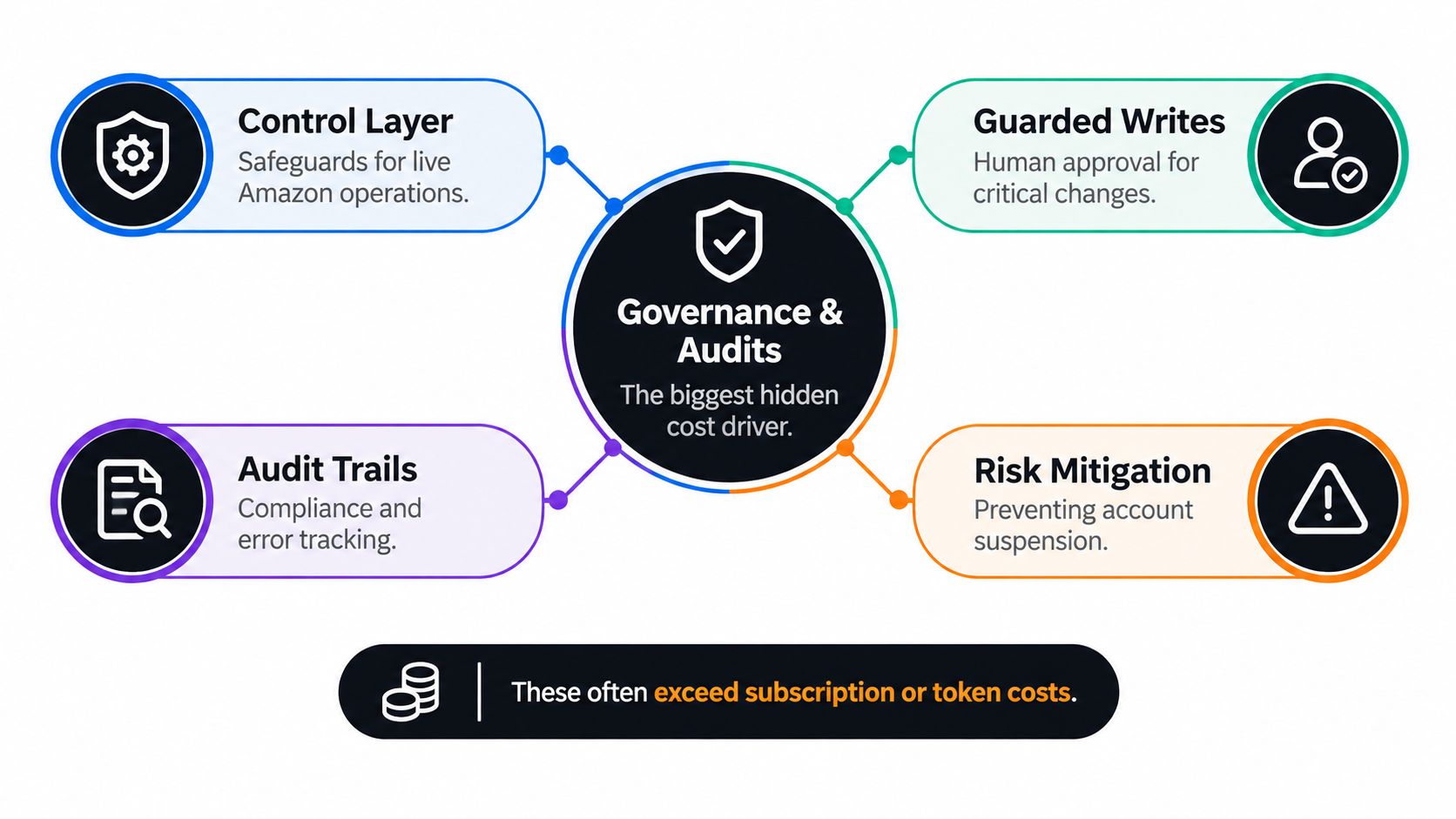
Where governance spending appears
- Permission design: SP-API operations involving personally identifiable information require a Restricted Data Token and the relevant restricted roles, not just an ordinary access token. Amazon's restricted-data authorization tutorial describes the separate token path.
- Advertising authorization: Amazon Ads uses OAuth scopes, including
advertising::campaign_managementfor campaign-related APIs. A narrower scope is preferable when the workflow doesn't need broader advertising access. Amazon's authorization-grant documentation sets out the permission model. - Approval handling: Operators need a clear queue for changes that affect spend, customer-facing content, pricing, or inventory.
- Evidence retention: Before-and-after values, timestamps, source fields, and the approving user help teams investigate errors and disputes.
Human review isn't free, but avoiding it can be more expensive. A budget change that runs twice, a price update applied to the wrong SKU, or a listing edit submitted with malformed fields can consume more margin than the review time would have cost.
The MCP governance discussion is relevant for teams formalizing permissions and approval boundaries. Broader material on IamVera's AI oversight tools can also help operators compare audit and oversight patterns outside the Amazon-specific context.
Example Cost Scenarios by Seller Size
A small seller usually has fewer orders but less tolerance for avoidable loss. A mid-market operator has more campaign, inventory, and marketplace interactions, so synchronization quality and exception prioritization become more important. An agency adds a different problem: separate authorization, scoped access, review queues, and audit records across client accounts.
| Seller Profile | Fixed Connector Cost | Variable Cost Focus | Primary Value Driver |
|---|---|---|---|
| Small seller | Order-volume plan priced by monthly Amazon orders | Model calls, basic synchronization, and review of occasional writes | Catching preventable stockouts, wasted campaign spend, fee exceptions, or pricing mistakes |
| Mid-market seller | Higher order-volume plan as account activity grows | Advertising reads, inventory-age analysis, reports, retries, and approval workflows | Connecting ad performance with stock, fulfillment, and contribution-margin decisions |
| Agency managing multiple accounts | Per-account planning plus order-volume fit for each account | OAuth administration, scoped permissions, client review time, synchronization, and audit evidence | Reducing coordination cost while keeping each client's data and actions separated |
For a smaller seller, the connector fee can be immaterial compared with one preventable stockout or an avoidable campaign overspend. That doesn't justify autonomous execution. It supports starting with read-heavy workflows such as campaign monitoring, fee investigation, inventory checks, order analysis, and catalog maintenance.
A mid-market seller should separate variable model usage from data access. Advertising teams may ask for search-term, budget, placement, product, and inventory context in the same workflow. The agent can return those facts, but a human or a separate decision system should determine whether a bid, budget, or listing change is appropriate.
Agencies need a cost model per completed client task. A shared workflow that uses overly broad access can create review and security problems, even if it appears cheaper. Amazon's permission model makes authorization a per-integration governance task, especially when different advertiser accounts need different campaign-management scopes.
The correct comparison is not “monthly fee versus no monthly fee.” It is “controlled operating cost versus the cost of missed exceptions, duplicated work, and unreviewed financial changes.”
The right pilot differs by profile. Small sellers can test exception detection. Mid-market teams can test advertising and inventory reconciliation together. Agencies can test account separation, scoped OAuth, review routing, and audit completeness before expanding the workflow.
How to Calculate ROI and Optimize Agent Operating Costs
ROI should begin with an operational baseline. Before deployment, record the time spent on daily campaign monitoring, the speed of detecting budget exhaustion, the frequency of duplicate changes, preventable overspend, stockout events, fee mismatches, inventory-age exceptions, and fulfillment discrepancies.
The agent's cost then includes four measurable buckets:
- Connection cost: The applicable hosted subscription or the amortized cost of an internal integration.
- Model cost: Input tokens, output tokens, context size, and tool-call volume.
- Operational cost: Synchronization, monitoring, retries, report handling, and engineering maintenance.
- Review cost: Human inspection, approvals, rejected actions, corrections, and exception handling.
Amazon advertising provides a concrete measurement environment. One marketplace benchmark places average ACoS at 29.6%, with most accounts between 25% and 36%. At $50,000 in attributed advertising sales, a 29.6% ACoS implies approximately $14,800 in ad spend. A five-percentage-point movement at the same sales level changes spend efficiency by about $2,500. The advertising benchmark source supports the calculation, but it doesn't prove that an agent will produce that improvement.
Run a controlled pilot
Use a defined workflow, a fixed account scope, and approval gates. Compare the baseline with the pilot on:
- hours spent reviewing campaigns and inventory;
- time from budget exhaustion to detection;
- duplicate or rejected write attempts;
- preventable spend leakage;
- stockout days and excess inventory exceptions;
- reimbursement or fulfillment issues surfaced;
- percentage of proposed actions approved without correction.
A read-heavy agent often provides a cleaner first test because the financial exposure is lower. Once the workflow produces reliable classifications and evidence, operators can add previewed writes for narrowly defined actions. Fully autonomous execution should require a stronger business case than simple convenience.
The best result isn't necessarily the lowest token bill. It is the lowest cost per completed, approved task after review and error remediation are included.
Final Checklist for Budgeting AI Agents in Amazon Operations
A defensible budget includes more than a connector invoice. It accounts for the model, Amazon access, synchronization, engineering, review, and financial exposure. Sellers should make the following checks before connecting a live account.
Subscription and scope
- Match the plan to orders: Agent Central plans are priced by monthly Amazon order volume, so estimate the applicable order band before comparing tools.
- Confirm data coverage: Verify that the workflow needs Seller Central, Amazon Ads, inventory, orders, catalog, ranking, finance, or fulfillment data, rather than advertising data alone.
- Separate history from refresh speed: A new account starts with 30 days of history that builds from there, and Amazon Ads history is retained while the account remains connected. Scheduled synchronization isn't a promise of real-time data.
Technical cost
- Count model usage: Estimate context size, tool calls, retries, and follow-up questions.
- Budget API handling: Include pagination, asynchronous report polling, rate-limit scheduling, backoff, and monitoring.
- Compare hosted and custom paths: A hosted connection buys operational coverage. An in-house build buys control but creates continuing maintenance and security obligations.
Governance and measurement
- Scope authorization: Use the narrowest practical SP-API and Amazon Ads permissions. Restricted PII workflows require the correct roles and Restricted Data Tokens.
- Guard writes: Preview high-impact changes, block duplicates, and record before-and-after values.
- Keep a human checkpoint: Require review where a mistaken bid, budget, price, listing, inventory, or fulfillment action could create material loss.
- Measure task economics: Track cost per completed operational task and cost per human-approved action, not just monthly software price.
- Run a bounded pilot: Start with reads and exception detection, then expand to guarded writes only when the baseline and review process are reliable.
Amazon's own fee and fulfillment structure explains why modest operational leakage can matter. Referral fees, FBA fulfillment, storage, aged-inventory surcharges, removal charges, and advertising can all compete for the same contribution margin. The cheapest agent on paper may be the most expensive after token waste, throttled calls, weak permissions, and unlogged writes are included.
Agent Central offers a hosted MCP connection between existing AI clients and Amazon Seller Central and Amazon Ads, with structured facts, synchronized account records, and guarded changes supported by audit logs. Sellers evaluating the total cost of AI agents for Amazon seller operations can visit agentcentral to review the connection model and start with the 14-day trial without a card.
Related Agent Central pages
- Amazon Seller Central MCP server
Canonical hosted MCP overview for Seller Central, Ads, inventory, catalog, finance, and fulfillment data.
- Amazon seller data for AI agents
How Agent Central normalizes Amazon seller data before exposing it to AI clients.
- Connect Seller Central to Claude
Step-by-step path from Amazon OAuth to a Claude connector or MCP config.
- Finance tool reference
Payment transactions, fee breakdowns, profitability, and settlement economics.
- Fulfillment tool reference
MCF shipping previews, orders, order creation, tracking, and returns.
- Amazon seller MCP servers compared
How hosted MCP services compare with official Ads MCP, local repos, connector tools, and automation platforms.
Related reading
- Amazon Ads API Guide: Build vs Agent Central in 2026
Learn how the Amazon Ads API works, authentication, endpoints, and async reporting. See why Agent Central is the faster route for Amazon sellers and agencies.
- How AI Agents Manage Amazon Seller Workflows
Learn how AI agents manage Amazon seller workflows to automate listings, optimize pricing, and streamline operations for better efficiency.
- Amazon Tacos: TACoS Metrics and Seller Guide
Decode Amazon Tacos search intent and master TACoS metrics. Learn to calculate ad efficiency, optimize listings, and automate reporting with Agent Central.
- AI Tools to Automate FBM Fulfillment: A Practical Guide
Which AI tools can automate FBM fulfillment today: agents read orders, inventory and MCF options and draft changes, while shipping software buys labels.
Connect Amazon seller data to your AI client.
Agent Central gives Claude, ChatGPT, OpenClaw, Cursor, and other MCP clients structured access to Amazon Ads, Seller Central, inventory, orders, catalog, finance, and fulfillment data.