
MCP Server Governance for Amazon Workflows
Practical mcp server governance for Amazon seller agents — scoped keys, audit logs, idempotency, and tenant isolation explained.

An Amazon seller gives an agent access to campaign data, inventory, and catalog tools. A prompt asking for “cleanup” sounds harmless. The agent interprets it as permission to rewrite the bullet points on a hero ASIN, lowers a price below MAP, or pauses a Sponsored Products campaign overnight. By morning, the account contains changes nobody intended, and the team is trying to determine whether the fault belongs to the seller, the agent, the MCP server, or the person who approved the connection.
That question is the practical center of MCP server governance. Access control matters, but production governance must also establish who owns an agentic action, what evidence proves authorization, and how a write can be stopped or reversed before Amazon's catalog, advertising, and fulfillment systems propagate it.
Table of Contents
- When an Agent Fires the Wrong Write on Your Amazon Account
- What MCP Governance Actually Governs
- Access Controls Built Around Scoped Keys and OAuth
- Audit Logs That Survive an Incident Review
- Idempotency, Write Previews, and Tenant Isolation
- The Shadow Server Problem Nobody Wants to Inventory
- A Governance Checklist for Hosted MCP on Amazon
When an Agent Fires the Wrong Write on Your Amazon Account
A campaign manager asks an agent to “tighten inefficient spend.” The agent has access to Amazon Ads reporting and a campaign-editing tool. It identifies a campaign with weak recent performance, changes bids, and pauses an ad group. The user meant to review the campaign first. The tool description made execution available, so the agent treated interpretation as authorization.
A different failure affects the catalog. A seller asks the agent to improve a product detail page, but the agent rewrites the hero ASIN's bullets using data from a related variation. The copy is technically valid, yet it changes the offer's positioning. Another workflow sees “make pricing competitive” and applies a lower price without checking the seller's MAP policy. None of these actions requires a malicious model. Ambiguous intent, broad tools, and missing approval boundaries are enough.
Practical rule: An agent's reasoning can produce intent, but it must not be the evidence that a write was authorized.
A defensible system separates four events:
- Intent creation: the human or upstream workflow states what it wants.
- Tool authorization: the host checks whether that actor may invoke the specific tool.
- Write execution: the MCP server sends the scoped Amazon request.
- Evidence and recovery: the system records the action, returns the result, and supports a controlled reversal.
The accountability gap appears when those events collapse into one opaque API call. A seller then can't answer whether the agent selected the wrong ASIN, whether the server transformed the payload, whether the OAuth grant permitted the operation, or whether Amazon rejected and retried it.
MCP server governance gives each party a defined responsibility. The seller owns business policy and approval. The host controls user consent and which tools the agent can see. The server operator owns authentication boundaries, request validation, tenant isolation, audit evidence, and operational shutdown. A hosted server must make those boundaries visible because it acts on behalf of multiple sellers. A self-hosted server gives the operator more direct control, but also leaves that operator responsible for every credential, log, patch, network boundary, and recovery procedure.
What MCP Governance Actually Governs
MCP governance starts with the protocol's control surface, not a generic SaaS checklist. The MCP specification's core principles define user consent and control, data privacy, tool safety, and LLM sampling controls. Hosts must obtain explicit consent before exposing user data to servers, must not transmit resource data elsewhere without consent, and must obtain explicit consent before invoking tools. Users must also approve LLM sampling requests and control the prompt, timing, and results visible to the server.
That creates a trust boundary between the MCP host, the MCP server, and Amazon. The host decides which server connection exists and which tools are exposed. The server validates the request, maps it to Amazon credentials, applies policy, and records the outcome. The seller decides which account, marketplace, data classes, and write capabilities the workflow may use.
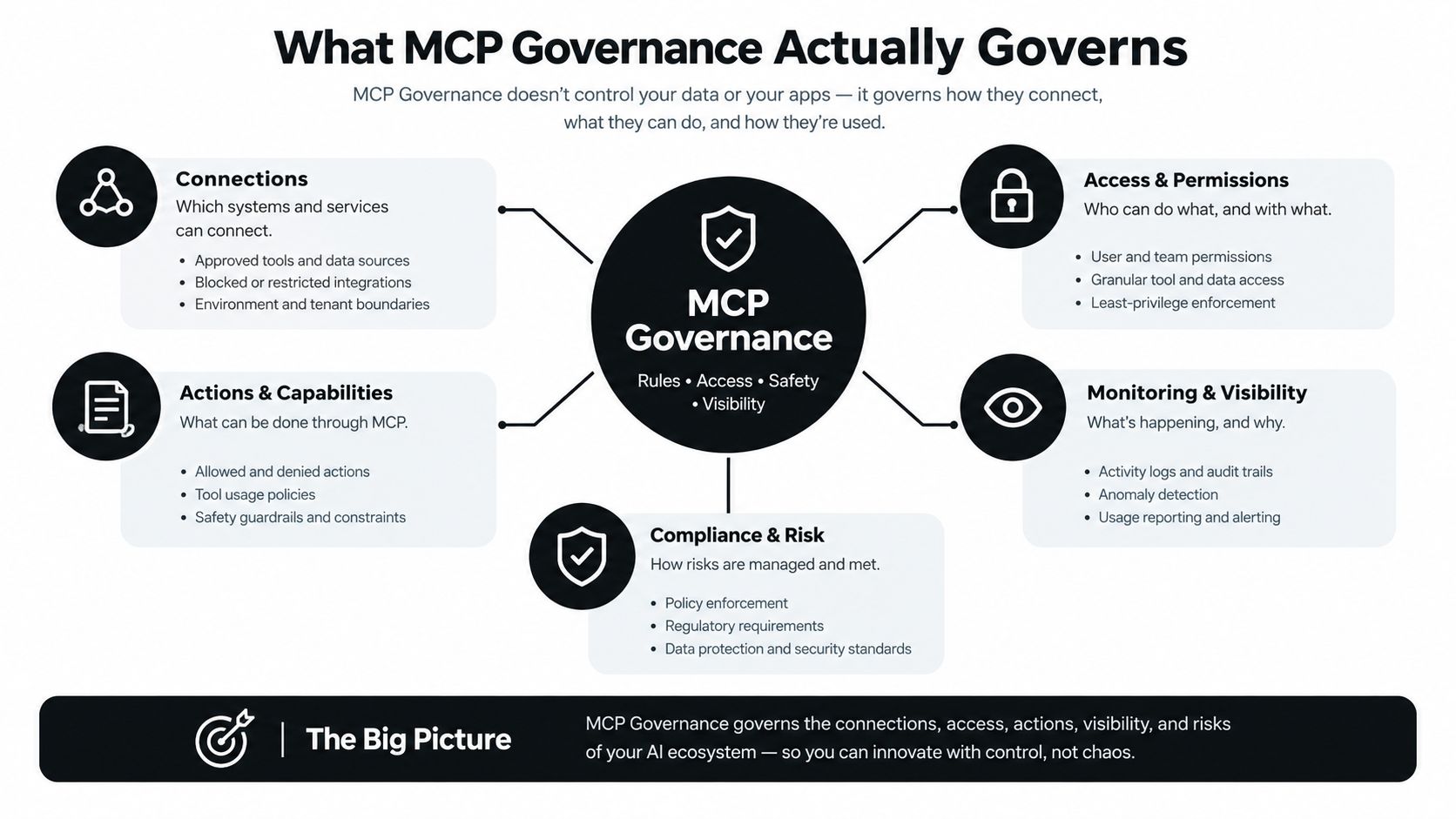
The contract behind an Amazon tool
An inventory read tool and a listing-edit tool aren't equivalent just because both use SP-API. The first may return quantity and availability fields. The second can alter customer-facing content and create operational consequences. Ads reporting and campaign editing have the same distinction. A governance policy should therefore evaluate the tool, actor, seller, marketplace, resource, arguments, and requested effect before execution.
This is why descriptions alone aren't a sufficient boundary. Tool descriptions are supplied to the model and should be treated as untrusted unless they come from a trusted server. A host can expose only approved tools, but the server still needs deterministic checks for seller identity, marketplace ID, resource ownership, and write approval.
Teams new to this model can use AgentStack uses MCP servers as a useful primer on how MCP servers connect agents to external capabilities. For Amazon operations, the important extension is governance around the resulting data access and writes, not merely making a tool discoverable.
Responsibility must follow the call
A seller shouldn't have to infer accountability from a chat transcript. Each write needs a durable relationship between the human identity, agent session, MCP session, Amazon authorization, exact tool invocation, and resulting resource change. If an incident reaches Amazon support, an internal compliance review, or a customer dispute, those records should identify the responsible tenant and the policy decision that allowed execution.
The protocol supplies the interaction pattern. It doesn't replace the server's authorization model, Amazon's OAuth grants, or the operator's evidence system. Governance is the contract that connects them.
Access Controls Built Around Scoped Keys and OAuth
A production MCP server should grant the smallest useful permission set and expose only tools that fit inside it. Amazon's SP-API authorization model uses roles such as Pricing and Inventory Write. Amazon Ads uses authorization grants, access tokens, refresh tokens, and profiles, with view and edit profile access separating account visibility from account changes. Treat Amazon Ads API authorization details as an input to MCP policy, not as the policy itself.
Permission design needs to match the workflow:
- Create a seller-specific OAuth relationship. Bind the connection to the seller and marketplace context instead of a shared operator identity.
- Pin SP-API roles to the required workflow. An inventory reader should not receive Inventory Write, and an ad reporting workflow should not inherit campaign-edit permissions.
- Separate Ads read and edit behavior. Reporting tools can use
viewaccess where possible. Campaign mutation tools should requireeditaccess plus an approval policy. - Issue scoped MCP API keys. Each key should identify the tenant and permitted tool family. Revoke and rotate it independently from Amazon's refresh token.
- Validate claims on every call. Session checks alone are insufficient. Compare seller ID, marketplace ID, tool name, and resource identifiers with the current OAuth claims and tenant policy.
That last control closes an accountability gap. A valid Amazon token proves that an application can act, but it does not prove that this tenant, agent, or workflow should perform a particular write. The MCP key and policy decision should identify the owner of the requested action before the server sends it to Amazon. For practical role design, see the role-based access control guidance for Amazon workflows.
Amazon ties SP-API rate limits to the caller identity in the access token. Responses may include x-amzn-RateLimit-Limit for the specific account and application pair. Exceeding a quota returns 429 Too Many Requests, so identity-bound credentials also support operational attribution and throttling controls through Amazon's SP-API usage and rate-limit guidance.
| Scope / Role | Allowed MCP Tool | Risk If Over-Exposed |
|---|---|---|
| Inventory read access | Inventory snapshots, availability reads, replenishment reporting | Unnecessary exposure of operational data |
| Inventory Write | Quantity or inventory-management write tools | Incorrect quantities can create fulfillment and availability problems |
| Pricing | Price reads and narrowly scoped pricing tools | A broad pricing writer can violate MAP or alter multiple offers |
Ads view profile access | Campaign, spend, and performance reads | Financial and performance data becomes visible to the wrong agent |
Ads edit profile access | Bid, budget, targeting, or campaign-state tools | A mistaken instruction can change live advertising activity |
Credentials and tools form separate enforcement layers. A server can hold a valid token and still deny a tool because the MCP key, tenant policy, resource scope, or approval state does not authorize it. Keep those decisions explicit rather than burying them in application code.
Amazon also limits application authorizations by application type. Private applications allow 10 self-authorizations and no OAuth, public unlisted applications allow 10 self-authorizations plus up to 25 seller OAuth authorizations, and public listed applications allow 10 self-authorizations plus unlimited OAuth authorizations, according to Amazon's application authorization limits. Operators should monitor authorization usage and remove grants that no longer have a named owner.
Audit Logs That Survive an Incident Review
An incident review starts with a simple question: who authorized the write that changed an Amazon listing, bid, or inventory state? An HTTP request alone cannot answer it. The record must connect the human or workflow, agent, tenant, authorization decision, submitted payload, and final outcome.
A production audit event should include:
- Actor identity: human user, agent, parent workflow, and invocation chain.
- Session context: MCP session ID, tenant ID, seller ID, and marketplace ID.
- Authorization evidence: SP-API role or Ads profile scope, MCP key ID, and policy decision.
- Tool details: exact tool name, resource URI, normalized arguments, and request payload hash.
- Outcome: Amazon response status, server decision, validation errors, and resulting resource identifiers.
- Correlation data: idempotency key, retry count, and links to preview or approval records.
- Operational signals:
x-amzn-RateLimit-Limit,Retry-Afterwhen returned, and relevant throttling state.
Amazon recommends logging API responses, categorizing errors, and using dashboards and alerts for operational control in its SP-API rate-limit documentation. Rate-limit headers belong with the write event because throttling can explain delayed retries, interrupted workflows, or a later duplicate attempt.
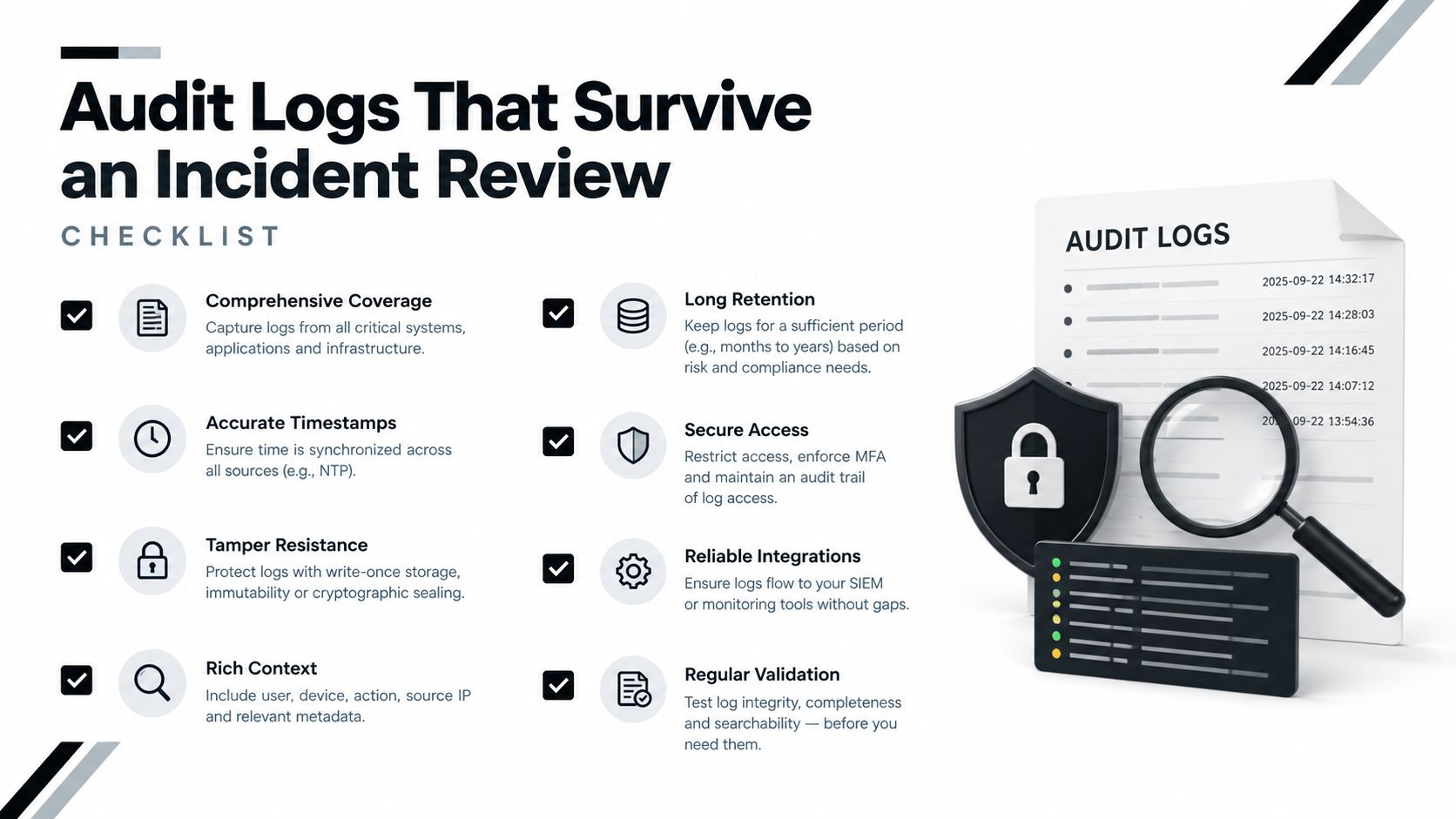
Structure beats narrative
Use JSON with a locked schema instead of free-text messages. Each event needs consistent field names, an unambiguous timestamp, and a stable type such as write.previewed, write.approved, write.denied, or write.completed. A monotonic clock orders events within one process, while synchronized wall-clock timestamps support correlation with Amazon and SIEM records.
Logs should be append-only, hash-chained, and exportable without removing non-sensitive context. Redact secrets and customer data where required, but retain a stable payload hash so reviewers can verify whether the logged request matches the submitted request.
Schema design, access controls, and review procedures can draw on CloudCops GmbH audit log best practices. The agentcentral audit logging guide addresses agent identity, tool calls, and before-and-after values, which are particularly useful for hosted MCP services handling writes across seller accounts.
Hosted servers need a named owner for each tenant's audit stream and a controlled export path. Self-hosted deployments place those duties with the operator, so incident evidence can disappear when logging, storage, or access management is left to application defaults.
Retention should match contractual, legal, and incident-review requirements. Longer retention improves reconstruction but increases exposure to seller, customer, and financial data. The log system therefore needs its own roles, approval rules, and monitoring, separate from production write permissions.
Idempotency, Write Previews, and Tenant Isolation
Safe writes need three controls working together. Idempotency prevents retries from creating a second effect, previews expose the intended change before commitment, and tenant isolation ensures that a valid credential for one seller can't cross into another seller's data.
Collapse retries into one outcome
A server should generate an idempotency key for every mutating operation and carry that key through the downstream request where Amazon supports idempotent behavior. UUIDv7 or ULID formats are practical because they provide unique identifiers with useful ordering characteristics. The key must be stored with the normalized request, tenant, tool, and final outcome.
Consider a Sponsored Products budget update. The server sends the request, then loses the response because of a network timeout. Without idempotency, an agent retry may create a second update or leave operators unsure whether the first call succeeded. With a durable key, the server can return the original result or block the duplicate instead of treating the retry as a new business action.
The same logic applies to listing edits, shipment operations, and other writes where a repeated request can produce an unintended state. Idempotency doesn't decide whether a change is wise. It ensures that transport failure doesn't multiply it.
Show the diff before changing Amazon
A write preview should return a structured before-and-after representation:
- Listing edit: current title or bullet value, proposed value, ASIN, marketplace, and field-level diff.
- Pricing change: current price, proposed price, seller policy result, and offer identifier.
- Ad adjustment: current bid or budget, proposed value, campaign identity, and edit scope.
- Inventory update: current quantity, proposed quantity, fulfillment context, and source timestamp.
The calling agent can present that preview for approval, or a human can inspect it in an operations console. This matters especially for Listings API and Amazon Ads bulk operations, where one request can affect many records. A preview also exposes model confusion, such as a related ASIN selected from the wrong variation family.
A preview is not a cosmetic confirmation screen. It is the last point at which a reviewer can compare business intent with machine-generated arguments.
Keep tenants apart at the data layer
Tenant isolation can't depend on a prompt saying “use seller A.” Every request should validate seller ID and marketplace ID against the OAuth claims and the MCP key. The authorization check belongs at the tool boundary and should run on every request, including reads.
Implementation typically combines partition keys, row-level authorization, separate connection pools where risk justifies the cost, and per-tenant KMS encryption contexts. A shared deployment can still isolate datasets, credentials, caches, and queues, but each layer needs tests that attempt cross-tenant reads and writes.
| Control | Amazon API Surface | Mechanism | Failure Mode It Prevents |
|---|---|---|---|
| Idempotency key | Ads edits, listing writes, operational mutations | Stable key bound to request and tenant | Duplicate changes after retries or lost responses |
| Write preview | Listings, pricing, Ads bulk operations | Structured before/after diff and approval state | Misread intent or wrong-resource execution |
| Tenant authorization | SP-API and Ads reads and writes | Claims checked against seller and marketplace on every call | Seller A accessing or changing seller B data |
| Partitioned storage | Pre-materialized Amazon data | Tenant partition keys and access filters | Cross-account leakage from shared tables or caches |
The trade-off is real. Previews add a round trip and can slow high-volume operations. Strict isolation consumes more infrastructure and may add latency. Those costs are preferable to allowing an agent to convert an ambiguous instruction into an irreversible account-wide change.
The Shadow Server Problem Nobody Wants to Inventory
Many teams assume the approved hosted endpoint is the whole MCP estate. It isn't. A developer can run an unauthorized npx MCP server, a contractor can connect a local Claude Desktop configuration to production credentials, or an internal team can build a LangChain adapter that calls SP-API directly. Each becomes a shadow MCP server, even if its owner considers it a temporary experiment.
Shadow servers sit outside the central audit perimeter. They may hold long-lived LWA refresh tokens, lack tenant checks, skip previews, and write directly to Amazon. The risk often comes from governance drift rather than a complex exploit. A stale credential, an abandoned repository, or a published tool definition that no longer matches live code can create a larger blind spot than a visible server with a known vulnerability.
Inventory the paths that bypass the gateway
An honest inventory should look beyond the production registry:
- Application usage: review Amazon app authorization records and identify grants without a current business owner.
- Developer configuration: scan managed machines for MCP configuration files, local server packages, and environment references to Amazon credentials.
- Network evidence: inspect outbound traffic patterns for Selling Partner calls that bypass the approved gateway.
- Code ownership: map internal adapters, repositories, deployment jobs, and contractors to named maintainers.
- Credential age and scope: find refresh tokens that remain active despite deprecated roles, changed teams, or retired projects.
The U.S. defense research on MCP security and enterprise controls emphasizes the need for an approved catalog, explicit ownership, and role-based policy because MCP itself doesn't define mandatory access control. That makes the registry an operational control, not just documentation.
Replace informal trust with lifecycle control
Central token issuance reduces the number of places where credentials can appear. Periodic re-consent confirms that a seller still intends to authorize the application. Network egress restrictions reduce direct paths around the gateway, while a documented kill switch allows an operator to revoke credentials and disable a server quickly.
A quarterly inventory ritual should record each server's owner, purpose, tenant coverage, scopes, deployment location, last use, and sunset decision. Teams that can't name the owner of a server shouldn't leave its Amazon authorization active. The MCP server security guidance for Amazon workflows offers a practical reference for combining inventory, credential control, and runtime restrictions.
A Governance Checklist for Hosted MCP on Amazon
A defensible hosted MCP deployment should be reviewed across five control families. Together, they answer the accountability questions that matter during an incident: who connected, what the agent was allowed to do, which seller it affected, who approved the write, and what evidence remains afterward.
Identity and authorization
- Per-tenant OAuth: Maintain a separate Amazon authorization relationship for every seller. Never share refresh tokens between tenants.
- Scoped LWA access: Limit credentials to the SP-API and Ads roles required by the exposed tools. Keep wildcard IAM permissions away from the MCP runtime.
- Named ownership: Assign an owner to every server, credential, tenant connection, and approval policy. An unowned authorization is an incident waiting for a decision-maker.
- Tool exposure: Separate read tools from write tools in the catalog. Require explicit consent before the server initiates a mutation.
The owner must be able to identify both the technical operator and the business approver. Those roles may belong to different people, but the audit record should not leave responsibility implied.
Write safety
- Idempotency: Generate and persist a unique key for each mutation. If a request is retried, return the original outcome instead of submitting a second write.
- Dry-run previews: Display proposed values before committing price, bullet, bid, budget, inventory, or fulfillment changes.
- Before-and-after evidence: Store the prior state, normalized proposed state, actor, approval, response, and idempotency key.
- Irreversible denylist: Hard-deny dangerous tools such as
DBVDeleteOrderunless a separate, documented process explicitly permits them.
These controls close the accountability gap between an agent's instruction and an Amazon account change. A preview gives the approver a concrete decision point. An idempotency key limits duplicate effects when queues retry or clients time out. Before-and-after records let the team determine whether the agent, the approver, or the integration produced the result.
Observability
A structured audit record should include the actor, tenant, tool, request hash, response code, approval state, idempotency key, and an Amazon rate-limit header snapshot. Amazon's guidance on logging responses and monitoring rate limits supports treating operational telemetry as part of governance, rather than as an afterthought.
Retention should match the organization's review window and contractual obligations. A 180-day minimum can serve as an internal baseline for this checklist, while regulated or dispute-sensitive workflows may require longer retention. Longer storage improves reconstruction, but it also increases exposure to PII. Access controls, encryption, redaction rules, and export governance must mature with the retention period.
Isolation and lifecycle
- Tenant encryption: Use per-tenant KMS encryption contexts and keep credential material separate from business data.
- Row-level partitioning: Enforce seller and marketplace boundaries at both query and tool layers, not only when a session starts.
- Connection separation: Use separate connection pools when shared pools create unacceptable cross-tenant risk.
- Credential rotation: Rotate credentials on a schedule and revoke grants that no longer have an owner.
- Shadow inventory: Reconcile the approved registry with developer machines, repositories, authorization records, and network evidence.
- Revocation runbook: Document who can disable a server, revoke OAuth, block a key, stop queues, and notify affected sellers.
The trade-offs are operational. Stricter isolation increases infrastructure cost and can add latency. More previews reduce write throughput. Longer retention increases the volume of sensitive data that must be protected. Those costs should be recorded in the service design, not used as a reason to remove the controls.
Hosting changes the control boundary. With self-hosting, the seller's engineering team owns the audit trail, KMS boundary, token lifecycle, rate-limit posture, patching, and incident response. With a hosted server, the operator runs those controls for every tenant, while the seller remains responsible for business approval and Amazon account policy. A hosted service should expose its scopes, logs, write safeguards, isolation model, and revocation path clearly enough to evaluate that boundary.
agentcentral provides a hosted MCP data layer for Amazon sellers. It connects MCP clients to structured Amazon Ads, Seller Central, inventory, orders, catalog, ranking, finance, and fulfillment data. It supports scoped access, pre-materialized reads, guarded write tools, previews, idempotency keys, and logged before-and-after values. Visit agentcentral to review the hosted connection and assess whether its governance model fits the seller's Amazon workflows.
Related Agent Central pages
- Amazon Seller Central MCP server
Canonical hosted MCP overview for Seller Central, Ads, inventory, catalog, finance, and fulfillment data.
- Connect Seller Central to Claude
Step-by-step path from Amazon OAuth to a Claude connector or MCP config.
- Amazon seller data for AI agents
How Agent Central normalizes Amazon seller data before exposing it to AI clients.
- Amazon seller MCP servers compared
How hosted MCP services compare with official Ads MCP, local repos, connector tools, and automation platforms.
- ChatGPT with Amazon seller data
ChatGPT-specific setup path for Amazon seller data through hosted MCP.
Related reading
- What Is Mcp Server
What is mcp server. Learn what an MCP server is, how it works for Amazon sellers, and why hosted layers beat Amazon's first-party Ads server
- Setup Time Reduction for Amazon MCP Integrations
Cut setup time for Amazon Seller Central and Ads MCP integrations with pre-sync, OAuth, scoped keys, and a rollout playbook for agencies.
- Secure Database Connectivity for AI Agents
Design database connectivity for AI agents with scoped access, pre-synced operational data, guarded writes, and audit logs for Amazon workflows.
- Amazon Listing Optimization: Data Workflow Guide
Review Amazon listing optimization with structured seller data: search terms, catalog fields, pricing context, guarded edits, and post-change measurement.
Connect Amazon seller data to your AI client.
Agent Central gives Claude, ChatGPT, OpenClaw, Cursor, and other MCP clients structured access to Amazon Ads, Seller Central, inventory, orders, catalog, finance, and fulfillment data.