
Amazon Seller Accounting: How to Reconcile Settlements
Amazon seller accounting guide: reconcile settlements, refunds, reimbursements and ad costs against bank deposits using Amazon's own sources.
Amazon sellers reconcile settlements by matching signed financial-event lines to orders and dates, then tying the settlement total to the bank deposit. Refunds, reimbursements, reserves, and fees need distinct ledger treatment. Ads charges come from separate invoices, while product cost comes from external inventory records. Amazon data supports the reconciliation, but it can't prove the bank match on its own.
A $100 order placed on 28 March, shipped on 30 March, included in an April settlement cycle, and deposited in May illustrates the problem: March is the revenue period, while May is the cash-receipt date. The sale can appear in reports on different timelines because Amazon's date-range transaction reports show activity over a selected window, while settlement reports explain a payout cycle. Amazon's payment-report guidance distinguishes those purposes.
The close must preserve the relevant dates rather than forcing every amount into the payout month.
| Date basis | What it governs | Source | Common mistake |
|---|---|---|---|
| Order date | Revenue period and marketplace sales totals | Order reports | Using the payout date as the sales date |
| Financial event posting date | Fee, refund, and adjustment timing | Date-range transaction report | Booking fees on the settlement date |
| Settlement period | Which payout cycle a line belongs to | Settlement report | Assuming a settlement equals a calendar month |
| Bank deposit date | Cash received and clearing-account balance | Bank statement, outside Amazon data | Treating a timing gap as a sales error |
| Ads traffic date | Ad spend and attributed sales | Amazon Ads reports | Joining ad sales to the order date |
The Ads traffic date is the date of the ad interaction, not necessarily the date of the resulting order. That's why the Ads report and sales ledger can differ even when both records are accurate.
Close rule: The payout date is never the sales date. Keep economic activity, settlement timing, and bank cash as separate bases until the reconciliation ties them together.
Table of Contents
- Why Your Bank Deposit Is Not Your Revenue
- What Does Each Line in a Settlement Report Mean?
- Which Marketplace, Currency and Timing Limits Break a Reconciliation?
- How to Reconcile a Settlement to the Bank Deposit
- How Should Refunds, Reimbursements and Chargebacks Be Booked?
- Where Do Advertising Charges Sit Outside the Settlement?
- Why Product Cost Never Appears in Settlement Data
- Set Your Close Cadence and Choose the Next Step
Why Your Bank Deposit Is Not Your Revenue
The bank deposit is the last step in a sale, not the sale's revenue. Booking only the net amount received can understate sales and hide refunds, fees, reserves, reimbursements, and other operating expenses inside one figure. Amazon's payment is a cash movement after those events, not a substitute for recording them.
Keep the sale and its deductions in separate accounts. Record gross sales as revenue, then classify refunds, fees, reimbursements, adjustments, and reserve movements according to their type. The deposit records cash received. The difference between recorded marketplace activity and cash received belongs in a marketplace receivable or clearing account until it is settled.
Keep the marketplace receivable visible
Reconcile economic activity to cash through a receivable roll-forward. Start with the opening Amazon receivable, add gross activity, subtract deductions, and account for reserve changes. The result should tie to settlement transfers and the ending receivable. Use separate clearing accounts for Amazon receivables, cash in transit, reserves, refunds, and fee classes when they help expose timing differences.
An order may belong to one revenue period even though its payout arrives later. A reserve may remain outstanding and be released in a later settlement cycle. Keep both differences visible in the roll-forward instead of posting them as unexplained bank variances. Amazon's reports show marketplace activity and settlement movements; the bank statement confirms the cash received. Inventory cost and other records outside Amazon are separate inputs to the close.
Accurate transaction records matter for sellers of every size. Amazon reports that independent sellers account for a significant share of sales in its store, with most being small and medium-sized businesses (Amazon's seller statistics). For a high-volume seller, aggregate deposits cannot replace transaction-level records.
Practical rule: Reconcile orders, returns, fees, settlements, inventory movements, and payouts. The bank feed records cash, not revenue.
What Does Each Line in a Settlement Report Mean?
A settlement report mixes sales, liabilities, expenses, and fee events. Preserve the sign Amazon supplies, then classify each row by transaction type. A refund shown as a negative amount is already negative; don't negate it again. For referral-fee mechanics, see the earlier section.
| Line type | Typical sign in source | Ledger treatment | Match key |
|---|---|---|---|
| Product sale | Positive | Gross sales at item price | Order ID and SKU |
| Shipping and gift-wrap credit | Positive | Gross sales, shown on its own line | Order ID and charge type |
| Sales tax collected | Positive | Liability, excluded from revenue | Order ID and tax line |
| Promotional rebate | Negative | Contra-revenue | Promotion ID |
| Referral fee | Negative | Selling expense, matched to the order and fee type | Order ID and fee type |
| FBA fulfillment and storage fee | Negative | Fulfillment or storage expense | SKU and fee date |
| Selling-plan fee | Negative | Selling expense, non-order event | Fee date and account |
Amazon's U.S. fee guidance distinguishes the Individual plan's per-item charge from the Professional plan's monthly charge (Amazon's seller-fee guidance). Treat either as a non-order fee event, not as a product-order cost. Match it by fee date and account, rather than trying to assign it to an individual order.
Keep each class separate
Post sales tax collected to a liability account. Keep shipping and gift-wrap credits and promotional rebates separate from item sales, so the gross components remain traceable. Book FBA fulfillment and storage fees as expenses, retaining the fee date and matching them to SKUs where Amazon's records support that link.
The bank deposit is the final step in the sale, not the source for classifying these lines. Each variance should lead to a named Amazon event, such as a refund or fee, or to an external record when Amazon's report does not contain the needed detail. Keep unclear transactions in a documented exception queue until you can classify them; don't bury them in an unlabelled “other” account.
For a ledger map that separates selling expenses from other categories, see Amazon expense categorization.
Which Marketplace, Currency and Timing Limits Break a Reconciliation?
Three boundaries commonly prevent a close from tying out: marketplace and currency, tax documents, and data freshness. Keep each basis explicit, and trace every variance to an Amazon event or an external record.
Marketplace and currency: Reconcile each marketplace's settlement group in its own currency. Keep payouts from different marketplaces separate, even when the same legal business owns both. If you convert amounts, record the exchange-rate date in the close notes. For agency or multi-account work, keep each seller's ledger and liabilities separate.
Tax document: A U.S. 1099-K reports gross payments, not profit. An Amazon seller-forum discussion describes possible form components, including product sales, shipping and gift-wrap credits, sales tax collected, and promotional rebates. Payment reports record transactions as they occur; they do not consolidate every entry by order. To investigate a difference, group relevant settlement lines by order ID across the reporting year, preserve the form's gross-payment basis, and identify each variance by name. Other marketplaces may use different tax documents and currencies, but the same source-to-ledger tracing method applies. This is operational accounting, not tax advice. Ask a tax professional to confirm the applicable treatment.
Data freshness: Amazon's Finances API reference states that events may omit orders from the most recent 48 hours. The documented rate for the relevant operation is 0.5 requests per second, with a burst capacity of 10. Build in checkpoints, pagination, throttling, and retries rather than polling without limits. Keep recent activity provisional, then revisit it after the lag.
Agent Central syncs seller data ahead of time and serves it to the connected AI client through MCP tools. Live Seller Central reads call Amazon directly, use the account's API quota, and may be affected by Amazon outages or throttling. Record the source for each figure. A newly retrieved response is not necessarily a final figure for the latest activity.
How to Reconcile a Settlement to the Bank Deposit
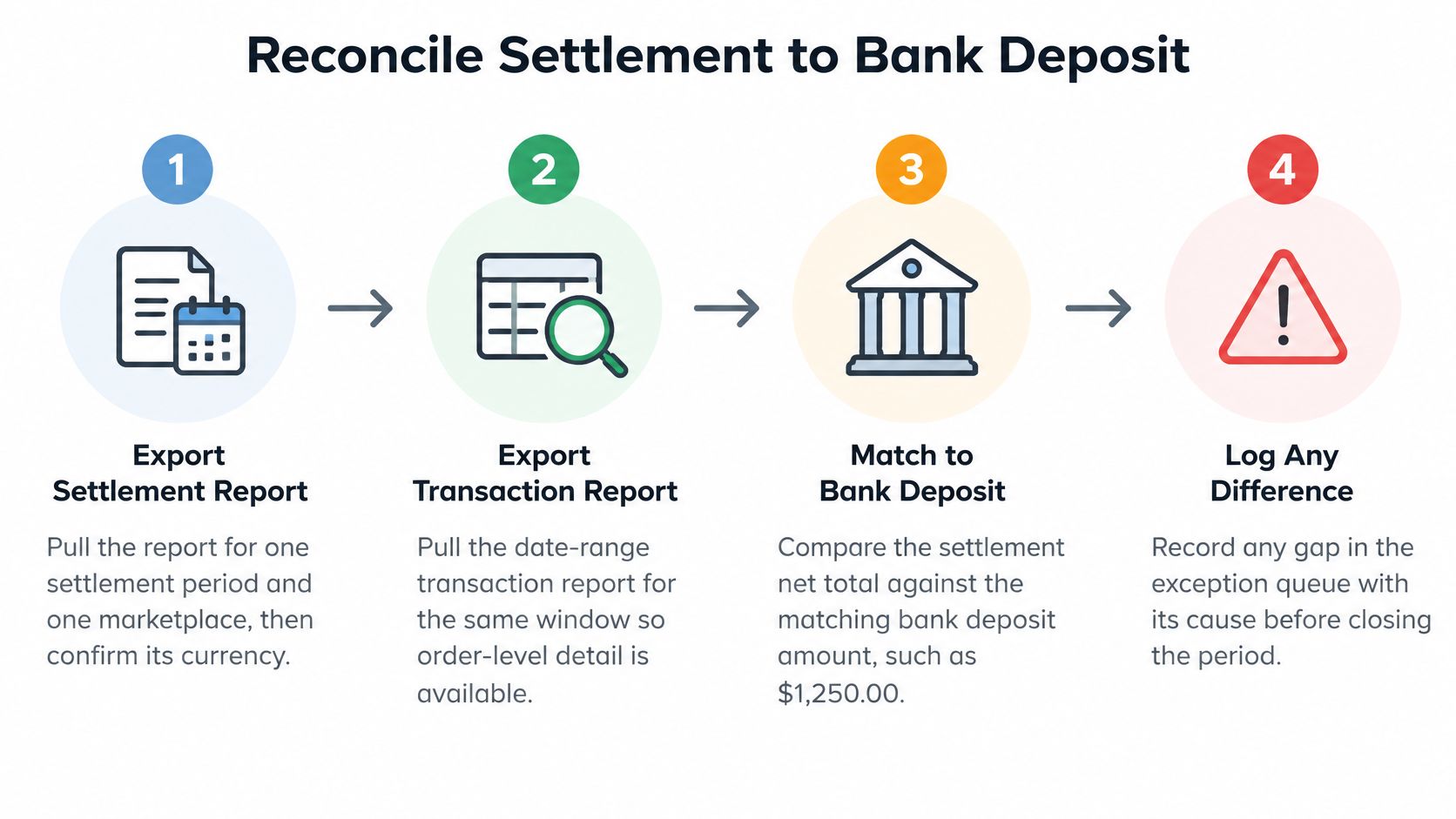
A reliable bank match starts with one settlement period and one marketplace, not a calendar-month summary. The settlement report explains the payout; the transaction report provides more detail about the financial activity. Amazon data stops at its records of that activity. The matching bank statement remains an external record.
- Export the settlement report. Select one settlement period for one marketplace, then confirm the report currency. The common slip is treating a settlement as a calendar month when the report is organized around a payout cycle.
- Export the transaction report for the same window. Use the date-range transaction report to inspect order-level lines and identify financial events behind the settlement total. Don't assume every line posts on the order date or settlement date.
- Group the lines by accounting category. Sum product sales, shipping and gift-wrap credits, sales tax, refunds, fees, reserves, and adjustments separately. A common error is netting a refund twice because it has already been included as a negative source line.
- Roll forward the Amazon receivable. Start with the opening receivable, add gross activity, subtract refunds and fees, and account for reserve changes. For example, an opening balance of 0, gross sales of 5,000, refunds of 400, and fees of 1,100 leave 3,500; that equals a transfer of 3,200 plus 300 held in reserve at period end.
- Match the transfer to the bank deposit. Compare the settlement transfer with the corresponding bank record in the same currency. This step requires an external bank statement, because Amazon's settlement report can explain the payout amount but can't prove that the bank received it.
- Separate timing from errors. Tag an order recognized before payout or a reserve released in a later settlement cycle as a timing difference when the records support that explanation. Don't alter sales to force them into the deposit month.
- Route unmatched items to an exception queue. For each open difference, record the order ID, event type, amount, and date. A named exception is actionable; an unexplained variance is not.
The four-stage process is straightforward when the source files remain aligned.
How Should Refunds, Reimbursements and Chargebacks Be Booked?
A refund reduces revenue when Amazon issues it, but it must remain linked to the original sale. A close policy should state whether the books leave the refund in the period of issuance or restate it into the sale period. For example, a $100 refund issued in April on a March sale should be connected to that March order, with the April refund event date retained for audit and reconciliation.
| Event | Accounting treatment | Match key | Timing basis |
|---|---|---|---|
| Customer refund, unit returned and sellable | Reduce revenue, return the unit to inventory at cost | Order ID and refund event | Refund event date, linked to the sale |
| Customer refund, no return received | Reduce revenue, then write off or hold inventory per policy | Order ID | Refund event date |
| FBA lost or damaged reimbursement | Other income or inventory recovery, reverse any prior write-off | Reimbursement ID and SKU | Reimbursement posting date |
| A-to-z claim or chargeback | Open item, expense or refund-equivalent until resolved | Claim ID | Claim open date and resolution date |
| Reserve held on receivable | Balance-sheet receivable, not an expense | Settlement period | Release date |
| Sales tax on refunded order | Reverse the tax liability on the same order | Order ID and tax line | Refund event date |
A reimbursement for lost or damaged inventory isn't a sale. Depending on the accounting policy and what was previously recorded, it may be other income or an inventory recovery. If the seller already wrote off the unit, the reimbursement can reverse that write-off. An open A-to-z claim or chargeback stays open until the outcome is known; a reserve held against a receivable remains a balance-sheet item, not an expense.
Amazon's payment reports can show refunds, reimbursements, claims, chargebacks, and reserve movements as distinct event lines. Reconcile those lines to the relevant order, claim, or reimbursement record, and consult Amazon's current Seller Central help pages for eligibility and claim outcomes because those rules can change. A practical guide to Amazon FBA reimbursements can help sellers structure that review.
The returned-unit check is essential. Record whether the item came back, whether it's sellable, and whether it returned to inventory. If it's damaged or missing, document the inventory treatment separately from the refund; don't assume a customer refund means a usable unit is back in stock.
Where Do Advertising Charges Sit Outside the Settlement?
Amazon Ads charges appear on Ads invoices, not as settlement-report deductions. Reconcile the invoice total against Amazon Ads reporting spend for the same invoice period, and record advertising expense separately from settlement activity. Matching a settlement to a bank deposit will not capture the Ads bill.
Keep four date bases distinct at close: the ad interaction date, the attributed order date, the invoice period, and the settlement period. Amazon reports conversion metrics on the traffic date, the date of the ad interaction. Amazon attributes ad conversions over a 14-day window, so yesterday's Ads data is incomplete and ACOS can appear artificially high. Recent figures may change as attributed conversions arrive (Amazon Ads reporting documentation).
| Record | Date basis | Reconciliation treatment |
|---|---|---|
| Ads conversion metrics | Traffic date, with a 14-day attribution window | Treat recent results as provisional; compare periods after the window closes |
| Ads invoice | Invoice period | Tie invoice spend to Ads reporting, separately from settlement lines |
| Settlement report | Settlement period | Reconcile its events to the related bank deposit |
Do not join attributed ad sales to order date alone. Retain the traffic date and report period, and compare closed windows when assessing campaign results. Amazon Ads reports support the advertising analysis; settlement and bank records support the cash reconciliation. Each variance should trace to an Ads invoice, an Amazon report date, a settlement event, or an external bank record.
Make unallocated spend visible
Some ad costs cannot be assigned reliably to a product SKU. Keep campaigns without an ASIN, portfolio- or brand-level spend, and DSP spend without SKU attribution in an explicit unallocated-cost bucket until the close policy assigns them.
For example, if spend totals $1,000 and $800 is allocated to three ASINs using ad-attributed sales, record the remaining $200, or 20%, as unallocated. Do not spread it across SKUs without documenting that choice. If the accounting team allocates it later, record the method and report window in the close notes.
Why Product Cost Never Appears in Settlement Data
Settlement data explains proceeds and deductions, but it doesn't calculate product cost. The seller needs an external SKU-level inventory record that connects units sold to landed unit cost and fulfillment channel. Without that link, a report can show fees accurately while still overstating product margin.

A perpetual inventory subledger records inventory transferred to FBA as an asset, then relieves that asset when units ship or are otherwise disposed of. Landed cost should include attributable purchase price, inbound freight, duties and tariffs, and prep or inspection costs. Allocate those costs consistently across units and preserve the method used.
Consider 500 units bought at $8.00 and another 500 at $9.50, followed by 500 units sold. Under FIFO, the cost of the first units sold is $4,000. Under weighted average, unit cost is $8.75, so COGS is $4,375. Amazon's cash settlement is identical under either method; the $375 difference comes from inventory valuation, not marketplace activity.
FBA fulfillment, storage, removal, and advertising charges are expenses under the seller's policy, not product acquisition costs to add automatically to inventory. Amazon's payment reports identify product lines and financial events, but the inventory subledger supplies the unit cost and disposition detail needed for COGS (Amazon inventory guidance).
Reconcile three independent quantities
At month-end, compare Amazon units sold and refunded, FBA inventory movements, and the general-ledger inventory balance. The FBA movement review should distinguish on-hand, reserved, inbound, damaged, and removed units. Damaged units should be reconciled against any reimbursement, without assuming the reimbursement restores sellable inventory.
When purchase prices change, FIFO and weighted-average costing can produce different gross margins even though Amazon's proceeds and fees haven't changed. The accounting policy must therefore be applied consistently, and the Amazon settlement should never be treated as a substitute for the SKU-level inventory roll-forward.
Set Your Close Cadence and Choose the Next Step
A close is ready when each variance points to a named Amazon event or an external record, with an owner and a status. Treat the bank deposit as the last step of a sale: Amazon activity, settlement, and payout occur on different date bases. Keep paid-out settlements separate from recent activity that may still change, and reconcile Ads invoices and inventory records independently.
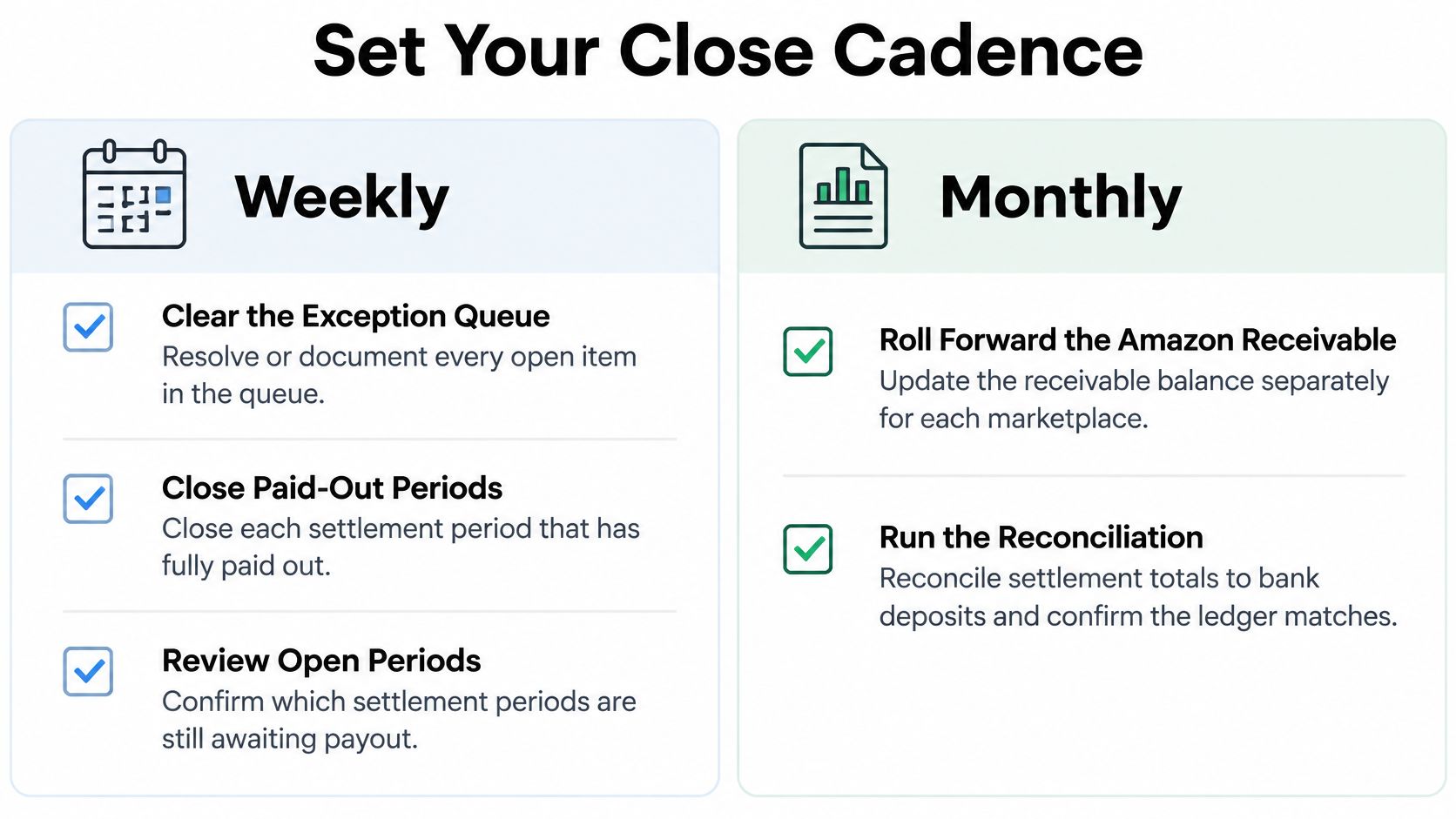
- Weekly: Assign every exception, document its source, close settlement periods that have fully paid out, and mark periods still awaiting payout.
- Monthly: Roll forward the Amazon receivable by marketplace. Match settlement totals to bank deposits, compare units sold and refunded with FBA movements and ledger inventory, and reconcile Ads invoices to reporting spend for closed windows. Keep any unallocated advertising share visible; distribute it only under a stated policy.
- Quarterly: Review the inventory-costing method, reserve balances, and aging of open claims. Keep recent activity provisional for at least 48 hours, then revisit orders after Amazon's documented event-data lag.
Cash timing also shapes purchase decisions and working capital. Use cash-flow forecasting to distinguish accounting profit from cash tied up in inventory or unsettled receivables.
Agent Central is a hosted Amazon MCP server that connects AI agents to Seller Central through one connection. It syncs seller data ahead of time and provides prepared records, metrics, history, and labeled classifications, including available settlement economics, fee events, and reimbursements. Agents can also make account changes, such as bid updates or campaign toggles, through Amazon's official APIs. The agent or accounting team decides what action to take. Agent Central isn't accounting software, doesn't post journals, and can't verify a bank reconciliation without external bank records.
To connect, authorize the Seller Central account and add the connection to the AI client. Agent Central handles credentials, token refresh, and API access, so Amazon API credentials are not needed. The seller can revoke access from Amazon account settings. Setup guidance for connecting Claude explains the client connection. Plans cost $39 to $159 per month based on the seller account's Amazon order volume. One subscription covers every supported marketplace under that account. See Agent Central pricing.
Use Agent Central's Amazon and Ads records alongside bank statements and the seller's inventory ledger. That keeps each variance tied to its source and makes the close traceable.
Related Agent Central pages
- Finance tool reference
Payment transactions, fee breakdowns, profitability, and settlement economics.
- Amazon Seller Central MCP server
Canonical hosted MCP overview for Seller Central, Ads, inventory, catalog, finance, and fulfillment data.
- Amazon seller data for AI agents
How Agent Central normalizes Amazon seller data before exposing it to AI clients.
- Amazon Ads MCP server
Campaign, keyword, search term, budget, TACOS, and guarded ads-write tools.
- Ads tool reference
Parameter-level docs for Amazon Ads campaign, keyword, search term, budget, and TACOS tools.
- Amazon seller MCP servers compared
How hosted MCP services compare with official Ads MCP, local repos, connector tools, and automation platforms.
Related reading
- Amazon Inventory Ledger Report: Reconcile Stock
Explore the Amazon inventory ledger report to understand key fields, track inventory changes, and reconcile stock with confidence.
- Amazon Search Term Report: How to Read and Use It
Learn how to access the Amazon search term report, interpret its fields, find wasted spend, and turn settled search-term data into controlled actions.
- Amazon IPI Score: What It Is and How to Improve It
What the Amazon IPI score measures, how it relates to monthly FBA capacity limits, and how to improve it ASIN by ASIN without cutting stock that sells.
- Amazon Pricing API: A Practical Guide for Sellers
How Amazon's pricing APIs work for sellers: what Product Pricing returns, batch limits, Featured Offer fields, and changing prices via Listings Items.
Connect Amazon seller data to your AI client.
Agent Central gives Claude, ChatGPT, OpenClaw, Cursor, and other MCP clients structured access to Amazon Ads, Seller Central, inventory, orders, catalog, finance, and fulfillment data.