
Amazon FBA Reimbursement: How to Recover Lost Funds
Learn how to file an Amazon FBA reimbursement for lost, damaged, or overcharged inventory. Get step-by-step guidance to recover the money you're owed.

A seller can do everything right on inbound prep, only to find a unit missing in FBA, a customer return never logged back into inventory, or a fee credit that never appears where it should. Amazon FBA reimbursement only works when the operation treats it as a standing reconciliation process, because the money shows up in different reports, under different rules, and sometimes not at all unless someone is watching the ledger.
Table of Contents
- Why Amazon FBA Reimbursement Needs a Standing Workflow
- Current Claim Windows and Which Deadlines You Cannot Miss
- How to Reconcile Reimbursements at the Unit Level
- Why the Cost Basis Shift Changed Reimbursement Economics
- Using Agent Central to Cross-Reference Reports by ASIN and Date
- What a Monthly Reimbursement Reconciliation Run Looks Like
- Preventing Repeat Losses and Knowing When to Escalate
Why Amazon FBA Reimbursement Needs a Standing Workflow
Amazon FBA reimbursement is not a one-time cleanup task. It's a recurring control process because losses, returns, and fee errors happen in different parts of the fulfillment chain, and each one leaves a different footprint in Seller Central.
Three reimbursement buckets show up in different places
The three core buckets are inventory lost or damaged in a fulfillment center, customer returns that never came back or came back unsellable, and fee or refund errors. Those events do not all surface the same way, so a seller who only checks one report will miss part of the picture. Amazon's claim policy is built around the event type, not around a single universal aging rule, so the workflow has to follow the event.
The two reports that matter most are the Reimbursements report, which shows what Amazon already paid, and the Inventory Ledger, which shows the events that should have triggered a payment. Amazon's Reimbursements report includes reason, quantity, per-unit amount, cash amount, and reimbursed quantity fields, and approved reimbursements can take up to five days to appear in the report after approval, with account and Payments visibility typically following in four to five business days Amazon's Reimbursements report help page. That delay is one reason a weekly or monthly check is safer than an occasional cleanup.
Practical rule: if a loss or return doesn't show up in both the event record and the cash record, the case is still open until proven otherwise.
Automatic credits reduced filing, not audit work
Amazon expanded automatic reimbursement for certain lost or damaged FBA units, but automation doesn't close the control gap. Sellers still need to verify whether the right quantity was credited, whether the reason code matches the event, and whether the reimbursement basis is correct. A useful outside reference on the filing side is FBA reimbursement claims help from LA Law Group, APLC, especially for teams that still handle manual escalation after an exception is found.
The operational difference is simple. A seller-filed claim is only one path to recovery, while a standing workflow also catches credits Amazon missed, duplicated credits, and reimbursements that later reverse in settlement. The team that reconciles ledger events against reimbursements on a schedule protects margin. The team that waits for someone to notice a missing payment usually finds the deadline has already passed.
Current Claim Windows and Which Deadlines You Cannot Miss
Deadlines make reimbursement work unforgiving. Amazon ties eligibility to the failure point, and once the window closes, the claim is ineligible even if the unit was lost, damaged, or mishandled Amazon policy on reimbursement deadlines.
The clock starts with the event type, not when the team notices it
Inbound shipment discrepancies, fulfillment-center damage, customer returns, and removal claims each follow a different trigger date. That is why reimbursement review should never run off a single aging column in a sales export. The right clock depends on whether the issue happened at receipt, inside the fulfillment center, at refund time, or during removal.
For shipments sent to an Amazon fulfillment center, missing-unit claims generally open 15 days after delivery and close 60 days after delivery Amazon inbound shipment help page. For inventory marked lost, misplaced, or damaged in the Inventory Ledger, the claim window is generally 60 days from the relevant ledger event date Amazon reimbursement workflow help page. Before the window opens, make sure the claim itself is filed correctly; see our guide on how to file a claim on Amazon. Customer-return claims follow a different window, they may be submitted no earlier than 60 days and no later than 120 days after Amazon refunds or replaces the order. Removal claims split again, with lost removal shipments filed within 75 days of shipment creation and damaged removal shipments filed within 60 days of delivery.
| Reimbursement Claim Windows at a Glance | ||
|---|---|---|
| Failure point | Window | Triggering event |
| Inbound shipment discrepancy | 15 to 60 days | Shipment delivery date |
| FC lost, misplaced, or damaged inventory | 60 days | Inventory Ledger event date |
| Customer return claim | 60 to 120 days | Amazon refund or replacement date |
| Lost removal shipment | 75 days | Shipment creation date |
| Damaged removal shipment | 60 days | Delivery date |
A missed deadline ends eligibility entirely, even on an otherwise valid event.
Treat every event as a countdown from its own source record. If the team cannot name the exact trigger date, the claim package is incomplete. The risk is not just under-recovery, it is a total loss of recovery rights on an otherwise valid event.
How to Reconcile Reimbursements at the Unit Level
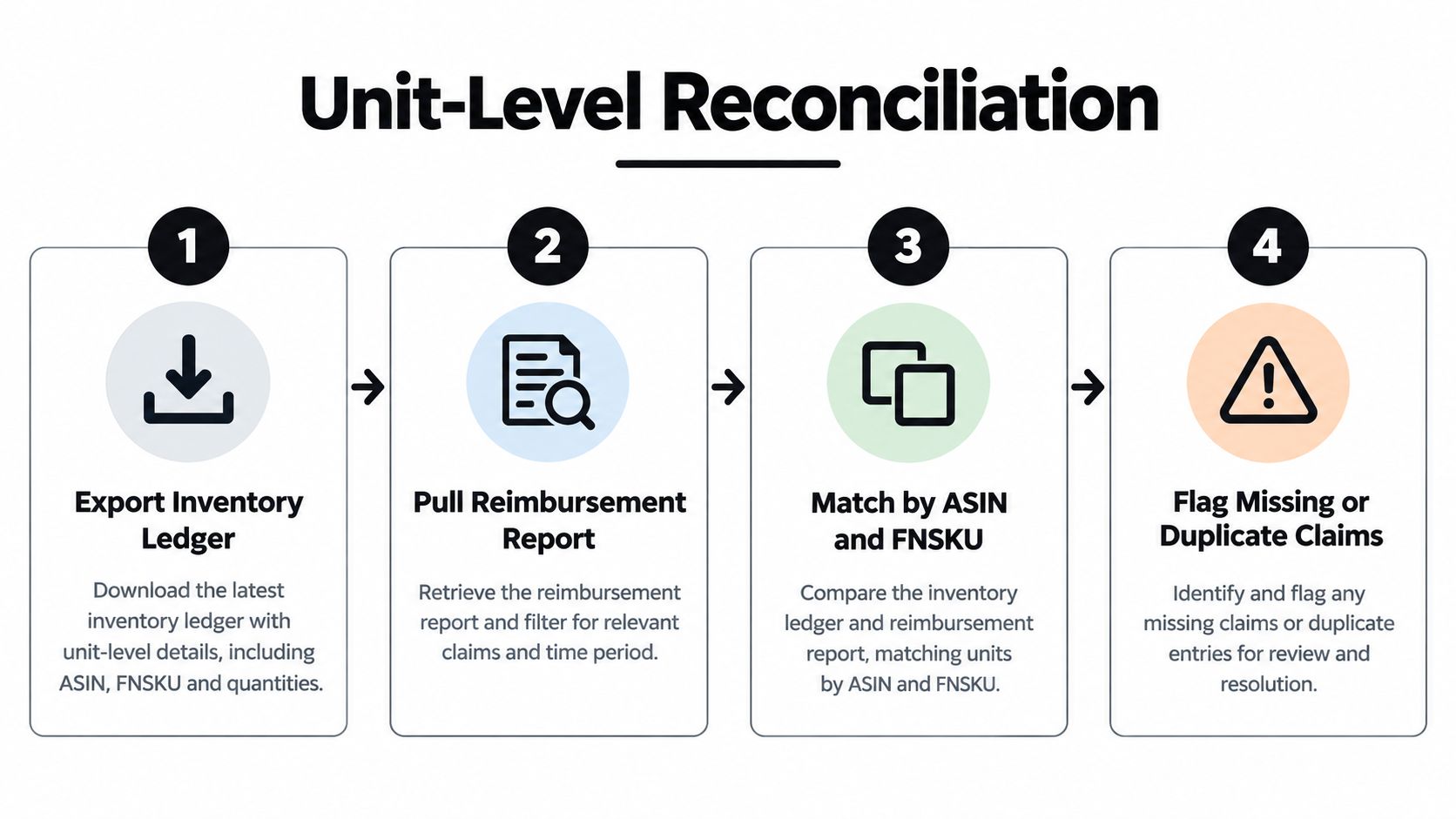
A real audit starts at the unit, not at the SKU summary. Line up the shipment or removal ID, the ASIN or FNSKU, the quantity, and the event date, then compare those details with what Amazon has already paid. A sales snapshot shows units sold, but it cannot prove which event triggered the reimbursement or whether Amazon already paid it.
The four records that have to agree
First, export the Inventory Ledger and isolate units marked lost, misplaced, or damaged. Second, match each event to inbound shipment quantities and proof of delivery for the same ASIN and FNSKU. Third, check the Payments or settlement records to confirm whether Amazon already issued a reimbursement. Fourth, submit only the unreimbursed exceptions with the exact transaction item ID and supporting documents. Amazon's reimbursement workflow page lists the required identifiers, shipment or removal ID, ASIN or FNSKU, quantity, and event date.
A common mistake is to file from a revenue view and skip the settlement view. That creates duplicate claims, or worse, it makes Amazon reject a case as already reimbursed. Another mistake is using retail selling price where the reimbursement basis is sourcing or manufacturing cost, which can distort the claim amount on shipment-to-Amazon, removal, and certain fulfillment-center claims.
For teams that also manage fee audits, the Amazon FBA fee guide for CPG brands is useful context because reimbursement and fee correction often overlap in the same ledger review. When dimensions, weights, or inventory events are off, the same operator usually has to sort out both the credit and the root cause.
Why the Cost Basis Shift Changed Reimbursement Economics
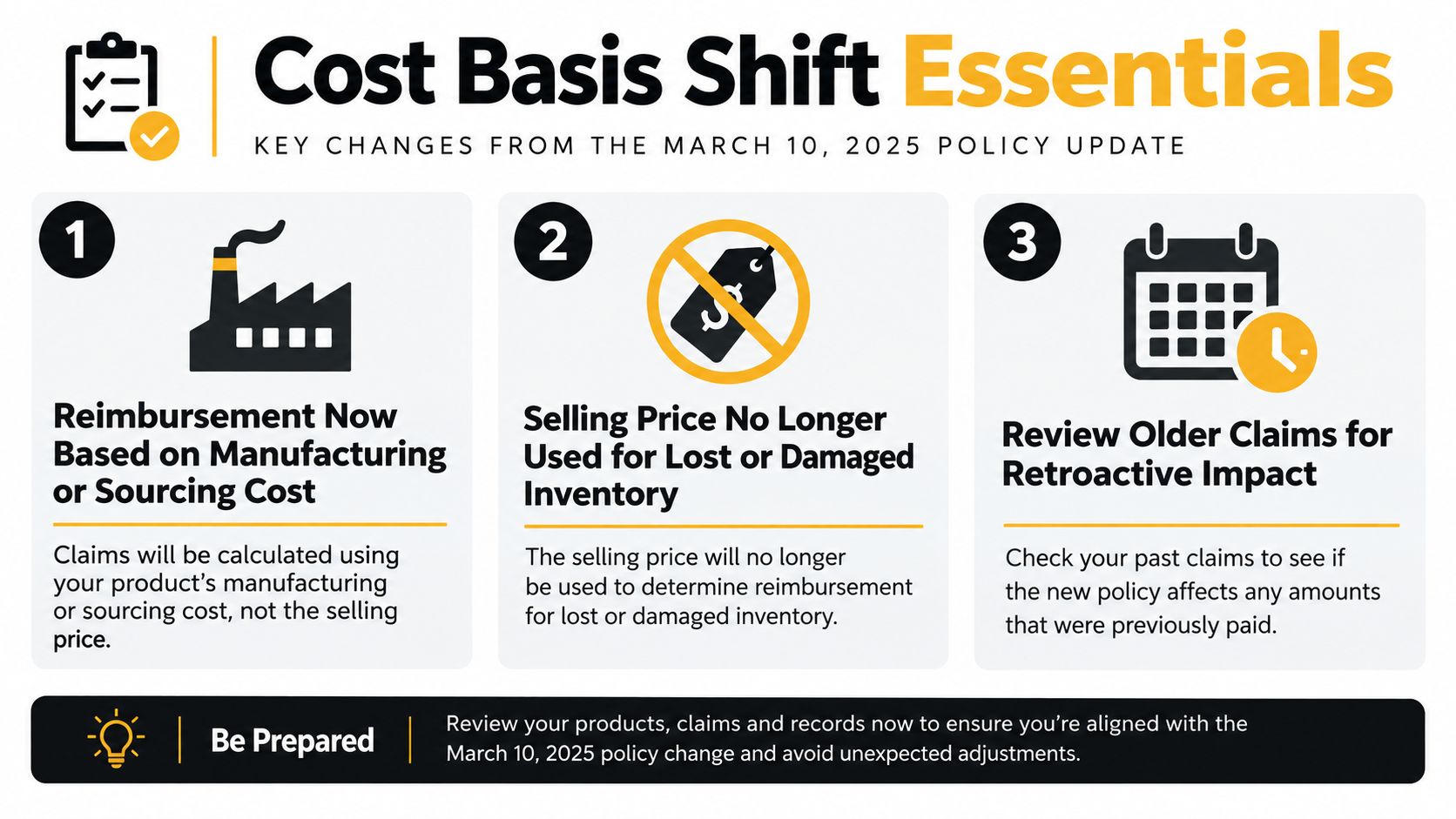
The March 10, 2025 policy change changed the math. For eligible lost or damaged FBA inventory, Amazon moved reimbursement away from selling price and toward manufacturing cost, which Amazon defines as the amount the seller paid a manufacturer, wholesaler, or reseller, or the production cost for a manufacturer.
Selling price no longer anchors the recovery
Amazon's policy also excludes shipping, handling, customs duties, and similar landed expenses from manufacturing cost. The reimbursement may cover the unit cost to source inventory, but it will not automatically make whole the freight, prep, and import costs that sit outside the formula. Amazon also allows sellers to provide their own cost information, and if they do not, Amazon applies its own estimate, which can be updated later.
What sellers need to keep on file
The practical response is a cost file by ASIN, marketplace, supplier, and time period. When a supplier changes, version the record instead of overwriting it. When a marketplace changes, do not assume the same sourcing basis applies everywhere. When Amazon uses its own estimate, invoices need to be ready if the number is off.
Seller reports in the forum discussion show that Amazon's estimates can come in below wholesale acquisition cost, but that is seller-reported, not a policy guarantee. Operationally, the point is straightforward: if the seller cannot defend the cost basis, Amazon's estimate becomes the working number.
Audit rule: Prove both the loss event and the cost basis behind it; an undefended cost figure defaults to Amazon's estimate.
The automatic credit expansion helps, but it does not finish the job. Credits still need to be checked against quantity, reason code, and cost basis. Teams that treat the policy shift as a simple automation win often miss the accounting change. Reimbursement now ties more tightly to sourcing records than to the shelf price shown on the listing.
Using Agent Central to Cross-Reference Reports by ASIN and Date
A reimbursement case usually starts as a mismatch across reports. One file shows the lost or damaged event, another shows the return, and a third shows whether Amazon posted the credit. Agent Central gives Claude or ChatGPT structured access to Seller Central reimbursement data so those records can be lined up by ASIN and date, which is the level where most review work happens.
What the connector does in a reimbursement review
The setup is direct. Sign up at agentcentral.to, connect Seller Central and Amazon Ads through Amazon's authorization, then add the connection to the AI client. The Claude quickstart is documented at Agent Central's Claude quickstart, and the Seller Central connector details are on Agent Central's Amazon Seller Central MCP page.
A useful prompt asks for ledger events flagged lost or damaged in the last 30 days, the matching return events for the same ASINs, and any reimbursements already posted in Payments. Reimbursement review is a join problem: the missing item sits in one report, the refund in another, and the credit in a third. Agent Central returns facts, metrics, and source-provided fields, so the operator still decides what to escalate.
That boundary matters in real operations. Agent Central does not file claims or decide the outcome for a seller. It surfaces the records, preserves the audit trail, and keeps the comparison controlled enough to defend later.
For teams building a repeatable reimbursement check across marketplaces, the reporting surfaces need to be read together. The Agent Central's Amazon seller central reports overview is the place to start if you need the inventory, payments, and returns views in one workflow.
One prompt returns ledger events, matching returns, and posted reimbursements for the same ASINs in a single table, which is what makes the trace possible.
What a Monthly Reimbursement Reconciliation Run Looks Like
A monthly run starts with one discipline, not with a claim form. The operator pulls the Reimbursements report for the previous 30 days, sorts by reason code, and checks every credit against the Inventory Ledger events for the same ASINs and dates.
The exceptions the run is designed to catch
The first exception is an unreimbursed event that slipped through because the amount looked too small to notice on a busy week. The second is a duplicate credit, which usually shows up when the same shipment ID appears more than once in a settlement path. The third is a reversal, where a reimbursement appears in one cycle and disappears in a later settlement.
That review is easier when it sits alongside finance cadence, which is why why management accounts matter for directors is a useful analogue for operators who already run a monthly close. Reimbursement review is part of the same discipline. It is another reconciliation tied to margin, not a side task for someone with spare time.
The operator then flags open events by deadline. Inventory Ledger status dates become the countdown clock, and each unresolved case gets a remaining-days marker. Claims that need evidence get grouped with the shipment ID, ASIN or FNSKU, quantity, event date, and invoice backup.
The best teams keep the run boring. Same date range, same reports, same exception categories, same ownership each month. That consistency is what exposes the drift.
See also Agent Central's financial reconciliation workflow for the broader close pattern that this audit fits into. Reimbursement review gets better when it is treated as a finance control instead of an ad hoc support task.
Preventing Repeat Losses and Knowing When to Escalate
Recovery work should feed prevention. If the same pattern keeps showing up, the root cause is usually upstream in packing, labeling, removals, or SKU planning, and fixing it there is cheaper than filing another claim.

Prevention belongs to the event type
Inbound discrepancies usually point back to packing discipline, carton counts, and carrier handoff records. Removal damage points to how the team packages outbound stock and documents condition before it leaves. Stranded inventory points to SKU planning and replenishment discipline, because units that linger create more chances for mismatch.
Escalation is a separate call. Seller support fits when the event is inside the standard claim flow and the evidence is clean. Fee or cost basis issues belong in the margin records because they affect profitability over time. Cases that cost more to pursue than they return should be written off and moved out of the queue.
Operating cadence: review reimbursements monthly, review open deadlines weekly, and review recurring loss patterns after every close.
That cadence keeps the team focused on what Amazon did not catch, not on re-chasing credits already paid. As automatic reimbursement expands, the work shifts toward exception handling, cost proof, and prevention.
Point the same monthly run at your ledger, returns, and reimbursement reports, and Agent Central will keep the records aligned by ASIN and date at agentcentral.
Related Agent Central pages
- Amazon seller data for AI agents
How Agent Central normalizes Amazon seller data before exposing it to AI clients.
- Amazon Seller Central MCP server
Canonical hosted MCP overview for Seller Central, Ads, inventory, catalog, finance, and fulfillment data.
- Inventory tool reference
Inventory, orders, sales velocity, listing registry, days of cover, returns, and reimbursements.
- Connect Seller Central to Claude
Step-by-step path from Amazon OAuth to a Claude connector or MCP config.
- ChatGPT with Amazon seller data
ChatGPT-specific setup path for Amazon seller data through hosted MCP.
- Fulfillment tool reference
MCF shipping previews, orders, order creation, tracking, and returns.
Related reading
- Amazon Brand Analytics: Reports and Metrics Guide
Learn how Amazon Brand Analytics reports reveal search terms, click share, and competitor data, and how to use these insights to grow sales in 2026.
- Amazon Seller Assistant vs AI Agents
Compare Amazon Seller Assistant vs AI agents for operations. See how Agent Central connects Claude and ChatGPT to Seller Central and Ads data.
- Amazon Ads API: Access, Cost, Reporting and Limits
Is the Amazon Ads API free? How to get access, how async reporting and limits work, and when a hosted connection like Agent Central saves the build.
- Amazon TACoS: Formula, ACoS vs TACoS and Benchmarks
Amazon TACoS is ad spend divided by total sales. See the formula, worked examples, how it differs from ACoS, and which reports supply each input.
Connect Amazon seller data to your AI client.
Agent Central gives Claude, ChatGPT, OpenClaw, Cursor, and other MCP clients structured access to Amazon Ads, Seller Central, inventory, orders, catalog, finance, and fulfillment data.