
How to Track Keyword Rankings the Right Way
Learn how to track keyword rankings with a workflow that covers tool choice, location and device settings, history, alerts, and Amazon seller data via

A Google Search Console graph dips. A Helium 10 alert flags an Amazon ASIN. Then a client message arrives: “we fell off page one.” The immediate reaction is familiar: open an incognito window, search the term, refresh the Amazon results page, and hope the first observation explains the change.
That reflex rarely produces a reliable answer. Keyword rank tracking is a workflow decision before it's a tool decision. Teams need a stable baseline, controlled search conditions, historical data, and an owner responsible for interpreting the result. The useful question isn't only “what's the rank?” It's “which source produced it, under what conditions, and what business signal should confirm it?”
Table of Contents
- The Moment You Realize You Need Rank Tracking
- Defining Your Keyword Portfolio and Tracking Scope
- Choosing Between Manual Checks, Tools, and Hosted APIs
- Configuring Frequency, Location, Device, and History
- Reading Rank Movement With CTR, Impressions, and Conversions
- Automating Alerts and Reports Through MCP Workflows
- Common Pitfalls and a Sanity Check on Rank as a Signal
The Moment You Realize You Need Rank Tracking
A rank drop becomes difficult when nobody can establish whether it's real. A manual Google search may show a different result from the one a customer sees because of location, device, personalization, or SERP features. An Amazon seller may see an ASIN move down the organic results while a sponsored placement remains prominent, creating the impression that visibility has held steady when the underlying organic position has weakened.
The problem isn't the absence of dashboards. Several already exist in most organizations. The problem is that each dashboard may use a different keyword list, marketplace, location, refresh schedule, or definition of rank. A client report might use weekly Google data, while an SEO manager checks mobile results manually and an Amazon Ads manager reviews sponsored placement separately. Those observations can all be accurate while still being impossible to reconcile.
Practical rule: A rank change without a controlled baseline is an observation, not a diagnosis.
Google Search Console provides keyword-level ranking data for up to 1,000 queries and reports an average position across the queries it tracks, making it a foundational source for organic visibility monitoring without depending entirely on paid tools. Its data is especially useful because it can be read alongside clicks, impressions, and CTR rather than treated as an isolated position score. Google Search Console's role in keyword ranking analysis explains why first-party search data remains important even when a team also uses a dedicated tracker.
Amazon requires a different starting point. An ASIN's organic rank, sponsored placement, search term performance, and conversion data come from different reporting surfaces. Amazon Ads states that account and campaign reports are available across ad products, while product-level and keyword-level reports are available only for some ad types, which limits how far native reporting can go for keyword-level analysis. Amazon's reporting FAQ documents that reporting boundary.
A dependable workflow therefore treats rank as a pipeline:
- Inputs: keyword manifest, search engine or marketplace, location, language, device, ASIN, landing page, and source system.
- Configuration: collection cadence, ranking definition, history retention, and reconciliation rules.
- Outputs: rank movement, impression share, CTR, clicks, conversions, and a documented interpretation.
- Ownership: a named person or agent workflow that checks anomalies and decides whether investigation is warranted.
Once those pieces exist, tool selection becomes less disruptive. A tracker can change, an API can be replaced, or an MCP client can be introduced without destroying the underlying time series.
Defining Your Keyword Portfolio and Tracking Scope
Keyword collection should start with a portfolio, not a search box. The portfolio needs to represent the queries that matter to the business and remain small enough for an owner to review regularly. A list that contains every discovered phrase may look complete, but it creates noisy reporting and encourages teams to celebrate movement that has no commercial relevance.
Group terms by intent and business role:
- Head terms describe the category and usually need broader interpretation.
- Long-tail terms often expose a clearer use case or product requirement.
- Branded queries help separate brand demand from non-branded discovery.
- Competitor variants can reveal comparison or substitution behavior.
- Amazon product terms should be tied to an ASIN set and marketplace.
- Sponsored terms must be separated from organic rank so paid placement doesn't obscure natural visibility.
Intent needs to be written down. An informational Google query shouldn't be judged by the same conversion expectation as a transactional query. On Amazon, a broad category phrase and a highly specific product attribute can both generate impressions, but they may represent different stages of the purchase process.
Freeze the search conditions
Every tracked term needs fixed parameters. Set the search engine, country, city or region, language, and device before collecting results. For Amazon, add the marketplace, ASIN, organic or sponsored classification, and any campaign or ad group relationship. The same phrase can produce different SERPs when a team mixes desktop US data with mobile UK data.
A written specification also prevents silent drift when a new operator joins the account or a vendor changes configuration. The following compact template is enough to begin:
| Field | Example, Google | Example, Amazon |
|---|---|---|
| Keyword ID | seo-software-001 | amazon-keyword-001 |
| Query | “SEO software” | “stainless steel lunch box” |
| Intent | Commercial | Transactional |
| Market | United States | United States marketplace |
| Location | New York City | Amazon US |
| Language | English | English |
| Device | Mobile | Amazon app or web classification |
| Ranking type | Organic result and SERP features | Organic rank and sponsored placement |
| Target URL or ASIN | /seo-software/ | ASIN assigned to the term |
| Source | Google Search Console plus tracker | Amazon Ads, Seller Central, or rank source |
| Cadence | Defined daily or weekly schedule | Defined daily or weekly schedule |
| Owner | SEO manager | Amazon Ads manager |
The portfolio should also record the expected landing page or ASIN. If two pages repeatedly rank for one query, or several ASINs compete for one product term, the dataset needs a deduplication rule. Without that rule, rank movement can be mistaken for growth when visibility has merely shifted between assets.
Choosing Between Manual Checks, Tools, and Hosted APIs
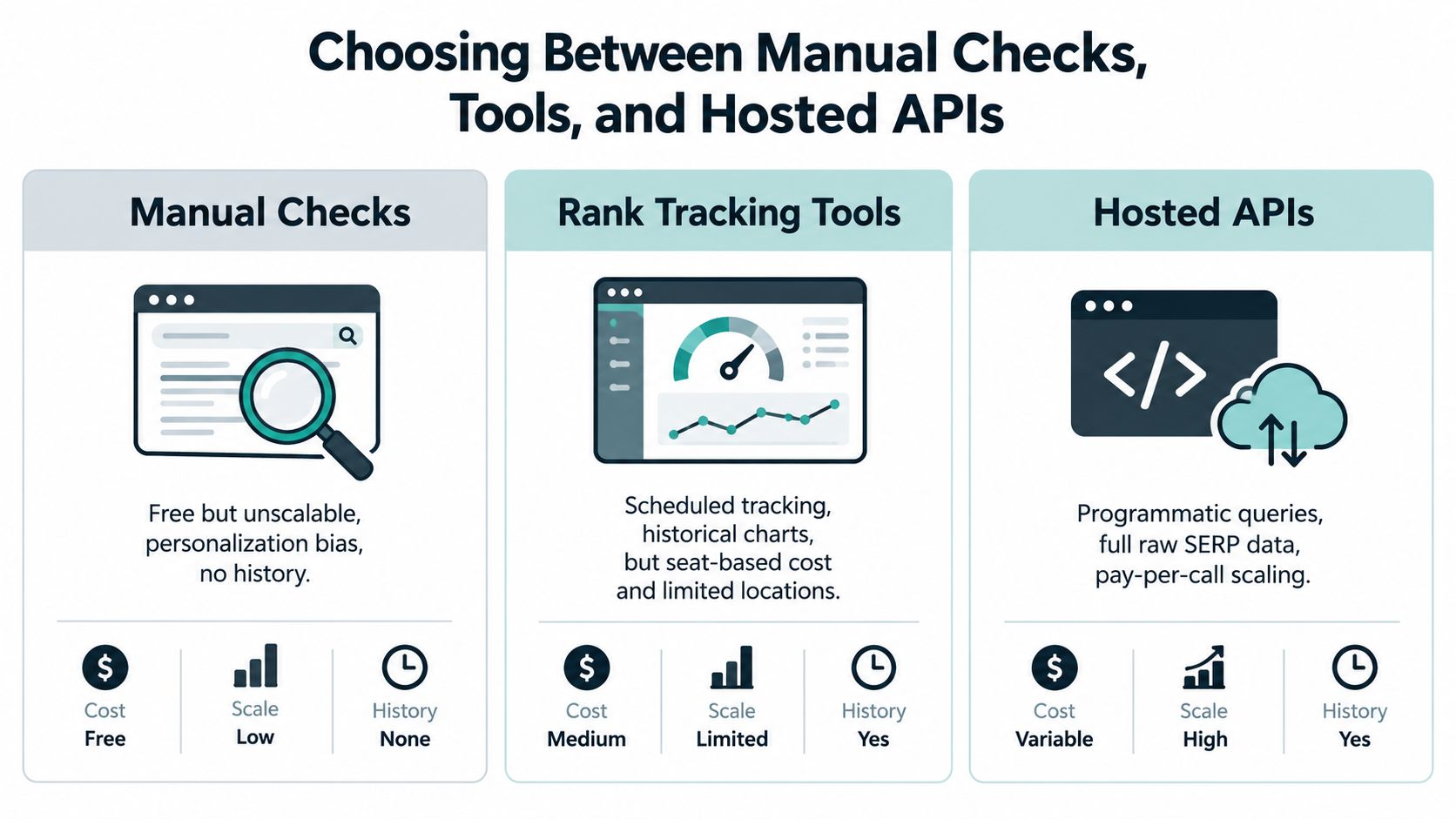
A ranking report can look precise while answering the wrong question. The collection method determines whether the result is useful for an investigation, a recurring report, or an automated decision. Each of the three practical paths has a different failure mode.
Manual checking works for one-off validation. An operator can search Google in an incognito window, inspect a featured snippet, compare a local pack, or confirm where an Amazon ASIN appears for a specific query. It costs little and can explain a surprising result quickly. It does not scale, creates no reliable history on its own, and incognito browsing does not remove location differences or SERP volatility.
Dedicated rank trackers package scheduled collection, historical charts, competitor comparisons, and segmentation. Ahrefs, Semrush, AccuRanker, and Helium 10 are familiar choices for SEO and Amazon teams. Their limits are operational: location coverage differs, Amazon accuracy changes by marketplace and query type, refresh cadence may be daily or weekly, and switching vendors can break time-series continuity unless the raw data has been exported. A tracker reduces engineering work, but it does not remove the need to validate scope and source freshness.
Hosted APIs provide finer control over each query and response. DataForSEO, SerpAPI, and Amazon scraping APIs can return raw result data for programmatic processing. That flexibility transfers responsibility to the buyer, including storage, proxy hygiene, rate-limit management, result normalization, and handling IP blocks or CAPTCHAs. Location and device parameters must stay fixed when results are compared. Neutral querying also matters because manual and automated results can diverge.
What a hosted MCP layer changes
A hosted MCP layer separates the agent from collection mechanics. The agent calls structured rank, impression, CTR, and commerce-data tools through scoped credentials, while the data layer handles source connections, permissions, pre-materialized reads, and audit records. The same workflow can run checks, trigger alerts, and produce scheduled reports without asking an agent to scrape a SERP during every request.
The trade-off is dependency. A hosted layer can make repeated reads fast and portable, but operators still need to verify source freshness, field definitions, retention, and marketplace coverage. MCP compatibility does not make a weak source accurate, and an agent cannot correct an incorrectly scoped keyword manifest. The useful design is a stable data layer that connects rank with impressions, CTR, and conversions, rather than a chatbot placed in front of an unreliable feed.
For Amazon teams measuring visibility beyond one position number, retail media SOV analytics adds context around share of voice and keyword rank measurement. For a focused implementation, the Amazon ranking workflow shows how rank history can sit alongside seller data instead of inside a disconnected dashboard.
Choose according to the operating requirement:
- Manual checks suit one-off validation and visual SERP investigation.
- Rank trackers suit teams that need packaged history and reporting with limited engineering work.
- Hosted APIs suit developers who need raw control and can operate the collection stack.
- Hosted MCP data layers suit teams that need structured, repeated reads for agents without building scraper infrastructure themselves.
Configuring Frequency, Location, Device, and History
Frequency determines what kind of change the dataset can reveal. Daily checks are appropriate for volatile SERPs, active launches, major listing changes, and Amazon terms where sponsored and organic competition can shift quickly. Weekly checks can be enough for stable head terms. Branded queries often need on-demand validation because the business question is usually tied to a campaign, outage, or reputation event.
A practical default is to track the top 20 results at 24-hour intervals, then increase collection during a launch week or a period of unusual algorithm volatility. The default should be documented rather than treated as universal. Infrequent refreshes can leave a position change up to 7 days old, which makes a tracker a poor control signal for fast-moving campaigns. Keyword.com's monitoring guidance describes why dashboard cadence affects operational trust.
Normalize every dimension
Location is not a reporting detail. A city-level local SERP can differ substantially from a country-level result, and a mobile result can expose different features from desktop. Lock the country, city or region, language, and device in the tracking specification. Keep those fields attached to every row so a later analyst can tell whether a change reflects ranking movement or a changed query environment.
Google Search Console should be connected where possible because rank-only reporting can overstate progress. A page may move upward for a low-demand query without generating meaningful clicks. Search Console supplies impressions, clicks, CTR, and average position that help test whether the tracked movement corresponds to actual exposure.
Preserve history outside the tool
Every tracker has a retention ceiling or a data-export limitation. History should be exported to CSV or written to a warehouse from the first collection date, not after a vendor switch has already erased the comparison baseline. Each row should include:
- Stable keyword ID and normalized query.
- Timestamp and collection cadence.
- Search engine or Amazon marketplace.
- Country, city, language, and device.
- Ranking type, such as organic, sponsored, or feature visibility.
- URL, ASIN, or winning asset.
- Rank, impressions, clicks, CTR, and conversion fields where available.
- SERP feature state and source-system identifier.
Amazon Ads unified reporting supports up to 15 months of daily or weekly data and up to 6 years of monthly or yearly data, so report grain directly affects how much history survives in the native system. Amazon's unified reporting documentation explains that retention varies by time grain.
| Keyword Type | Recommended Frequency | Location Scope | Device Split |
|---|---|---|---|
| Branded Google terms | On-demand or weekly | Primary market | Split if traffic differs materially |
| Stable informational terms | Weekly | Country or priority region | Desktop and mobile when both matter |
| Commercial Google terms | Daily or weekly | Country plus priority cities | Keep mobile and desktop separate |
| Amazon launch terms | Daily | Marketplace | Preserve the source's device classification |
| Volatile Amazon category terms | Daily | Marketplace and relevant market | Separate web and app data when available |
A canonical keyword list with stable IDs protects the trend line when a tool, API, or reporting layer changes. The query text can be normalized, but the ID should remain constant.
Reading Rank Movement With CTR, Impressions, and Conversions
A rank number becomes useful only when it is connected to demand and business outcomes. The working data layer should join rank, impressions, CTR, and conversions for each tracked query and asset. For Amazon, apply the same logic to organic rank, impression share, click share, and ordered-product or conversion measures available from the account's reporting sources.
Consider two movements. A stable position seven with rising impressions may indicate growing demand or wider exposure. A move to position three with flat impressions may reflect a low-demand query, a SERP feature that captures attention, or a measurement change. The second result looks better in a dashboard, but the first may deserve more commercial attention.
Click distribution makes upper-position movement more consequential. The benchmark summarized in Ahrefs' keyword ranking glossary assigns 75.1% of clicks to the top three organic results and 31.73% to the first result. Similarweb's rank-tracking benchmarks note that position one captures about 28% of clicks while position ten receives under 2%, with the outcome affected by query type and SERP layout. Treat these figures as directional benchmarks, not forecasts for every query.
Use portfolio distributions
Average position hides too much. A portfolio can improve its average while losing valuable terms near the top. Track distributions and outcome-weighted measures instead:
- Top 3 share, the proportion of tracked terms in positions one through three.
- Top 10 share, the proportion in the first-page range defined by the tracking system.
- Weighted average position, with priority terms carrying more weight than low-value discoveries.
- Impression-weighted CTR, showing whether visibility produces engagement.
- Conversion contribution, connecting search exposure with business results.
For a data-layer workflow, calculate these measures from stored observations rather than asking an agent to infer them from a chart. An MCP-hosted agent can read rank, impression, CTR, click, and conversion fields from approved sources, compare the current window with a baseline, and produce the same diagnostic report on schedule without scraping search results. Keep the calculations deterministic so a change in prompt or tool does not change the KPI definition.
SERP features alter expected CTR. A featured snippet, image pack, People Also Ask module, local pack, or AI Overview can change the attention received by a blue-link position. A tracker that stores only ordinal position may therefore report improvement while the page sits below a visually dominant feature.
| Rank Change | Impressions | CTR | Likely Diagnosis |
|---|---|---|---|
| Improves | Rises | Rises | Genuine visibility and demand gain |
| Improves | Flat | Flat or falls | Feature displacement, low demand, or intent mismatch |
| Stable | Rises | Stable | More exposure without a meaningful presentation change |
| Falls | Rises | Falls | Demand expansion with competitive or feature pressure |
| Falls | Falls | Stable | Reduced visibility, seasonal demand, or tracking drift |
| Multiple URLs change | Stable | Stable | Possible cannibalization or asset substitution |
Cannibalization needs a direct check. If two pages climb for the same query while total impressions remain similar, the site may be distributing visibility rather than gaining it. Amazon teams should run a parallel review when several ASINs appear for one term, especially when click share shifts without a corresponding increase in total category exposure.
For portfolio reporting, share of search reporting provides a broader way to frame rank and visibility together. The diagnostic loop is simple: when rank moves, inspect impressions and CTR first, then clicks and conversions. Rank without demand is a vanity number.
Automating Alerts and Reports Through MCP Workflows
Automation works when the data contract is stable. A scheduled agent shouldn't discover its keyword list from a loose prompt each morning. It should read a versioned manifest containing keyword IDs, queries, markets, devices, URLs or ASINs, ranking definitions, and alert thresholds.
A practical MCP workflow has four layers:
- Manifest layer: Stores the canonical keyword portfolio and the expected asset for each term.
- Data layer: Exposes structured rank, impression, CTR, click, and conversion fields from the approved providers.
- Agent layer: Runs on a schedule, compares the latest read with a defined baseline, and assembles findings.
- Delivery layer: Sends a report or alert to Slack, email, or an internal system.
Scoped keys should limit each connection to the required account, marketplace, report, and operation. Google Search Console, Amazon Ads, Brand Analytics, Seller Central, and rank providers may expose different permissions, so one broad credential creates unnecessary blast radius. Read-only scopes should be the default for monitoring.
The alert logic should identify conditions, not prescribe actions. Examples include a meaningful position change, a drop in Top 3 or Top 10 share, an impression increase paired with CTR decline, or a conversion fall without a corresponding rank change. The agent returns the facts and classifications. A human or separate workflow decides whether to revise a title, investigate a listing, change a campaign, or do nothing.
Guardrail: No automated visibility alert should become an automatic content or listing edit without review, approval, and a recorded change reason.
Every tool call should produce an audit record with the account scope, request time, source, parameters, returned fields, and result status. Prompts should be versioned so a change in interpretation can be traced to a specific workflow revision. If a write tool exists elsewhere in the operating stack, it should use previews, idempotency controls, and human approval before a live page or listing changes.
A weekly report can remain compact:
- Coverage: Terms collected, missing rows, changed configuration, and source freshness.
- Visibility: Top 3 share, Top 10 share, weighted position, organic rank, and sponsored placement.
- Demand: Impressions, clicks, CTR, and Amazon impression or click share.
- Outcome: Conversions, ordered products, revenue fields, or qualified lead events available from the source.
- Exceptions: Cannibalization candidates, SERP feature changes, ASIN substitutions, and data gaps.
- Review queue: Questions requiring an operator, with no implied autonomous recommendation.
The MCP server integration guide is relevant for teams connecting structured seller data to compatible clients. The important design choice is to use MCP as an access and orchestration layer, not as a replacement for measurement discipline.
Common Pitfalls and a Sanity Check on Rank as a Signal
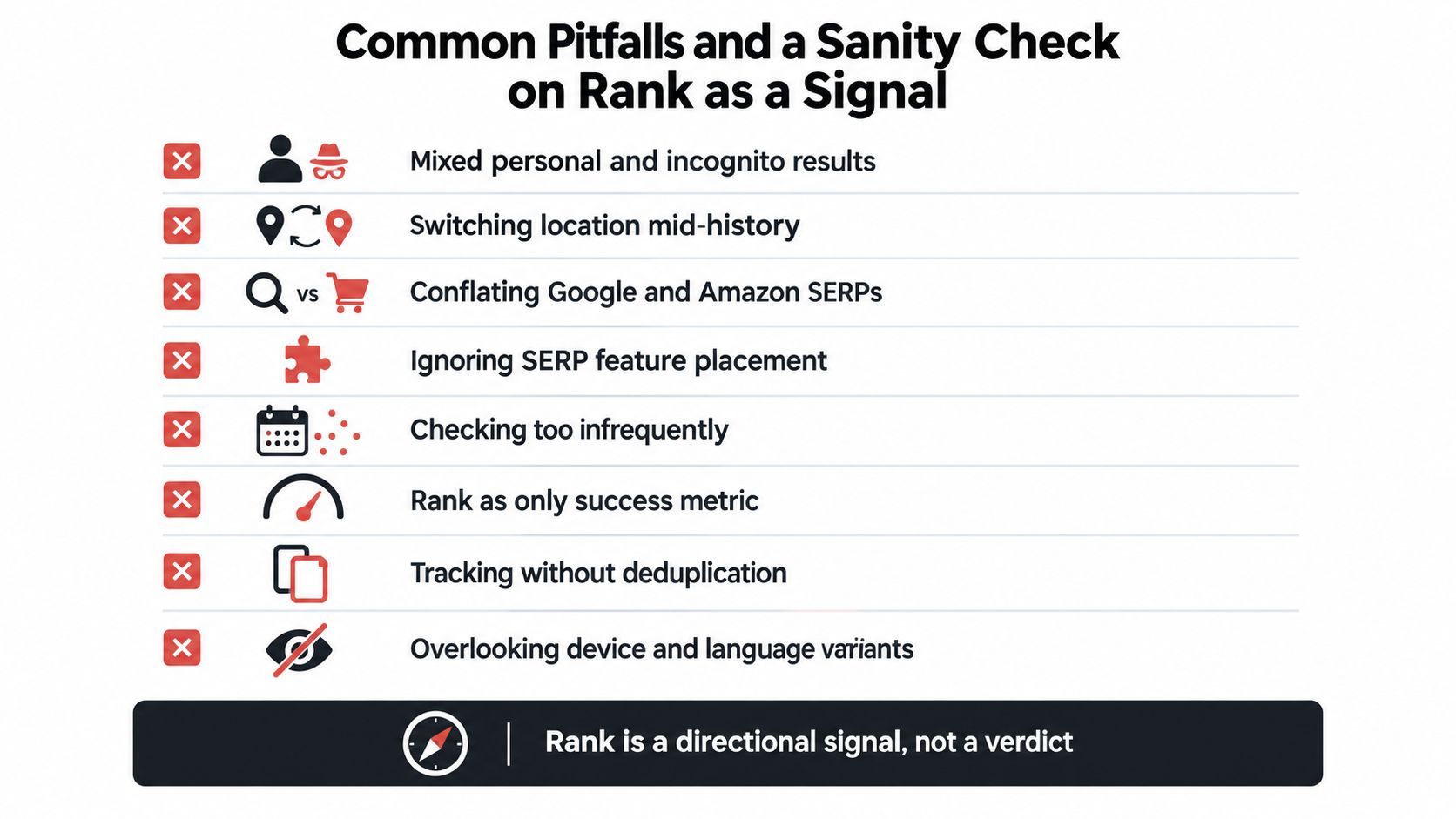
Rank tracking fails most often through inconsistent measurement. Personal searches get mixed with controlled queries. A team changes location settings halfway through a history. Google and Amazon positions enter the same chart under one generic “rank” field. SERP features receive no separate state, so an organic result below a prominent module appears equivalent to one above it.
A single day can also create false urgency. Rankings fluctuate, competitors change listings, demand changes, and collection systems refresh at different times. Infrequent updates can miss short-lived volatility, while excessive querying can trigger blocks or CAPTCHAs. The correct response to an unexpected movement is validation, not immediate optimization.
Rank is best treated as a lagging diagnostic and hypothesis generator, not a control signal. Search Console's average position, impressions, clicks, and CTR should confirm whether a Google movement matters. Amazon rank should be read beside marketplace, ad, product, and conversion fields. A position change that doesn't alter exposure or outcomes may deserve documentation, but not necessarily an intervention.
Before a dataset drives a decision, the operator should verify:
- Configuration: Search engine, marketplace, country, location, language, and device match the baseline.
- Identity: Keyword IDs, URLs, ASINs, and intent labels are stable.
- Coverage: Missing terms and delayed reports are visible rather than left out.
- Classification: Organic rank, sponsored placement, SERP features, and marketplace fields remain separate.
- Demand: Impressions and clicks support the interpretation.
- Outcome: CTR and conversions indicate whether the movement has business relevance.
- History: The timestamp and source are preserved for later comparison.
- Ownership: A named reviewer can investigate the exception.
The right question isn't “how to track keyword rankings” as if the answer were a single tool. The operational question is whether the organization can collect comparable data, preserve it, connect it to demand, and route the result to a controlled decision process. That standard applies equally to a traditional SEO program and an Amazon seller account.
agentcentral provides a hosted MCP data layer for Amazon sellers and their AI agents, with structured access to ranking, Amazon Ads, Seller Central, inventory, orders, catalog, finance, and fulfillment data. Sellers and operators can connect scoped accounts, use pre-materialized reads for repeated checks, and retain auditability around workflow activity. Visit agentcentral to connect the data layer to an MCP-compatible client and build controlled rank alerts and reports.
Related Agent Central pages
- Amazon Seller Central MCP server
Canonical hosted MCP overview for Seller Central, Ads, inventory, catalog, finance, and fulfillment data.
- Connect Seller Central to Claude
Step-by-step path from Amazon OAuth to a Claude connector or MCP config.
- Ranking tool reference
Keyword rank positions, changes, and search-volume joined views.
- Amazon seller data for AI agents
How Agent Central normalizes Amazon seller data before exposing it to AI clients.
- ChatGPT with Amazon seller data
ChatGPT-specific setup path for Amazon seller data through hosted MCP.
- Amazon seller MCP servers compared
How hosted MCP services compare with official Ads MCP, local repos, connector tools, and automation platforms.
Related reading
- Query Response Time for MCP Agents
Measure MCP query response time for Amazon seller data, separate client and server latency, and keep report generation outside live agent turns.
- Financial Reporting Automation for Amazon Sellers
Learn how financial reporting automation works for Amazon FBA sellers and agencies, with MCP-based data layers, key metrics, and audit-ready writes.
- How to Improve Profit Margins for Amazon Sellers
Learn how to improve profit margins with a data-driven framework for Amazon sellers. Optimize pricing, ads, inventory, and fulfillment using agentcentral.
- What Is Inventory List
What is inventory list. Learn what an inventory list is for Amazon FBA, how to structure fields, and how agents use it via agentcentral
Connect Amazon seller data to your AI client.
Agent Central gives Claude, ChatGPT, OpenClaw, Cursor, and other MCP clients structured access to Amazon Ads, Seller Central, inventory, orders, catalog, finance, and fulfillment data.