
What Is Mcp Server
What is mcp server. Learn what an MCP server is, how it works for Amazon sellers, and why hosted layers beat Amazon's first-party Ads server

An MCP server is a process that exposes tools, resources, and prompts over JSON-RPC so AI clients can call them through a standard protocol. MCP, short for Model Context Protocol, was publicly introduced by Anthropic on November 25, 2024, and its initial stable specification is date-stamped 2024-11-05 (protocol history and specification milestone).
For an Amazon seller, that definition becomes practical the moment an agent needs more than a conversational answer. A Claude, ChatGPT, OpenClaw, Cursor, or internal copilot session might need to read campaign performance, inspect FBA inventory, compare catalog fields, check orders, or retrieve finance and fulfillment data. Without a controlled integration layer, every request must handle Amazon authentication, endpoint formats, report delays, throttling, and permissions independently.
An MCP server puts that complexity behind a consistent contract. It doesn't decide whether a seller should raise a bid, change a listing, or create a shipment. It exposes structured facts, source-provided fields, classifications, and guarded actions so the connected agent or workflow can make that decision with appropriate controls.
Table of Contents
- What an MCP Server Actually Is
- The Protocol Architecture Behind MCP
- How MCP Fits an Amazon Seller Workflow
- Inside a Single Tool Call
- Why Amazon's Own APIs Make MCP Hard
- Hosted vs Self-Hosted MCP Servers
- Setting Up a Hosted Amazon MCP Server
- Choosing the Right MCP Server for Your Stack
What an MCP Server Actually Is
An MCP server is a long-running process that publishes capabilities to an AI client. Those capabilities are organized into three protocol primitives:
- Tools perform actions, such as pulling a campaign report, fetching an order, or checking inventory.
- Resources provide addressable data that a client can read, such as catalog records or pre-materialized performance tables.
- Prompts package reusable instruction templates for recurring tasks, such as a weekly PPC review.
The server communicates through the Model Context Protocol, which uses JSON-RPC 2.0 and gives the client a predictable way to discover available capabilities. The agent doesn't need a separate custom adapter for every downstream operation. It can inspect the server's declared tools, understand their input schemas, and request structured results.
For Amazon sellers, the server sits between an AI runtime and one or more seller accounts. It handles the translation from an agent's requested operation into authenticated calls to Amazon Ads, Selling Partner API services, Seller Central data systems, or an internal synchronized store. It also decides which account, marketplace, dataset, and action scope apply.
The operational boundary
That makes an MCP server more than a plugin endpoint. It can serve as the contract surface, authentication boundary, and data gatekeeper for an agent.
A read-only tool might return advertising spend, orders, inventory position, or listing attributes. A write tool might prepare a budget update, price change, shipment plan, or listing mutation. The distinction matters because reads generally inform a decision, while writes can change a live account.
Practical rule: A tool that can mutate an Amazon account should be treated as a privileged execution path, not as a convenient extension of chat.
The protocol standardizes how the client asks for the capability. It doesn't remove the need for authorization, validation, rate-limit handling, audit records, or approval policies. Those responsibilities belong in the server and the surrounding platform.
The Protocol Architecture Behind MCP
MCP uses a client-host-server architecture. The host is the AI application or agent environment, such as Claude, ChatGPT, an IDE, or an internal operations interface. The host launches or manages one or more MCP clients. Each client maintains a connection to an MCP server, which owns the specialized capabilities and access logic.
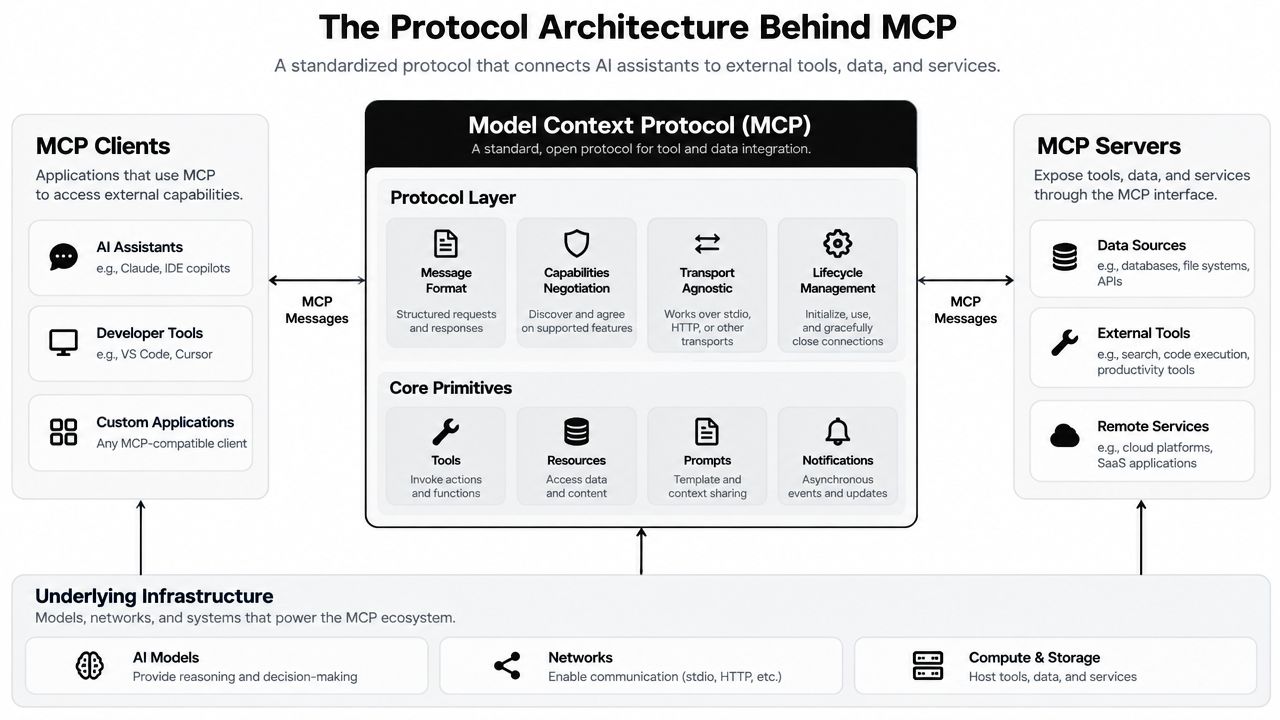
The connection begins with an initialization exchange. The client and server negotiate protocol capabilities, then the server advertises the tools, resources, and prompts it supports. This discovery step reduces hard-coded integration sprawl because the client learns the available contract at connection time.
Three primitives, three jobs
A tool is a callable operation with defined inputs and outputs, commonly expressed through JSON Schema. In an Amazon workflow, listOrders, inventory_health, search_terms_report, or adjust_campaign_bid could each be exposed as separate tools. A well-designed tool accepts a narrow argument set and returns structured fields rather than an unbounded text dump.
A resource is an addressable data source, commonly identified by a URI. A catalog resource could resemble catalog://asin/{id}, while an inventory resource might represent a marketplace-scoped stock view. Resources are useful when the agent needs context that shouldn't be modeled as a mutation-capable function.
A prompt is a reusable template surfaced by the host. A weekly PPC review prompt can define the expected date range, account scope, and output structure while leaving the agent to read the relevant resources and call permitted tools.
MCP supports local and networked deployments. stdio suits co-located processes where the host launches the server locally with minimal transport overhead. Streamable HTTP plus SSE fits remote or multi-tenant deployments where TLS, OAuth, connection management, and scaling become central concerns (MCP architecture and transport details).
How MCP Fits an Amazon Seller Workflow
A useful Amazon MCP server maps seller data domains to narrow, understandable tool groups. The core domains are ads, inventory, orders, catalog, finance, and fulfillment. Each group can expose read operations independently, while write access remains disabled until the account owner explicitly permits it.
Authentication typically combines Amazon's Login with Amazon OAuth flow for Seller Central access with scoped advertising credentials for Amazon Ads. The agent client should receive a scoped API key or session credential, not unrestricted account secrets. The server then maps that identity to the authorized seller account and marketplace before it executes a request.
An MCP server differs from a thin API wrapper. A wrapper forwards requests. A production data layer also enforces account boundaries, validates arguments, handles Amazon-specific response behavior, and records what happened.
| Domain | Example MCP Tool | Auth Source |
|---|---|---|
| Ads | search_terms_report | Amazon Ads OAuth and scoped advertising access |
| Inventory | inventory_health | Seller Central OAuth through SP-API |
| Orders | list_orders | Seller Central OAuth through SP-API |
| Catalog | get_catalog_item | Seller Central OAuth through SP-API |
| Finance | get_finance_events | Seller Central OAuth through SP-API |
| Fulfillment | shipment_status | Seller Central OAuth through SP-API |
Reads can cover campaign pulls, FBA stockout checks, FBM shipment status, listing differences, finance events, and order history. Writes require a separate policy layer. Budget changes, bid updates, price changes, shipment creation, restock actions, and listing edits should be individually allow-listed and logged.
Teams evaluating the wider integration pattern can also review what API integration means for connected systems. The key distinction is that MCP gives the agent a discoverable tool surface, while the Amazon data layer determines which operations are safe and available.
Inside a Single Tool Call
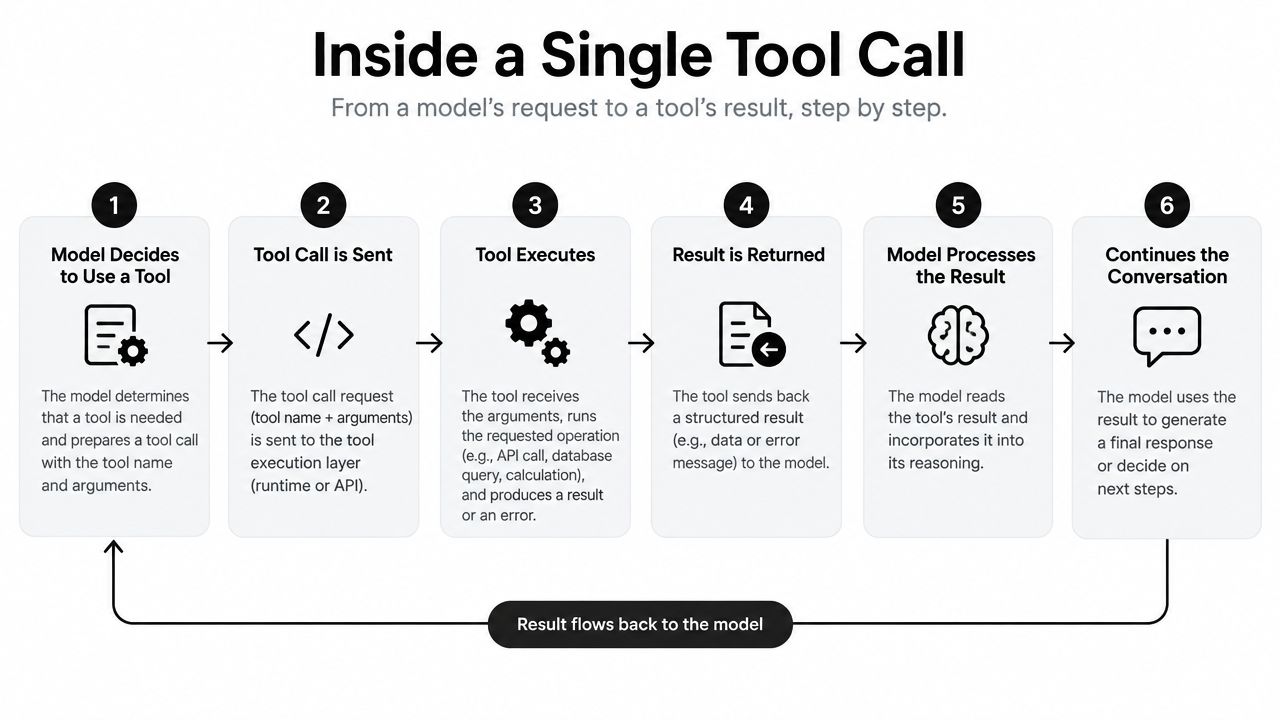
A request starts before the agent asks Amazon for anything. The MCP client connects to the server and completes the initialization handshake. The server responds with its supported capabilities, including its available tools, resource types, prompts, and relevant transport features.
From intent to operation
Suppose the user asks for search-term performance for an advertising account. The agent identifies that it needs a reporting tool, examines the tool's input schema, and supplies the account, marketplace, date range, and campaign filters. The client sends a JSON-RPC tools/call request to the server with those arguments.
The server validates the request before touching Amazon. It verifies the account identity, checks the tool scope, confirms that the parameters are allowed, and selects either a synchronized dataset or a live Amazon operation. It then authenticates against the relevant Amazon service and normalizes the response into fields the client can process.
A structured response might include rows, dates, campaign identifiers, spend, sales, impressions, clicks, and source status. It can also return an explicit error object. A timeout should not look like an empty result, and a report that hasn't finished should not be presented as zero activity.
Failure is part of the contract
A production server needs to distinguish among invalid arguments, missing authorization, throttling, unavailable reports, upstream errors, and partial data. The agent can then stop, retry, ask for approval, or explain the limitation instead of guessing.
For asynchronous operations, the server may return a status and polling state rather than forcing the model to hold an open request. For a synchronized store, it can return the latest successful sync timestamp and source coverage. Those details let the agent explain whether it is answering from current pre-materialized data or waiting for a live API result.
Why Amazon's Own APIs Make MCP Hard
Connecting an MCP server to Amazon doesn't make Amazon's APIs synchronous, unlimited, or safe to mutate. The server still has to absorb the operational behavior of the underlying services.
Amazon Ads reporting is a clear example. Async reports and async snapshots have a documented 15-minute generation window, so a reporting tool must create the job, poll for completion, and download the result rather than expecting an immediate payload (Amazon Ads API reporting limits). A tool that returns “report not ready” isn't necessarily broken. It may be accurately exposing an upstream state that the agent must handle.
Rate limits create a second failure mode. Amazon Ads returns HTTP 429 with a Retry-After header when the client encounters quota or queue pressure, which requires backoff and retry handling (Amazon Ads API rate limiting). SP-API exposes per-operation limits through the x-amzn-RateLimit-Limit response header when available, so a server can't safely assume that every endpoint shares the same budget (SP-API usage plans and rate limits).
Why naive agent loops fail
An agent can request campaign, keyword, search-term, inventory, and order data in a sequence that looks reasonable to a human. To Amazon, that may be a burst of separate operations with independent throttles and asynchronous jobs. A long chain can exhaust quota, exceed an agent timeout, or return an incomplete answer.
Writes deserve a stricter standard. A bid or budget mutation may be valid at the API level but wrong for the account context, marketplace, campaign state, or approval policy. The server should validate the target, show the proposed change, support idempotent execution where possible, and record the before and after values.
The Amazon SP-API integration overview is useful background for teams designing around those endpoint and authorization constraints. MCP is not a shortcut around Amazon's behavior. It is the place to make that behavior visible and manageable.
Hosted vs Self-Hosted MCP Servers
A self-hosted server gives a development team direct control over code, deployment, data storage, and release timing. That control can be appropriate when the organization has unusual internal systems, strict network requirements, or engineers who need to own every adapter and policy.
The cost is operational ownership. The team must manage OAuth refresh, credentials, SDK drift, report polling, retries, rate-limit handling, data normalization, deployment health, and log retention. Every new Amazon data domain becomes another integration surface to test.
A hosted Amazon-focused server moves those responsibilities into a managed service. The vendor operates the remote endpoint, maintains account connections, and provides a client-ready contract. A seller still needs to assess the vendor's security, data isolation, retention, failure handling, and write controls. Hosted doesn't mean risk-free. It means the risk is concentrated in a service contract rather than spread across an internal codebase.
| Dimension | Self-Hosted MCP Server | Hosted MCP Server (agentcentral) |
|---|---|---|
| Hosting | Team runs deployment and availability | Vendor operates the MCP endpoint |
| Sync model | Often fetches live data on demand | Can use pre-materialized seller data for repeated reads |
| Authentication | Team implements token storage and refresh | Vendor manages connected account authorization |
| Auditability | Depends on internal logging design | Structured tool-call records can be provided by the service |
| Write safety | Guardrails must be implemented in code | Scoped keys, previews, confirmations, and policy controls can be built into the layer |
| Time to first answer | Requires integration and deployment work | OAuth and client configuration provide a shorter setup path |
Pre-materialized reads change the latency profile. Instead of asking Amazon to generate a report during every conversation, the hosted layer can synchronize ads, orders, inventory, finance, and related history into a queryable store. Live reads still have a place for freshness-sensitive checks, but repeated analysis generally benefits from stable local data.
The right comparison isn't hosted versus engineering quality. It's managed operational burden versus internal control.
Teams comparing deployment models can use the MCP server hosting guide to frame the infrastructure decision. A self-hosted design is enough for a narrow internal tool with limited read scope. A hosted layer becomes more practical when multiple sellers, agents, marketplaces, or operational teams need the same controls.
Setting Up a Hosted Amazon MCP Server
A hosted setup should begin with permissions, not prompts. The operator creates the workspace, connects Seller Central through OAuth for SP-API access, and authorizes Amazon Ads Manager for advertising data. The resulting connection should expose only the seller accounts and scopes required by the workflow.
The next step is client configuration. The operator places the issued scoped API key into the MCP-compatible client, then confirms that the client can discover the server's tools and resources. The first session should remain read-only.
A safe first session
A practical validation sequence looks like this:
- Read inventory first. Query an inventory health tool for a known marketplace and verify SKU, fulfillment channel, available units, and source timestamps.
- Read advertising data second. Request spend or campaign performance for a constrained account and date range. Confirm that the returned fields match the Amazon Ads context.
- Inspect the audit record. Verify that the user, client, workload, tool, authorization decision, arguments, result status, and downstream effect are recorded.
- Enable writes last. Allow only the specific action required, such as a bid preview or budget update, and require confirmation before execution.
The setup can be completed in minutes when scopes are already mapped, while a self-hosted implementation requires endpoint wiring, token handling, normalization, and deployment work. The exact time depends on the account and client, so the useful test is whether the first read succeeds without exposing a mutation path.
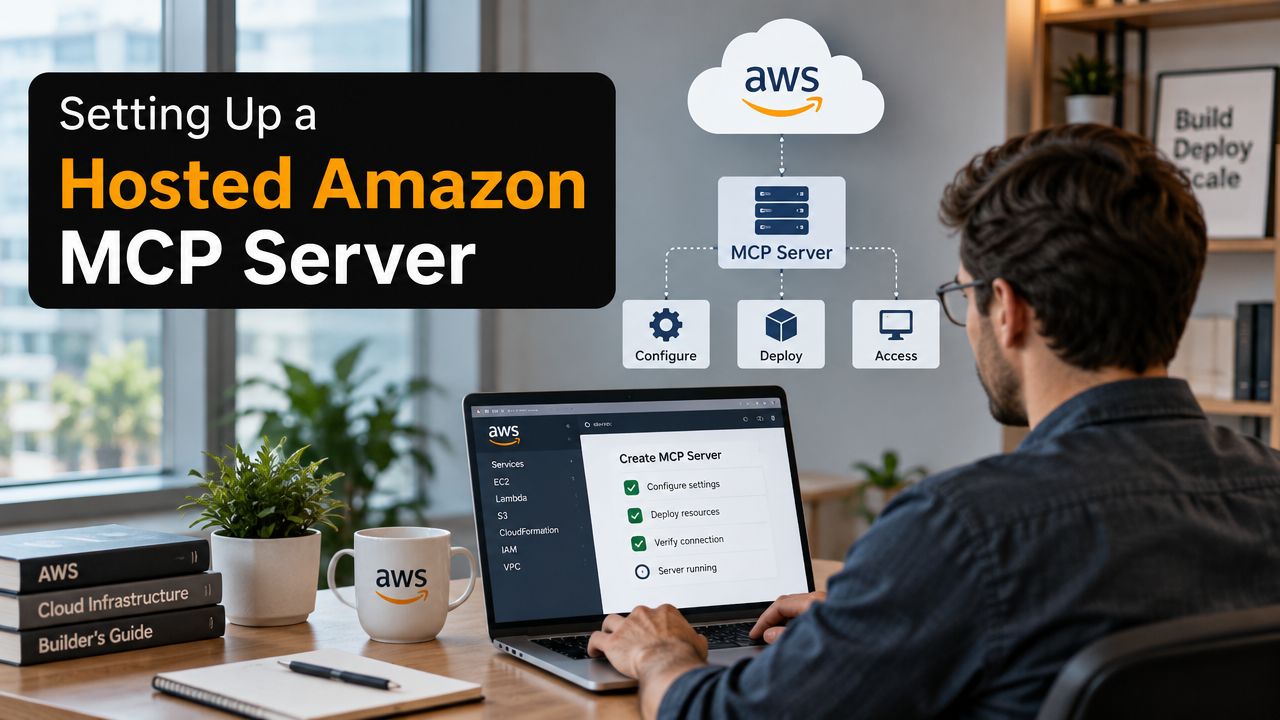
Two settings deserve special attention. Read-only mode should remain active during initial validation, and a per-tool allowlist should govern any later budget, bid, price, listing, shipment, or order mutation. A scoped key is useful only when the server enforces its scope at execution time.
Enterprise audit guidance recommends capturing the verified user, OAuth client, workload, resource or tool, authorization decision, approval state, downstream effect, and outcome, while avoiding reusable bearer tokens in logs (MCP audit logging guidance). That record gives operators a way to investigate what an agent attempted and what Amazon changed.
Choosing the Right MCP Server for Your Stack
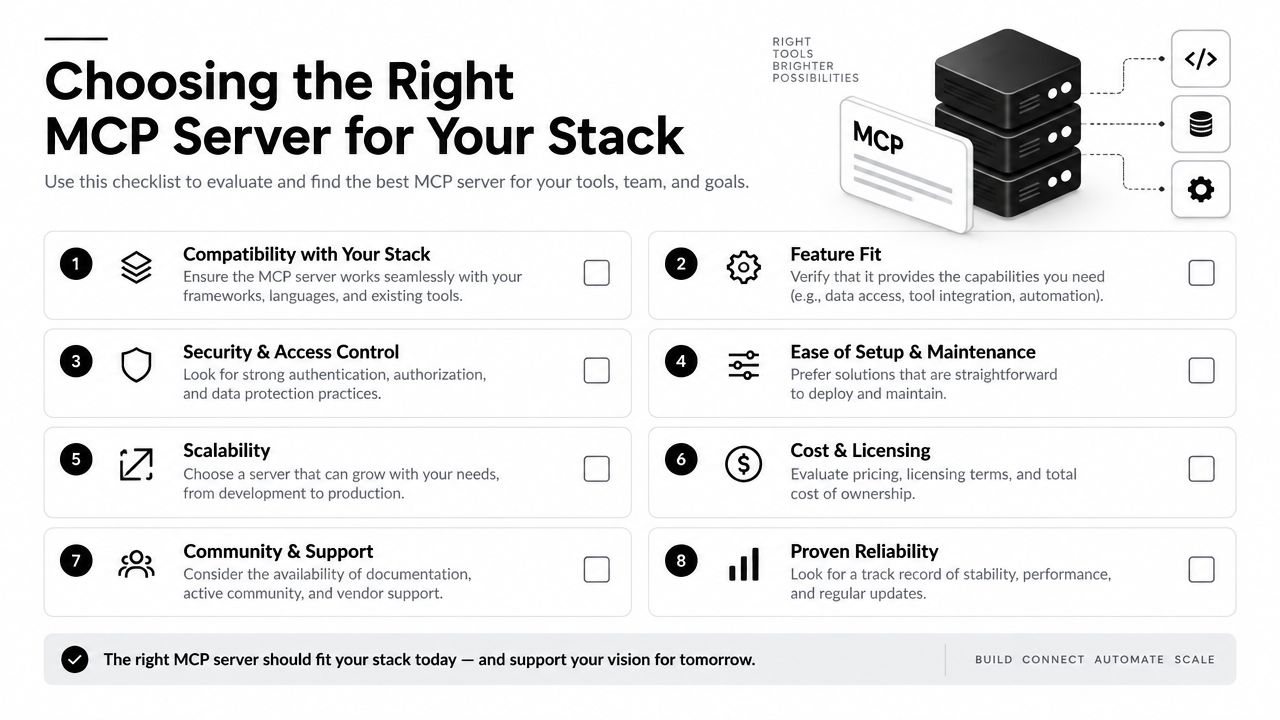
The first buying question is about the data layer, not the model. Does the server cover ads, inventory, orders, catalog, finance, and fulfillment through pre-synced resources, or does every tool call return to Amazon and inherit the same report delays, throttles, and timeout risks?
A first-party or self-hosted server can be appropriate when the workflow is narrow, read-only, and owned by a team that can maintain Amazon-specific integrations. A hosted seller-focused layer makes more sense when operators need shared access, retained history, fast repeated reads, multiple AI clients, and policy-controlled writes without building each subsystem.
Evaluation criteria that matter in production
- Data freshness: Check whether each resource identifies its sync status and whether freshness-sensitive values can be fetched live.
- Authentication: Prefer OAuth-backed account connections and scoped credentials over static, unrestricted keys.
- Write safety: Require previews, dry-run behavior, idempotency protection, per-action approval, and clear target identification.
- Observability: Review tool arguments, authorization decisions, downstream responses, errors, rate-limit state, and correlation identifiers.
- Coverage: Verify that the server handles the seller domains the team operates, not only advertising data.
- Portability: Confirm whether the data can be exported and whether tools use understandable schemas instead of opaque vendor-specific abstractions.
Tool catalogs also need ownership after launch. Teams responsible for managing internal tool lifecycles should define who reviews schemas, retires unsafe actions, rotates scopes, and validates behavior after Amazon changes an API.
Before an agent can write to a live account, the operator should verify four conditions:
- Test mode has passed with known account and marketplace values.
- Audit logs show the complete authorization and execution trail.
- A rollback or compensating action is documented for the operation.
- A human approval step protects every spend-changing call.
An MCP server becomes dependable when it makes those checks part of the workflow rather than leaving them to the model's judgment.
agentcentral provides a hosted MCP data layer for Amazon sellers, connecting Claude, ChatGPT, OpenClaw, Cursor, and other MCP clients to structured Ads, Seller Central, inventory, orders, catalog, finance, ranking, and fulfillment data. Sellers and agencies can connect an account through OAuth, use scoped access and guarded write tools, and give an agent fast repeated reads with auditable execution. Visit agentcentral to connect an Amazon account and test a controlled MCP workflow.
Related Agent Central pages
- Amazon Seller Central MCP server
Canonical hosted MCP overview for Seller Central, Ads, inventory, catalog, finance, and fulfillment data.
- Connect Seller Central to Claude
Step-by-step path from Amazon OAuth to a Claude connector or MCP config.
- Amazon seller data for AI agents
How Agent Central normalizes Amazon seller data before exposing it to AI clients.
- Amazon seller MCP servers compared
How hosted MCP services compare with official Ads MCP, local repos, connector tools, and automation platforms.
- ChatGPT with Amazon seller data
ChatGPT-specific setup path for Amazon seller data through hosted MCP.
Related reading
- What Is API Integration and How It Works for Amazon Sellers
Learn what is API integration, how it connects software systems, and why Amazon sellers use MCP servers to access Seller Central, Ads, and fulfillment data
- Setup Time Reduction for Amazon MCP Integrations
Cut setup time for Amazon Seller Central and Ads MCP integrations with pre-sync, OAuth, scoped keys, and a rollout playbook for agencies.
- View Amazon Advertising Promotional Credits
Find Amazon Advertising promotional credits, distinguish them from retail promotions, and reconcile promotion status, amounts, dates, and invoices.
- AI Agents for Ecommerce on Amazon
Learn how Amazon operators can structure ecommerce agents around reliable data, narrow permissions, reviewed writes, and durable audit records.
Connect Amazon seller data to your AI client.
Agent Central gives Claude, ChatGPT, OpenClaw, Cursor, and other MCP clients structured access to Amazon Ads, Seller Central, inventory, orders, catalog, finance, and fulfillment data.