
MCP Server Integration for Amazon Sellers: A Complete How-To
Connect AI agents to Amazon seller data with this MCP server integration guide. Learn OAuth, scoped keys, write previews, and auditability for agents.
Yes, AI clients like Claude and ChatGPT can connect to Amazon seller data through a hosted MCP server in minutes, using OAuth and scoped API keys for read and guarded write access. MCP server adoption expanded from roughly 100 servers in November 2024 to more than 4,000 by May 2025, while combined Python and TypeScript SDK downloads reached more than 8 million per month by April 2025 (ecosystem analysis).
An Amazon operator can ask for inventory, Ads TACOS, settlement data, or fulfillment status and receive a structured answer inside an AI client. The difficult part isn't establishing the connection. It's making the connection reliable when Amazon's APIs impose asynchronous reports, operation-specific throttles, OAuth constraints, and permissions that can turn an apparently simple tool call into a production incident.
That distinction matters for agentcentral, the Amazon seller data layer for AI agents. Its hosted MCP server gives Claude, ChatGPT, OpenClaw, Cursor, and other MCP clients structured access to Amazon Ads, Seller Central, inventory, orders, catalog, ranking, finance, and fulfillment data. The practical standard is not whether an agent can call a tool once. The standard is whether an operator can trust repeated reads, approve writes, trace changes, and promote the same configuration from development into production.
Table of Contents
- Why Hosted MCP Servers Beat Async Reports
- Connecting Agentcentral to Claude and ChatGPT
- Hosted Data Layer vs Native Amazon MCP
- Guarded Writes and Audit Trails
- Rate Limits and Production Constraints
- Troubleshooting and Security Checklist
Why Hosted MCP Servers Beat Async Reports
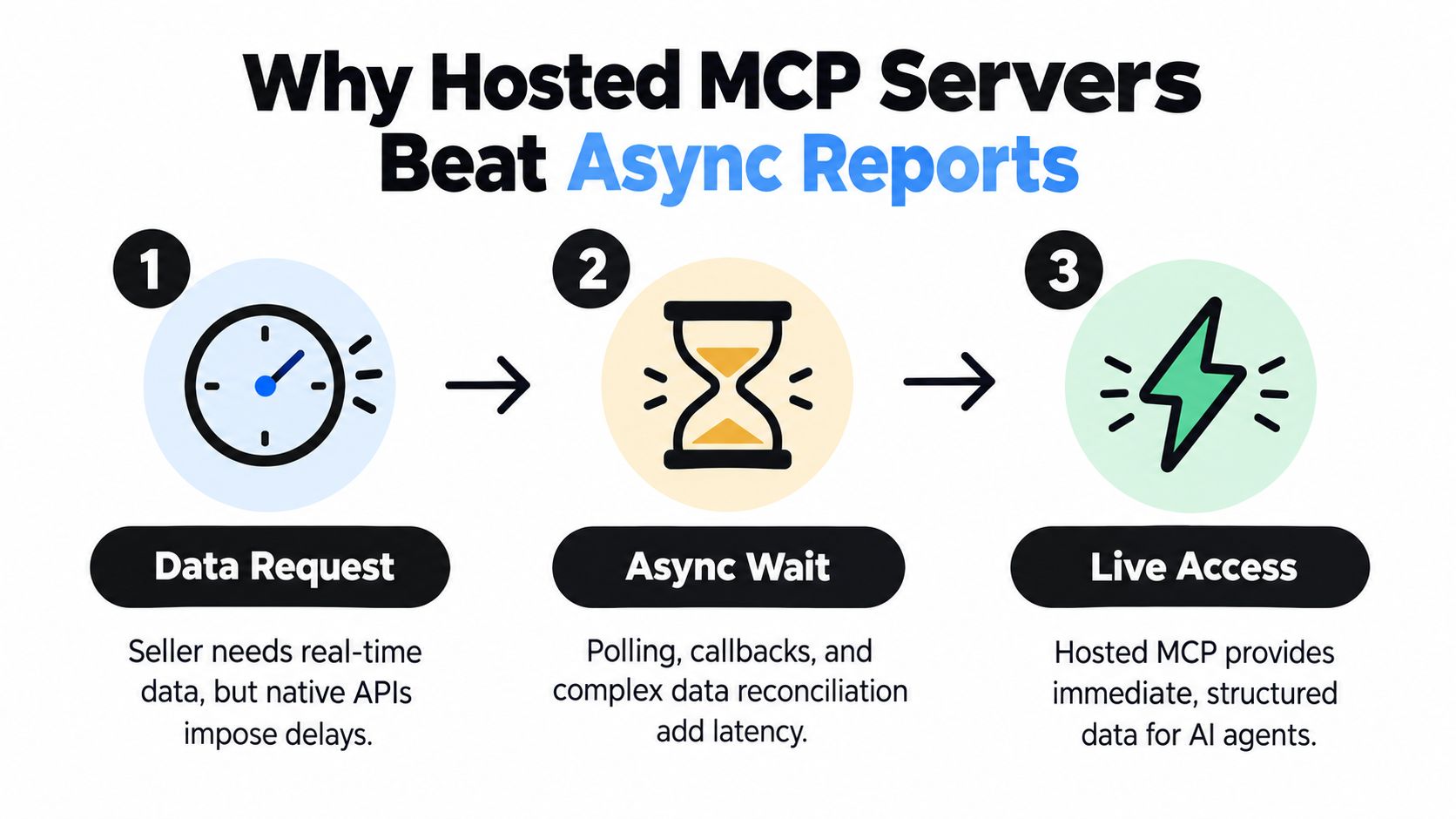
An Ads manager needs yesterday's TACOS before changing a campaign. An operations lead needs current inventory before approving a replenishment order. An agency needs FBA reimbursement history while speaking with a client. Amazon's native reporting flow can turn each request into a sequence of report creation, status checks, downloads, parsing, and reconciliation. A local MCP server that performs that entire sequence during an agent conversation leaves the user waiting while several failure points accumulate.
Amazon's Selling Partner API also applies per-operation usage plans. The x-amzn-RateLimit-Limit response header can identify the applied limit for an account and application pair, and Amazon notes that an operation can have multiple limits, with requests constrained by whichever threshold is reached first (Amazon's reports API rate-limit documentation). A server that treats every request as an unrestricted live read will eventually hit throttling, timeout, or incomplete-result problems.
Move latency out of the agent conversation
A hosted data layer changes where the slow work happens. Instead of asking Claude or ChatGPT to wait for an Amazon report, the platform synchronizes source data in its backend, normalizes it, retains historical records from the first connection, and exposes pre-materialized results to the client.
For agentcentral, that means account data is pre-synced daily and reads are served from prepared datasets. The agent can query inventory, Ads, finance, catalog, ranking, and fulfillment data without initiating a long report workflow in the middle of a conversation. This doesn't make Amazon's upstream systems faster. It prevents upstream latency from blocking the user-facing tool call.
The distinction is especially important for repeated reads. A workflow comparing search-term performance across several periods, checking stock across many SKUs, or reconciling orders against fulfillment records shouldn't repeatedly recreate the same expensive source query. A prepared data layer provides a consistent read surface while the backend manages synchronization, retries, normalization, and source-specific constraints.
What pre-materialized data changes
A production MCP integration should separate freshness requirements from interaction speed. Some decisions need the latest available operational snapshot. Others need historical context that native reports make awkward to retrieve during a live exchange. Pre-materialization supports both by allowing the backend to maintain data before an agent asks for it.
The operator still needs visibility into data age and source fields. “Instant” should describe response delivery, not imply that every value was retrieved from Amazon seconds ago. A trustworthy tool response should make freshness, scope, and source context clear enough for a user to judge whether a write or business decision is appropriate.
For deeper implementation detail on Amazon report workflows, the Amazon seller reports guide provides a useful operational reference. The core rule remains simple:
Practical rule: Keep asynchronous synchronization in the platform layer, not in the agent's request loop.
Connecting Agentcentral to Claude and ChatGPT
The setup path has four operational stages: create the hosted connection, authorize Amazon, issue a scoped credential, and add the remote MCP endpoint to the client. The exact labels in Claude, ChatGPT, OpenClaw, or Cursor can vary, so the durable details are the endpoint, authentication method, permissions, and verification query.
Authorize the Amazon account
The operator starts by creating an agentcentral account and selecting the Amazon seller or Ads connection required for the workflow. Amazon's public SP-API authorization model uses OAuth 2.0 through Login with Amazon, while private applications can use self-authorization. Public developers must obtain seller permission, and the authorization process generates an LWA refresh token that must be renewed annually (Amazon's SP-API authorization documentation).
That renewal requirement belongs in the operating calendar. A connection can appear healthy until its refresh-token lifecycle becomes the hidden cause of authentication failures. Agencies should also plan account ownership carefully, because Amazon states that an application has a maximum of 10 authorizations. That constraint affects multi-account tooling, especially when one application is expected to serve several seller relationships.

Create the credential with the smallest useful scope
The API key should match the task, not the entire organization. A read-only key is appropriate for reporting, diagnosis, inventory visibility, and finance analysis. A key that can invoke write tools should be reserved for an environment and user group that can review changes.
A practical scope model looks like this:
- Reporting scope: Ads metrics, Seller Central reports, finance records, and historical reads.
- Operations scope: Inventory, orders, catalog, and fulfillment visibility.
- Controlled-write scope: Explicitly permitted bid, listing, shipment, or order actions, with previews and audit records.
An agency managing several sellers shouldn't place one broad credential in a shared prompt or automation. Separate datasets and revocable keys make it possible to disable one account without interrupting unrelated clients. Operators evaluating the connection should also apply the same discipline used in software AI quality assurance, especially around permission tests, malformed parameters, and expected failure behavior.
Add the MCP endpoint and verify it
The client configuration needs the remote MCP endpoint, the issued API key, and the authentication format supported by that client. agentcentral documents its remote endpoint as https://mcp.agentcentral.to/mcp, with scoped API keys and signed connector URLs available for MCP-capable tools.
The first test should be read-only and narrow. A useful verification prompt asks for a known account, a small set of seller data, and a clearly defined date range, such as current inventory for selected SKUs or recent campaign metrics. The response should confirm the expected account, return structured fields, and make the data scope apparent.
Only after that test succeeds should the operator inspect available tools or enable writes. The OAuth setup reference covers the authorization sequence without relying on assumptions about a specific client interface.
Permission check: A successful connection proves authentication. It doesn't prove that the key has the correct account, dataset, or write scope.
Hosted Data Layer vs Native Amazon MCP
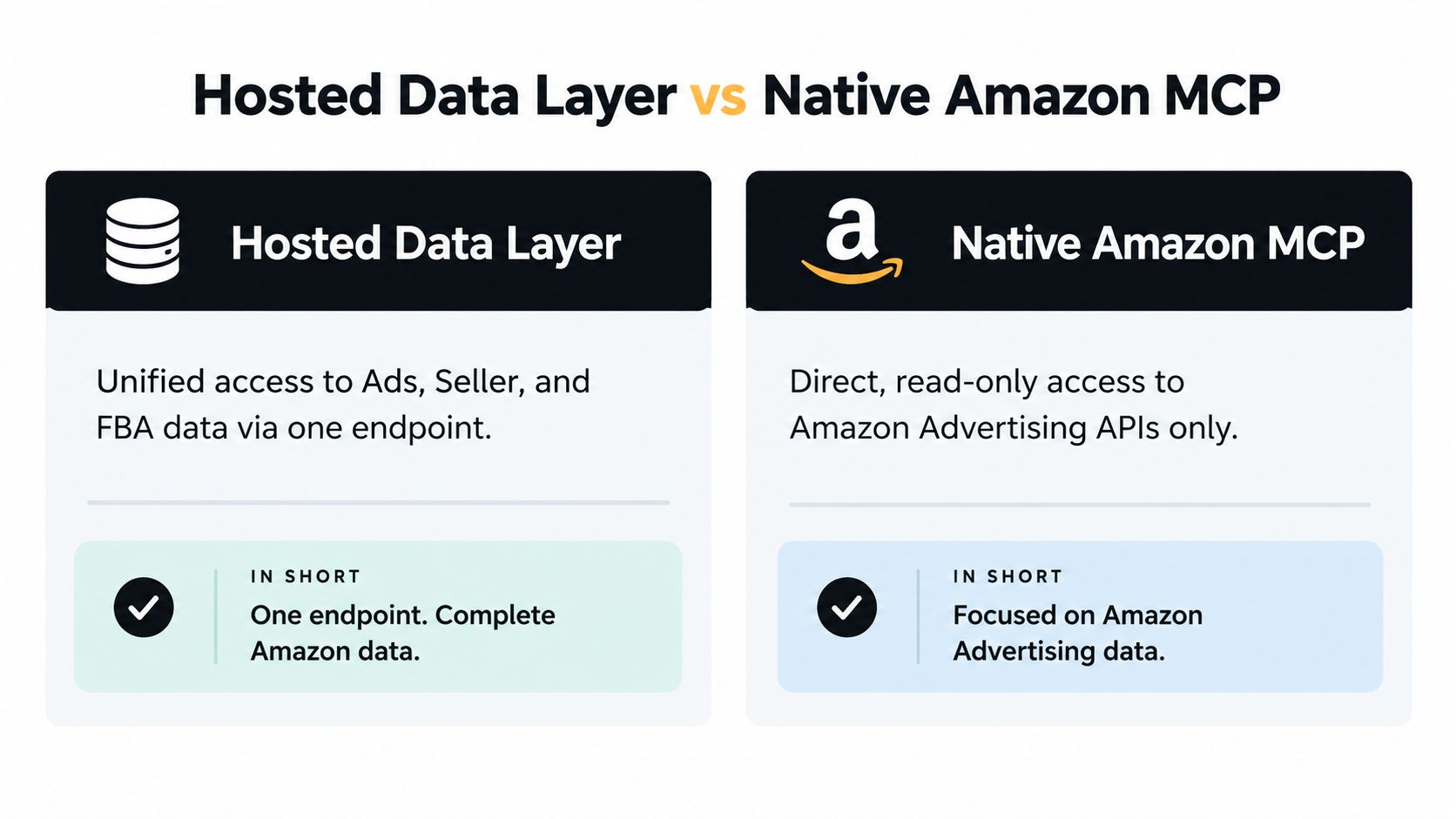
The choice depends on whether the agent needs advertising data alone or a broader operating view of the Amazon business. Amazon's native Ads MCP server is appropriate for direct campaign and advertising workflows. It doesn't provide the same surface as a seller operations layer that combines Ads with inventory, orders, catalog, finance, ranking, and fulfillment.
| Requirement | Hosted data layer | Native Amazon Ads MCP |
|---|---|---|
| Advertising data | Included with broader seller context | Direct advertising focus |
| Inventory and orders | Available through the unified seller layer | Not the primary scope |
| FBA and fulfillment | Available when supported by the hosted dataset | Outside the Ads silo |
| Historical reads | Pre-materialized platform data can support repeated queries | Depends on native API workflows |
| Credential control | Scoped keys and connector-level access | Governed through the native application model |
| Writes | Can expose guarded tools with previews and audit logs | Depends on the native tool surface and permissions |
| Operations burden | Hosted provider maintains synchronization and endpoint behavior | Operator maintains any custom local integration |
Choose the narrow path when the workload is narrow
A PPC manager who only needs campaign metrics, targeting data, and advertising operations may have no reason to introduce fulfillment or finance tools. A direct native Ads connection can reduce the number of moving parts and keep the permission boundary narrow.
The trade-off appears when the question crosses domains. “Did the campaign drive profitable sales while the SKU remained in stock and the fulfillment pipeline stayed healthy?” requires more than advertising data. A native Ads server can't answer inventory, FBA shipment, settlement, or reimbursement questions unless another integration supplies those datasets.
Choose the hosted path for cross-functional workflows
A hosted server like agentcentral presents one MCP endpoint for Amazon Ads, Seller Central, inventory, orders, catalog, ranking, finance, and fulfillment. Its stated product surface includes 89 tools, while the important operational difference isn't the count alone. The value is the common account context, prepared reads, scoped access, and guarded write behavior across related workflows.
Local servers can still be the right choice for teams that need custom transformations, private infrastructure, or direct control over every connector. They also inherit the hard work: token storage, Amazon API throttling, report polling, schema changes, retries, monitoring, and safe deployment. A hosted model shifts that maintenance to the provider, but introduces a provider dependency that should be evaluated through data isolation, credential handling, export needs, and audit access.
The decision should follow the operating boundary. Advertising-only analysis favors a narrow native integration. End-to-end seller operations favor a unified data layer, provided the hosted service exposes enough freshness metadata, permission controls, and traceability for the business process.
Guarded Writes and Audit Trails
Read-only access is the easy part of MCP server integration. The risk profile changes when an agent can modify a bid, update a listing, create a shipment, or alter an operational record. Natural-language intent is useful for selecting a tool, but it shouldn't be treated as sufficient authorization for an irreversible action.
agentcentral's boundary is important here. It is a data layer, not a recommendation engine. It returns facts, metrics, classifications, and source-provided fields, while the user's agent or workflow decides what those facts mean. Guarded write tools can then enforce the mechanics of review, scope, and traceability without pretending that the platform should decide what a seller ought to do.
Use preview before commit
A bid change illustrates the safe sequence. The agent retrieves the campaign and current bid, proposes a new value in a write-preview call, and returns the before and proposed after values. The operator checks the campaign identity, targeting context, account scope, and reason for the change before allowing the commit.
Inventory needs the same treatment. A quantity update should identify the SKU, marketplace, current quantity, proposed quantity, and source of the current value. A shipment creation should show destination, contents, quantities, and the exact action that will be sent to Amazon.
A useful write contract includes:
- Explicit tool scope: The credential can invoke only the write operations required by the workflow.
- Preview response: The system returns the intended before-and-after state before committing.
- Idempotency key: A retry reuses the same key so a network failure doesn't create duplicate work.
- Commit confirmation: The user or an approved workflow authorizes the final mutation.
- Audit event: The system records actor, account, tool, parameters, result, and before-and-after values.
Write rule: If a retry could duplicate a shipment or apply a bid change twice, the tool needs idempotency before it belongs in an unattended workflow.
Make the audit record useful
An audit log shouldn't merely say that a tool ran. It should allow an agency manager, security reviewer, or seller to reconstruct what happened. The record should connect the natural-language request to the selected tool, the authorized identity, the Amazon account, the input parameters, the preview, the commit decision, and the source response.
This is a material control because production MCP servers often lack standardized audit trails, use broad permissions, or expose authentication, authorization, and supply-chain risks. A 2026 security review reported at least seven confirmed high- or critical-severity CVEs affecting major MCP-integrated platforms, and another cited an internet scan that found at least 1,862 publicly accessible instances responding to unauthenticated requests (MCP security review).
Teams implementing these controls can use the audit logging best practices guide as a reference point. The objective isn't to make every action manual. It's to ensure that automation remains reversible, attributable, and constrained.
Rate Limits and Production Constraints
A hosted layer removes report polling from the interactive path, but Amazon's upstream limits still govern production. The backend needs queues, retries, caching, concurrency controls, and account-aware scheduling. A fast MCP response is not permission to send requests faster than the source API accepts.
Amazon's external fulfillment limits show why each operation needs its own plan. Amazon documents batchInventory at 50 requests per second with a burst of 100, getShipments at 2 requests per second with a burst of 5, and processShipment, createPackages, updatePackage, and retrieveShippingOptions at 1 request per second with a burst of 5 (Amazon's external fulfillment rate limits).
| Workflow | Operational response |
|---|---|
| Repeated inventory lookup | Read the prepared dataset when freshness requirements allow |
| Shipment status review | Avoid synchronous fan-out across many shipments |
| Package creation | Queue and serialize calls according to the operation limit |
| Batch inventory synchronization | Use the higher documented capacity without assuming it applies to other actions |
Design around the slowest operation
A fulfillment workflow that reads shipments, requests shipping options, and creates packages cannot run at the speed of its fastest endpoint. The constrained operations set the practical pace. Pre-synced inventory and fulfillment records reduce live calls, while writes need rate-aware queues, visible status, and failure handling.
Hosted MCP servers such as agentcentral should expose bounded execution rather than passing unlimited client demand to Amazon. Set per-account concurrency, apply exponential backoff for throttling, and preserve request IDs and outcomes in operational logs. A retry that outlives the client timeout can still finish upstream, so the client needs a way to check final status before attempting the action again.
MCP adoption increases the number of client, tool, permission, and upstream-limit combinations that operators must test. Ecosystem summaries report growth from roughly 100 MCP servers in November 2024 to more than 4,000 by May 2025. Production deployments therefore need explicit backoff, bounded concurrency, and errors that explain whether a request was queued, throttled, or rejected, instead of retrying until the agent times out.
Troubleshooting and Security Checklist
Most failures fall into a small set of categories: the client can't authenticate, the credential reaches the wrong scope, the tool returns stale or incomplete data, or a write fails after the user assumes it succeeded. Operators should diagnose the layer that failed instead of repeatedly reconnecting the entire integration.
Keep the maintenance routine explicit
A reliable weekly or release-based check should include:
- Authorization health: Confirm that the Amazon connection remains valid and that refresh-token renewal is tracked.
- Key scope: Verify that each client uses the intended seller account, dataset, and read or write permission.
- Data freshness: Check synchronization timestamps before using inventory, Ads, finance, or fulfillment facts.
- Rate behavior: Review throttling, retries, queue depth, and timeout events by operation.
- Write controls: Confirm preview, approval, idempotency, and before-and-after logging for every mutable tool.
- Credential exposure: Keep keys out of prompts, source repositories, screenshots, and shared chat transcripts.
- Revocation path: Test that a compromised or departed user's access can be disabled without waiting for a broad system change.
Security architecture should cover the endpoint as well as the Amazon credential. A focused guide on securing production AI endpoints is useful when reviewing authentication, secret handling, tool exposure, and monitoring around MCP clients.
Troubleshoot from symptom to cause
| Symptom | Likely cause | Practical fix |
|---|---|---|
| Authentication error after a long period of success | OAuth refresh lifecycle or revoked seller authorization | Reauthorize the account and record the renewal owner |
| Data from the wrong seller appears | Key or connector scope mismatch | Revoke the credential, issue a narrower key, and verify account identity with a read-only query |
| Agent times out during a report request | Live polling, upstream throttling, or unbounded retries | Use prepared reads, queue source requests, and apply bounded backoff |
| Write preview shows no change | Tool lacks the required write scope or parameters resolve to the wrong resource | Inspect the tool response, confirm permissions, and test with a known safe record |
| A mutation may have run twice | Retry without an idempotency key | Check the audit record before retrying, then reuse the original idempotency key |
| Results look current but lack context | Missing freshness or source metadata | Require synchronization timestamps and source-provided fields in the response |
The final operational test is a controlled write in a noncritical workflow. The operator should see the intended resource, preview the mutation, approve it, confirm the source response, and locate the complete audit event. If any step is opaque, the integration isn't ready for broader automation.
agentcentral provides a hosted MCP server for connecting Claude, ChatGPT, OpenClaw, Cursor, and other clients to structured Amazon Ads, Seller Central, inventory, orders, catalog, ranking, finance, and fulfillment data. Visit agentcentral to authorize an account, create a scoped API key, and start with fast prepared reads before enabling guarded writes with previews, idempotency keys, and audit logs.
Related Agent Central pages
- Amazon Seller Central MCP server
Canonical hosted MCP overview for Seller Central, Ads, inventory, catalog, finance, and fulfillment data.
- Connect Seller Central to Claude
Step-by-step path from Amazon OAuth to a Claude connector or MCP config.
- ChatGPT with Amazon seller data
ChatGPT-specific setup path for Amazon seller data through hosted MCP.
- Amazon seller data for AI agents
How Agent Central normalizes Amazon seller data before exposing it to AI clients.
- Amazon seller MCP servers compared
How hosted MCP services compare with official Ads MCP, local repos, connector tools, and automation platforms.
- Seller Central integration hub
Governed routes for Seller Central data into accounting, CRM, BI, and internal workflows.
Related reading
- Amazon Performance Dashboard: A Data Access Guide
Build an Amazon performance dashboard that joins ads, inventory, fulfillment, catalog, and finance data with clear freshness, scopes, and audit trails.
- AI Agent Security: Best Practices for Data Security
Protect Amazon seller data when you run AI agents: best practices for encryption, scoped access, least privilege, and audit logs in MCP-based workflows.
- Seller Central Inventory Reference for AI Agents
A practical reference for seller central inventory fields, reports, FBA workflows, SP-API limits, and how agentcentral exposes this data to AI agents.
- What Is Mcp Server
What is mcp server. Learn what an MCP server is, how it works for Amazon sellers, and why hosted layers beat Amazon's first-party Ads server
Connect Amazon seller data to your AI client.
Agent Central gives Claude, ChatGPT, OpenClaw, Cursor, and other MCP clients structured access to Amazon Ads, Seller Central, inventory, orders, catalog, finance, and fulfillment data.