
FBA Removal Order: Fees, Options, and Timing
An FBA removal order returns, disposes of, or liquidates FBA stock. See 2026 fees, 10-90 day timelines, and how to reconcile units and charges.

An FBA removal order asks Amazon to return, dispose of, liquidate, or in some European stores donate FBA units; processing is often 10 to 14 business days and can run 30 or 90 days or more at peak, with a per-unit size and weight fee rather than one flat order fee.
That gap between submission and physical movement is where sellers lose money. A removal looks like a menu click in Seller Central, but it behaves like a delayed, fee-bearing state change. Units sit in process, cash leaves when Amazon charges the movement, and resale plans fail if an operator treats requested stock as stock that's already back in a warehouse.
Table of Contents
- What Is an FBA Removal Order?
- What Are the Removal Disposition Options?
- 2026 FBA Removal and Disposal Fees
- How Long Removal Processing Takes
- The 14 Day Unfulfillable Removal Window
- How Do I Reconcile Shipped Units, Fees, and Receipts?
- Choose Return Disposal or Leave It in FBA
What Is an FBA Removal Order?
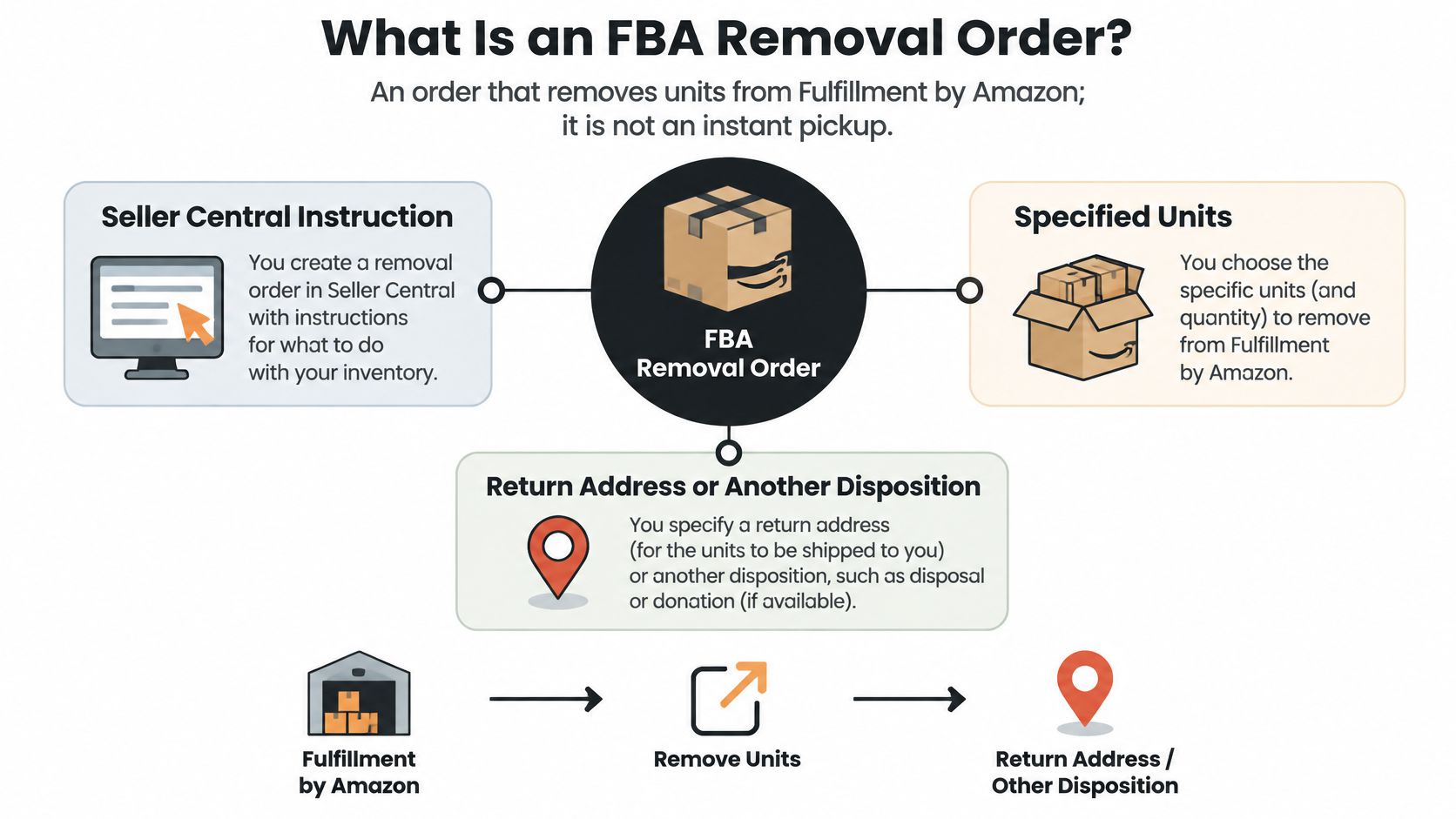
An FBA removal order is a Seller Central instruction that takes specified units out of Fulfillment by Amazon and sends them to a return address or to another disposition. It's not an instant pickup, and it doesn't put inventory back on a shelf the day it's submitted.
Say a seller finds a packaging defect across one SKU. The listing is paused, the units can't be sold as they sit, and the seller creates a removal to inspect them. From that moment, two clocks matter. The processing clock runs while Amazon picks, packs, and processes the units. The carrier clock starts only after Amazon finishes, so delivery planning that ignores the second clock will miss inbound labor, relabeling, and relisting dates.
Storage Pause Is Not a Free Removal
Once a removal order is successfully created, the Amazon standard FBA removal order help page says Amazon doesn't charge storage fees on the units while the order remains in process. The same page separates that pause from the removal charge itself, which is a one-time, per-unit fee based on size and shipping weight.
That distinction stops a common error. Submission can pause storage exposure, but it doesn't make the exit free, and it doesn't make units available for inspection or resale. Order status, not the calendar, proves where a unit sits.
Triggers Operators Usually Face
Removals aren't only end-of-life cleanups. Sellers create them for stranded listings, forecast errors, compliance or packaging problems, product transitions, and required removal of unfulfillable stock. Each trigger has a different deadline and a different recovery value, so lumping them into one cleanup batch hides the economics.
Practical rule: Treat a submitted removal as inventory in transit between states, not as inventory received, until Amazon confirms dispatch and the carrier confirms delivery.
For planning, use the published-range table in the processing-time section rather than a single remembered estimate. The range an operator chooses changes staffing, cash recovery, and whether a returned unit can still hit a selling season.
What Are the Removal Disposition Options?
Amazon names four routes, but a seller doesn't get all four for every SKU in every store. Availability depends on the marketplace, the physical location of the inventory, and the unit itself. Checking the live removal screen for that SKU and store is the only reliable way to confirm what's offered.
The Amazon Europe removal and disposal help page distinguishes a return-to-seller order, which sends inventory to the seller's designated return address, from a disposal order, which directs Amazon to dispose of eligible unwanted inventory. The same page notes that in certain European marketplaces, eligible inventory can instead be donated to selected charities, and that charges are applied in the currency of the country where the inventory is stored.
Four Routes, Four Constraints
- Return to seller: Units come back for inspection, repair, relabeling, or resale elsewhere, but the seller needs a valid address that can receive carrier deliveries.
- Disposal: Amazon destroys eligible unwanted units and the seller gives up any chance to inspect or resell them.
- Liquidation: Units move through a liquidation route only where Seller Central offers it for that SKU and store.
- Donation: Eligible units go to selected charities in certain European marketplaces, with eligibility set by Amazon.
| Disposition | What happens to the units | Where it applies | Main constraint |
|---|---|---|---|
| Return to seller | Amazon ships the units to the seller's designated return address | Marketplaces where return-to-seller is offered | Needs a valid address; carrier time is extra; per-unit fee by size and weight |
| Disposal | Amazon disposes of eligible unwanted inventory | Marketplaces where disposal is offered for that inventory | Separate per-unit disposal fee; units are not recoverable |
| Liquidation | Inventory is liquidated through the route Amazon offers | Only where the liquidation option is available for that SKU and store | Do not assume it appears on every removal screen |
| Donation | Eligible inventory can be donated to selected charities | Certain European marketplaces | Not a universal substitute for disposal; eligibility is Amazon's |
Required removal of unsuitable inventory isn't a fifth voluntary option. It's a deadline case with its own notice period, covered in its own section below.
Currency follows storage location, not the seller's home account. A multi-marketplace operator who models every removal in dollars will misstate cost for units stored in Europe or Brazil, even when the SKU and quantity are identical. The fee lookup that follows keeps each marketplace on its own row for that reason.
2026 FBA Removal and Disposal Fees
Fees are per-unit charges that scale with shipping weight, size tier, marketplace, disposition, and policy date. There's no single flat order fee, so a 1,000-unit batch multiplies whatever band the product falls into. Sellers comparing options should also read the wider FBA inventory and inbound services fees breakdown so removal isn't modeled in isolation from the storage and inbound charges around it.
For the 2026 U.S. change, the Amazon U.S. 2026 FBA fee help page puts standard-size fees beginning at $0.84 for units up to 0.5 lb and rising to $2.89 plus $1.06 per pound above 2 lb, calculated when an order is placed and charged when inventory leaves the fulfillment center. The Amazon U.S. disposal fee help page separately lists standard-size disposal at $1.04 for 0 to 0.5 lb, $1.53 for over 0.5 lb through 1 lb, $2.27 for over 1 lb through 2 lb, and $2.89 plus $1.06 per pound above 2 lb, with large bulky, extra-large, and special-handling items at 0 to 1 lb at $3.12. The Amazon Brazil removal fee schedule lists BRL 0.99 for 0 to 250 g, BRL 1.04 for 250 to 500 g, BRL 1.12 for 500 g to 1 kg, BRL 1.26 for 1 to 2 kg, and BRL 3.60 plus BRL 0.17 per additional kilogram above 10 kg, and Europe's update effective February 1, 2025 moved local return-to-seller for 501 g to 1 kg from £1.36 to £1.48 and disposal for that band from £1.88 to £2.28.
Removal and Disposal Fees by Marketplace and Weight
| Schedule | Weight or size band | Per-unit fee | Charge timing or note |
|---|---|---|---|
| 2026 U.S. standard-size direction | Up to 0.5 lb | $0.84 | Calculated when the order is placed; charged when inventory leaves |
| 2026 U.S. standard-size direction | Above 2 lb | $2.89 plus $1.06 per lb above 2 lb | Middle bands are not stated in this policy summary |
| U.S. disposal schedule | 0 to 0.5 lb standard-size | $1.04 | Cite the disposal fee help page, not the 2026 summary row |
| U.S. disposal schedule | Over 0.5 lb through 1 lb | $1.53 | Standard-size |
| U.S. disposal schedule | Over 1 lb through 2 lb | $2.27 | Standard-size |
| U.S. disposal schedule | Over 2 lb standard-size | $2.89 plus $1.06 per lb above 2 lb | Standard-size |
| U.S. disposal schedule | 0 to 1 lb large bulky, extra-large, or special handling | $3.12 | Different size tier from standard-size |
| Europe local return from 1 Feb 2025 | 501 g to 1 kg | £1.48 | Was £1.36 |
| Europe disposal from 1 Feb 2025 | 501 g to 1 kg | £2.28 | Was £1.88 |
| Brazil removal schedule | 0 to 250 g | BRL 0.99 | Per unit |
| Brazil removal schedule | 250 to 500 g | BRL 1.04 | Per unit |
| Brazil removal schedule | 500 g to 1 kg | BRL 1.12 | Per unit |
| Brazil removal schedule | 1 to 2 kg | BRL 1.26 | Per unit |
| Brazil removal schedule | Above 10 kg | BRL 3.60 plus BRL 0.17 per extra kg | Heavier-band rule |
Why Two U.S. Figures Can Both Be Right
Where the 2026 schedule and the disposal schedule name different amounts for a light standard-size unit, don't average them. They come from different Amazon pages describing different schedules and policy moments. Label every quote with its page, marketplace, and effective context before it goes into a forecast.
Charge timing is the cash point sellers miss. Because the 2026 U.S. fee is calculated at placement and charged when inventory leaves, a large batch can hit payouts weeks after the cleanup decision, not on the day an operator clicks submit. Effective dates also differ by marketplace, so a U.S. date shouldn't be applied to Japan or Europe rate cards. Finance teams should accrue expected removal cost at placement while expecting the cash outflow at exit, otherwise the payout dip looks like an unexplained variance.
How Long Removal Processing Takes
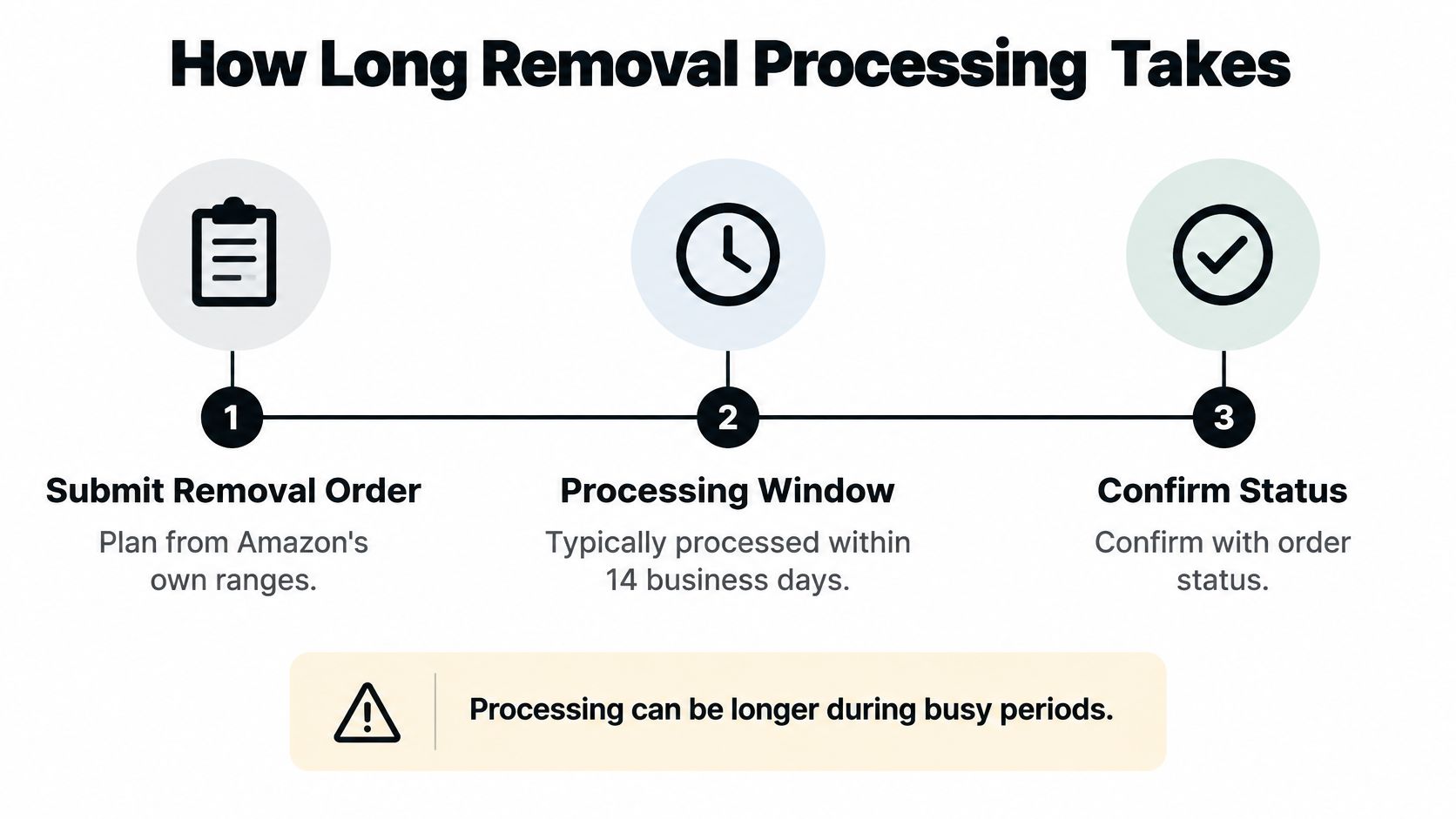
Plan from Amazon's published ranges, then confirm against order status. The ranges differ across Amazon help pages because they describe different order types and contexts, and averaging them into one number produces bad plans.
The Amazon U.S. removal order reference states removal orders are typically processed within 14 business days, can extend to 30 business days or more during the holiday season and other peak-removal periods, and may need an additional two weeks of carrier time after processing. On that reference, a normal end-to-end return lands at roughly four weeks, and a peak-period return runs materially longer.
Published FBA Removal Processing Times
| Order type and source context | Normal processing | Peak processing | After Amazon processing |
|---|---|---|---|
| U.S. removal, typically-processed reference | 14 business days | 30 business days or more | Carrier may take about two more weeks |
| U.S. standard removal order help | 10 to 14 business days | Far longer than the typical peak range | Carrier may take about two more weeks |
| U.S. disposal order | Multi-week processing | Extends during peak-removal periods | Units are disposed of, not shipped back |
| Europe return-to-seller | Weeks to dispatch | Longer during peak periods | Check Payments for the fee after the movement |
Normal Clock Versus Peak Clock
The standard-order help range of 10 to 14 business days describes picking, packing, and processing during a normal period. That page's peak warning runs far longer than the 30 business days or more used in the typically-processed reference. Treat the rows as different clocks. A seller planning a catalog cleanup before a seasonal peak should budget against the peak row, because removal demand rises exactly when many sellers submit orders at once.
Disposal and Europe rows measure different endpoints as well. European guidance counts to dispatch rather than delivery, and disposal has no carrier leg at all because the units never ship back. Mixing those definitions makes a disposal order look late when nothing was ever going to arrive, or makes a Europe order look overdue when the published clock already stopped at dispatch.
Don't resubmit because a normal order hasn't arrived on day 15. Check status first, since processing and carrier time are sequential, not simultaneous.
While an order sits in processing, the inventory is mid-transition. Storage fees stop for units on a successfully created in-process removal, yet those units are not physically available, sellable, or back in the seller's warehouse until dispatch and delivery are confirmed. That gap matters for liquidation planning, product transitions, quality investigations, and stranded inventory. Operators who promise returned stock to another channel before delivery create oversells out of inventory that may still be sitting in an Amazon building, and any shipped-versus-received shortage only surfaces once the boxes land.
The 14 Day Unfulfillable Removal Window
Required removal is not voluntary cleanup. Amazon can require a seller to remove unsuitable stock, and the notice clock starts whether the seller notices it or not.
The Amazon required removal policy for unsuitable FBA inventory defines that inventory as damaged, defective, expired, or otherwise unfit for sale, and gives a 14-day notice period before required disposal. The same policy says that if the seller creates a removal order within that period, Amazon will not dispose of the unsuitable inventory under that notice, and that a fee is charged for the removal.
The Seller Central Path
- Open Manage Inventory: Start in Seller Central's Manage Inventory area and find the affected SKU and its unfulfillable quantity.
- Choose remove unfulfillable inventory: Select the removal option for that stock rather than editing the sellable quantity.
- Select the route: Pick a return-to address or a liquidation route where that route is available for the unit and store.
- Record the notice details: Save the notice date, SKU, quantity, disposition selected, and Amazon order identifier for later reconciliation.
Missing the window has a concrete cost. Amazon can dispose of the units under the notice, which removes any chance to inspect them, photograph damage, test a defect claim, or resell them through another channel. A seller who suspects carrier or warehouse damage loses the physical evidence along with the stock.
Make It a Recurring Control
Checking unfulfillable quantity belongs on a recurring schedule, especially before holiday peaks when removal processing itself slows down. A weekly check costs little. A missed notice costs the units.
The same per-unit fee logic and the same reconciliation fields apply here as on a voluntary removal, including the later fee line in Payments. Sellers still choosing among return, disposal, and leaving sellable stock in FBA should run the recovery test in the final section rather than defaulting to whichever button appears first.
How Do I Reconcile Shipped Units, Fees, and Receipts?
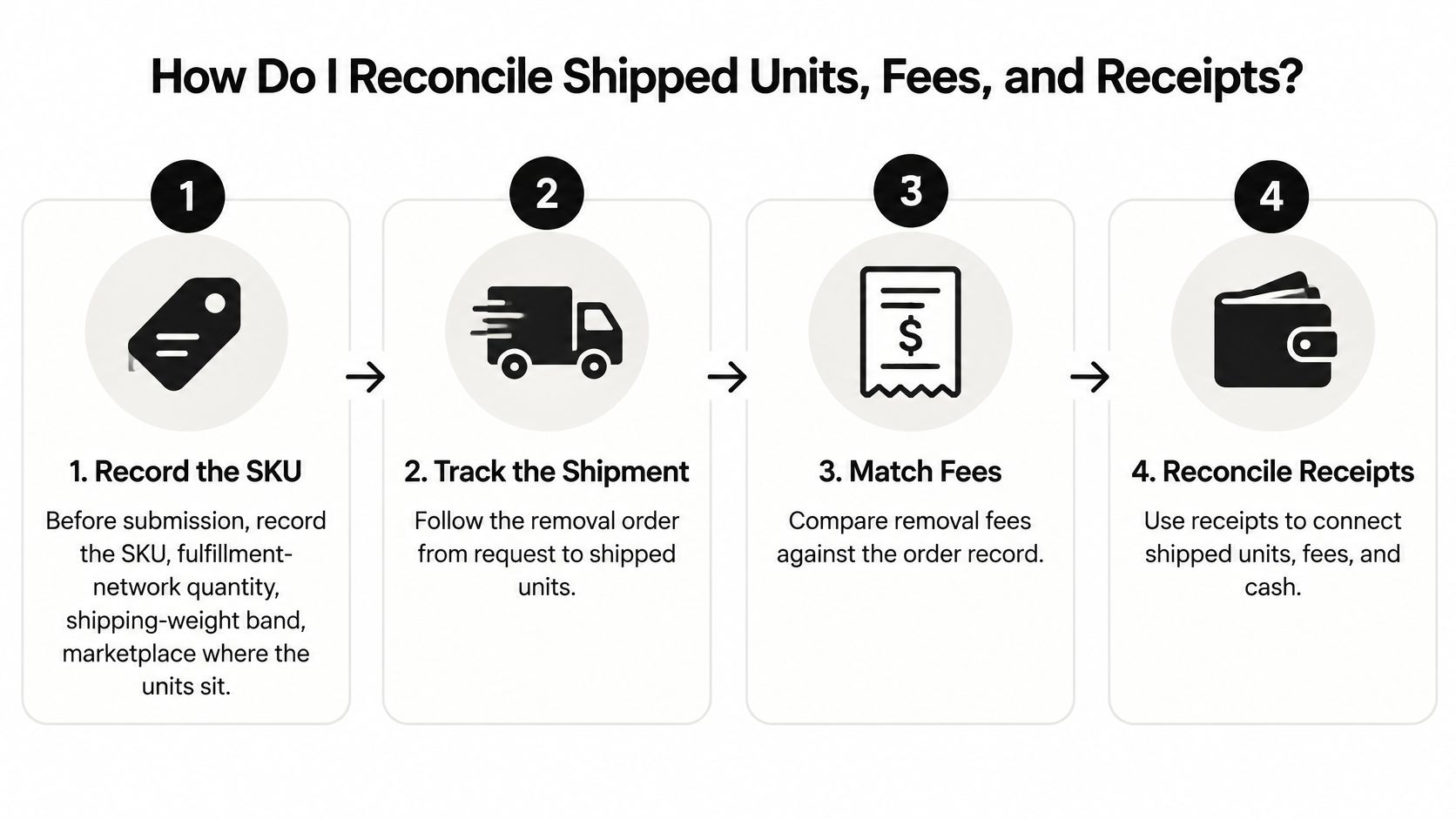
A removal isn't reconciled when Amazon says the order exists. It's reconciled when requested units, shipped units, received units, and the charged fee all agree, or when every difference has a named cause.
Capture List From Request to Cash
- Before submission: Record the SKU, fulfillment-network quantity, shipping-weight band, marketplace where the units sit, disposition, destination, and request timestamp.
- After submission: Keep the Amazon removal order identifier, order status, shipped quantity, received quantity, carrier tracking when Amazon provides it, condition at receipt, and the fee charged.
- At reconciliation: Match the removal report against the warehouse receipt, then match the fee to Payments.
The Amazon removal order help page supports that capture discipline, noting charges appear in Payments under service-fee transactions labeled FBA return fee or FBA disposal fee, and warns against resubmitting a seemingly stalled order without checking order status and transaction records because duplicate submissions can create unnecessary fees and duplicate inventory movements. Pairing that check with the Amazon inventory ledger report helps an operator trace quantity movements around the removal instead of relying on a single status screen.
Worked Cost Examples
Using Brazil's published bands, a removal of 1,000 units at 0 to 250 g produces BRL 990 in removal fees before any other cost. The same 1,000 units at 1 to 2 kg produces BRL 1,260. The expected fee should be calculated before submission, so the eventual Payments line is verified against a forecast rather than accepted on sight.
Finance teams closing the books across marketplaces face the same matching problem at payout level, which is why structured help to reconcile marketplace payouts accurately matters once removal fees, storage pauses, and refunds all land in the same settlement window.
Reading Mismatches Correctly
- Requested but not shipped: Units may still be in process, so status comes before any escalation.
- Shipped but not received: Carrier tracking separates an in-transit gap from a possible carrier loss.
- Received but damaged: Condition notes at receipt separate fulfillment-center damage from transit damage.
- Fee charged, units unprocessed: An unprocessed unit isn't automatically a reimbursable loss, and a fee line alone doesn't prove physical movement.
Agent Central returns inventory, fulfillment, and finance facts, including source-provided fields and fee-related records, on its sync schedule. It does not decide whether to remove stock. A new account starts with 30 days of history that builds from there, so an operator reconciling an older removal may still need Seller Central reports for the earliest records.
Choose Return Disposal or Leave It in FBA
There's no universal winner. Run a recovery test per SKU, marketplace, and weight band, then let the net number decide.
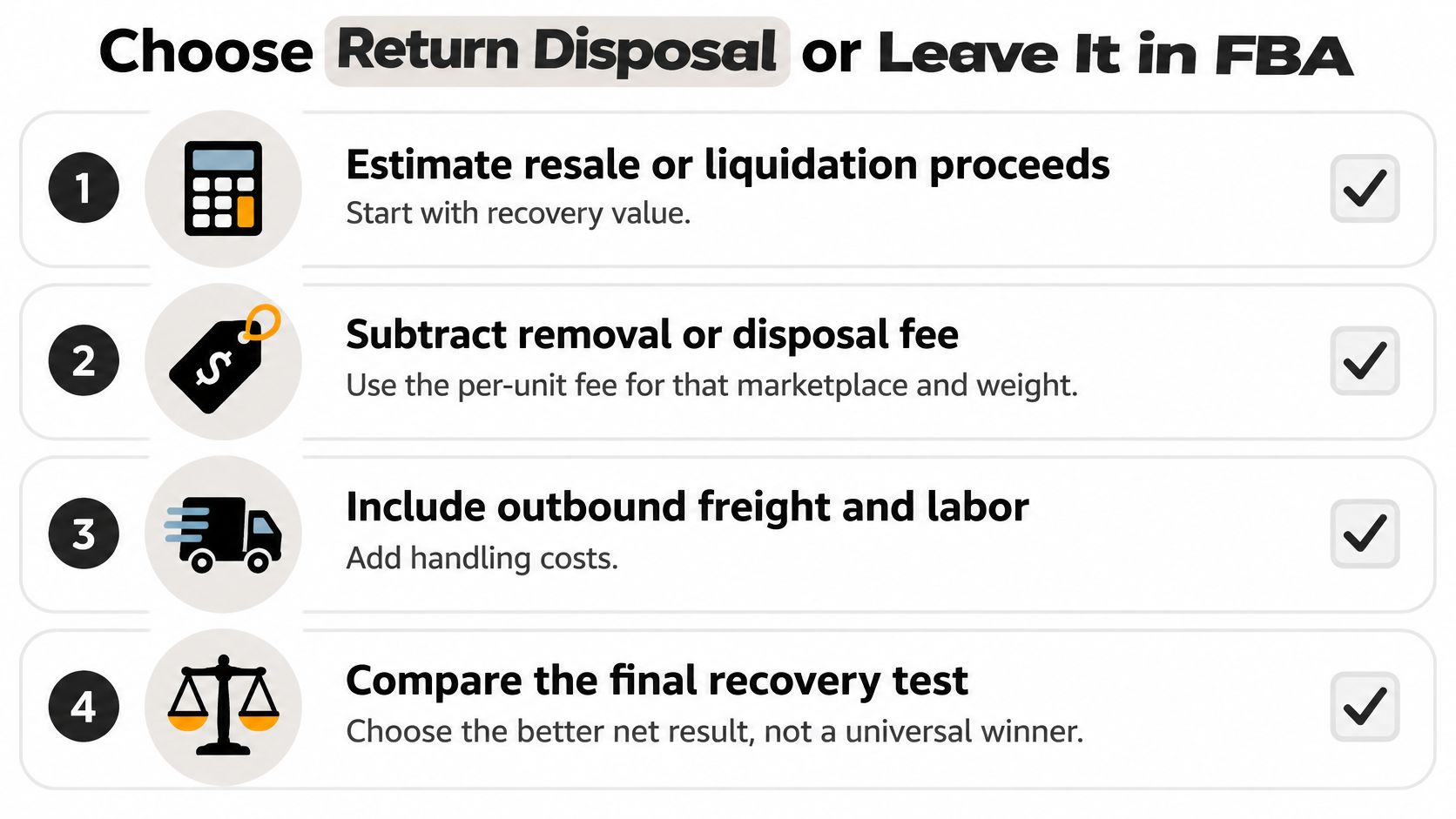
Start with expected resale or liquidation proceeds. Subtract the per-unit removal or disposal fee for that marketplace and weight, outbound freight, receiving labor, inspection, and refurbishment. Add back the storage fees avoided while a successful removal is in process, and keep the units out of available inventory until they physically arrive and clear inspection.
Leave sellable stock in FBA when expected storage and aged-inventory cost is still lower than removal plus freight plus the risk that goods return unsellable. That check connects directly to the Amazon IPI score, since aged and excess units pressure inventory performance while they sit. Return units when inspection value, a compliance question, or a viable resale channel beats disposal. Dispose, or donate where Amazon offers it, when proceeds won't clear fees and freight. Liquidate only if that option is offered on the removal screen.
Weight flips answers quickly. A light unit can survive return freight and inspection, while a heavy unit in a higher band can cost more to recover than it returns in resale. A Brazil or Europe rate card won't match a U.S. one, so the same SKU can be a return in one marketplace and a disposal in another.
Treat the order as an inventory state change rather than a menu click. From submission to carrier delivery the units sit in limbo: no longer sellable in FBA, not yet countable in your warehouse, and already carrying a fee. The disposition decides how that limbo ends, in recovered stock, a liquidation credit, or nothing but the charge.
For operators who want quantities and fee facts inside the AI client already in use, Agent Central is a hosted MCP server that connects Claude, ChatGPT, OpenClaw, Cursor, and other MCP clients to Seller Central and Amazon Ads. It returns facts, metrics, classifications, and source-provided fields, and leaves the disposition call to you. Setup means authorizing Seller Central and Amazon Ads through Amazon for the accounts you manage, then connecting your AI client with a Connector URL, a scoped API key, or Claude's OAuth connection. Plans are priced by monthly Amazon order volume, with a 14-day free trial that needs no card. Account data syncs on a schedule, and the seller still creates the removal in Seller Central and confirms the outcome against the Payments fee.
Connect Agent Central to Seller Central and Amazon Ads to pull inventory quantities, fulfillment records, and finance fields into Claude, ChatGPT, OpenClaw, or Cursor before the next removal batch is priced or submitted. The facts arrive with source fields intact, so expected fees can be checked against Payments lines and warehouse receipts instead of guessed. Start at agentcentral and bring removal order identifiers, weight bands, and disposition costs into the same workflow.
Related Agent Central pages
- Amazon seller data for AI agents
How Agent Central normalizes Amazon seller data before exposing it to AI clients.
- Amazon Seller Central MCP server
Canonical hosted MCP overview for Seller Central, Ads, inventory, catalog, finance, and fulfillment data.
- Inventory tool reference
Inventory, orders, sales velocity, listing registry, days of cover, returns, and reimbursements.
- Finance tool reference
Payment transactions, fee breakdowns, profitability, and settlement economics.
- Fulfillment tool reference
MCF shipping previews, orders, order creation, tracking, and returns.
- Amazon seller MCP servers compared
How hosted MCP services compare with official Ads MCP, local repos, connector tools, and automation platforms.
Related reading
- Amazon IPI Score: What It Is and How to Improve It
What the Amazon IPI score measures, how it relates to monthly FBA capacity limits, and how to improve it ASIN by ASIN without cutting stock that sells.
- What Is an Inventory List? A Guide for Amazon Sellers
What is inventory list. Learn what an inventory list is for Amazon FBA, how to structure fields, and how agents use it via Agent Central
- Shipping to Amazon FBA from China
A practical operator's guide to shipping to Amazon FBA from China, covering freight, customs, prep, and automation with MCP workflows.
- SKU Rationalization for Amazon Sellers: A Practical Guide
Learn SKU rationalization for Amazon FBA and private-label sellers, from KPIs and decision rules to audit-ready workflows you can automate safely.
Connect Amazon seller data to your AI client.
Agent Central gives Claude, ChatGPT, OpenClaw, Cursor, and other MCP clients structured access to Amazon Ads, Seller Central, inventory, orders, catalog, finance, and fulfillment data.