
What Is Inventory List
What is inventory list. Learn what an inventory list is for Amazon FBA, how to structure fields, and how agents use it via agentcentral

An inventory list is a structured record of every stock-keeping unit an Amazon seller holds or fulfills, including identifiers, quantities, locations, costs, and status fields that agents can query and update. Poor inventory control costs businesses about USD 1.1 trillion annually worldwide, while retail inventory distortion from out-of-stocks and overstocks has been estimated at USD 1.77 trillion globally (inventory control statistics).
An Amazon operator usually notices the problem before seeing the data problem. A listing promises units that aren't available, an inbound shipment sits unreceived, or a replenishment order goes to the wrong warehouse because one spreadsheet still carries yesterday's numbers. The visible symptom might be a stockout, stranded inventory, a missed reimbursement, or an FBA shipment built against an outdated count.
For sellers managing FBA, FBM, and MCF at the same time, an inventory list isn't a static document. It's the operational data layer that connects listings, physical stock, fulfillment status, sales velocity, purchasing, and agent workflows.
Table of Contents
- The Amazon Inventory Problem in Plain Terms
- What an Inventory List Actually Is
- Core Fields That Make an Inventory List Useful
- Inventory Lists Across FBA, FBM, and MCF
- How Agents and MCP Integrations Use Inventory Lists
- Real Amazon Inventory List Examples
- Building a Reliable Inventory Workflow for Amazon Sellers
The Amazon Inventory Problem in Plain Terms
Consider an Amazon seller with one SKU stored in FBA, another quantity moving through an inbound shipment, and a smaller reserve in a local warehouse for FBM orders. Seller Central shows one set of values, a warehouse spreadsheet shows another, and an advertising manager sees a campaign still spending against a listing that is close to running out.
Nothing has to be dramatically wrong for the operation to fail. If reserved units are treated as sellable, the listing can overpromise. If inbound units are counted as available before Amazon receives them, the reorder decision arrives late. If a warehouse assignment is missing, a team can create an FBM shipment from stock that has already been allocated to MCF.
The resulting costs are operational, not theoretical. Amazon's inventory reports are snapshots of listing data at the moment the report runs, including SKU, price, quantity, and ASIN (Amazon Inventory reports). A snapshot can be useful, but it can't compensate for a workflow that ignores timing, custody, or status.

Practical rule: A unit shouldn't be treated as available merely because it appears somewhere in an export. Its status and location must support the specific decision being made.
A reliable operating model starts with the same checks described in these inventory management best practices: reconcile the source, preserve the field meaning, and make changes traceable. That matters because a list with only SKU and quantity hides the difference between available, reserved, inbound, unfulfillable, and future-supply units.
What an Inventory List Actually Is
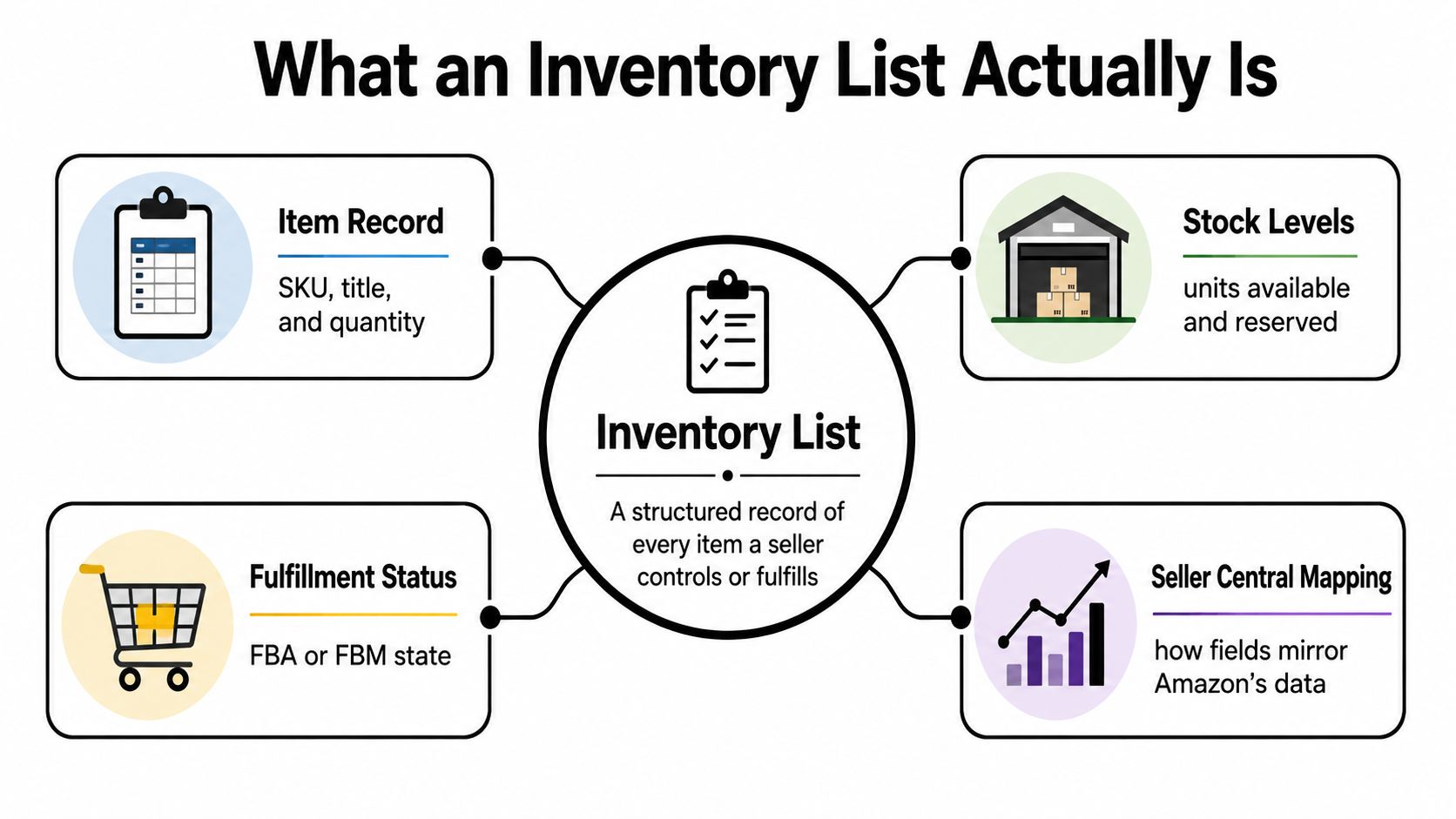
An inventory list is a structured record of every item a seller controls or fulfills. In Amazon operations, each record normally connects an SKU and ASIN to quantity fields, price, fulfillment mode, location, and status. More mature records also include unit cost, supplier, lot or serial information, movement history, and replenishment rules.
That makes the list more than a catalog. A catalog answers what exists for sale. An operational inventory list answers what exists, where it is, whether it can be sold, who holds it, what it costs, and what event should change the next action.
Inventory lists have existed long before ecommerce. Historians describe ancient temples and sanctuaries keeping lists of held items, while royal courts and noble households were creating inventories of wardrobes, household effects, and libraries by the 13th century. The commercial version kept the same basic structure, an organized record of items on hand, quantities, and value (history and structure of inventories.pdf?sequence=3&isAllowed=y)).
The Amazon data mapping
For an Amazon seller, the list usually draws from several systems:
- Seller Central reports provide listing and fulfillment snapshots.
- SP-API resources expose inventory, listings, orders, shipments, and financial fields.
- Warehouse systems track physical custody and movements outside Amazon.
- Agent tools query normalized records and may submit guarded updates.
Amazon's Inventory report is appropriate for a large open-listing account, while Amazon directs smaller accounts toward the Active Listings report. Neither report should be mistaken for a complete perpetual ledger. The operator still needs to distinguish a current listing state from historical movement and physical reconciliation.
Teams designing an agent-readable schema can also browse the inventory docs to compare how inventory fields and operations are represented. Once the record is hosted behind an MCP endpoint, a client such as Claude, ChatGPT, OpenClaw, or Cursor can request structured facts instead of parsing a manually exported spreadsheet.
Core Fields That Make an Inventory List Useful
The right fields are determined by the decisions the list must support. A SKU identifies the seller's offer, while an ASIN connects that offer to Amazon's catalog. Quantity alone isn't enough because available, reserved, inbound, future-supply, and unfulfillable units have different operational meanings.
A usable record should answer four questions quickly: what item is this, where is it, what can happen to it, and what financial or replenishment rule applies?
Identity and commercial fields
SKU should be the seller-controlled key used across listings, warehouses, purchase orders, and agent calls. ASIN links the record to Amazon's catalog, while title and variation attributes prevent teams from confusing parent and child products. Price matters for listing control and margin analysis, but it shouldn't be used as a substitute for unit cost.
Availability and custody fields
Separate quantities by state. An FBA record that combines fulfillable and reserved units can make a listing appear healthier than it is. Location or warehouse assignment is essential for FBM and MCF because the same SKU may exist in multiple facilities with different routing rules.
Replenishment and traceability fields
A reorder point, lead time, supplier, and purchase order reference turn the list into a purchasing input. Unit cost supports valuation and margin work. Lot or serial fields matter when products have expiration, warranty, recall, or compliance requirements.
| Field | Decision supported |
|---|---|
| SKU | Match listings, orders, shipments, and warehouse records |
| ASIN | Map the seller offer to Amazon's catalog |
| Price | Check current offer and revenue context |
| Quantity by status | Separate sellable, reserved, inbound, and blocked stock |
| Warehouse or location | Select a fulfillment source and reconcile custody |
| Fulfillment mode | Distinguish FBA, FBM, and MCF handling |
| Reorder point | Flag when replenishment should be reviewed |
| Lead time | Estimate exposure during procurement and transit |
| Unit cost | Evaluate value, margin, and purchasing impact |
| Lot or serial | Trace affected units and support controlled operations |
| Supplier and purchase order | Connect stock to procurement records |
| Sales velocity | Compare movement with available supply |
FBA inbound quantity should remain separate from sales velocity. A fast-moving SKU can look safe if inbound units are included too early, while a slow-moving SKU can look urgent if reserved or blocked units are ignored. Richer fields give an agent readable inputs, but the seller's workflow still defines which fields are authoritative. A practical Seller Central inventory workflow should preserve those distinctions rather than flattening them into one number.
Inventory Lists Across FBA, FBM, and MCF
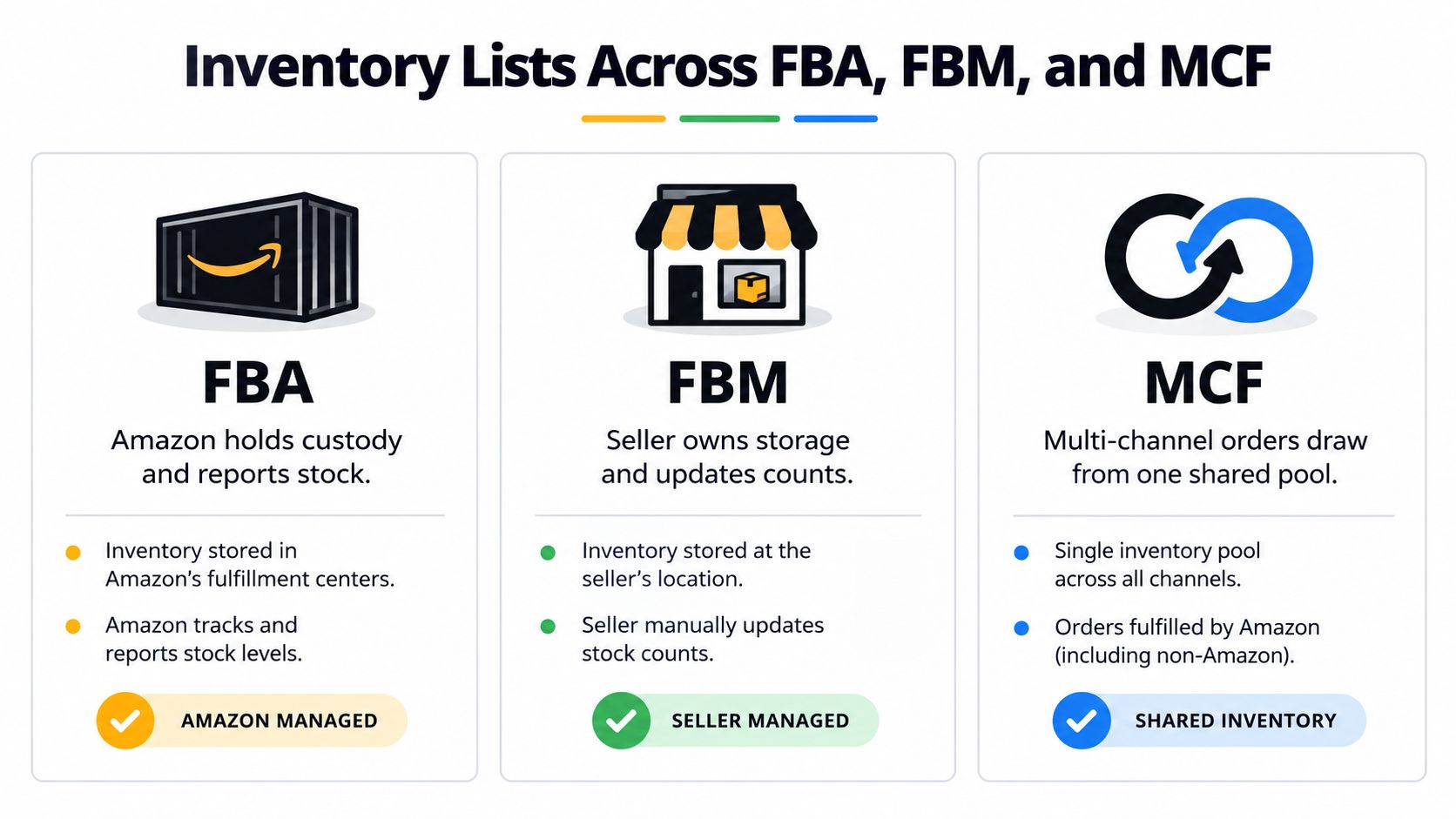
The inventory list has one conceptual role across fulfillment modes, but custody and update responsibility change.
FBA
Amazon holds the sellable inventory and reports fulfillment states through Seller Central and SP-API-connected workflows. The list should retain the distinction between fulfillable, reserved, inbound, future-supply, and unfulfillable units. Amazon's Inventory Ledger can show starting balance, received, sold, returned, removed, damaged, lost, found, and adjusted movements, plus ending balance, with up to 18 months of historical inventory data (Amazon Inventory Ledger).
The main mismatch appears when a seller treats a report snapshot as a real-time ledger. A shipment can be physically moving while Amazon's available quantity remains unchanged, or an adjustment can alter the balance after a local planning file was prepared.
FBM
The seller controls storage, allocation, pick, pack, and shipment confirmation. The inventory list therefore depends on warehouse scans, order reservations, returns, and manual corrections. A listing quantity update can be accurate at the moment of submission but wrong after an unrecorded order or damaged-unit adjustment.
MCF
MCF draws from Amazon-held stock for orders outside the standard Amazon storefront. The list must connect channel demand to the shared pool and preserve routing or facility information where available. A common failure is counting MCF demand separately from FBA availability, which makes the same unit appear available twice.
A reconciliation process compares the mode-specific source with the central record, then flags unexplained differences. It doesn't force FBA, FBM, and MCF into identical fields. It preserves the distinctions that explain why their balances differ.
How Agents and MCP Integrations Use Inventory Lists
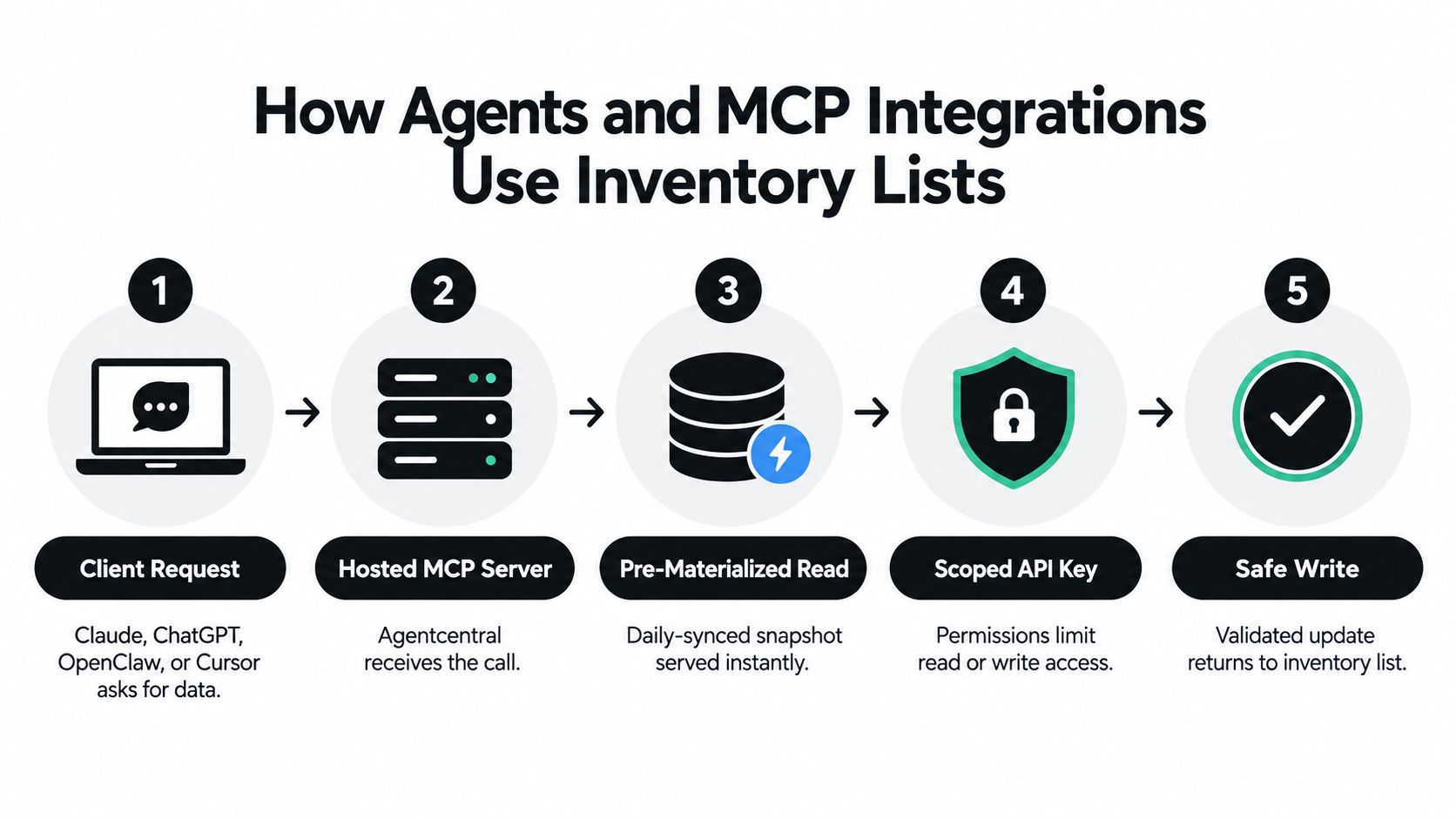
An MCP-enabled workflow turns the inventory list into a structured interface for an AI client. Claude, ChatGPT, OpenClaw, or Cursor can ask for a SKU's current fulfillment breakdown, retrieve inbound shipments, compare inventory with sales velocity, or request a listing quantity update. The client receives data fields, not a vague narrative extracted from a spreadsheet.
A hosted MCP server such as agentcentral can sit between the client and Amazon seller systems. It provides structured access to inventory and related Amazon Ads, orders, catalog, finance, ranking, and fulfillment data. The important boundary is clear: the data layer returns facts and guarded write tools; the seller's agent or workflow decides what those facts mean and whether a business action is appropriate.
Reads should be fast and repeatable
Amazon reports can be asynchronous, delayed, or constrained by account and operation limits. Amazon's SP-API uses a token bucket algorithm, with rate and burst limits assigned through usage plans. When available, the x-amzn-RateLimit-Limit response header identifies the applicable limit for the caller's account-application pair (SP-API usage plans and rate limits).
Pre-materialized reads address a different problem from throttling. A platform can synchronize inventory data on a schedule, retain history from connection onward, and serve repeated queries from prepared records. That gives an agent a stable response for questions such as:
- Which SKUs have inbound units but no available units?
- Which FBA listings have reserved inventory?
- Which MCF orders drew from a shared stock pool?
- Which listing quantity differs from the warehouse record?
Writes need boundaries
A safe write workflow should expose the intended change before submission, restrict permissions with scoped API keys, accept an idempotency key, and record before and after values in an audit log. OAuth authorization, isolated datasets, encrypted credentials, and revocable access limit the blast radius when an agency or developer connects multiple seller accounts.
The workflow doesn't need to pretend that an agent is an autonomous inventory manager. A seller can ask for a change, inspect the proposed SKU and quantity, approve it, and retain the audit record. The same pattern applies to updating seller-fulfilled quantities through the Listings Items API or creating a fulfillment-related operation.
Teams evaluating an MCP setup can use this MCP server integration guide to check client connection, authentication, tool scope, and write controls before exposing operational data.
Real Amazon Inventory List Examples
A useful inventory list is readable as a snapshot, but its fields should preserve the events behind the snapshot. The following examples show the minimum operational shape.
Active FBA listing
| Field | Value |
|---|---|
| SKU | BLUE-MUG-12 |
| ASIN | B0EXAMPLE12 |
| Fulfillment | FBA |
| Fulfillable | 84 |
| Reserved | 11 |
| Inbound | 48 |
| Unfulfillable | 3 |
| Price | 24.99 |
| Reorder point | 60 |
The listing has inventory that can fulfill orders, but the reserved units shouldn't be counted as immediately available. Inbound units support a replenishment plan only after transit and receiving assumptions are accounted for.
Inbound shipment record
textSKU: BLUE-MUG-12
Shipment: FBA-INBOUND-REFERENCE
Units expected: 48
Units received: 32
Units remaining: 16
Status: Receiving
The useful signal isn't just that an inbound shipment exists. The record must show expected, received, and remaining quantities so the seller can investigate a discrepancy instead of treating the entire shipment as available.
Replenishment review
textSKU: BLACK-LID-4
Available: 19
Reserved: 7
Inbound: 0
Sales velocity: elevated
Reorder point: 25
Decision state: review replenishment
This record doesn't tell the agent to place an order. It exposes the classification and supporting fields so the seller's workflow can decide whether to purchase, transfer stock, adjust advertising, or investigate a count mismatch.
Amazon inventory reports themselves are point-in-time outputs. A repeatable operational list should therefore store the retrieval time, source, status interpretation, and any subsequent write. Without those fields, two apparently different snapshots may be impossible to compare.
Building a Reliable Inventory Workflow for Amazon Sellers
A reliable inventory list is a living system with explicit ownership. The operating rhythm can stay compact:
- Sync cadence: Refresh marketplace, warehouse, inbound, and order data on a defined schedule, then label each snapshot with its source time.
- Field hygiene: Keep SKU, ASIN, fulfillment mode, location, status, cost, and quantity states separate. Don't overwrite history when a value changes.
- Write safety: Require scoped access, previews, idempotency keys, and before-and-after audit records for updates.
- Reconciliation: Compare physical counts, Seller Central states, inbound movements, and MCF allocation. Investigate differences instead of averaging them without explanation.
- Review ownership: Assign a person or team to resolve blocked, reserved, unfulfillable, and unexplained inventory states.
For teams starting with a smaller operation, an SMB stock control guide can help establish basic ownership and record discipline before adding agent access. The goal isn't a larger spreadsheet. It's a dependable record that an operator, application, or MCP client can query without guessing what each quantity means.
agentcentral provides a hosted MCP data layer for Amazon sellers, connecting clients such as Claude, ChatGPT, OpenClaw, and Cursor to structured Seller Central, Ads, inventory, orders, catalog, finance, ranking, and fulfillment data. Connect an account through OAuth, use scoped access and guarded writes, and let the seller's workflow decide how to act on the returned facts. Visit agentcentral to connect an Amazon account and put the inventory list behind an auditable agent workflow.
Related Agent Central pages
- Amazon Seller Central MCP server
Canonical hosted MCP overview for Seller Central, Ads, inventory, catalog, finance, and fulfillment data.
- Amazon seller data for AI agents
How Agent Central normalizes Amazon seller data before exposing it to AI clients.
- Connect Seller Central to Claude
Step-by-step path from Amazon OAuth to a Claude connector or MCP config.
- Inventory tool reference
Inventory, orders, sales velocity, listing registry, days of cover, returns, and reimbursements.
- Amazon seller MCP servers compared
How hosted MCP services compare with official Ads MCP, local repos, connector tools, and automation platforms.
- ChatGPT with Amazon seller data
ChatGPT-specific setup path for Amazon seller data through hosted MCP.
Related reading
- How to Calculate Inventory Turnover for Amazon
Calculate inventory turnover by aligning seller-owned COGS with inventory value, then use Amazon-side records without confusing unit snapshots with cost data.
- Online Arbitrage Software for Amazon Sellers
Evaluate online arbitrage software by matching quality, fee assumptions, price history, eligibility checks, and fit with structured Amazon seller data.
- Inventory Management for Amazon: Operator Guide
Amazon inventory management guide for FBA stock, inbound shipments, days of cover, velocity, fulfillment constraints, and agent workflows.
- FBA Amazon for Beginners: Operator Guide
FBA Amazon beginner guide: setup steps, fees, prep, inventory, replenishment, exceptions, and the data workflows sellers need.
Connect Amazon seller data to your AI client.
Agent Central gives Claude, ChatGPT, OpenClaw, Cursor, and other MCP clients structured access to Amazon Ads, Seller Central, inventory, orders, catalog, finance, and fulfillment data.