
10 Ecommerce Reporting Software Tools Compared for 2026
Compare ecommerce reporting software by data integrations, reporting depth, automation, and use case, including Amazon Seller Central and Amazon Ads coverage.

An Amazon Ads campaign looks profitable, but the advertised ASIN is nearly out of sellable stock. Ecommerce reporting software fits this problem only when it connects advertising to seller operations. Agent Central suits MCP-enabled workflows, Sellerboard suits profit review, and broader BI or attribution platforms suit cross-channel questions rather than every Seller Central task.
The practical comparison starts with data integrations, reporting capabilities, automation, and use case. For Amazon sellers, integration means more than an Amazon logo: the platform needs the relevant advertising, order, inventory, finance, or fulfillment fields. Reporting needs reproducible definitions, while automation needs a clear distinction between scheduled reports, agent reads, and account changes.
Freshness is a separate requirement. A recently refreshed dashboard can still contain older source records. Amazon's reporting documentation describes different generation limits across FBA reports and notes that not every Seller Central report is available through the Reports API, according to AWS's SP-API data guidance. Sellers should distinguish transaction time, snapshot time, report-generation time, and settlement time before treating a figure as operationally current.
- For Amazon operations, prioritize source fields, report coverage, reconciliation, and controlled access.
- For marketing measurement, prioritize attribution definitions, supported advertising sources, and exportable results.
- For company-wide reporting, compare these specialist tools with top BI software options, especially when analysts maintain custom metrics.
A missing capability shouldn't be confused with a confirmed absence. Where a tool's MCP access, refresh cadence, Amazon report coverage, or write controls aren't established, those remain procurement checks rather than assumed features.
Table of Contents
- 1. Agent Central
- 2. Sellerboard
- 3. Helium 10 Profits
- 4. Amazon Seller Central Reports
- 5. Triple Whale
- 6. Polar Analytics
- 7. Glew
- 8. Daasity
- 9. Lifetimely
- 10. Northbeam
- How the ten ecommerce reporting software options compare on Amazon coverage, pricing signals, and AI access
- Choosing Ecommerce Reporting Software for Your Amazon Workflow
1. Agent Central
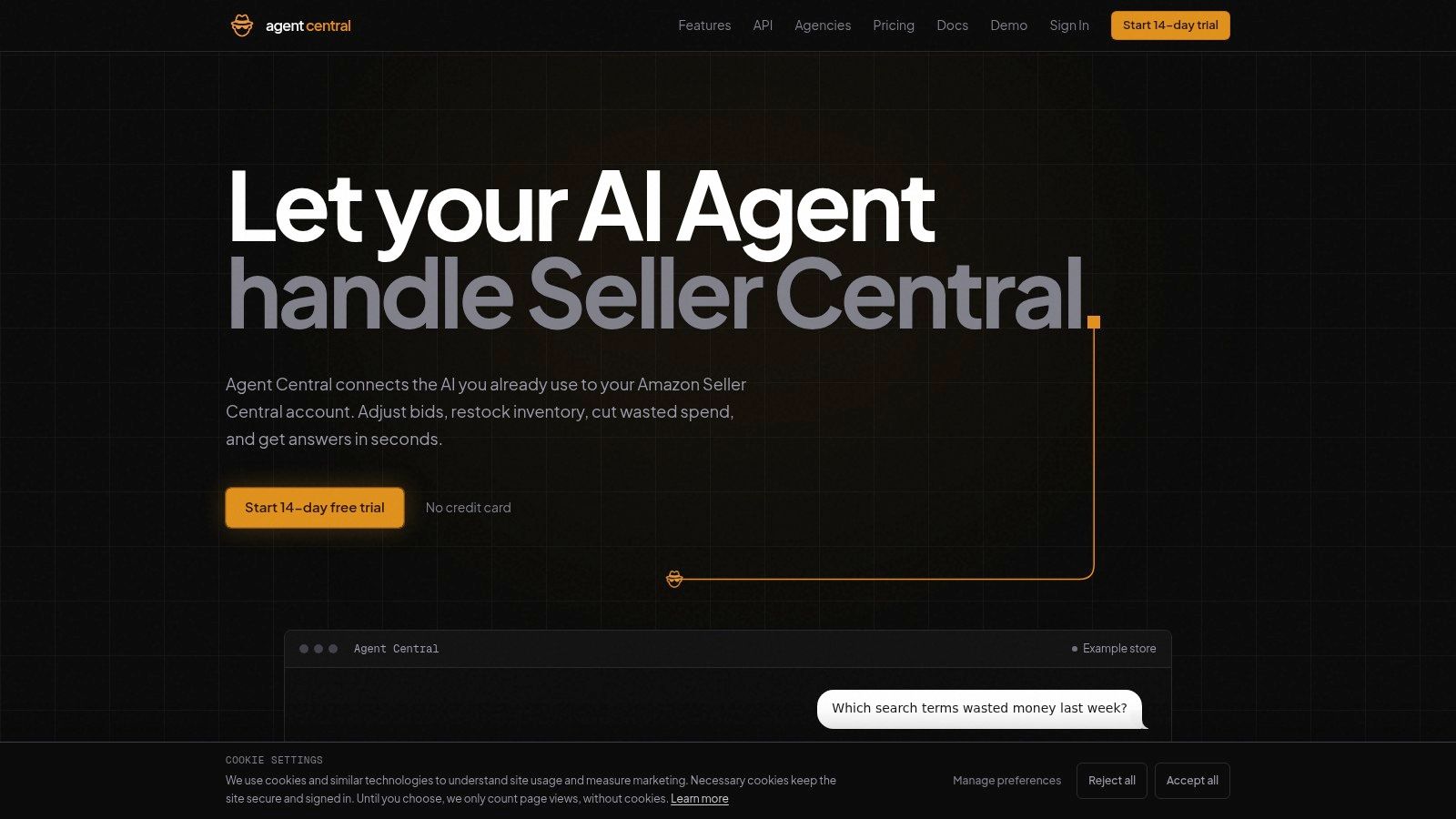
Agent Central is a hosted MCP server for Amazon seller workflows, connecting the AI clients a team already runs to Seller Central and Amazon Ads. It supports Claude, ChatGPT, OpenClaw, Cursor, and other MCP-compatible clients, and joins advertising, sales, inventory, orders, catalog, ranking, finance, and fulfillment records across 23 Amazon marketplaces in one connection.
The reporting advantage is that join. An agent can pull campaign performance next to inventory positions and payment transactions instead of reading advertising results in isolation, which is the separation most Seller Central exports force. The service returns facts, metrics, and Amazon's own fields rather than recommendations; the agent or operator decides what to do with them.
Scheduled reads and controlled changes
Synced data answers fast. Account data syncs on a schedule, a new account starts with 30 days of history that builds from the connection date, and Amazon Ads history is kept while the account stays connected. Business Reports themselves typically run 48 to 72 hours behind, so scheduled records are only as current as Amazon's slowest source. Live Seller Central reads are the exception: they call Amazon in real time, consume the customer's API quota, and can return an upstream_unavailable error when Amazon throttles or fails.
- Developer access: A read-only REST API serves the synced records as JSON over HTTP for server-side dashboards and reporting backends, while MCP tools are the path agents use for queries and guarded writes.
- Write safeguards: Supported changes, including bids, budgets, campaign states, prices, inventory quantities, listings, and MCF orders, are previewed by default, protected against duplicate submissions, and logged with before-and-after values.
- Trade-off: Scheduled records are not a promise of current stock or freshly finalized ad spend, and live reads inherit Amazon's quota and throttling limits.
Amazon report generation is asynchronous, and applications must wait for completion before retrieving documents, as Amazon's report error guidance explains. Agent Central works around that wait by syncing seller data ahead of time and serving prepared records to the agent.
Setup means connecting Seller Central and Amazon Ads through Amazon's authorization, then adding the connection to the AI client via a scoped API key, a Connector URL, or Claude's OAuth connection. Plans are priced by monthly Amazon order volume, with a 14-day free trial that needs no card.
2. Sellerboard
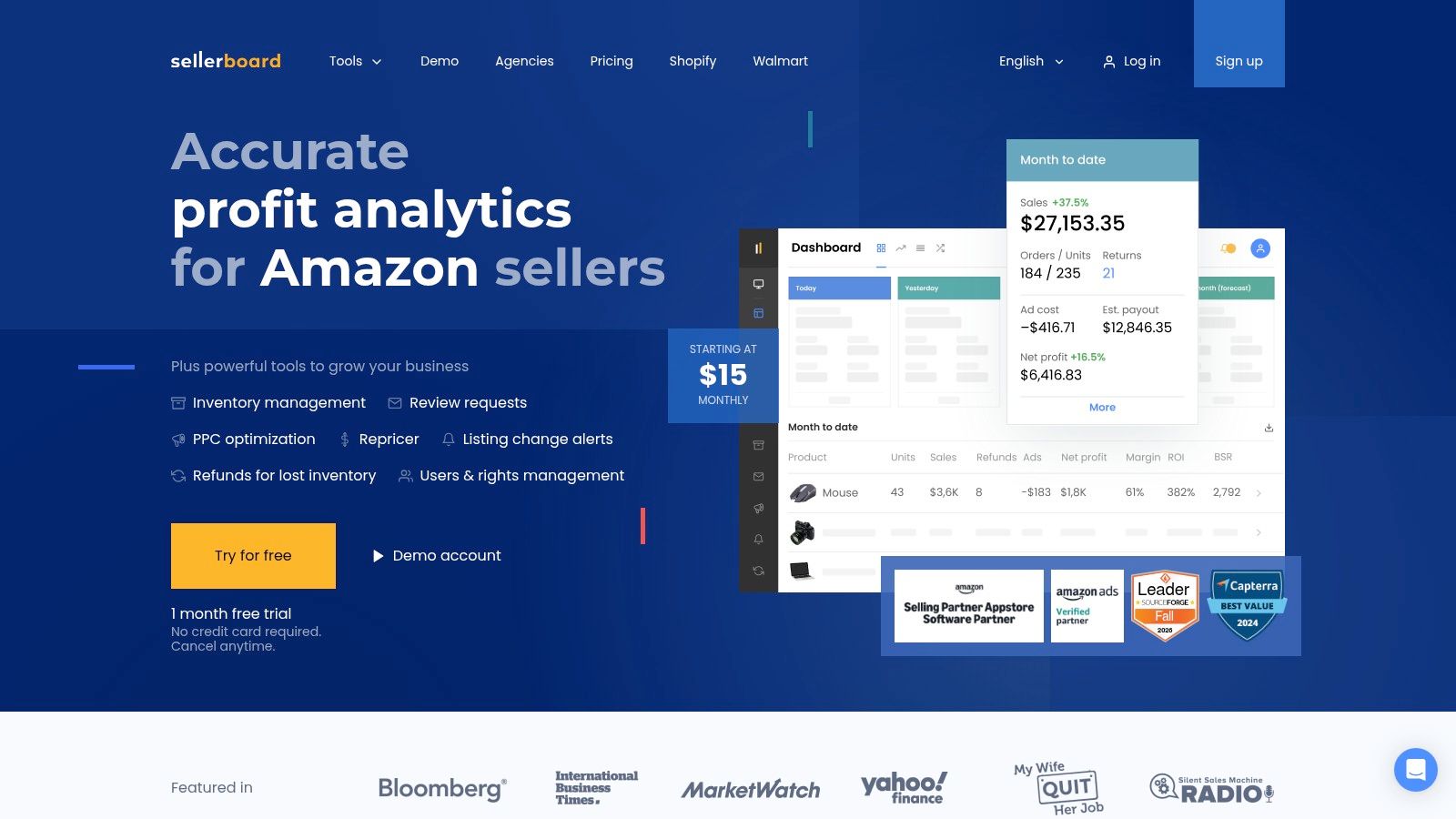
Profit review is Sellerboard's strongest fit. Sellerboard combines Amazon sales, advertising expenses, fees, refunds, estimated payouts, and seller-entered costs such as cost of goods. Product, order, and account views suit sellers who need to explain margin rather than just track revenue.
Say an ASIN's sales rise while its reported profit falls. The useful investigation separates advertising expense, refunds, fulfillment charges, shipping, and product costs, then compares equivalent periods and marketplaces. Product-level filtering makes that investigation more practical than an account-wide sales chart.
Where the profit calculation needs scrutiny
Profit accuracy depends on correct inputs and the Amazon records available to the platform. A missing landed-cost adjustment or an outdated product cost can make a polished margin figure misleading. Estimated payouts also shouldn't be treated as identical to finalized settlement activity.
- Reporting strengths: Amazon-specific cost breakdowns, marketplace filters, date comparisons, and automated reporting.
- Operational extras: PPC, repricing, inventory, and refund capabilities are available in parts of the offering, with features varying by plan.
- Evaluation boundary: Confirm the exact refresh cadence, downloadable fields, API or MCP availability, and controls governing any account-changing features.
Practical rule: A profit dashboard should make missing costs visible, not quietly treat them as zero.
Sellerboard is primarily an Amazon reporting choice rather than a general omnichannel BI platform. Public pricing and a free trial make an account-level evaluation possible, but the trial should include refunds and cost corrections, not only uncomplicated sales.
The Sellerboard workflow comparison is useful for distinguishing a dedicated profit interface from structured seller-data access through an existing AI client.
3. Helium 10 Profits
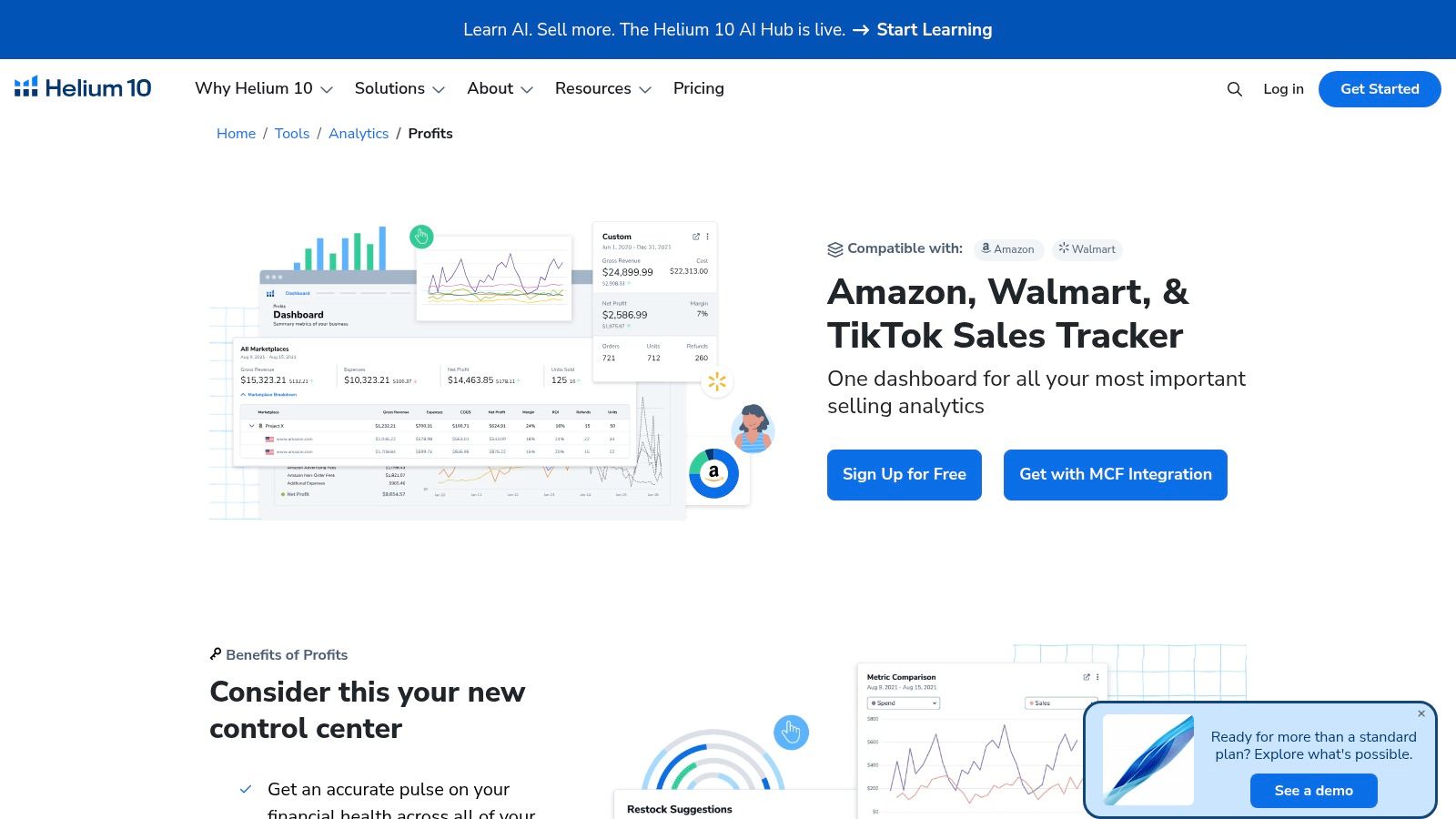
An existing Helium 10 subscription changes the buying decision. [Helium 10 Profits](https://www.helium10.com/tools/analytics/profits/) places sales and performance reporting inside a broader Amazon seller platform, alongside research, listing, advertising, and operational tools.
That combination can suit a private-label team already using the wider suite. Operators can review sales trends and profit performance without purchasing another standalone interface purely for reporting. Published tier pricing provides an initial comparison point, although access to individual capabilities differs by tier.
The relevant distinction is suite convenience versus reporting depth. A seller who needs research and listing tools may value the bundle; an agency building a reporting backend may care more about accessible source fields, account separation, and repeatable programmatic reads.
Test the reporting feature, not the subscription bundle
- Reporting scope: Examine profit calculations, period comparisons, product detail, and the handling of refunds and advertising costs.
- Related capabilities: Inventory tools, heat maps, advertising features, and AI capabilities belong to the wider suite, not necessarily every subscription.
- Access requirements: Establish whether the selected plan exposes the needed records through exports, an API, or MCP before designing an agent workflow around it.
For an Amazon Ads manager, a visual sales trend isn't enough to establish campaign economics. The evaluation should connect the advertised ASIN to its cost assumptions, available stock, and applicable reporting period.
Published plan prices don't establish a refresh guarantee or confirm guarded writes. Any account-changing feature should be evaluated separately for permissions, approval behavior, and auditability. Helium 10 Profits fits teams seeking reporting within an existing seller toolkit, but it may be more subscription than a reporting-only buyer needs.
4. Amazon Seller Central Reports
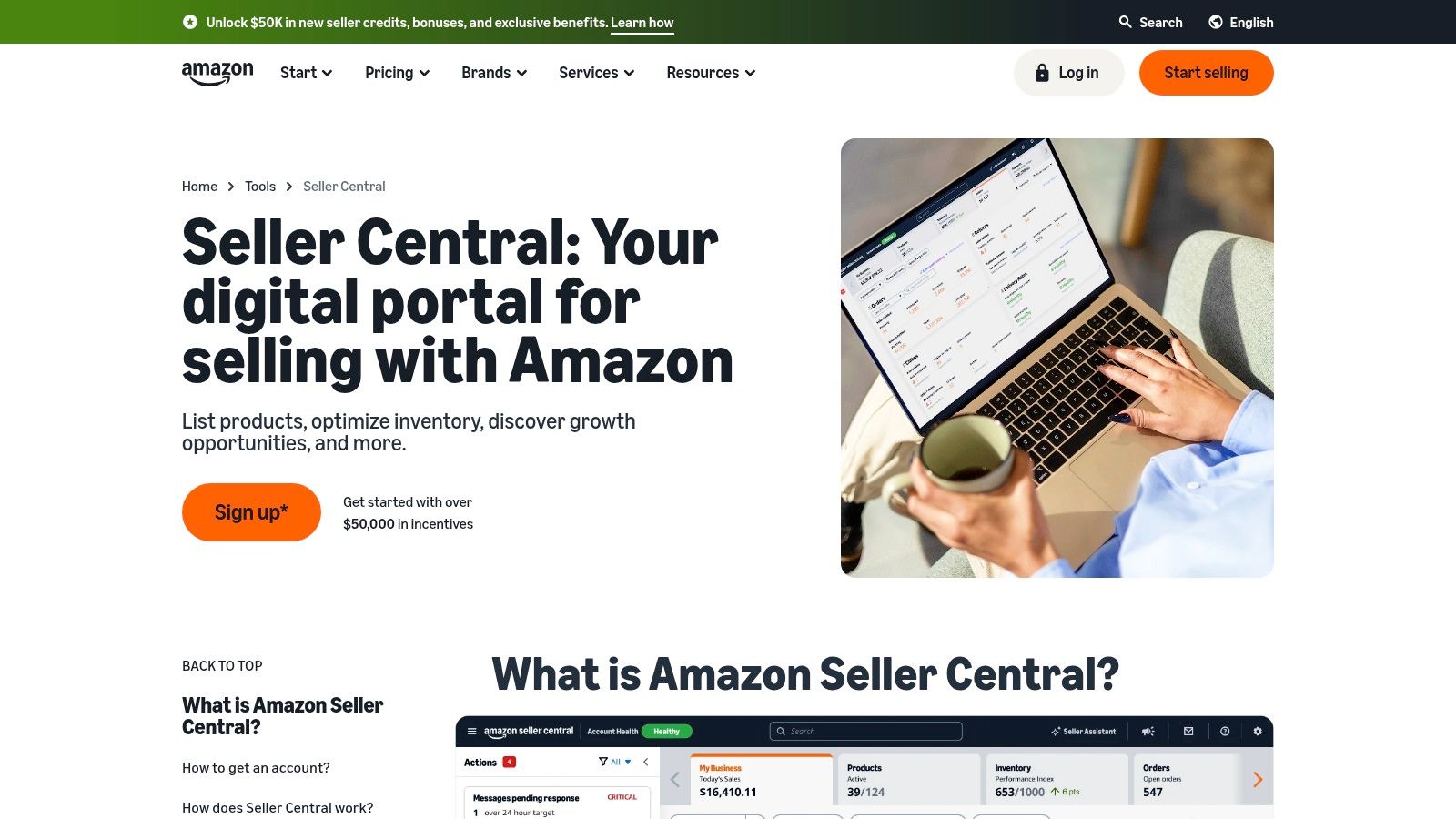
[Amazon Seller Central](https://sell.amazon.com/tools/seller-central) reports are the first-party reconciliation baseline. Business Reports cover sales and traffic, payment records support financial checks, and fulfillment reports describe operational activity. Eligible brands can also access Brand Analytics.
No separate analytics-software subscription is needed to use the reporting surfaces available to an account. Access still depends on seller eligibility, plan, and the requirements of particular reports. The trade-off is fragmentation: operators often need exports and spreadsheets to combine information distributed across Seller Central.
What first-party reporting does and doesn't solve
Seller Central is useful when a third-party dashboard disagrees with Amazon. The comparison must still match marketplace, reporting timezone, transaction status, and date basis. An order-based sales figure and a settlement-based payment figure describe different events, so disagreement doesn't automatically indicate an error.
- Best use: Validate platform-reported sales, traffic, payments, inventory, and fulfillment records.
- Main limitation: Advertising and seller-operation reports still require deliberate joins; Shopify and other channels aren't unified here.
- Developer caveat: A report visible in Seller Central isn't automatically available through the same programmatic route.
Sensitive-field access adds another boundary. Amazon's Restricted Data Token documentation explains that some restricted operations require approved roles and a Restricted Data Token, with restricted resources specified explicitly.
Seller authorization doesn't grant unrestricted access to every buyer, shipping, tax, or fulfillment field.
For agent workflows, native reports provide evidence rather than a complete execution framework. Developers still need request tracking, authorization handling, status checks, retrieval, reconciliation, and their own controls around any writes. First-party provenance is valuable, but it doesn't eliminate reporting mechanics or source delays.
5. Triple Whale

Triple Whale is better aligned with store and marketing measurement than Amazon operations alone. Its shared reporting environment combines ecommerce performance with advertising integrations, geographic views, and industry or peer benchmarks.
The platform also offers an MCP connection for working with its data through AI tools such as Claude and ChatGPT. That matters for teams moving beyond dashboard-only access, but MCP support shouldn't be mistaken for complete Seller Central coverage. The relevant question is which underlying records the connection exposes.
For a brand selling through a storefront and Amazon, Triple Whale can be evaluated for channel comparisons and marketing analysis. A separate test is needed for Amazon-specific requirements such as settlement transactions, FBA availability, reimbursements, inbound shipments, and order status.
Separate attribution from seller facts
- Strong fit: Marketing teams comparing advertising performance, geography, and store outcomes.
- Important caveat: Attribution results can differ from advertising-platform totals because the measurement definitions differ.
- Commercial check: Pricing depends on revenue tier and package; the Foundation and Automate plan costs provide a starting point for package evaluation, not a substitute for a current quote.
A useful trial compares attributed revenue with platform-reported revenue while keeping the model and attribution window visible. Neither figure should replace the other in financial reporting.
Refresh cadence, accessible Amazon fields, and write permissions remain separate checks. The MCP connection establishes an AI-access option, not proof that Amazon bid changes, inventory updates, or listing edits are previewed and audited. For an Amazon-only operator, the broader marketing environment may add complexity without answering the required operational questions.
6. Polar Analytics
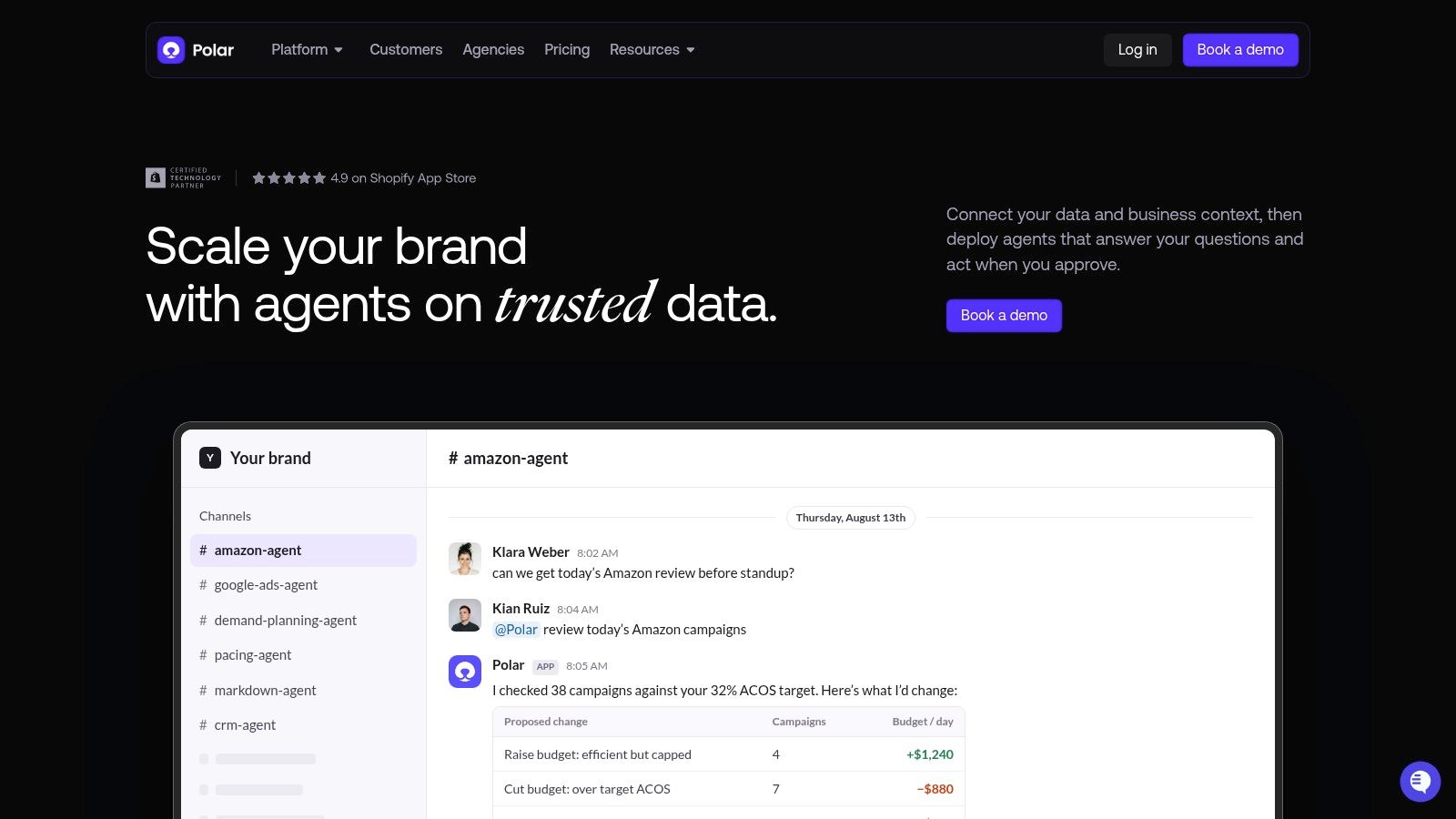
Custom metric definitions are a reason to evaluate [Polar Analytics](https://www.polaranalytics.com). Its offering combines dashboards, custom reporting, attribution, goal tracking, alerts, and scheduled reports, with a dedicated Snowflake database and an ecommerce semantic layer.
That architecture suits teams that need consistent definitions across business reports and analyst-built models. A finance analyst and a marketing manager shouldn't unknowingly use different treatments of discounts, refunds, or advertising costs while both reporting net profit.
Polar also offers AI-agent/MCP and data-activation products. Those capabilities should be evaluated as selected products rather than assumed parts of every reporting package. The platform lists unlimited users and historical data among its benefits, but connector-specific history and accessible fields still matter.
An Amazon acceptance test
An Amazon evaluation should start with a field map: marketplace, ASIN, seller SKU, order date, advertising date, transaction type, fee category, and inventory status. Analysts then need to establish which identifiers support joins and how the platform handles records that arrive later.
- Reporting advantage: Custom analysis can go beyond packaged charts and standard attribution views.
- Implementation trade-off: A small seller needing basic profit reporting may not need the broader platform.
- Unresolved checks: Confirm the selected package's Amazon connectors, refresh cadence, MCP scope, and authorization controls.
The ecommerce analytics guide provides useful context for separating metric design from presentation.
Scheduled alerts aren't equivalent to guarded Amazon writes. Any activation workflow needs its own review of destination permissions, approval requirements, and logs. Polar is a candidate for teams buying a broader analytics environment, not an automatic substitute for seller-specific operational access.
7. Glew
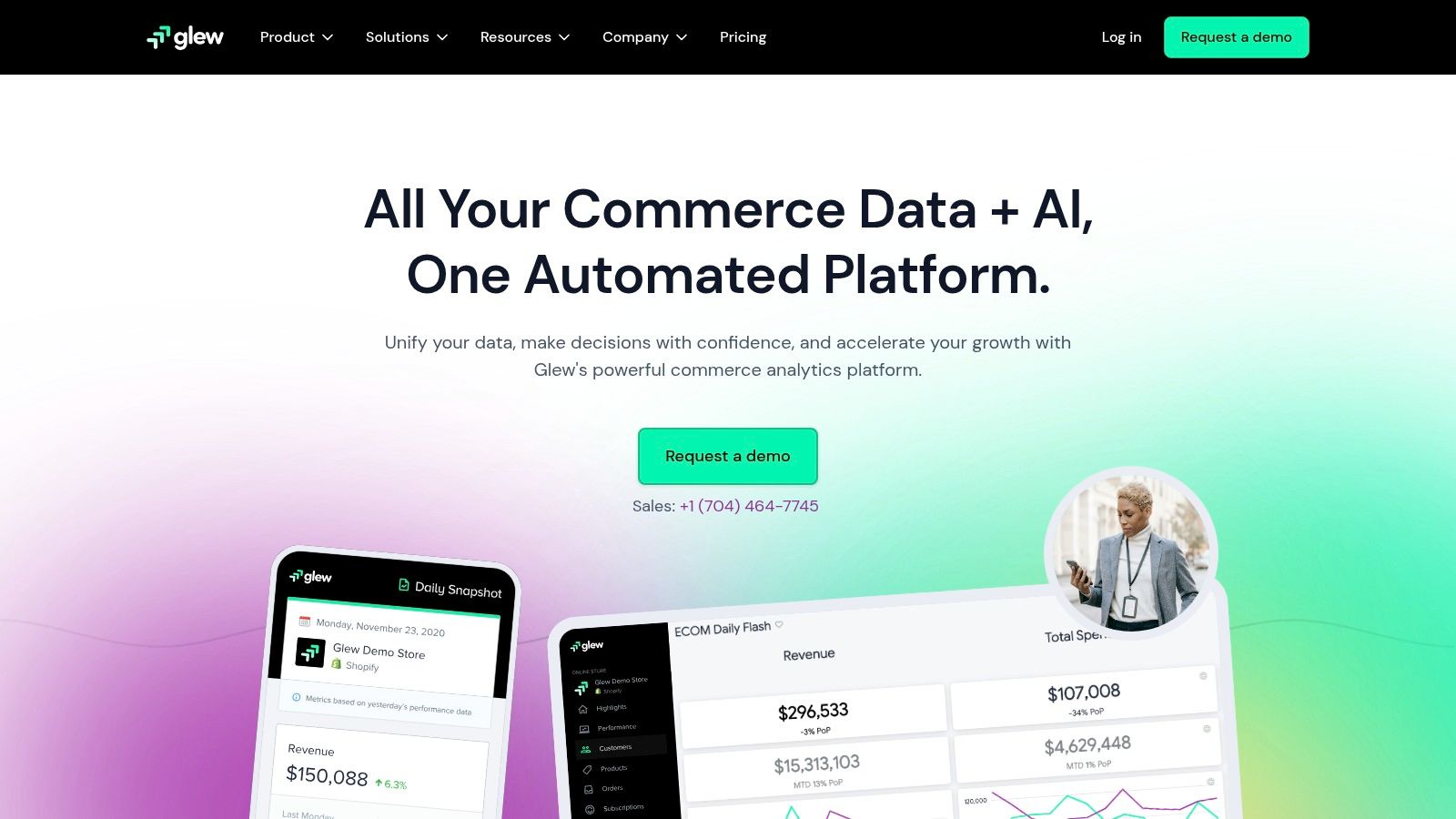
A retailer investigating repeat purchases, product performance, and inventory together has different requirements from an Amazon Ads manager adjusting campaigns. [Glew](https://www.glew.io) addresses the broader retail reporting problem with customer, marketing, product, inventory, subscription, and performance views.
Prebuilt dashboards and scheduled reporting can help teams distribute recurring metrics. Customer segments can also sync with tools such as Klaviyo and Mailchimp, connecting analysis to lifecycle marketing rather than only to advertising acquisition.
The higher-tier Commerce Data Cloud adds managed pipelines, a warehouse, and custom reporting options. Looker-based reporting is also part of the broader offering. These capabilities make package selection important: a buyer shouldn't assume that advanced custom reporting comes with the dashboard package under consideration.
Where Amazon teams should probe
- Field coverage: Establish whether the Amazon connection includes the exact order, fee, advertising, and inventory records needed.
- Delivery behavior: Distinguish scheduled email reports from source synchronization and late-record corrections.
- Programmatic access: Verify API or MCP availability rather than assuming that custom reporting implies agent access.
- Execution controls: Customer-segment synchronization doesn't establish guarded Amazon campaign or catalog writes.
Glew's main advantage is the combination of customer and product analytics with recurring reporting. Its trade-off is that Amazon-specific operational coverage needs an explicit demonstration, especially for finance and fulfillment.
A useful test follows a product from sale through refund and compares the result with its inventory and marketing records. That exposes missing joins more effectively than a dashboard tour. Buyers should also obtain the applicable package price and distinguish packaged reporting from higher-tier customization before committing.
8. Daasity
[Daasity](https://www.daasity.com) fits consumer brands operating across ecommerce, Amazon, retail, and wholesale. Its scope includes marketing, merchandising, inventory, finance, and operations, with prebuilt reports and customizable analysis.
The practical advantage is cross-channel context. A brand can evaluate marketplace performance alongside other distribution channels rather than treating Amazon revenue as a disconnected total. Merchandising capabilities, including demand forecasting and inventory optimization, also extend the evaluation beyond paid-media attribution.
Daasity can serve as a broader reporting platform or work alongside an existing Snowflake and analytics environment. That flexibility is relevant to teams with analysts and established reporting conventions, but it also introduces implementation and model-design decisions.
Broader coverage requires explicit joins
Amazon-specific records need a clear relationship to the rest of the business. Analysts should establish how ASINs and seller SKUs map to internal products, how returns affect channel comparisons, and how marketplace fees enter contribution reporting.
- Best fit: Omnichannel consumer brands that need marketing and operational analysis together.
- Main trade-off: A single-channel seller may be buying more platform and implementation work than necessary.
- Procurement checks: Review connector coverage, historical availability, refresh behavior, and the custom pricing proposal.
Forecasting and optimization capabilities must remain distinguishable from source facts. A projected demand figure isn't an Amazon-reported inventory quantity, and the report should preserve that distinction.
An Amazon integration also doesn't establish MCP access or guarded account changes. Those requirements need separate confirmation, including accessible fields, read permissions, and audit records. Daasity is most compelling when the reporting question spans channels and departments, rather than when a seller needs a faster way to retrieve an Amazon report.
9. Lifetimely
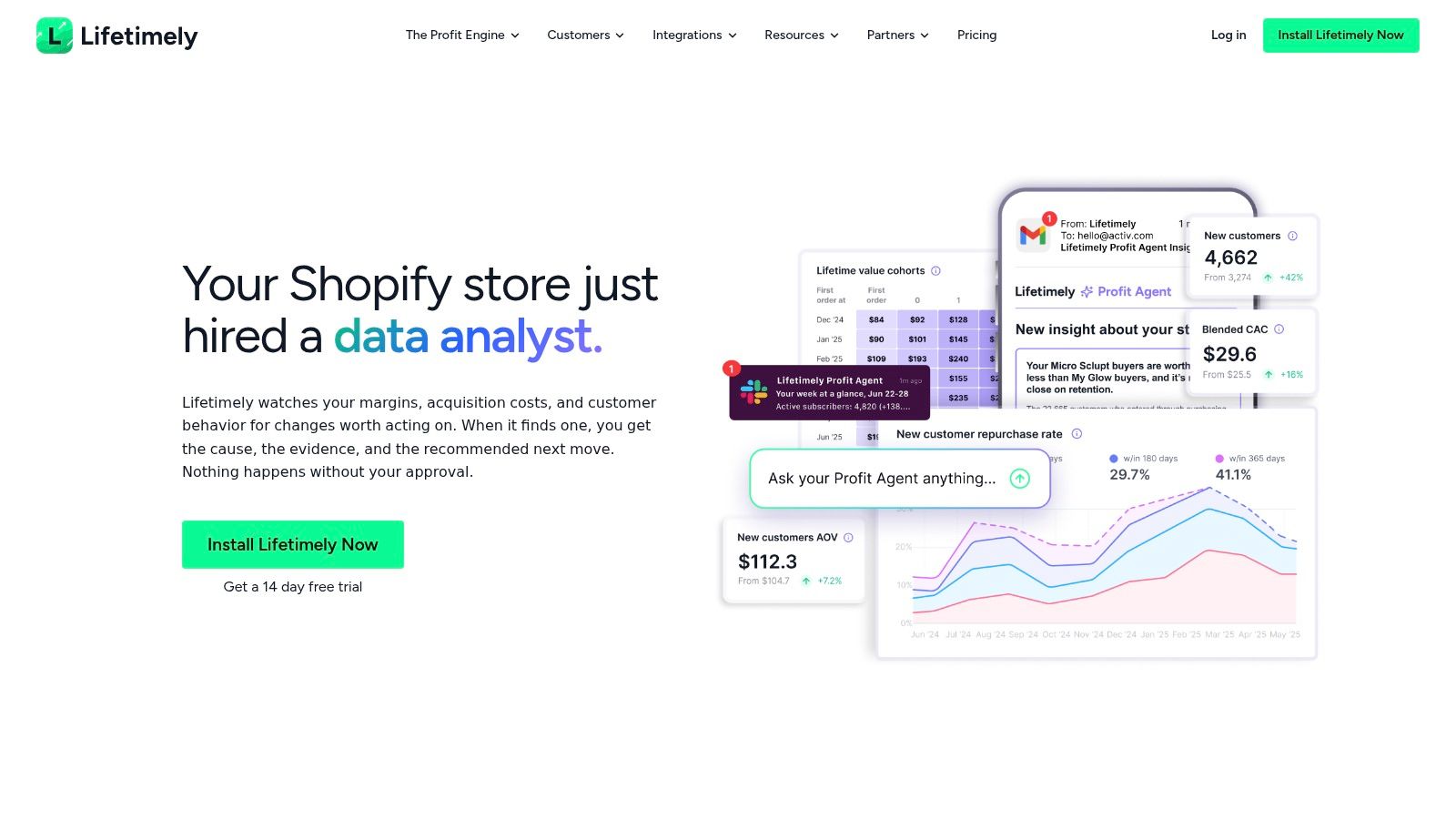
Customer economics are the reason to consider [Lifetimely](https://lifetimely.io). Its Shopify-centered reporting combines profit-and-loss analysis with customer acquisition cost, lifetime value, cohorts, marketing, and product performance.
That focus suits brands asking whether acquired customers return and whether acquisition costs are justified by later purchases. Custom reporting and sales forecasting extend the analysis beyond an isolated advertising-platform ROAS figure.
The Amazon boundary matters. Shopify customer-cohort reporting shouldn't be assumed to offer equivalent buyer-level visibility for Amazon orders. Seller Central operations also require different records from those used to calculate storefront retention and lifetime value.
Keep customer analysis separate from operational coverage
- Useful capabilities: Profit reporting, CAC and LTV analysis, customer cohorts, and customizable marketing or net-profit reports.
- Evaluation access: A free plan and free trial are listed, while current paid-plan access and integration requirements need review.
- Amazon limitation: Confirm Seller Central and Amazon Ads scope before relying on the product for marketplace reporting.
A customer-retention report can't substitute for an FBA inventory report, even when both include product revenue.
For an Amazon FBA team, the acceptance test should request sellable stock, applicable fees, refunded orders, and advertising expense for matching products and periods. Missing domains may be acceptable if another system handles them, but they shouldn't remain implicit.
The same caution applies to automation. Custom reports don't establish MCP support, Amazon API access, or approval-controlled writes. Lifetimely fits Shopify-oriented profitability and retention questions; it should be shortlisted for Amazon operations only after the required source coverage and access methods have been demonstrated.
10. Northbeam
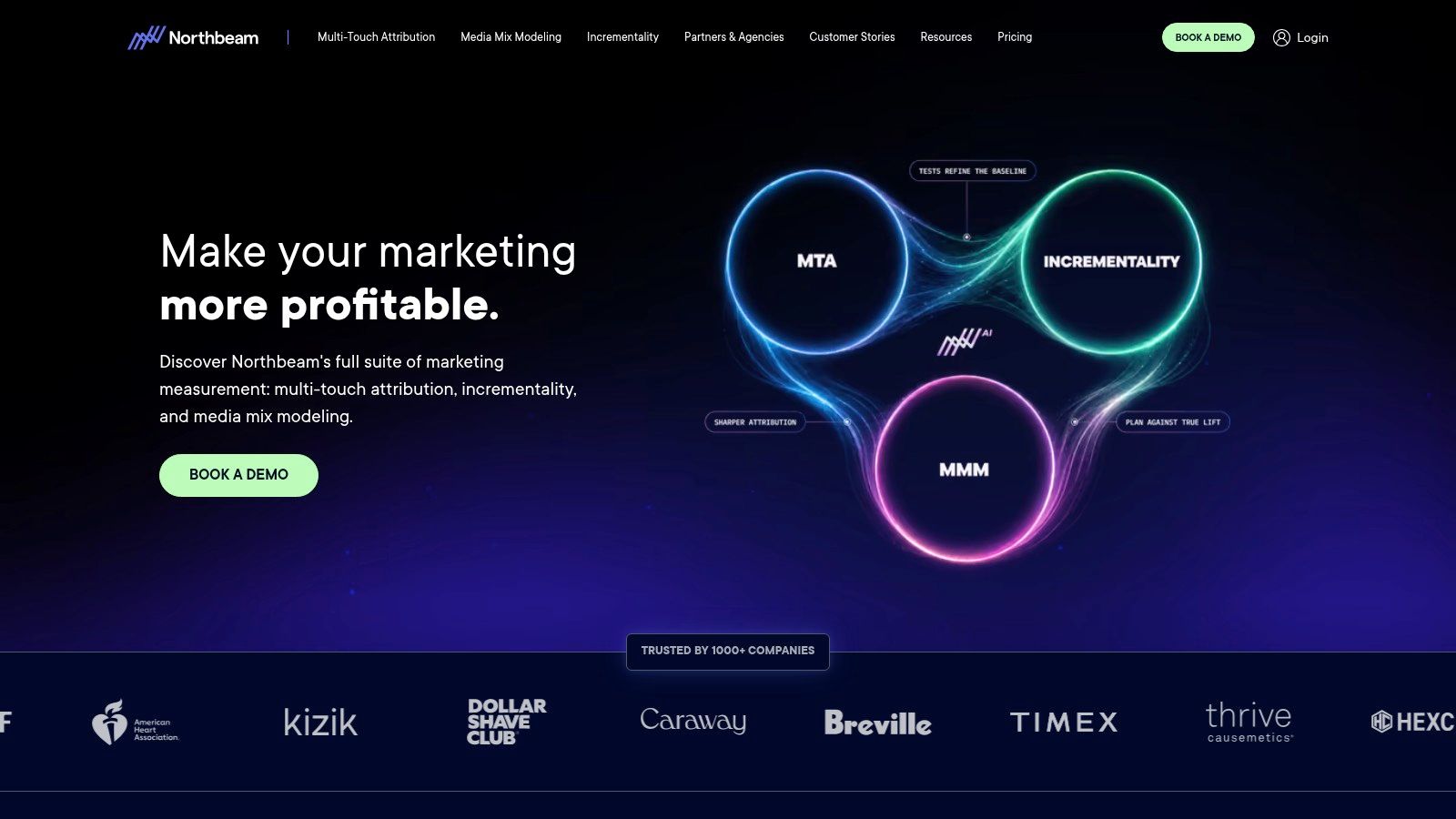
[Northbeam](https://www.northbeam.io) is a marketing measurement platform, not a general Amazon operations system. Its focus includes multi-touch attribution and, for supported sources, Clicks + Deterministic Views, which combines verified impression data with first-party performance data.
Advertising teams can customize timeframes, attribution models, and reporting granularity. Metrics Explorer supports analysis of relationships such as advertising spend and revenue, while custom views and exports support further investigation.
Those capabilities address a different question from settlement reconciliation or fulfillment monitoring. Northbeam may help a marketer examine upper-funnel activity, but it shouldn't be selected on the assumption that attribution coverage includes FBA inbound shipments, seller-managed inventory, or Amazon fee transactions.
Measurement isn't proof of incremental profit
The attribution modeling explainer helps distinguish revenue-credit rules from business outcomes. A model assigns credit under defined assumptions; it doesn't automatically establish whether an advertising exposure caused a sale.
That distinction matters under margin pressure: 32% of respondents were concerned about rising advertising expenses in Jungle Scout's 2025 survey of nearly 1,500 Amazon sellers.
- Best fit: Ecommerce advertising teams evaluating channel contribution and impression-aware measurement.
- Trade-offs: Results can differ from store or ad-platform totals, and quote-led purchasing requires a demo.
- Amazon checks: Confirm supported advertising sources, export fields, refresh timing, and any API or MCP access.
The attribution software shortlists for small businesses offer adjacent comparisons. Northbeam's value lies in specialized measurement, not presumed seller-data completeness or account-changing controls.
How the ten ecommerce reporting software options compare on Amazon coverage, pricing signals, and AI access
| Item | Best for | Amazon data coverage | Pricing signal | AI or MCP access |
|---|---|---|---|---|
| Agent Central (recommended) | AI-assisted Amazon seller reporting and controlled actions | Seller Central and Ads data across 23 marketplaces, joined across Amazon's separate reports: sales, inventory, orders, finance, ranking, and fulfillment | $39–$159/month by order volume; custom Enterprise pricing; 14-day free trial | MCP-compatible clients and a read-only REST API over synced data |
| Sellerboard | Amazon profit and margin analysis | Sales, ads, fees, refunds, payouts, and costs | Public pricing and free trial; features vary by plan | None listed |
| Helium 10 Profits | Profit reporting within a broader Amazon seller toolkit | Amazon sales and performance reporting | Published tier pricing; features vary by tier | AI capabilities on higher tiers; no MCP access listed |
| Amazon Seller Central reports | First-party Amazon performance checks and report downloads | Sales, traffic, brand, payment, and fulfillment reports | No separate analytics subscription required | None listed |
| Triple Whale | Ecommerce and advertising measurement across channels | Ecommerce and advertising data; Amazon coverage not described on the vendor's overview page | Pricing by revenue tier; quote required | MCP connection for AI tools such as Claude and ChatGPT |
| Polar Analytics | Ecommerce BI, custom reporting, and data-platform needs | Ecommerce data; Amazon coverage not described on the vendor's overview page | No straightforward public starting price | Optional AI-agent and MCP products |
| Glew | Retailer reporting across customers, products, marketing, and inventory | Ecommerce reporting; Amazon coverage not described on the vendor's overview page | Custom-quoted by plan | None listed |
| Daasity | Omnichannel consumer-brand reporting and operations | Includes Amazon alongside ecommerce, retail, and wholesale reporting | Custom pricing; demo-based | None listed |
| Lifetimely | Shopify profitability and customer analytics | Amazon coverage not described on the vendor's overview page | Free plan and trial listed; paid pricing not published | None listed |
| Northbeam | Ecommerce marketing attribution and measurement | Marketing measurement data; Amazon coverage not described on the vendor's overview page | Quote-led; book a demo | None listed |
The last column narrows the field fastest. Three rows give an AI client any access at all, and only Agent Central pairs reads with guarded writes: changes previewed by default, protected against duplicate submissions, and logged. Coverage alone also says nothing about freshness; first-party Business Reports typically run 48 to 72 hours behind records a synced platform already holds.
Choosing Ecommerce Reporting Software for Your Amazon Workflow
A profit question and an attribution question do not need the same record set. Sellerboard and Helium 10 Profits fit profit-reporting work; Triple Whale and Northbeam fit marketing measurement. Polar Analytics, Glew, and Daasity matter when reporting crosses channels, departments, or custom models, while Lifetimely centers on Shopify customer economics.
For MCP-enabled Amazon workflows, source coverage and execution controls deserve separate tests. A platform can expose useful reporting without supporting writes, or support changes without providing the finance and inventory context needed to judge them safely. Neither capability proves the other.
Which records make the answer defensible?
Start with the required Amazon data domains and report types. An advertising-efficiency question may need spend, attributed sales, total sales, refunds, fees, product costs, and sellable inventory. A fulfillment question may instead need order status, shipment records, inbound status, and inventory snapshots.
Freshness should be visible at the field or source level where possible. Operators need to distinguish collected records from live reads, identify missing periods, and understand whether delayed conversions or financial corrections will change the result. Treat Business Reports as typically 48 to 72 hours behind when a decision depends on same-day sales. A successful API response does not establish that the underlying record is current.
Authorization also deserves a separate review, because selling-partner consent, approved application roles, valid access tokens, and added requirements for restricted data each control a different part of access.
For agencies, authorization scale can affect deployment design: Amazon's application authorization limits cap unlisted applications at 25 OAuth authorizations, while listed applications have unlimited OAuth authorizations. Client credentials, seller consent, and application distribution status therefore need distinct treatment.
Execution boundary: An agent should never interpret permission to read a report as permission to change an account.
A shortlist checklist
- Coverage: Identify the exact Ads and Seller Central fields required, including finance and fulfillment records.
- Timing: Document scheduled synchronization, source delays, live-read limits, and failure behavior.
- Reconciliation: Match marketplaces, timezones, identifiers, transaction status, and metric definitions.
- Agent access: Test MCP or API reads with the intended client and account permissions.
- Write safety: Require previews, confirmation, scoped access, duplicate protection, and auditable changes.
- Commercial fit: Model pricing against actual order volume, connected accounts, required features, and implementation work.
Before committing, run a trial on a real Seller Central and Amazon Ads question: identify an advertised ASIN with declining contribution profit, retrieve its spend and sales, check refunds and fees, and compare sellable inventory. The preferred tool is the one that returns traceable records, exposes uncertainty, and preserves the operator's control over any resulting change.
Agent Central connects existing AI clients to joined Amazon Seller Central and Amazon Ads records through hosted MCP, with scoped access and guarded, auditable writes. It returns facts, metrics, and Amazon's own fields rather than recommendations. Sellers, agencies, and developers can visit agentcentral to test a reporting workflow that combines advertising, inventory, finance, and fulfillment facts before authorizing account changes.
Related Agent Central pages
- Amazon Seller Central MCP server
Canonical hosted MCP overview for Seller Central, Ads, inventory, catalog, finance, and fulfillment data.
- Amazon seller data for AI agents
How Agent Central normalizes Amazon seller data before exposing it to AI clients.
- Connect Seller Central to Claude
Step-by-step path from Amazon OAuth to a Claude connector or MCP config.
- ChatGPT with Amazon seller data
ChatGPT-specific setup path for Amazon seller data through hosted MCP.
- Amazon Ads MCP server
Campaign, keyword, search term, budget, TACOS, and guarded ads-write tools.
- Ads tool reference
Parameter-level docs for Amazon Ads campaign, keyword, search term, budget, and TACOS tools.
Related reading
- What Is Ecommerce Analytics? Metrics, Sources and Examples
Learn what ecommerce analytics measures, which data sources feed it, and how Amazon sellers use metrics like contribution profit and TACOS to decide.
- 10 AI Agents for Business Tools for Amazon Sellers in 2026
Compare 10 AI agents for business tools for Amazon sellers, covering Seller Central and Ads data, MCP access, write guardrails, audit logs, and limits.
- FBA Fee Calculator: How to Estimate Amazon Fees Accurately
Learn how to use an FBA fee calculator to estimate referral, fulfillment and storage fees, which inputs matter, and how to read the results.
- Ecommerce Automation Tools: 10 Options Compared for 2026
Compare 10 ecommerce automation tools by use case: inventory, orders, marketing, shipping, and AI workflows, with Amazon seller fit and pricing links.
Connect Amazon seller data to your AI client.
Agent Central gives Claude, ChatGPT, OpenClaw, Cursor, and other MCP clients structured access to Amazon Ads, Seller Central, inventory, orders, catalog, finance, and fulfillment data.