
10 AI Agents for Business Tools for Amazon Sellers in 2026
Compare 10 AI agents for business tools for Amazon sellers, covering Seller Central and Ads data, MCP access, write guardrails, audit logs, and limits.

An ads manager opens a chat and asks why spend climbed while units fell. The answer is only as complete as the Amazon domains the agent can query. Campaign reports can explain bids, budgets, clicks, and cost. They cannot connect the drop to stockouts, suppressed listings, order mix, fulfillment delays, or finance charges unless the agent can also reach inventory, orders, catalog, fulfillment, and finance data.
McKinsey's 2025 State of AI survey of 1,993 respondents found that 62% of organizations were at least experimenting with AI agents, while 23% were scaling an agentic system in at least one function, and no single function had more than 10% reporting scaled use. That pattern matches Amazon operations. Interest is broad, while production use stays bounded by approval gates, write limits, and logs.
The ten AI agents for business platforms below split into two practical groups. Amazon-focused connectors expose seller data quickly. General-purpose platforms need custom connectors, authorization, a defined read set, and change logging before they can support the same workflow.
Rank each option by which Amazon domains it reaches: Ads, inventory, orders, catalog, finance, and fulfillment. Then check how writes are gated, whether results and changes are logged, and whether the pricing basis fits order volume. Teams that also buy phone leads can evaluate a pay-per-call data API for AI agents separately, but that category does not count as Amazon coverage.
Table of Contents
- 1. agentcentral
- 2. Amazon Seller Assistant and Selling Partner plugin
- 3. Amazon Ads MCP Server
- 4. Seller Labs Amazon MCP
- 5. DataDoe
- 6. SellerForge
- 7. UiPath Agentic Automation Platform
- 8. Salesforce Agentforce
- 9. Microsoft Copilot Studio
- 10. IBM watsonx Orchestrate
- How the Ten Options Differ on Amazon Data, Write Controls, and Pricing Basis
- Matching AI Agents for Business to Your Amazon Operation
1. agentcentral
Data is not live. Agent Central syncs Seller Central and Amazon Ads on a schedule, and Amazon's own reporting lag still sits underneath that schedule. A new account starts with 30 days of history that builds from there. Amazon Ads history stays only while the account remains connected. Treat any “right now” question as a scheduled snapshot, then use the speed of repeated reads.
That schedule exists because Amazon reports are asynchronous and documents do not stay available forever. Amazon's report retention change, effective May 30, 2024, set type-specific windows, and 30 days is the retention period for certain types, including Easy Ship reports. An undownloaded document must be generated again after the window. Querying prepared records avoids waiting on a fresh report for every chat turn.
Which Amazon domains the connection actually reaches
Agent Central is a hosted MCP server. It gives Claude, ChatGPT, OpenClaw, Cursor, and other MCP clients structured access to advertising, inventory, orders, catalog, ranking, finance, and fulfillment across 23 marketplaces, joined in one connection. It returns facts, metrics, classifications, and source-provided fields. It does not decide bids, prices, or next actions. The user's agent or workflow decides.
Supported writes cover bids, budgets, campaign states, prices, listings, seller-managed inventory quantities, MCF orders, and FBA inbound shipments. Writes are previewed before confirmation, blocked from duplicate submissions, and logged with before-and-after values. Scoped keys, read-only keys, and hard bid and budget limits are extra gates. The same prepared data is available through a REST API and a CLI for scripts and dashboards.
Setup is short. Sign up at Agent Central, connect Seller Central and Amazon Ads through Amazon's authorization, then add the connection to the AI client. The Claude quickstart walks through that last step. Seller Chris G. described the result as “downloading ten years of Amazon experience.” That is a seller's reaction, not a performance guarantee.
Practical rule: If the question spans ads and units, require both domains in one connection. Two separate chats will not reconcile spend with orders.
Coverage is the trade-off that matters. You get Seller Central plus Ads, with guarded writes. You do not get a real-time feed, and early history is 30 days, not a full archive.
2. Amazon Seller Assistant and Selling Partner plugin
Amazon's own Seller Assistant answers questions about the seller's business and can help with Seller Central tasks. A Selling Partner plugin also connects account data to Amazon Quick and, in beta, Claude. Sellers can set guardrails, review proposed actions, and open an audit trail. For a workflow that should stay inside Amazon's interface, that native path is the first thing to test.

Restricted customer, shipping, and tax fields are a different authorization problem. Amazon's Tokens API guide requires the restricted role first, then a Restricted Data Token. That token replaces the normal access token only for the restricted call. It cannot be reused for ordinary SP-API requests. Any agent that touches PII needs that boundary, whether the client is Amazon's or a third party's.
What it reaches: Seller Central business context and seller-defined routines, not a full Ads-plus-finance MCP for outside clients.
What it gates: Proposed actions can be reviewed, and Amazon describes an audit trail.
What it doesn't replace: A connector you drop into Cursor, a custom CLI, or a multi-account agency stack. Claude access is in beta, and availability varies. Amazon also warns that AI answers can be wrong, so verify anything that moves money or inventory. A closer look at scope sits in this Seller Assistant comparison. Details are on the Seller Assistant page.
3. Amazon Ads MCP Server
If the question is only advertising, start with Amazon's own Ads MCP server rather than a seller suite. It connects compatible clients, including Claude, ChatGPT, and Gemini, to Amazon Ads API reporting and account actions. Amazon offers it in open beta for eligible partners who already hold active API credentials.
Prebuilt flows cover creating, updating, or deleting campaigns and expanding a campaign into new locales. That cuts the number of hand-built API steps an integration needs. The trade-off is coverage. The server reaches advertising data only, so an agent on it cannot see inventory, orders, catalog, finance, or fulfillment. A sales drop that started in stock levels or the buy box stays invisible to an ads-only agent.
For a single-brand account focused on campaign management, that scope may be enough. For a cross-domain agent or an agency stack, it is one connector, not the whole answer.
Campaign creates and deletes belong behind a human preview. Open beta does not make a write reversible.
Eligibility gates the whole rollout. Partner status and active API credentials come first, so confirm both before planning client work. Agencies should also expect throttling to be enforced per advertiser account rather than as one shared ceiling, which matters when a single agent loops many accounts.
The beta notes and partner requirements are on the Amazon Ads MCP Server page.
4. Seller Labs Amazon MCP
Seller Labs exposes an MCP connection so a supported assistant can query Seller Labs data in plain language and, where the plan allows, take actions. That is useful when the team already lives in Seller Labs and wants chat on top of software they pay for. It is a weak default if you need one connector for every Seller Central domain.
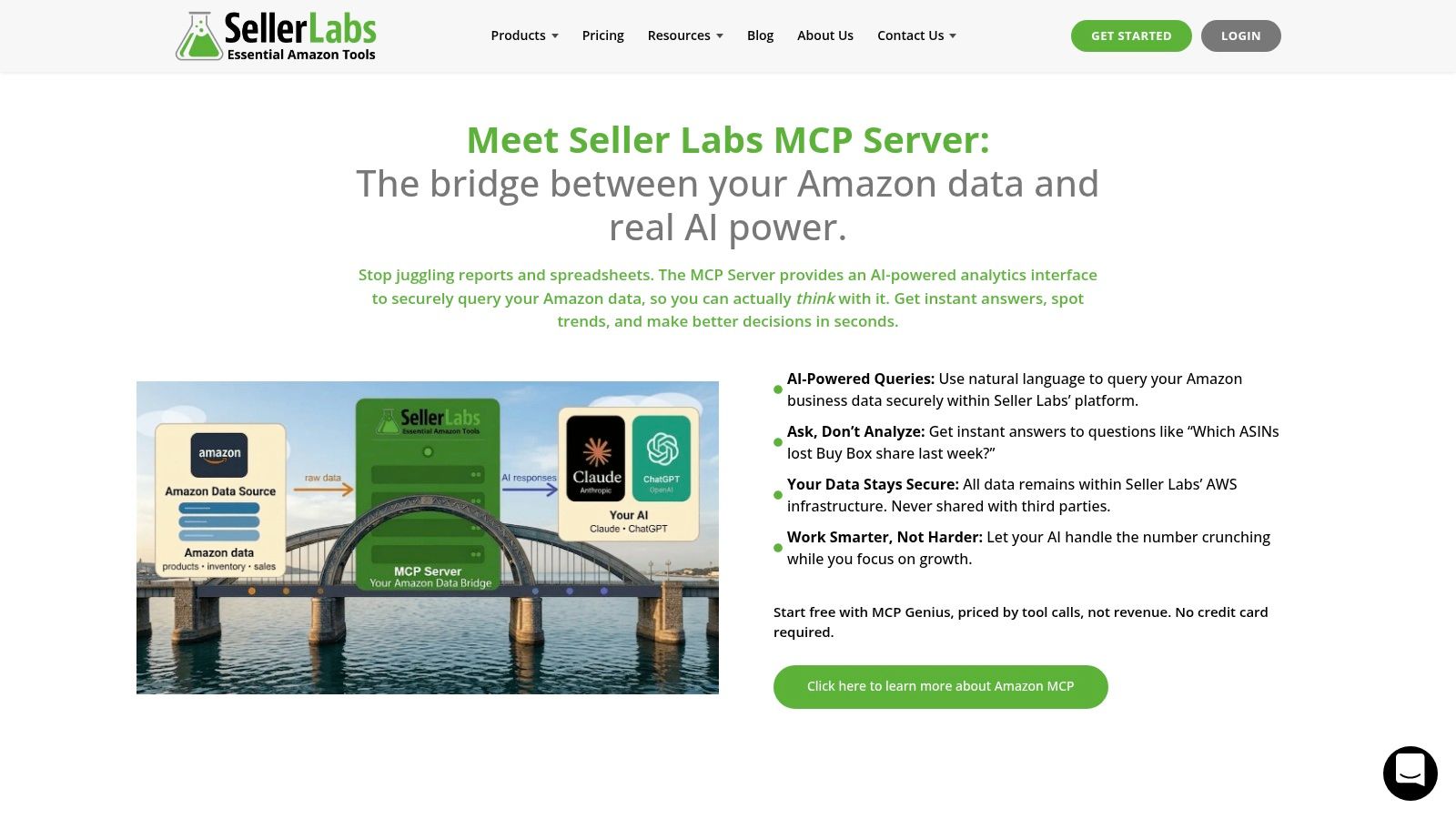
Access is not automatic. You need a subscription that includes Amazon MCP, an eligible marketplace, and the permissions that subscription grants. Public terms do not publish a full action list or a complete price breakdown, so the buyer has to confirm reads versus writes on the current plan.
Fit: Existing Seller Labs users who want an AI front end.
Gap: Coverage stops at Seller Labs' data and supported functions. Ads, inventory, and orders are included only if that product already stores them.
Check: Ask which actions are propose-only and which can post to Amazon.
A wider map of hosted and self-run options is in this MCP server roundup. Product terms start at Seller Labs.
5. DataDoe
Vendor Central coverage is rare in this list. DataDoe is a hosted MCP server that reaches Seller Central, Vendor Central, and Ads through one connection, with a REST API and BigQuery access beside the MCP endpoint. The vendor publishes a base plan of $97 per month with a 14-day trial on the DataDoe site, and stored rows, AI tokens, extra capacity, and extra seats can push the bill above that base.
That mix suits a brand operating as both seller and vendor, or a builder who wants warehouse queries and chat against the same extract. Claude and ChatGPT are named clients. On writes, the documentation describes actions that can be turned on individually, with dry runs and logging. Dry run is the control to verify before anyone enables a live write: run the action against test parameters, read the logged result, then decide whether to allow it.
The base-plan caps are the practical limit. A high-order account can exhaust included rows quickly, and token caps bite when several operators query all day. Because a third party holds the seller data here, read the retention, authorization, and security terms before connecting production accounts. For a seller who only needs an Ads connector, this is more system than the job requires.
6. SellerForge
SellerForge's MCP connector exposes its Amazon seller tools to Claude, ChatGPT, Cursor, and Claude Code. Published coverage includes profitability, advertising, keywords, inventory, account health, and customer feedback. Reads are on all plans. Staging and applying actions depend on plan level and approval rules.

Reads are not writes
A read-only plan still answers “what is my margin” and “which SKU is low.” It does not mean the model can change a bid. Eligible plans stage proposals. Approval rules, an audit history, and extra limits on higher-risk actions are how SellerForge describes the gate. That is the right shape for price and inventory changes. Confirm the audit record stores before-and-after values, not only that an action was attempted.
Coverage is SellerForge's own data and tools. If a metric you use in Seller Central is absent from that product, the agent cannot invent it. Some integrations listed on the site are not generally available, so treat the MCP page as the source of truth and ignore roadmap items. Start at the SellerForge MCP page.
Stage the change, read the diff, then apply. A chat confirmation is not an audit log.
7. UiPath Agentic Automation Platform
UiPath is not an Amazon seller connector. It orchestrates agents with software robots, APIs, and human reviewers across enterprise systems, so it fits a company where the Amazon step is one handoff inside a larger process, such as a finance close or a ticket queue, and automation staff already maintain the workflows.
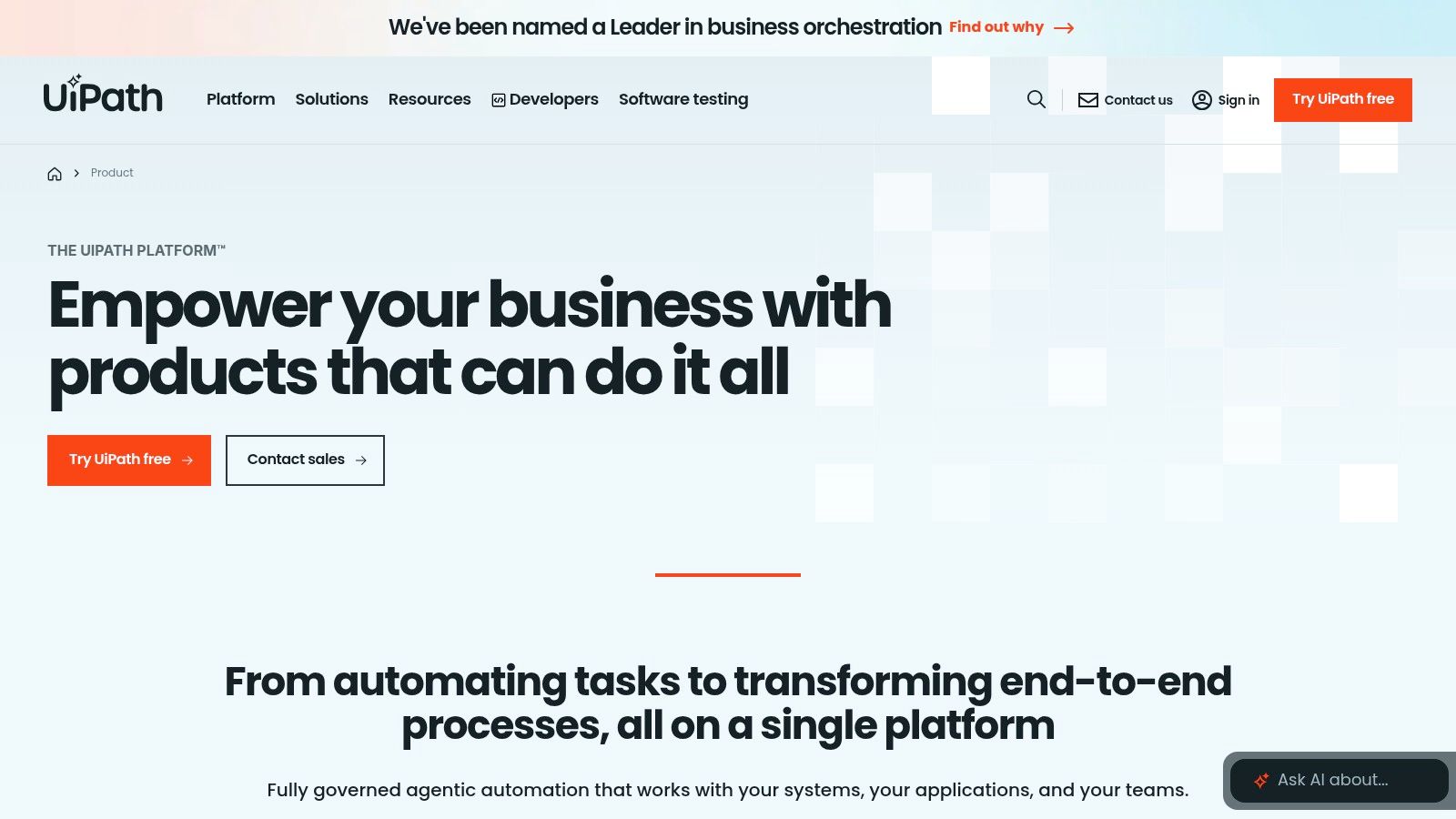
A Basic Automation Cloud plan is listed from $25 per month on the UiPath product page. Agentic features and wider scale sit on sales-led plans, so the entry price is not the agent price.
None of the Amazon data domains this list ranks on, from advertising and inventory to orders, catalog, finance, and fulfillment, is native to the platform. You build the connection yourself or pair UiPath with a seller MCP, and write gating, previews, and audit logging become whatever that connector implements rather than a platform default. That makes governance the buying decision. UiPath gives you orchestration controls across systems, but the safety of a bid change or price update depends on the Amazon layer underneath it. A three-person brand will spend more time on the platform than on the question.
Stanford's 2025 AI Index reported that 78% of organizations said they used AI in 2024, up from 55% in 2023, alongside $109.1 billion in U.S. private AI investment. That is broad AI use, not proof of Amazon agents in production. Orchestration suites absorb that budget and still need a seller data source. How platforms differ on process scope is covered in this agentic platform comparison, and cost shape is outlined in this review of workflow automation software costs and features.
8. Salesforce Agentforce
Agentforce builds and runs agents inside Salesforce's customer and business data. Ready-made options exist for smaller companies, and teams can customize tasks. It fits a brand whose orders, cases, and accounts already sit in Salesforce and whose Amazon work is downstream of that CRM.
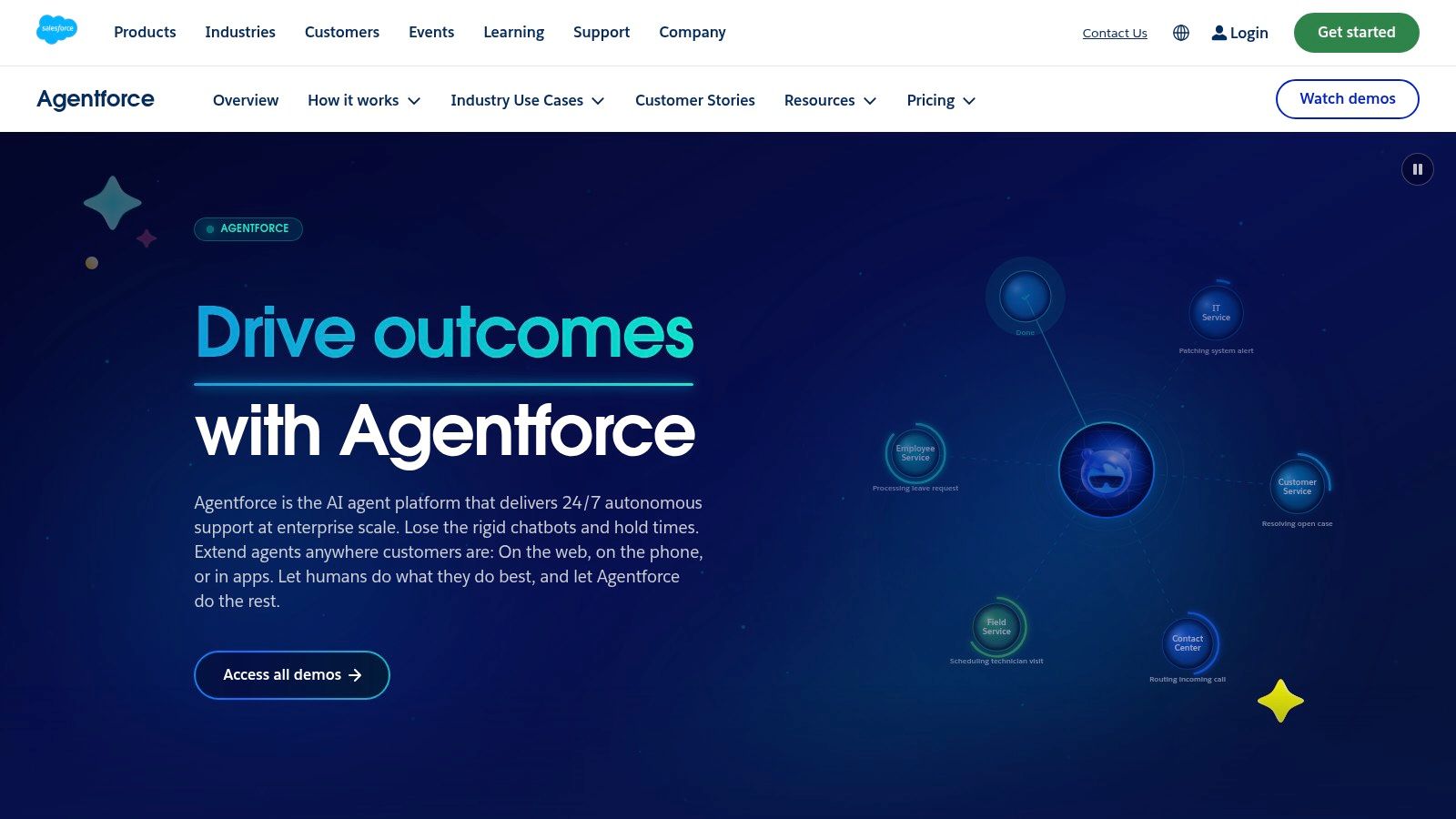
It does not reach Seller Central or Amazon Ads by itself. Bids, inbound shipments, and settlement reports stay outside unless you add a separate connector. Pricing can mix products, plans, and usage, so estimate the bill against the workflows you will run, not a demo agent.
Use it when: Service and sales agents must read Salesforce records.
Skip it when: The daily questions are ACOS, stranded inventory, or reimbursement lines.
Govern it by: Limiting which objects an agent can update, the same way you would limit a seller write key.
An outside take is in Agentforce reviewed by DBotMaker. Salesforce's own description is on the Agentforce site.
9. Microsoft Copilot Studio
Copilot Studio is Microsoft's builder for custom agents, through natural language or a graphical canvas. It belongs with Microsoft 365, Power Platform, or Teams. Licensing text describes Copilot Studio licenses and some agent use for people who already hold certain Microsoft 365 Copilot licenses. Entitlements change by license and scenario, so verify the tenant you will deploy into before you count it as included.
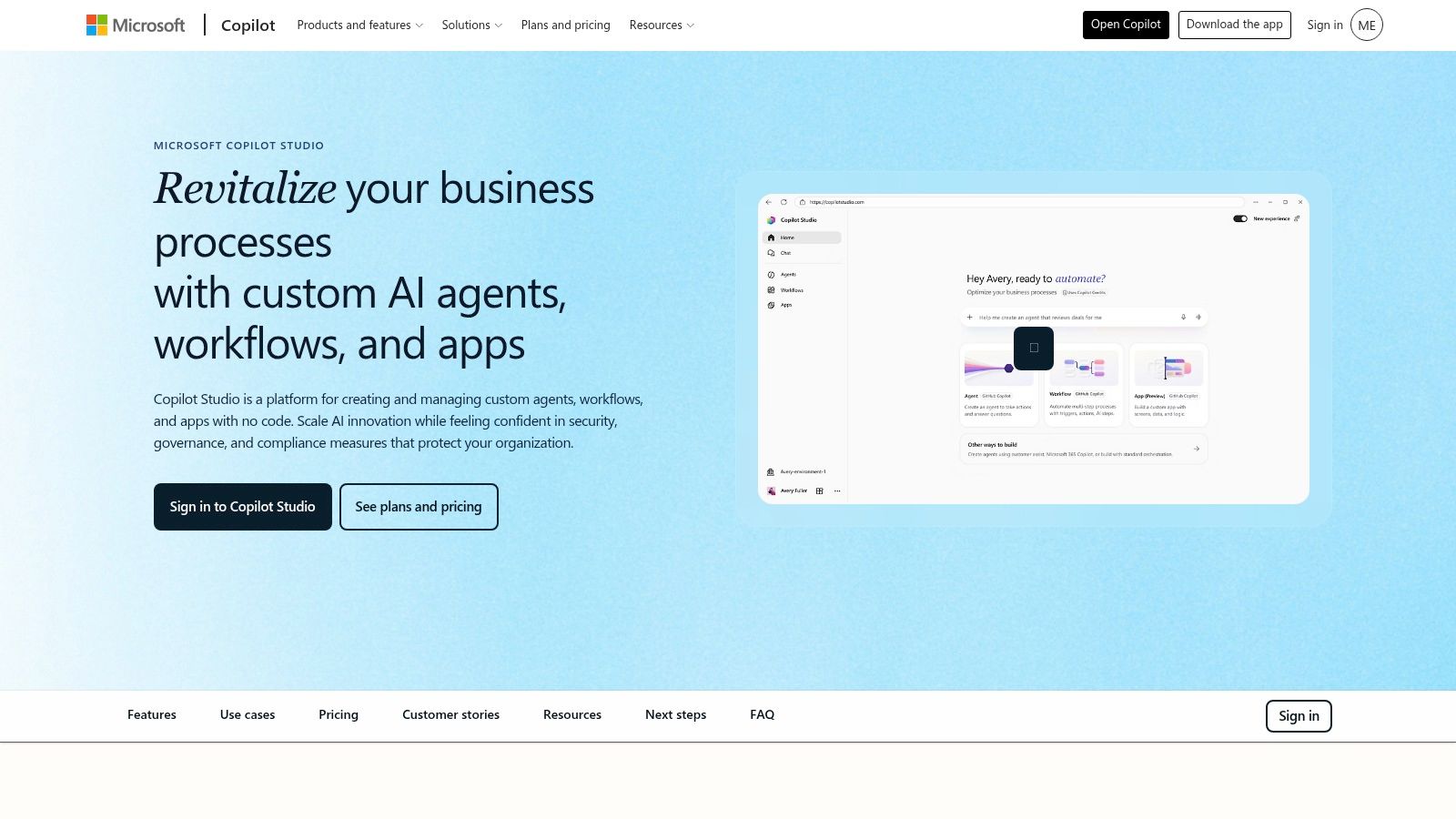
Out of the box, this is not Amazon reporting. You can connect organizational data and business workflows, then maintain those connections. That maintenance is the cost people miss. A Power Automate flow that calls Amazon APIs still has to respect report delays, role scopes, and throttling. The studio will not add inventory, finance, and Ads for you.
It is a reasonable shell when the company standard is Teams and the Amazon piece is one connector among several internal tools. It is the wrong first buy when the only job is seller operations. Confirm license fit, then read the Copilot Studio overview.
10. IBM watsonx Orchestrate
IBM positions watsonx Orchestrate as a place to build, deploy, orchestrate, manage, and govern agents, including agents built elsewhere. Highlighted uses include HR, sales, and procurement, plus application integrations. That is central management for a company running many agents, not a seller or Ads connector.
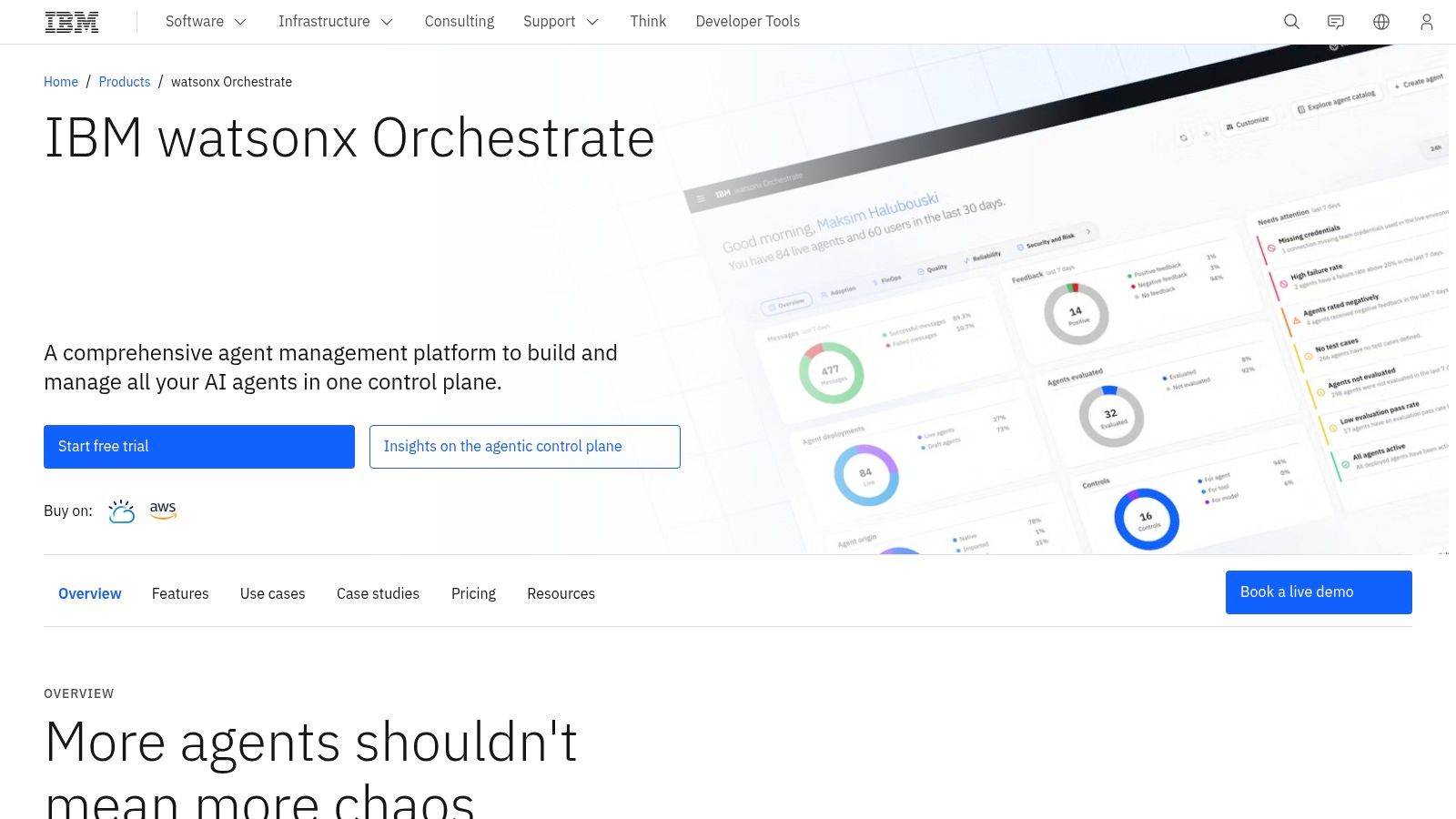
IBM's AI Projects to Profits study of 2,900 executives found that 83% expected AI agents to improve process efficiency and output by 2026. Expectation is not deployment, and the study is not an Amazon benchmark. A private-label brand with one Seller Central login does not need an orchestration tier to ask why a campaign's spend moved.
Pricing depends on usage and how widely you deploy. Budget for integration work before you budget for the license. If several teams must share one control plane, and Amazon is only one system among many, shortlist it. Product scope is on watsonx Orchestrate.
How the Ten Options Differ on Amazon Data, Write Controls, and Pricing Basis
| Item | Amazon data coverage | Write actions | Pricing basis | Best fit |
|---|---|---|---|---|
| agentcentral | Seller Central and Ads data across 23 marketplaces, including sales, inventory, orders, listings, finance, and fulfillment | Supported changes with previews, confirmation, duplicate protection, and audit logs | Monthly order volume; plans $39–$159/month, custom Enterprise pricing; 14-day trial | Sellers seeking broad Amazon data, AI access, and controlled operational changes |
| Amazon Seller Assistant and Selling Partner plugin | Seller Central account and business context | Seller tasks with review, approval controls, and audit trails | Pricing not specified | Amazon-focused sellers wanting native assistance |
| Amazon Ads MCP Server | Amazon Ads reporting and account capabilities | Create, update, or delete campaigns; eligibility and credentials required | Pricing not specified | Eligible advertisers and developers focused on Ads workflows |
| Seller Labs Amazon MCP | Seller Labs data; coverage depends on products and permissions | Some supported account or campaign actions | Subscription required; detailed pricing not specified | Existing Seller Labs customers seeking AI access |
| DataDoe | Seller Central, Vendor Central, and Ads; API and BigQuery access | Actions can be enabled, with dry runs and logging | Base plan $97/month; limits apply; 14-day trial | Sellers, vendors, agencies, and builders needing combined Amazon data |
| SellerForge | Seller tools covering profitability, ads, keywords, inventory, account health, and feedback | Staged proposals and actions vary by plan; approval controls | Plan-based; pricing not specified | Sellers seeking broader operational context with permissioned actions |
| UiPath Agentic Automation Platform | No dedicated Amazon coverage; connects business systems through automation | Agents, robots, APIs, and people can be orchestrated | Basic plan starts at $25/month; advanced pricing varies | Enterprises automating processes across multiple systems |
| Salesforce Agentforce | Salesforce customer and business data; no specialized Amazon coverage | Customizable agents for business tasks and workflows | Product-, plan-, and usage-based | Organizations already using Salesforce |
| Microsoft Copilot Studio | Organizational data and workflows; no Amazon-specific coverage out of the box | Build and customize agents for workflows | Licensing and usage entitlements vary | Organizations standardized on Microsoft tools |
| IBM watsonx Orchestrate | Business application integrations; no specialized Amazon coverage | Build, manage, and orchestrate agents and processes | Depends on usage and deployment scope | Enterprises coordinating agents across teams and systems |
Matching AI Agents for Business to Your Amazon Operation
Pick the platform from the data the team asks about. Advertising-only questions can stay on Amazon's Ads MCP server, with partner access and a human check before campaign creates or deletes. Full Seller Central work, ads plus inventory, orders, catalog, finance, and fulfillment, needs a hosted seller connection with previewed writes and an audit log. Cross-system work that also touches HR, procurement, or a CRM belongs on UiPath, Agentforce, Copilot Studio, or watsonx Orchestrate, and those still need a separate Amazon source.
PwC's May 2025 survey of 308 U.S. executives found 79% saying agents were already adopted, while only 35% called adoption broad and 17% said agents were fully adopted across almost all workflows. Among adopters, 66% reported productivity gains and 57% reported cost savings. Those are executive perceptions, not audited Amazon results. Measure time-to-answer, exception handling, and completed writes that passed a preview, not prompt counts.
Gartner's 2025 survey found 75% of organizations piloting or using some form of AI agent, but only 15% considering, piloting, or deploying fully autonomous agents. 74% saw agents as a new attack vector, and only 13% strongly agreed that suitable governance existed. Controlled autonomy fits Amazon. Separate read-only analysis, reversible edits, money-moving edits, and hard-to-undo fulfillment actions. Set a human gate on the last two.
Test any seller connector on questions you already know the answer to. Check scoped keys, read-only mode, duplicate protection, and before-and-after logs. Match the pricing basis to monthly order volume so a busy Q4 does not surprise the bill. For Ads, inventory, orders, catalog, finance, and fulfillment in one MCP connection, Agent Central offers a 14-day free trial that needs no card. Plans run by monthly Amazon order volume, from $39 to $159 per month, with custom Enterprise pricing. See the pricing documentation. Questions go to support@agentcentral.to.
Agent Central gives the AI client you already use a hosted MCP connection to Amazon Seller Central and Amazon Ads, returning facts and guarded write tools instead of account advice. If your team is comparing AI agents for business by the seller domains they can read and the logs they keep, start with that connection. Visit agentcentral to see coverage, connect your accounts, and run the trial against a real spend-versus-units question.
Related Agent Central pages
- Amazon Seller Central MCP server
Canonical hosted MCP overview for Seller Central, Ads, inventory, catalog, finance, and fulfillment data.
- Connect Seller Central to Claude
Step-by-step path from Amazon OAuth to a Claude connector or MCP config.
- Amazon seller data for AI agents
How Agent Central normalizes Amazon seller data before exposing it to AI clients.
- ChatGPT with Amazon seller data
ChatGPT-specific setup path for Amazon seller data through hosted MCP.
- Amazon seller MCP servers compared
How hosted MCP services compare with official Ads MCP, local repos, connector tools, and automation platforms.
- Amazon Ads MCP server
Campaign, keyword, search term, budget, TACOS, and guarded ads-write tools.
Related reading
- MCP Client Explained for Amazon Seller Teams
An MCP client connects Claude or ChatGPT to one MCP server. See how it keeps permissions and writes on one Amazon seller account.
- Reliability Metrics for Amazon AI Agents
Learn the reliability metrics that matter for Amazon seller AI agents, from uptime and MTTR to latency percentiles, with formulas and dashboards.
- How AI Agents Manage Amazon Seller Workflows
AI agents read Amazon seller data, calculate metrics and draft changes for approval. See the five-stage workflow, four recipes and the safety controls.
- Inventory Management Automation for Amazon Sellers
Practical guide to inventory management automation for Amazon FBA and private-label sellers using AI agents, MCP, and pre-synced Seller Central data.
Connect Amazon seller data to your AI client.
Agent Central gives Claude, ChatGPT, OpenClaw, Cursor, and other MCP clients structured access to Amazon Ads, Seller Central, inventory, orders, catalog, finance, and fulfillment data.