
Amazon Seller Assistant vs AI Agents
Compare Amazon Seller Assistant vs AI agents for operations. See how Agent Central connects Claude and ChatGPT to Seller Central and Ads data.
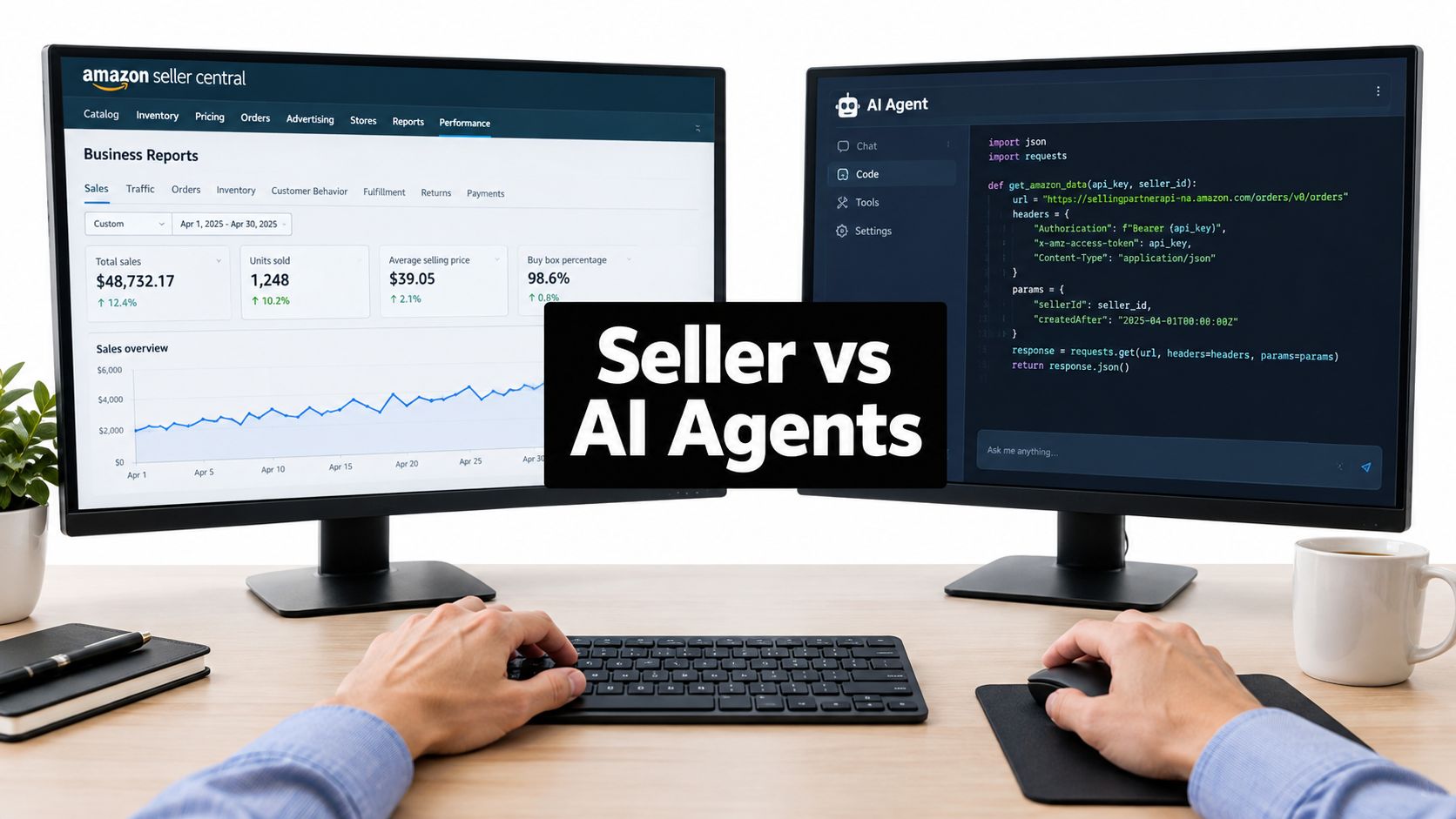
Amazon Seller Assistant provides native recommendations inside Seller Central, while AI agents use hosted MCP servers like Agent Central to execute cross-domain workflows with scoped permissions and audit logs. Amazon Seller Assistant is the simpler choice for guided native tasks; an external agent is more useful when the workflow must combine advertising, inventory, orders, finance, and fulfillment data without losing control of writes.
The popular advice says to compare listing generation, research, and conversational quality. That misses the operational failure points. Amazon sellers don't usually lose control because an assistant can't produce a plausible answer. They lose control when a report is stale, a request is duplicated, a marketplace scope is wrong, or a price change happens without a clear record of what changed.
Amazon's third-party marketplace is large enough to make this distinction material. Independent sellers surpassed $200 billion in store sales in 2023, and they accounted for more than 60% of sales in Amazon's store globally, according to Amazon seller statistics reported in the AI-agent context. A seller operation therefore spans catalog, pricing, inventory, orders, fulfillment, finance, and advertising. It isn't a single customer-service workflow.
Table of Contents
- Redefining the Amazon Automation Comparison
- Data Freshness and Asynchronous Reporting Limits
- Comparing Data Domains and Marketplace Coverage
- Security Roles and Profile Scoped Authorization
- Handling API Throttling and Execution Guardrails
- Connecting Seller Central to MCP Clients
- Choosing the Right Architecture for Your Operations
Redefining the Amazon Automation Comparison
Teams often compare Amazon Seller Assistant vs AI agents by asking which one writes better prompts, generates better listings, or feels better in chat. That is the wrong frame for an Amazon operation. The actual comparison is recommendation layer versus controlled execution layer, because operational failures usually come from stale inputs, wrong scope, duplicate requests, and weak write controls, not from weak phrasing.
Amazon positions Seller Assistant as an AI companion inside its own seller environment. It answers questions, surfaces insights, and helps with native tasks. Amazon also says Seller Assistant has reached over 90% of Amazon's selling partners worldwide, and that sellers accept recommendations more than 90% of the time, according to Amazon's announcement about Seller Assistant and its Claude plugin. That matters because it shows where the product fits. Seller Assistant is built for Amazon-managed context, inside Amazon-managed workflows.
An external AI agent connected through a hosted MCP server solves a different problem. It gives the model access to structured operational records, lets it combine signals across domains, and can submit a change only when the connection, permissions, and execution rules allow it. The model interprets intent. The control layer decides what can be read, what can be written, how retries behave, and what gets logged.
Practical rule: A useful answer is not evidence that the automation is safe. Safe automation shows the data window, authorization scope, proposed mutation, and resulting Amazon status.
The difference shows up most clearly on write operations.
Take a price change. A recommendation layer can suggest that a SKU looks overpriced or underpriced. A controlled execution layer has to do more than suggest. It should fetch the current value, confirm the right marketplace and seller account, preview the new value before submission, block duplicate attempts, wait for the API response, and preserve a record of what changed. If Amazon accepts the request and later returns a listing issue or another asynchronous status, that outcome has to stay visible to the operator. Otherwise the system gives a clean narrative while the actual state remains unresolved.
That is why feature lists usually miss the buying decision. A team reviewing agentic AI platforms for ecommerce workflows should spend less time on chat polish and more time on control questions that affect live operations:
- Source visibility: Can the operator inspect which Amazon fields support the answer?
- Freshness: Does the response show the observation window and ingestion timestamp?
- Permission boundaries: Can the connection read and write only within the approved scope?
- Duplicate protection: Do retries avoid resubmitting the same report or mutation?
- Auditability: Is there a durable record of the request, result, and before and after state?
Seller Assistant remains a good fit when the work belongs inside Amazon's native workflow and the team wants guided recommendations with Amazon-managed context. An external agent is the better architecture when the operation needs repeatable workflows across multiple Amazon domains, multiple users, or multiple client accounts, with tighter control over how reads and writes are executed.
The key comparison is not whether both products can answer a question. It is whether the system can operate safely once the answer turns into an action.
| Execution model | Amazon Seller Assistant | Agent Central MCP |
|---|---|---|
| Primary role | Native recommendations and guided action inside Amazon's selling environment | Structured access for an external AI agent or workflow |
| Execution model | Amazon-managed permissions and approval flows | Scoped Amazon authorization, previews, duplicate protection, and audit logs |
| Best fit | Native seller questions and recommendations | Cross-domain analysis and controlled external workflows |
Data Freshness and Asynchronous Reporting Limits
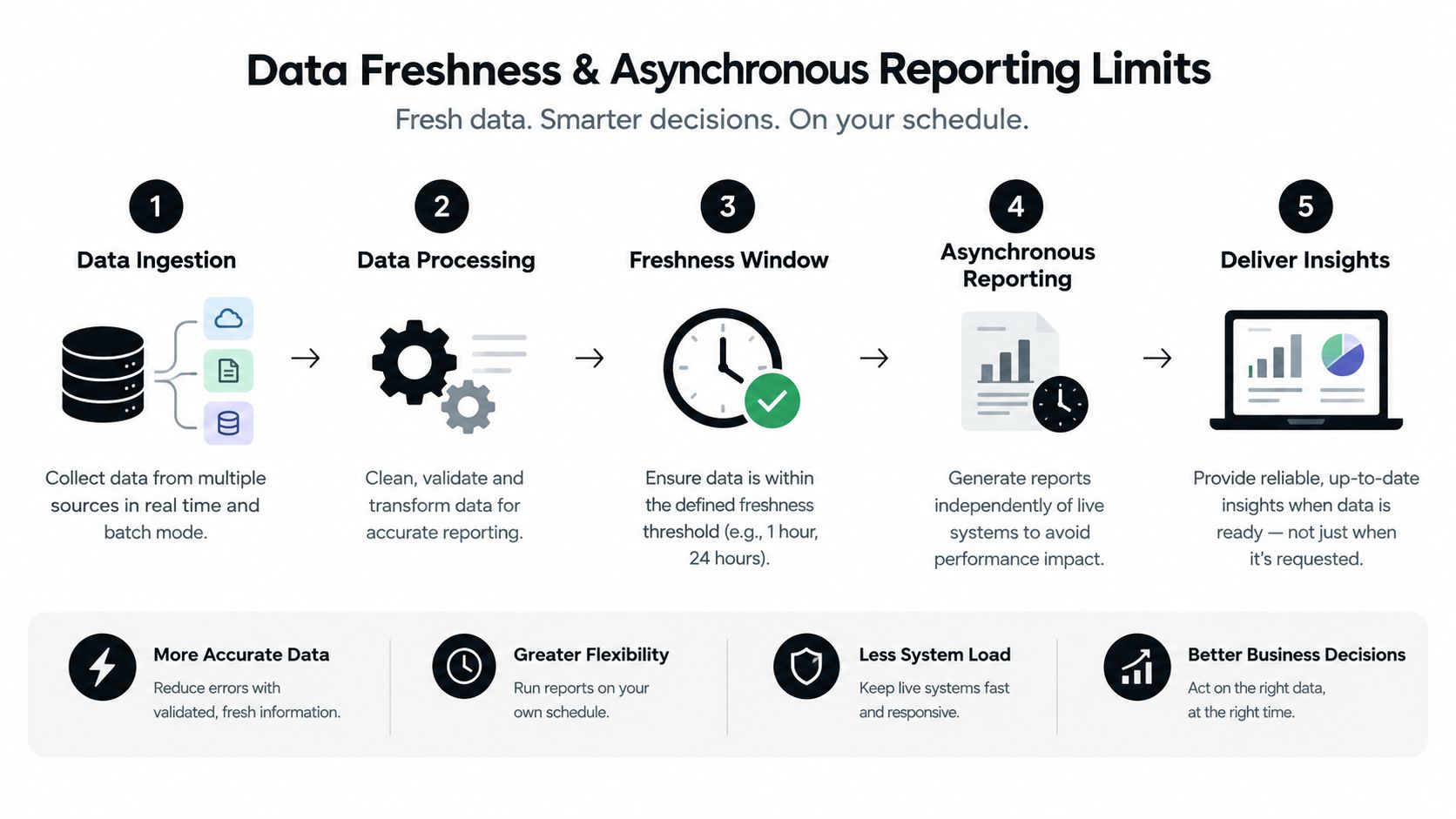
Model speed isn't the same as data speed. Amazon Ads reporting can require a report request, status polling, and file download, and Amazon states that report generation can take up to three hours in its Ads Reporting API guide.
That sequence changes how an agent should answer a question such as, “Which campaign should be adjusted this morning?” A direct integration may still be waiting for a finalized report. Reissuing the same request isn't a safe workaround because duplicate identical requests can return HTTP 425. A reliable connector needs persistent report IDs, polling with backoff, recovery for PENDING, PROCESSING, and COMPLETED states, and a clear distinction between finalized and provisional metrics.
Freshness is an operational field
Agent Central syncs account data on a schedule, so connected clients can query prepared records rather than waiting for every conversational request to trigger a new Amazon report. A new account starts with 30 days of history, which builds from there, and Amazon Ads history is kept while the account remains connected. These facts describe the connection's available history, not a promise of real-time or instant refreshes.
The correct question isn't “How quickly did the model answer?” It is “How old is the data behind the answer?” A production workflow should expose:
- Observation window: The dates covered by spend, sales, conversion, inventory, or finance metrics.
- Ingestion time: When the connected system last synchronized the relevant records.
- Finality state: Whether the metric comes from completed reporting or may still change.
- Account boundary: Which seller account, advertising profile, marketplace, currency, and time zone apply.
Amazon's documentation also describes an advertising reporting limit of one concurrent report per advertiser and estimates that this supports approximately 100 reports per day based on average run times. Amazon recommends serializing requests per advertiser and distributing them across the day in its reporting overview. That constraint affects architecture more than prompt quality.
A connector serving several brands needs a per-advertiser job queue, report-ID cache, idempotency handling, and backoff. An agent that launches parallel report calls may produce throttling, duplicate jobs, or an answer based on incomplete data. The practical benchmark is data-age SLA, report completion rate, duplicate-request rate, and the share of decisions supported by finalized metrics.
Teams comparing response behavior can use this technical discussion of query response time, but the useful standard remains explicit freshness. A fast answer with an undisclosed reporting delay is less valuable than a slower answer that states exactly what the operator can trust.
Comparing Data Domains and Marketplace Coverage
Feature lists obscure the architectural question. The useful comparison here is which Amazon data domains each option can reach at the same time, and whether the operator can trace a write or decision back to the exact marketplace, account, and reporting context that produced it.
Amazon's native seller tools stay closest to the workflows inside Seller Central and Amazon's own advertising surfaces. An external MCP setup such as Agent Central is more useful when the question crosses operational boundaries and the answer depends on joining records that normally live in separate systems.
A seller investigating weaker sales rarely needs one dataset. They usually need order trends beside inventory position, listing status, pricing changes, fee impact, and ad delivery. Budget decisions have the same shape. A campaign may look healthy in isolation, but stock coverage, suppressed listings, or marketplace-specific margin pressure can still make more spend the wrong move.
Operational Data Coverage Comparison
Rather than rebuild the earlier tool comparison, focus on domain mapping.
| Data domain | Amazon native environment | Agent Central MCP |
|---|---|---|
| Orders and sales operations | Seller Central order management, sales views, and related account records | Structured access to order, sales, catalog, inventory, fulfillment, finance, and ranking records in one workflow |
| Advertising performance | Amazon Ads interfaces and APIs by advertising profile | Sponsored Products, Sponsored Brands, Sponsored Display, and DSP data alongside seller records |
| Cross-domain analysis | Usually handled by switching between seller and ads contexts | The same workflow can place ad metrics next to inventory, pricing, fulfillment, and order movement |
| Marketplace scope | Depends on product availability and account context | 23 Amazon marketplaces through the connected service |
| Marketplace interpretation | Native views reflect the active store, profile, and report context | Responses can be tied back to the specific connected marketplace, account, currency, and reporting window used |
That difference matters more than UI preference. If a team asks, "Did advertising efficiency fall, or did the offer lose availability?", the answer depends on whether the system can inspect both sides without forcing an analyst to reconcile exports manually.
Amazon is also expanding its own AI access path. The Selling Partner plugin announcement describes Seller Assistant support in Amazon Quick and a beta rollout with Claude, with availability in US stores and international expansion still to follow. For agencies and aggregators, that means marketplace coverage and client availability should be validated before standardizing one workflow across accounts.
Here is where domain coverage changes day-to-day operations. A merchandising lead can compare recent price changes with settlement outcomes. A media buyer can check whether rising spend coincides with stock pressure or fulfillment disruption. An operations team can review a sales drop against listing status and order movement without bouncing between disconnected tools.
Agent Central's boundary is simple. It returns facts, metrics, classifications, and Amazon-provided fields for the connected domains, while recommendations and account decisions remain with the user or the system built on top of those records.
Security Roles and Profile Scoped Authorization
Amazon access isn't one unrestricted credential. The Selling Partner API uses explicit roles that determine whether an application can access an operation or resource, including sensitive data. Amazon explains that an application calling an operation without the required role receives HTTP 403, as documented in SP-API roles and authorization.
That model supports least privilege. A workflow that reads catalog data doesn't automatically need permission to access order details, pricing mutations, fulfillment operations, or restricted personal information. Amazon identifies roles such as Pricing for price-related operations and Fulfillment for FBA sales, order tracking, and fulfillment operations.
What authorization has to cover
Adding access isn't a single toggle. Amazon's process requires the developer to request and qualify for the role, apply the approved role to the application, relist the application, and obtain new seller authorizations so the refresh token covers the newly permitted operations, reports, feeds, and notifications.
Amazon Ads introduces another boundary. Campaign operations require the correct advertising profile context. Amazon's Sponsored Products documentation uses the Amazon-Advertising-API-Scope header, and onboarding requires an access token and profile ID before creating targets or promotions. Sponsored Display also requires bids to remain below the maximum allowed bid for the campaign's marketplace, as described in Amazon's Sponsored Display API documentation.
An external MCP connection therefore needs more than a general OAuth success. It must preserve:
- Seller authorization: Amazon's authorization determines which account data and operations the application can reach.
- Application scope: A scoped API key, Connector URL, or Claude OAuth connection should expose only the intended connection.
- Advertising profile: The workflow must send the correct profile context for the campaign operation.
- Marketplace validation: A bid or price change must be checked against the marketplace and operation constraints.
- Account separation: Agency workflows must keep each seller account's data and authorization context distinct.
Teams implementing a connector can also consult these Hono API security tips for broader API security practices. Those practices don't replace Amazon's roles or advertising profile requirements, but they help developers treat the connector boundary as a security control rather than a convenience setting.
Handling API Throttling and Execution Guardrails
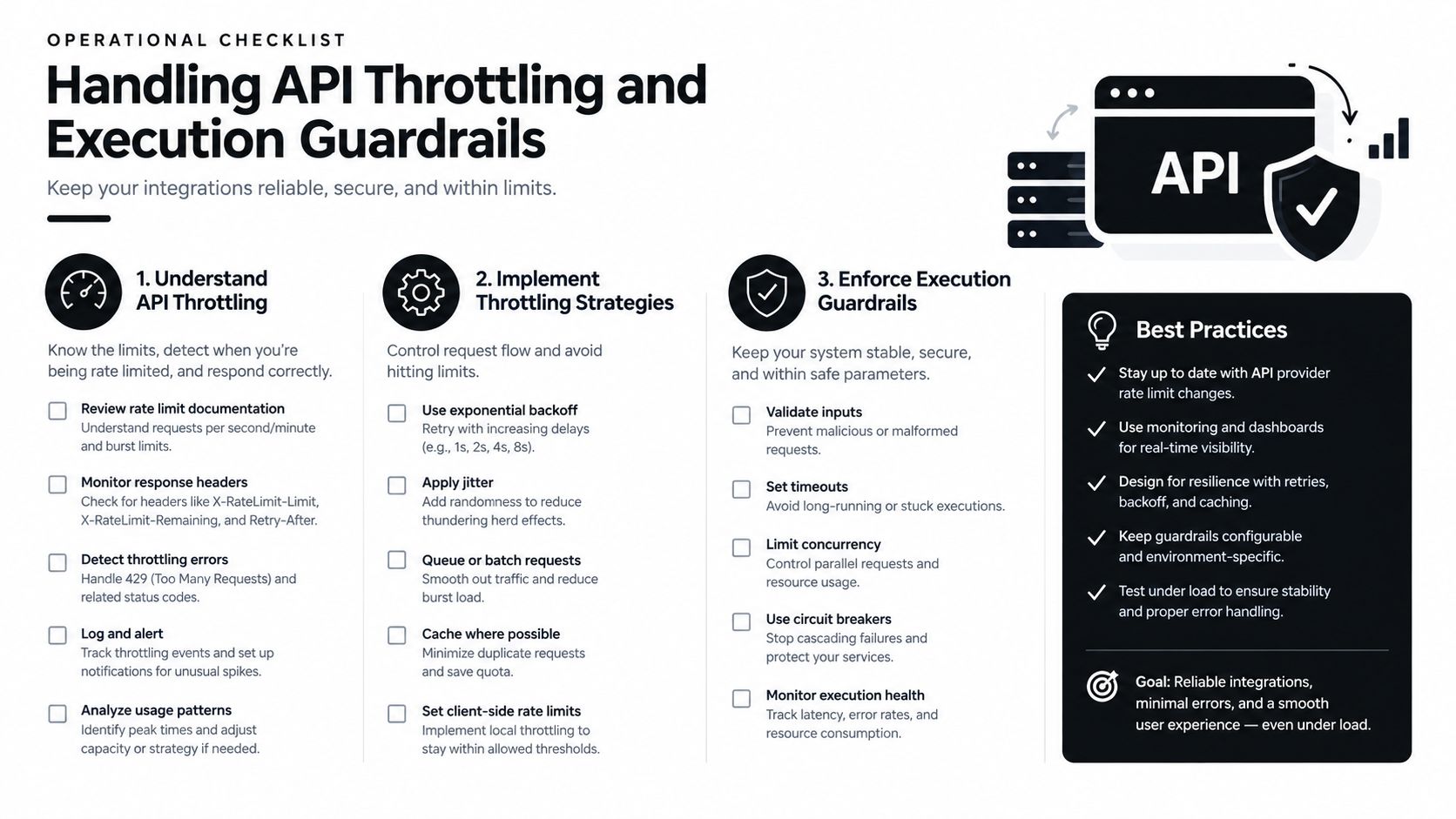
An agent can turn one natural-language request into several Amazon calls. The backend doesn't treat that conversation as one unlimited request. SP-API limits are tied to operation-specific usage plans, and Amazon says most limits apply to the combination of selling-partner account and application. The applicable limit may appear in the x-amzn-RateLimit-Limit response header, while requests beyond steady-state or burst limits can fail with HTTP 429, according to Amazon's SP-API usage-plan guidance.
HTTP 403 and HTTP 429 require different responses. A 403 points to roles, profile permissions, or application configuration. A 429 calls for request pacing, queue management, and retry behavior. Treating both as generic model failures makes diagnosis harder and can cause an agent to repeat the wrong operation.
Reliability requires a queue and a record
A production workflow should serialize operations where Amazon requires it, pace calls by operation, cache completed report IDs, and use exponential backoff for throttling. It should also preserve the original request and response status, because an operator needs to know whether the system was blocked by authorization, throttling, validation, or an asynchronous Amazon result.
Agent Central's supported changes, including bids, budgets, campaign states, listings, prices, seller-managed inventory quantities, MCF orders, and FBA inbound shipments, are previewed by default. The connection protects against duplicate submissions and logs before and after values. That makes the user or workflow responsible for approval while giving the operator a durable execution record.
Guardrail principle: A write isn't complete when an agent sends the request. It is complete when Amazon returns a result, the workflow records that result, and the operator can identify the exact state before and after the change.
The same discipline applies to Amazon Ads. A bid must carry the right profile scope and satisfy marketplace rules before submission. A budget change should show the target campaign and proposed value. A listing update should expose the fields being changed and handle later processing issues instead of assuming that an accepted request means a published listing.
Native Amazon workflows already include their own permissions and approval experiences. External agents add flexibility, but the team operating them must verify that the connector has equivalent controls around scope, preview, deduplication, retries, and audit logs. Greater autonomy isn't automatically greater operational value.
Connecting Seller Central to MCP Clients
Connecting Seller Central to an MCP client is the easy part. Setting the right operating boundary is what prevents bad assumptions about freshness, scope, and write safety.
Start with the connection, then verify what the client can see and do.
- Create the connection: Sign up through the Agent Central Claude quickstart or in the app directly.
- Authorize Amazon: Connect Seller Central and Amazon Ads through Amazon's authorization flow, using the correct seller and ads profiles for the account you want exposed.
- Attach the client: Add the connection to Claude, ChatGPT, OpenClaw, Cursor, or another compatible MCP client. Teams reviewing the MCP layer itself can use this guide to connecting Seller Central to MCP clients.
- Test read access: Query a single marketplace, date range, and metric set first. That surfaces profile-scope mistakes early and shows how timestamps are returned.
- Validate a preview: Use a low-risk supported change to confirm the proposed fields, approval path, and audit trail before allowing broader operational use.
What the client receives
The client does not query Amazon live on every prompt. It reads from synced records prepared on a schedule through agentcentral.to. That usually makes repeated operational questions faster, but it also means the answer can lag the current Amazon state. Read the timestamps. Treat attribution, inventory, and other fast-moving fields as observed data tied to a window, not as proof of present state.
For onboarding, the first sync matters more than the first prompt. Check which marketplaces appeared, whether Amazon Ads profiles mapped to the expected accounts, and whether the time ranges available match the reporting job the team expects to do. The history boundary described in the data freshness section also applies here.
Pricing is based on monthly Amazon order volume. Plans include a 14-day free trial with no card required, with current details on the Agent Central pricing documentation. Evaluate the plan against account volume, client separation, read frequency, and how many workflows need guarded writes with review and logging.
Choosing the Right Architecture for Your Operations
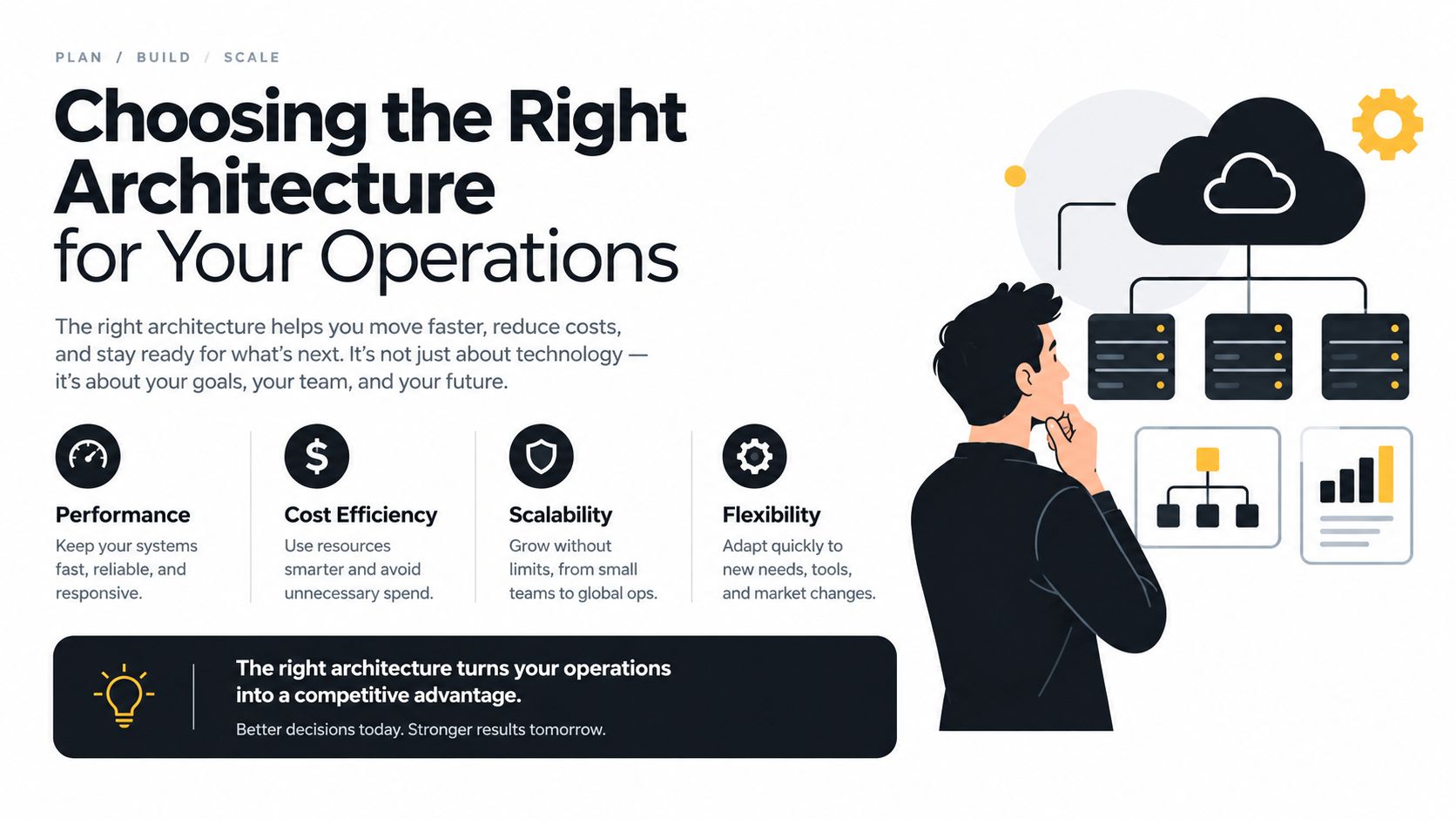
Amazon Seller Assistant is usually sufficient when the work stays close to Amazon's native experience. A seller checking account health, asking for listing help, or seeking a recommendation on a routine Seller Central task may not need an external connector.
An MCP architecture becomes more appropriate when the operating question crosses systems, accounts, marketplaces, or risk boundaries. Agencies may need separate seller authorizations and auditable changes. Ads managers may need campaign records beside inventory and sales. Developers may need Claude Code, ChatGPT, or another MCP client to call structured Amazon data as part of a larger workflow.
A practical selection test
Choose the native route when:
- The task is advisory: The seller wants Amazon's recommendation and will perform the final work in Seller Central.
- The data is local: The answer depends on one native account area rather than advertising, inventory, finance, and fulfillment together.
- The write risk is limited: The workflow doesn't need external approval records or before and after values.
Choose a controlled external route when:
- The question is cross-domain: The agent needs to compare ads, sales, inventory, orders, catalog, ranking, finance, or fulfillment.
- The operation is repeatable: The team needs the same workflow across marketplaces or client accounts.
- The write is consequential: Price, bid, budget, listing, inventory, or fulfillment changes require preview, approval, deduplication, and auditability.
- Freshness must be visible: The operator needs timestamps and a clear warning when Amazon reporting is delayed or incomplete.
Agent Central fits the second pattern as a hosted MCP server that gives compatible clients structured access to Amazon Ads and Seller Central records. It returns facts and Amazon source fields, not business recommendations. The user's agent or team decides whether an observed metric justifies an action.
The decision framework resembles broader guidance for deploying agents in business systems, including this 2026 SEO agent guide for B2B, where permissions, workflow ownership, and measurement matter as much as model capability. For Amazon operations, the decisive questions are narrower: How fresh is the data, which roles are authorized, what happens after a 429 or 403, and can every consequential write be reviewed and reconstructed?
Agent Central connects Claude, ChatGPT, OpenClaw, Cursor, and other MCP clients to Amazon Seller Central and Amazon Ads with scheduled syncs, scoped authorization, prepared records, and guarded, logged changes. Visit agentcentral to connect an account and test whether a controlled cross-domain workflow fits the team's Amazon operation.
Related Agent Central pages
- Amazon Seller Central MCP server
Canonical hosted MCP overview for Seller Central, Ads, inventory, catalog, finance, and fulfillment data.
- Connect Seller Central to Claude
Step-by-step path from Amazon OAuth to a Claude connector or MCP config.
- Amazon seller data for AI agents
How Agent Central normalizes Amazon seller data before exposing it to AI clients.
- ChatGPT with Amazon seller data
ChatGPT-specific setup path for Amazon seller data through hosted MCP.
- Amazon Ads MCP server
Campaign, keyword, search term, budget, TACOS, and guarded ads-write tools.
- Ads tool reference
Parameter-level docs for Amazon Ads campaign, keyword, search term, budget, and TACOS tools.
Related reading
- Amazon Ads API Guide: Build vs Agent Central in 2026
Learn how the Amazon Ads API works, authentication, endpoints, and async reporting. See why Agent Central is the faster route for Amazon sellers and agencies.
- Amazon Tacos: TACoS Metrics and Seller Guide
Decode Amazon Tacos search intent and master TACoS metrics. Learn to calculate ad efficiency, optimize listings, and automate reporting with Agent Central.
- Labeling Automation for Amazon Sellers and AI Agents
Learn how labeling automation works for Amazon sellers and AI agents, from product and fulfillment tags to ML dataset prep, with practical MCP examples.
- Agentic AI Platforms for Amazon Operators: Practical Guide
Compare agentic AI platforms for Amazon workflows by data access, permissions, guarded writes, audit logs, and operator review controls.
Connect Amazon seller data to your AI client.
Agent Central gives Claude, ChatGPT, OpenClaw, Cursor, and other MCP clients structured access to Amazon Ads, Seller Central, inventory, orders, catalog, finance, and fulfillment data.