
7 Best MCP Servers for Amazon Sellers in 2026
Compare the best mcp servers for Amazon sellers, including hosted data layers, official tools, security, audit logs, integrations, and pricing.

The best MCP server for Amazon seller operations isn't the one with the biggest generic tool list. It's the one that fits the workflow, and for Amazon operators that usually means agentcentral, while the broader MCP market has already moved from roughly 100 servers in late 2024 to tens of thousands by 2026.
Most advice about the best MCP servers still ranks coding helpers, browser tools, and document connectors as if Amazon operations were just another developer use case. They aren't. An Amazon seller workflow lives or dies on data freshness, repeated-read speed, permission scope, audit logging, deployment burden, and pricing that still makes sense when an agency is managing several brands.
That difference matters more now because MCP adoption is no longer niche. The protocol was introduced publicly on November 25, 2024 as an open standard for secure, two-way connections between data sources and AI tools, and by mid-2026 independent reports described broad production adoption across the ecosystem, including more than 10,000 MCP servers in production and major vendor support across the stack, as noted in Anthropic's Model Context Protocol announcement and updates.
For Amazon sellers, the useful question isn't which server is most popular with developers. It's which server can return structured facts from Amazon Ads and Seller Central quickly, safely, and repeatedly enough for day-to-day operations. The seven options below are ranked on that basis. agentcentral sits first because it acts as a data layer, not a recommendation engine. It returns facts, metrics, classifications, source-provided fields, and guarded write tools, while the connected agent or workflow remains responsible for decisions.
Table of Contents
- 1. agentcentral
- 2. Anthropic reference MCP servers
- 3. GitHub MCP Server
- 4. Slack MCP Server
- 5. Notion MCP Server
- 6. Stripe MCP Server
- 7. Microsoft Playwright MCP Server
- Top 7 MCP Servers, Feature Comparison
- Choose by Data Risk and Operating Model
1. agentcentral

General MCP popularity is a weak ranking method for Amazon operators. The harder question is operational fit: which server can answer repeated questions across ads, orders, catalog, finance, inventory, ranking, and fulfillment without forcing a team to assemble separate connectors, wait on report generation, or grant broad write access. On that standard, agentcentral ranks first in this list.
The reason is specific. agentcentral is a hosted MCP service built around Amazon seller workflows, not a general developer utility adapted after the fact. It gives MCP clients structured access to Amazon Ads and Seller Central data across marketplaces, uses OAuth setup, and avoids the self-managed burden that comes with stitching together source APIs, hosting, credential storage, and sync jobs internally.
That hosted delivery changes the operating model.
Amazon workflows often break on latency, polling overhead, and uneven API behavior, especially where reports or fulfillment writes are involved. agentcentral's design addresses that by serving pre-synced reads instead of relying on the agent to pull everything live at query time. For an agency reviewing several brands, that matters more than feature breadth on paper. Faster repeated reads usually produce more usable agent workflows than a larger tool catalog with slower source access.
Why it ranks first for Amazon operations
Its edge is not developer mindshare. It is the combination of Amazon-specific coverage, sync behavior, and governance controls that sellers need in production.
- Broad Amazon data coverage: It spans ads plus core commerce datasets such as inventory, orders, catalog, finance, ranking, and fulfillment. That is a better fit for seller operations than Ads-only connectors or generic browser tools.
- Pre-synced reads: Data is synced daily and historical data is retained from the first connection, which supports recurring analysis better than repeated live polling against slower source endpoints.
- Scoped permissions: Read-only and scoped API keys let a team separate analysis access from execution access.
- Write safety: Write previews, idempotency keys, before-and-after logging, and hard limits reduce the risk of silent agent actions.
- Hosted deployment: Teams can start without owning MCP hosting, credential orchestration, and uptime management. For teams weighing that tradeoff, this guide to hosted MCP server deployment models is relevant.
A practical example shows why this ranking is seller-specific. An agency operator asks Claude or ChatGPT to identify accounts where rising ad spend coincides with weakening inventory cover and unresolved fulfillment issues. A coding-focused MCP stack might answer one part through a database or browser session. agentcentral is better suited to the full workflow because the relevant Amazon facts sit in one hosted data layer with permission controls already defined.
Pricing and caveats
Procurement needs caution here because earlier product materials have shown different packaging references. To avoid presenting conflicting tiers, the safest summary is this: pricing materials referenced a 7-day Full Suite trial, then $29 per month for Ads or $79 per month for the Full Suite. Confirm current terms at checkout before rollout, especially if you are pricing multi-brand agency usage or comparing Ads-only access against broader seller operations.
That caveat matters because pricing structure affects operational fit. A low entry price for Ads alone can look attractive, but it does not solve the same problem as a full seller data layer with commerce, finance, and fulfillment coverage.
Teams should also inspect governance before connecting production accounts. Write previews, audit history, revocation controls, and scoped credentials matter more here than headline tool count, because Amazon workflows carry real inventory, order, and financial consequences.
2. Anthropic reference MCP servers
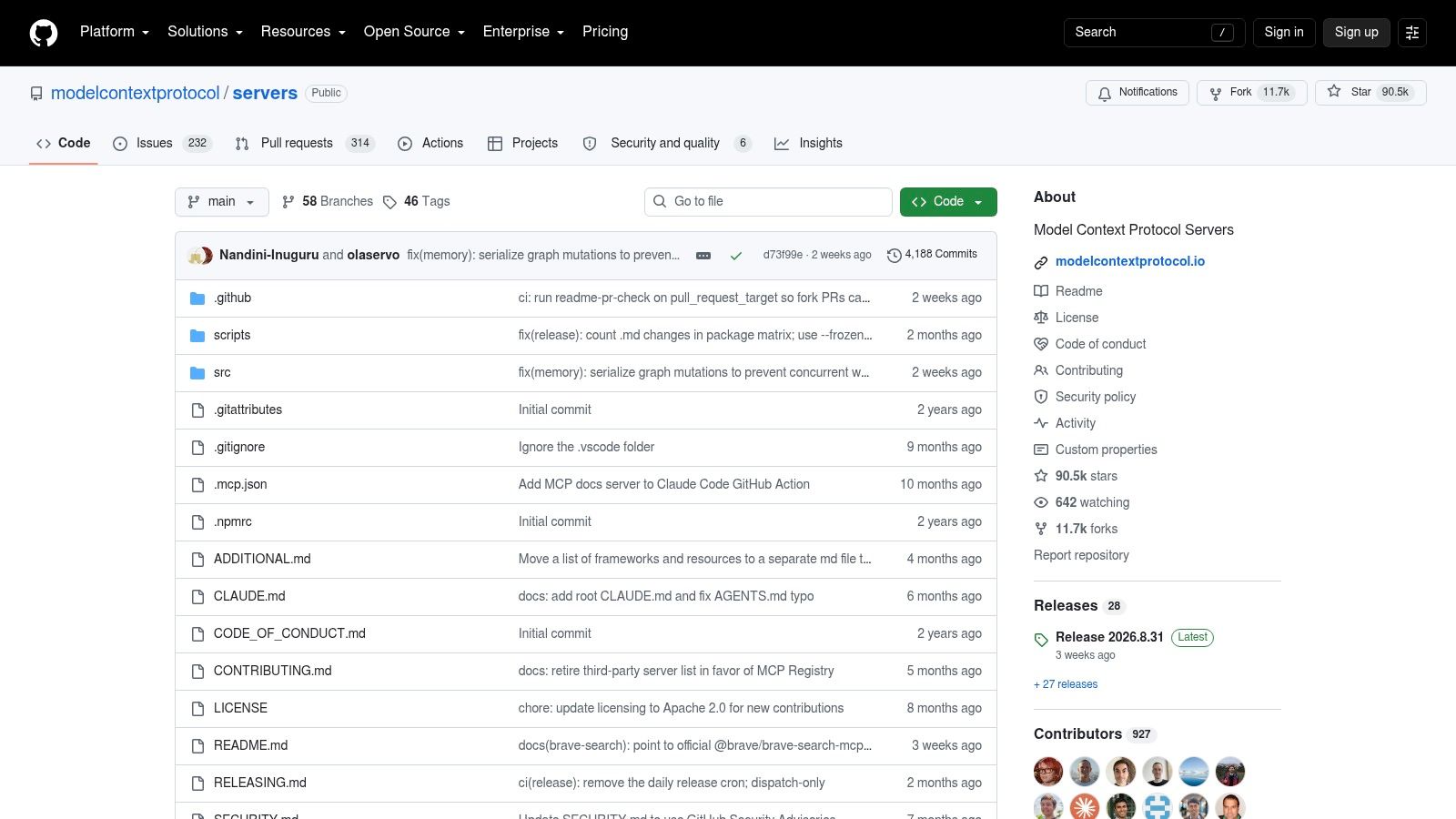
If the goal is to understand MCP correctly before wiring it into a production seller workflow, the Anthropic reference servers are still the baseline. They include practical primitives such as filesystem, fetch, git, time, memory, and database servers, which makes them valuable for developers testing client behavior, transport choices, and permission boundaries.
They rank second here because they're foundational, not because they solve Amazon seller operations directly.
Best for architecture and testing
These servers show what good MCP design looks like in practice. The filesystem server demonstrates roots-based access control. The fetch server converts pages into LLM-friendly markdown. The database servers cover common SQLite and Postgres patterns. For teams building internal adapters, that's a strong starting point.
The tradeoff is simple. Reference servers are examples and utilities, not an opinionated seller data layer. An Amazon operator still has to define the domain tools, host the components, manage credentials, and control how the agent crosses from read workflows into writes.
- Strong fit: Protocol learning, internal experimentation, security review, and custom MCP development.
- Weak fit: Ready-made Amazon Ads and Seller Central operations.
- Main burden: Hosting, permissions, and domain adaptation stay with the team.
A practical use case would be a developer prototyping an internal MCP tool that reads a pre-exported catalog file, checks it against a Postgres pricing table, and sends the result back to Claude. That's useful. It still isn't a replacement for hosted Amazon seller data access.
For teams that need the conceptual grounding before choosing a server, agentcentral's MCP server explainer helps frame why reference implementations and production data layers solve different problems.
Website: modelcontextprotocol/servers on GitHub
3. GitHub MCP Server
GitHub MCP ranks well for Amazon sellers only in a specific operating model: teams that build and maintain their own internal seller tooling. That makes it less broadly useful than a hosted seller data server, but often more relevant than general collaboration connectors if the operational risk sits in code, jobs, and deployment history.
The practical value is traceability.
An agency might ask an agent why marketplace margin reporting changed after last week's release. GitHub MCP gives the agent a path to inspect the repository, search the codebase, review pull requests, and check issue discussions tied to that change. That is a different job from querying Seller Central or Amazon Ads directly, but it can be the faster route to the root cause when the failure came from an internal parser, feed transformer, or attribution rule.
For Amazon operators, the fit comes down to where the system of record lives:
- If product, ads, and operational truth live mainly in Amazon platforms, GitHub MCP is secondary.
- If reporting logic, alerting, catalog automation, or bid tooling live in private repos, GitHub MCP becomes operational infrastructure.
- If non-technical account managers need business-ready access with minimal setup, a hosted MCP service is usually the better fit.
That difference matters because GitHub MCP is an official integration for software assets, not a seller-specific service layer. It covers repositories, issues, pull requests, discussions, and code search. It does not solve seller data normalization, sync design, or write controls for Amazon account actions.
Permissions also deserve more attention here than they usually get in generic MCP roundups. Read access to code can expose credentials, business logic, and client-specific workflows if repository boundaries are loose. Write access raises the stakes further because opening or editing issues is low risk, while changing code or automation paths belongs in a different approval model. For agencies handling multiple brands, that separation is often more important than feature breadth.
A sound deployment keeps software investigation and seller-account execution in separate tools with separate scopes. As noted earlier, the hard production problem is usually not getting tool access. It is limiting access to the smallest surface that still supports the workflow.
Website: GitHub MCP documentation
4. Slack MCP Server
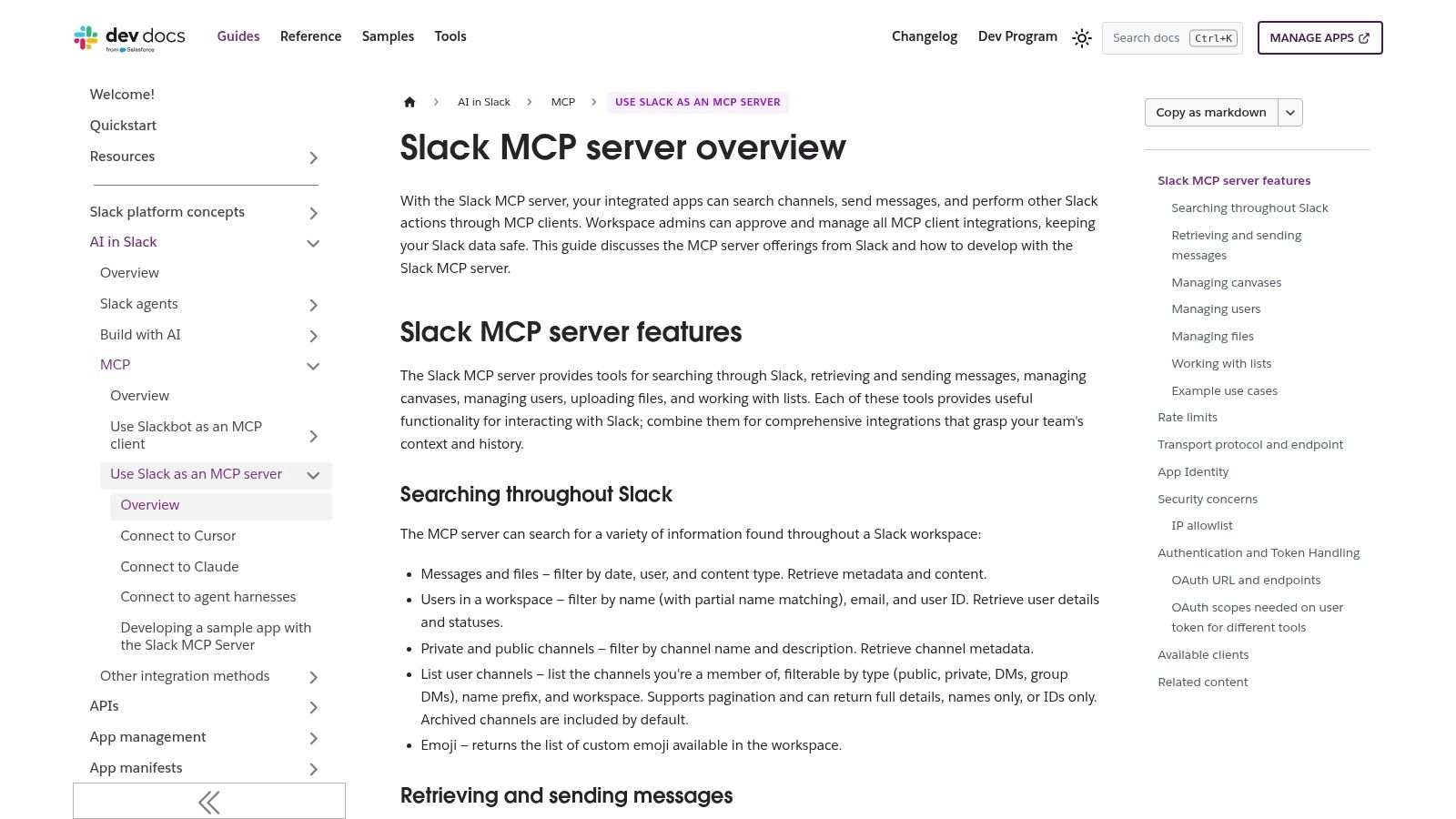
Slack is rarely the system of record for Amazon operations. It still ranks high for many seller teams because operational decisions often pass through Slack before anyone updates a spreadsheet, ticket, or dashboard.
That distinction matters for how to evaluate this MCP server. Slack's official MCP server is not a seller data layer, a sync engine, or an execution surface for Amazon account changes. It is a communication layer with first-party access to message history and posting workflows. For agencies, aggregators, and in-house teams that run launches, incident response, and approval chains in channels, that can be operationally valuable.
A concrete example makes the fit clearer. If an ASIN suddenly goes suppressed, the seller data system can confirm the status change. Slack MCP can then recover the surrounding context, who raised the issue, which team approved the last title edit, whether policy risk had already been discussed, and where the handoff stalled. That saves time during live investigations because the agent is not searching for facts and human context in separate places.
The strongest use cases are coordination-heavy:
- Incident review: Search channel history around stranded inventory, listing suppression, or buy box loss.
- Approval tracking: Find the latest ad budget, pricing, or catalog-change decision across threads and stakeholder groups.
- Closed-loop communication: Post a summary back into the right channel after an investigation or data pull.
For Amazon sellers, Slack MCP usually ranks below a hosted seller-focused MCP service if the goal is direct access to normalized account data, controlled write actions, or audit trails tied to commerce workflows. It ranks higher when the operating problem is fragmented communication across brand managers, agencies, creatives, and ops leads. In other words, Slack explains why a change happened, who approved it, and what was missed. Another system still needs to tell the agent what is happening inside Amazon.
There are also practical limits. Access depends on admin-approved scopes, which is good for control but adds setup work. Coverage is only as good as the team's Slack hygiene. Decisions made in private messages, off-platform calls, or poorly named channels are harder to recover and review later.
For that reason, Slack MCP is usually strongest as a secondary server in an Amazon stack. Pair it with a seller-specific data source when agents need both account facts and communication history. Used on its own, it improves context retrieval. Used with a data layer, it becomes a useful audit and coordination surface.
Website: Slack MCP server documentation
5. Notion MCP Server
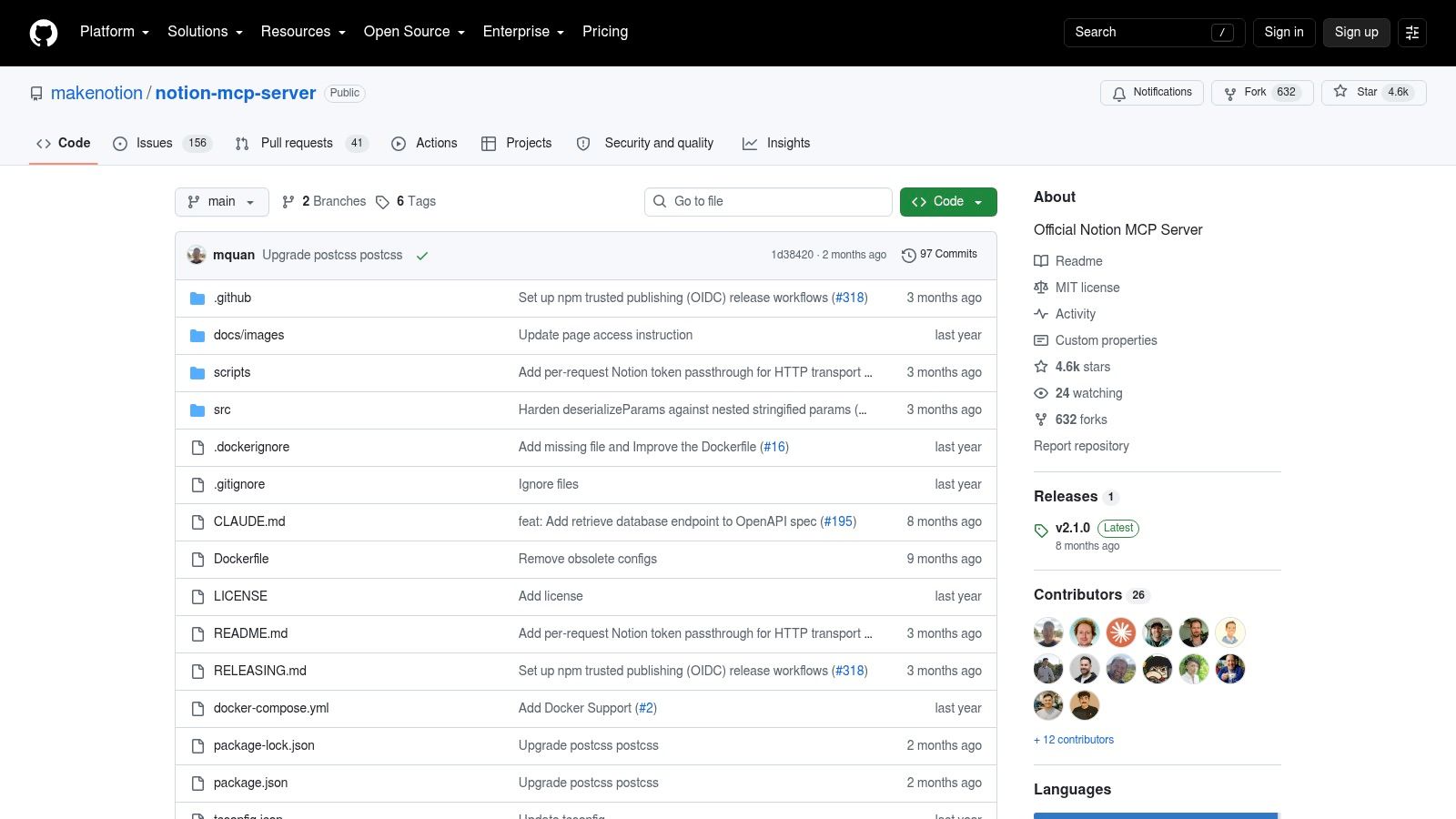
Notion ranks higher for Amazon operators than its general MCP popularity suggests. For seller teams and agencies, it can matter more than a code repository or payment tool because a large share of Amazon work runs on process documents, approval logs, launch trackers, and QA checklists rather than on APIs alone.
That makes Notion MCP a process layer, not an account telemetry layer.
A practical example is a launch database keyed by ASIN. An agent can query Notion for ASIN B0XXXX where Status = Ready for QA, pull the required checks for title, images, A plus content, and variation setup, then write the verification result back to the same record after catalog review. That is useful in agency environments where the operational question is not just what changed, but whether the team followed the documented release process before the change went live.
Notion's official MCP server supports CRUD actions across pages, blocks, comments, and databases. In Amazon workflows, that usually translates into three strong uses:
- Reading client SOPs before drafting a catalog update or escalation
- Querying structured launch or creative-review databases by owner, marketplace, or status
- Writing audit notes, approvals, and follow-up tasks back into the workspace
The operational tradeoff is less about generic permissions and more about data design. Notion works well when fields are predictable and teams use the database as a system of record. It gets weaker when one client tracks launches by ASIN, another by product name, and a third stores approvals in page text instead of database properties. In that setup, the MCP server still has access, but the agent has a harder time retrieving consistent answers or making safe updates.
Relative to Slack, Notion usually has better long-term structure and cleaner write targets. Relative to a seller-focused hosted MCP service, it has far less direct Amazon coverage. That puts it in the middle of an Amazon stack. Useful for documented process, approvals, and reusable operating context, but not the primary source for account state, inventory movement, or listing health.
Website: Notion MCP server on GitHub
6. Stripe MCP Server
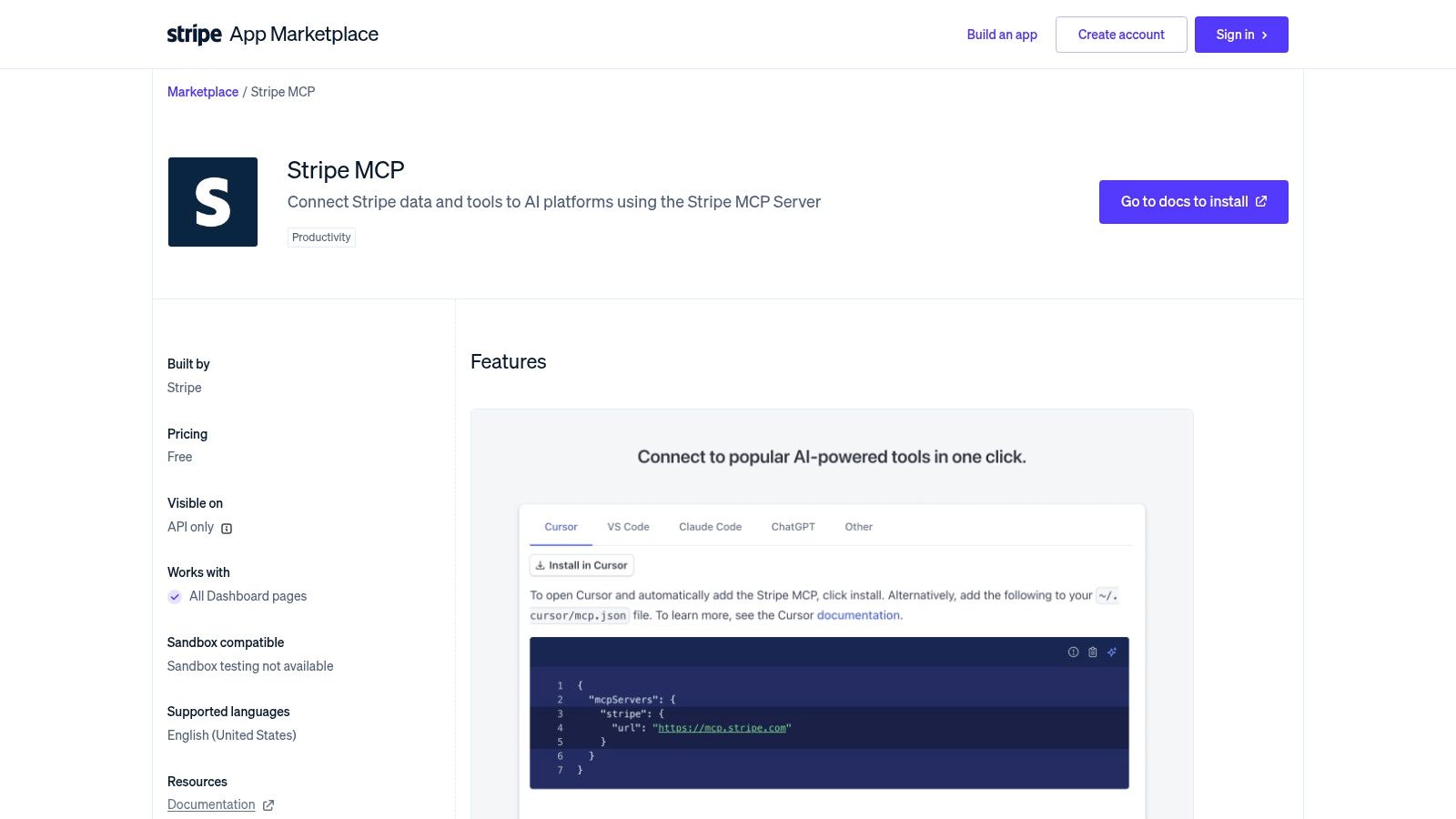
Stripe ranks this high for a narrow reason. For Amazon sellers, it is rarely core operating infrastructure. For agencies, SaaS vendors, and service providers that bill Amazon clients outside Seller Central, it can be one of the cleaner MCP deployments in the stack because the server is official, hosted, and tied to a single financial system.
That distinction matters in this list.
A popular MCP server is not automatically a good fit for Amazon operations. Stripe has limited value for catalog, ads, FBA, or account-health work, but strong operational fit for payment-side workflows where teams need fast access to customer, charge, product, and event data without standing up their own server.
A useful way to place Stripe is by transaction boundary. It helps before or after Amazon-side execution, not during it. An agency can generate a payment link for a new retainer, confirm whether a charge cleared before starting a bulk listing project, or inspect billing history while handling a support thread about paused service. A seller software company can use the same setup to check subscription status before granting access to reporting or automation features.
That makes Stripe stronger on delivery model than on Amazon coverage. Compared with self-managed MCP tooling, the hosted endpoint reduces setup and maintenance overhead. Compared with seller-focused hosted services, the data scope is much narrower and does not answer operational questions inside Amazon systems.
The practical upside is control around money flows. Stripe MCP exposes OAuth-backed tools for customers, products, payment links, charges, events, and documentation search. The practical limit is just as clear. It will not tell a team why inventory is stranded, whether a reimbursement case changed status, or which ASIN triggered a suppression.
For teams ranking MCP servers by operational fit, Stripe belongs in the stack only if billing actions sit close to service delivery.
Website: Stripe MCP on the Stripe Marketplace
7. Microsoft Playwright MCP Server
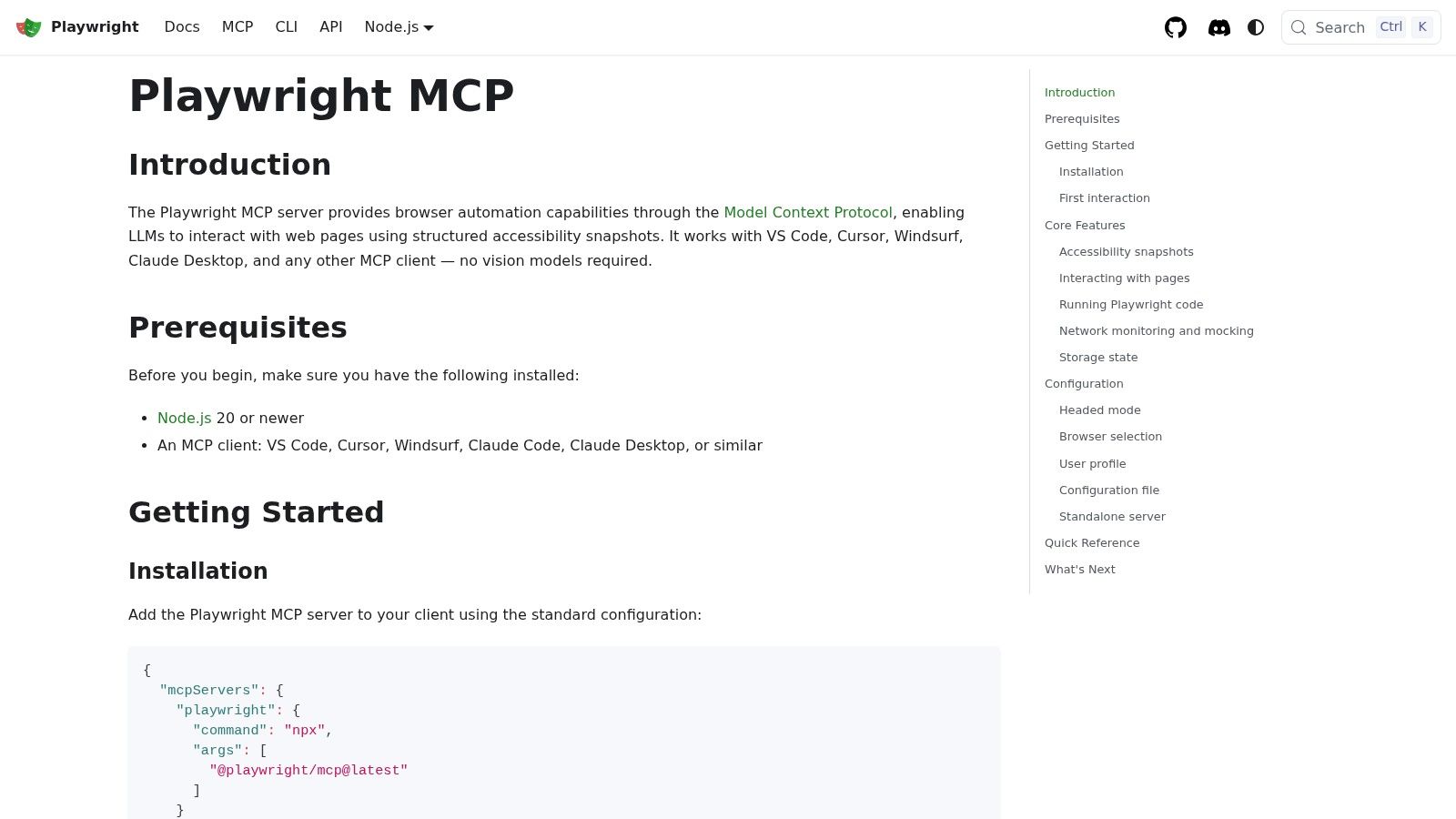
Playwright ranks lower for Amazon operators for a simple reason. It automates the browser layer, not the underlying seller data model.
That distinction matters in real workflows. An Amazon agency managing catalog fixes, inventory checks, and case follow-up usually needs structured reads, repeatable sync behavior, and tightly scoped actions. Playwright MCP gives an agent a controlled browser session with tools for navigation, clicks, form entry, screenshots, and extraction. Useful, but different. It is better suited to interface interaction and verification than to broad account intelligence.
A concrete seller scenario makes the tradeoff clearer. Suppose a team needs proof that a suppression notice appeared in Seller Central, or wants a screenshot of a reimbursement page before sending an escalation to a client. Playwright can help capture the page state and repeat the same inspection path later. If the same team wants fast, wide coverage across listings, inventory, ads, reimbursements, and account health, browser control is a slower and riskier foundation than a hosted seller-specific MCP service or an official API-backed integration.
The fit is strongest in three situations:
- UI-only checks where no clean API or structured MCP source exists
- Evidence capture, including screenshots and page-state validation for client reporting or internal QA
- Controlled automation of repetitive web tasks inside internal tools or support runbooks
The operational caveats are more important here than with the other servers in this list. Browser sessions expand the action surface. They also require stricter host allowlists, credential handling, and session controls if an agent can click through production interfaces. Token use can rise because the model must interpret rendered pages instead of querying structured objects. Write safety is also weaker by default. A browser can submit forms, but that is not the same as an MCP server designed around previews, typed actions, or auditable business operations.
So where does Playwright belong for Amazon sellers? At the edge of the stack. Use it for inspection, proof, and UI regression checks. Use official or seller-focused MCP servers for the systems of record.
Website: Playwright MCP documentation
Top 7 MCP Servers, Feature Comparison
| Name | Implementation complexity | Resource requirements | Expected outcomes | Ideal use cases | Key advantages |
|---|---|---|---|---|---|
| agentcentral | Low, hosted, OAuth setup in minutes | Subscription tiers (no self-hosting), API key; supports 23 marketplaces | Instant, pre-synced reads; cross-domain Amazon automation with auditable writes | Amazon sellers (FBA/private-label), ads/inventory/listing automation | Pre-synced fast reads, wide domain coverage, write safety (previews, idempotency, audit) |
| Anthropic reference MCP servers | Moderate, deploy and adapt reference servers | Self-hosted components, devops to run primitives (filesystem, fetch, DBs) | Baseline, secure MCP primitives and examples for integrations | Prototyping MCP integrations, learning spec best practices | Maintained by spec authors; clear security and transport examples |
| GitHub MCP Server (official) | Moderate, config and org/admin coordination | GitHub org permissions and tokens; integration setup | Structured repo, issue, PR and code-access for agents | Codebase automation, PR/issue workflows, DevOps tasks | First-party GitHub integration and toolchain alignment |
| Slack MCP Server (official) | Low–Moderate, admin approvals and scope configuration | Slack admin consent, scoped permissions, enterprise controls | Searchable messages/files, member data access, message posting for ops | Support desks, ops war rooms, internal knowledge lookup | Enterprise-grade security and granular permission model |
| Notion MCP Server (official) | Low–Moderate, workspace connection and schema handling | Notion workspace permissions, subject to API limits | CRUD on pages/blocks and DB queries/updates for document workflows | SOPs, product briefs, project trackers, content automation | Official support; fits document- and content-centric agent workflows |
| Stripe MCP Server (official, hosted) | Low, hosted OAuth endpoint, minimal setup | Stripe account and OAuth, transaction fees; no self-hosting needed | Payments/customers/products automation and docs search | Billing/reconciliation, payments ops, finance automation | Managed, secure hosted endpoint with direct Stripe API alignment |
| Microsoft Playwright MCP Server (official) | High, careful configuration and security controls | Headless browser infrastructure, higher compute and token use | Deterministic browser automation, interaction, screenshots, scraping | End-to-end web automation and QA when no API exists | Rich page interaction tools and stable browser automation maintained by Microsoft |
Choose by Data Risk and Operating Model
The best MCP servers stop looking interchangeable once production risk enters the conversation. Amazon seller workflows create that risk quickly because they combine ads, catalog, orders, inventory, finance, and fulfillment, often with agencies, contractors, and multiple clients involved. A server that works well for code search or note-taking can still be the wrong choice for a live Seller Central workflow.
Independent ecosystem reporting helps frame why this matters. By 2026, one enterprise survey cited by independent industry sources reported 41% of surveyed software organizations using MCP servers in limited or broad production, and related summaries described 12,000+ public MCP server repositories on GitHub with 86,148 stars on the core servers repository, as compiled in Digital Applied's MCP adoption statistics for 2026. The market has matured enough that buyers need to separate experimentation from operating fit.
For Amazon sellers and agencies, agentcentral is the best fit when the workflow needs fast repeated reads across Ads and Seller Central, retained history, scoped access, and guarded, audited writes. That combination lines up with how Amazon behaves. Amazon's SP-API doesn't expose one global fixed ceiling. It returns operation-level throttling through the x-amzn-RateLimit-Limit response header per account-application pair, and Amazon notes that the header may not include every usage-plan constraint, which is why production systems need to inspect the returned header on each response rather than assume a static limit, according to Amazon's SP-API usage plans and rate limits documentation.
The constraints get sharper in the report endpoints. Amazon documents getReports at 0.0222 requests per second with a burst of 10, createReport at 0.0167 requests per second with a burst of 15, and getReport at 2 requests per second with a burst of 15 in the Reports API rate limits documentation. That's why hosted, pre-synced reads matter so much for seller-facing MCP. It's also why “just let the agent poll Amazon directly” is usually poor advice.
The same pattern shows up in fulfillment and shipment writes. Amazon lists createFulfillmentOrder at 2 requests per second with a burst of 30 and processShipment at 1 request per second with a burst of 5 in the Fulfillment Outbound API rate limits documentation. Write tooling therefore needs back-off logic, previews, and clear audit trails.
Amazon's own operational guidance points the same way. It recommends logging complete API responses, including status codes, headers, and error messages, then categorizing errors such as 403 authentication issues and 429 rate-limit breaches, and building dashboards and alert thresholds to monitor workload health in the SP-API rate-limit optimization guidance. That's the right checklist before any team connects an agent to production data.
Choose the Anthropic reference servers when the job is learning MCP patterns, testing transports, or building internal adapters. Choose GitHub, Slack, Notion, Stripe, or Playwright when that system is the actual operational center of the task. Before rollout, check OAuth flow, API-key scope, refresh cadence, source-data lag, write previews, idempotency behavior, audit logs, permission boundaries, and total pricing. That's how teams pick the right MCP server, rather than the loudest one.
agentcentral gives Amazon sellers a hosted MCP server built for the workflows generic rankings usually miss. It connects Seller Central and Amazon Ads data to agents through structured reads, scoped access, and guarded writes with audit history. Teams comparing the best MCP servers for real Amazon operations can review the product directly at agentcentral.
Related Agent Central pages
- Amazon Seller Central MCP server
Canonical hosted MCP overview for Seller Central, Ads, inventory, catalog, finance, and fulfillment data.
- Amazon seller data for AI agents
How Agent Central normalizes Amazon seller data before exposing it to AI clients.
- Amazon seller MCP servers compared
How hosted MCP services compare with official Ads MCP, local repos, connector tools, and automation platforms.
- Connect Seller Central to Claude
Step-by-step path from Amazon OAuth to a Claude connector or MCP config.
- ChatGPT with Amazon seller data
ChatGPT-specific setup path for Amazon seller data through hosted MCP.
- Seller Central integration hub
Governed routes for Seller Central data into accounting, CRM, BI, and internal workflows.
Related reading
- Order Management Automation for Amazon Sellers Using AI
Automate Amazon order workflows with structured reads, exception handling, and guarded supported writes without polling live reports in every agent turn.
- AI Agents for Ecommerce on Amazon
Learn how Amazon operators can structure ecommerce agents around reliable data, narrow permissions, reviewed writes, and durable audit records.
- Online Arbitrage Software for Amazon Sellers
Evaluate online arbitrage software by matching quality, fee assumptions, price history, eligibility checks, and fit with structured Amazon seller data.
- Amazon Inventory Management for Operators
A technical Amazon inventory management guide covering days of cover, fulfillment tradeoffs, forecast inputs, guarded writes, and audit logs.
Connect Amazon seller data to your AI client.
Agent Central gives Claude, ChatGPT, OpenClaw, Cursor, and other MCP clients structured access to Amazon Ads, Seller Central, inventory, orders, catalog, finance, and fulfillment data.