
Amazon Ads Software Compared for AI Agent Workflows
Compare amazon ads software for AI agents. Evaluate latency, automation, auditability and MCP integrations to choose the right stack.

An Amazon seller asks an agent for today's spend, TACOS, and inventory cover. The agent starts polling for a report, waits through an asynchronous generation cycle, receives incomplete intraday data, and eventually times out. The seller still has to open Campaign Manager, export files, reconcile Ads with finance and inventory data, then decide whether the agent's answer can be trusted.
That failure usually isn't caused by the language model. It comes from the data path. Amazon Ads software built for human campaign management can expose useful controls while remaining a poor foundation for an agent that needs fast repeated reads, stable historical context, tightly scoped permissions, and an audit trail for every write.
The right comparison therefore goes beyond bids, keyword harvesting, and budget rules. It asks whether the software can supply reliable facts at the time an agent needs them, whether it covers the seller's wider operating data, and whether a human can review what changed before a workflow writes to an account.
Table of Contents
- Introduction Why Amazon Ads Software Choices Now Shape Agent Performance
- Understanding What Amazon Ads Software Covers Today
- How to Evaluate Amazon Ads Software for MCP and Agent Workflows
- Detailed Comparison of Amazon Ads Software Categories and MCP Tools
- Use Cases That Determine the Right Amazon Ads Software Stack
- Implementation Guide for Connecting Amazon Ads Software to AI Agents
- Recommendations for Choosing Amazon Ads Software by Team and Scale
Introduction Why Amazon Ads Software Choices Now Shape Agent Performance
A seller checking intraday TACOS needs more than an advertising dashboard. TACOS joins advertising cost with total sales, while inventory cover requires stock, orders, and velocity data. An agent can only answer that question cleanly when the underlying Amazon Ads, Seller Central, finance, and inventory records share usable time boundaries and consistent identifiers.
Amazon's API documentation sets a practical limit on expectations. Synchronous CRUD operations have a P99 guarantee of 30 seconds, asynchronous report generation has a P99 guarantee of 15 minutes, and impression or click events can take up to 12 hours to become available through the API. Invalidations can take up to 72 hours. These are platform behaviors, not edge cases an operator can solve by asking an agent to retry indefinitely. Amazon's API limits documentation gives the relevant latency and freshness boundaries.
Why feature lists miss the operational problem
Traditional Amazon Ads managers focus on campaign construction and optimization. They help operators adjust bids, allocate budgets, inspect search terms, and manage placements. Those functions still matter, but an agent introduces different failure modes:
- Stale inputs: The agent may act on data that excludes recent clicks or spend.
- Polling overhead: Repeated report requests consume time and can trigger throttling.
- Missing context: Ads data alone can't establish profitability, stock risk, or fulfillment constraints.
- Weak accountability: A write without before-and-after values leaves no dependable reconstruction of the decision.
Amazon Ads reporting requests are dynamically rate limited according to system load and the report-generation queue in each region. Rate-limited calls return HTTP 429, and Amazon recommends spreading report requests throughout the day in its reporting overview for API developers. An agent workflow that treats report generation as an instant database query will eventually encounter queue delays or throttling.
The evaluation question
The market has moved from Sponsored Products into a broader full-funnel advertising environment. Amazon's advertising services revenue reached $15.69 billion in Q2 2025, up 23% year over year, and represented 9.36% of Amazon's total revenue, the highest share recorded for the segment at that time, according to coverage of Amazon's advertising milestone.
That scale changes software requirements. Sellers need to evaluate not only whether a tool can optimize a campaign, but whether it can act as a dependable data layer for Claude, ChatGPT, OpenClaw, Cursor, or another MCP client. The strongest choice depends on the team's tolerance for latency, need for non-ads data, write sensitivity, and governance model.
Understanding What Amazon Ads Software Covers Today
Amazon Ads software began in a narrower operating environment. Amazon launched Sponsored Products in 2012, giving sellers a self-serve way to bid on keyword-targeted placements inside search results. Marketplace Pulse's account of Amazon's advertising expansion describes that launch as the foundation for a broader platform that now includes Sponsored Ads, display, video, and Amazon DSP.
The product surface now spans several related but distinct domains:
- Campaign management: Campaigns, ad groups, targets, products, bids, budgets, and delivery settings.
- Placement analysis: Performance by placement and supply context, where available.
- Search and targeting data: Search terms, targeting combinations, and classification fields.
- Full-funnel formats: Sponsored placements, display, video, and DSP workflows.
- Measurement: Purchases new to brand, purchase rate, cost per purchase, CTR, CPC, video completion rate, cost per completed view, and CPM.
- Reporting access: Campaign Manager, Report Center, API reporting, and Amazon Marketing Stream for supported hourly-grain data.
Amazon Ads' benchmark reporting covers eight core performance metrics across major ad products, creating a normalized layer for comparing campaigns and formats. The Amazon Ads benchmarks announcement lists the covered measures, including new-to-brand purchase metrics, CTR, CPC, video completion measures, and CPM.
Format breadth creates measurement debt
A tool can expose many ad formats and still leave operators with fragmented measurement. Ads may sit across accounts, countries, products, targeting types, and supply combinations. An agency or brand team then has to reconcile advertising records with orders, finance, inventory, and fulfillment data before an agent can answer a business question rather than a campaign question.
Amazon's unified reporting work addresses this fragmentation by combining data across ad products, accounts, countries, and supply or targeting combinations. Amazon also says the legacy Sponsored Ads reports and Amazon DSP reports pages will be sunset on December 31, 2026, as described in its unified reporting announcement.
The important conclusion is that measurement architecture now matters more than another bid control for larger sellers. Limited historical access, inconsistent metric definitions, and manual exports make year-over-year analysis and governance fragile. A software buyer should first map the required data joins, then check whether the product supports them without forcing an agent to rebuild the reporting layer on every request.
For a concise explanation of the protocol that connects clients to hosted tools, see what an MCP server is. MCP compatibility matters because it determines whether an agent can call structured tools directly, rather than relying on brittle browser steps or ad hoc file handling.
How to Evaluate Amazon Ads Software for MCP and Agent Workflows
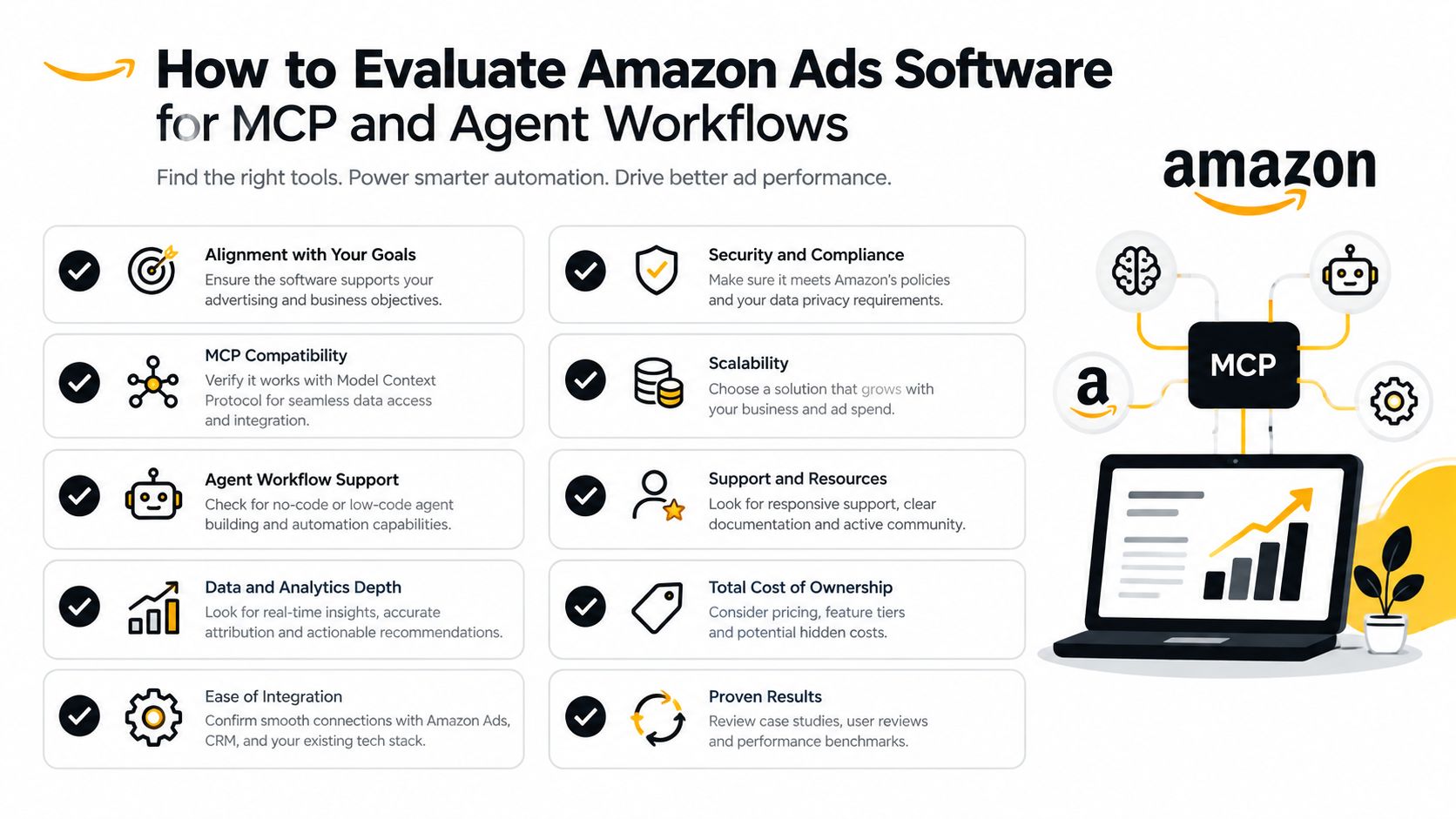
Agent readiness is an operational property, not a marketing label. A product can advertise automation and still perform poorly when an agent needs repeated reads, cross-domain joins, or controlled writes.
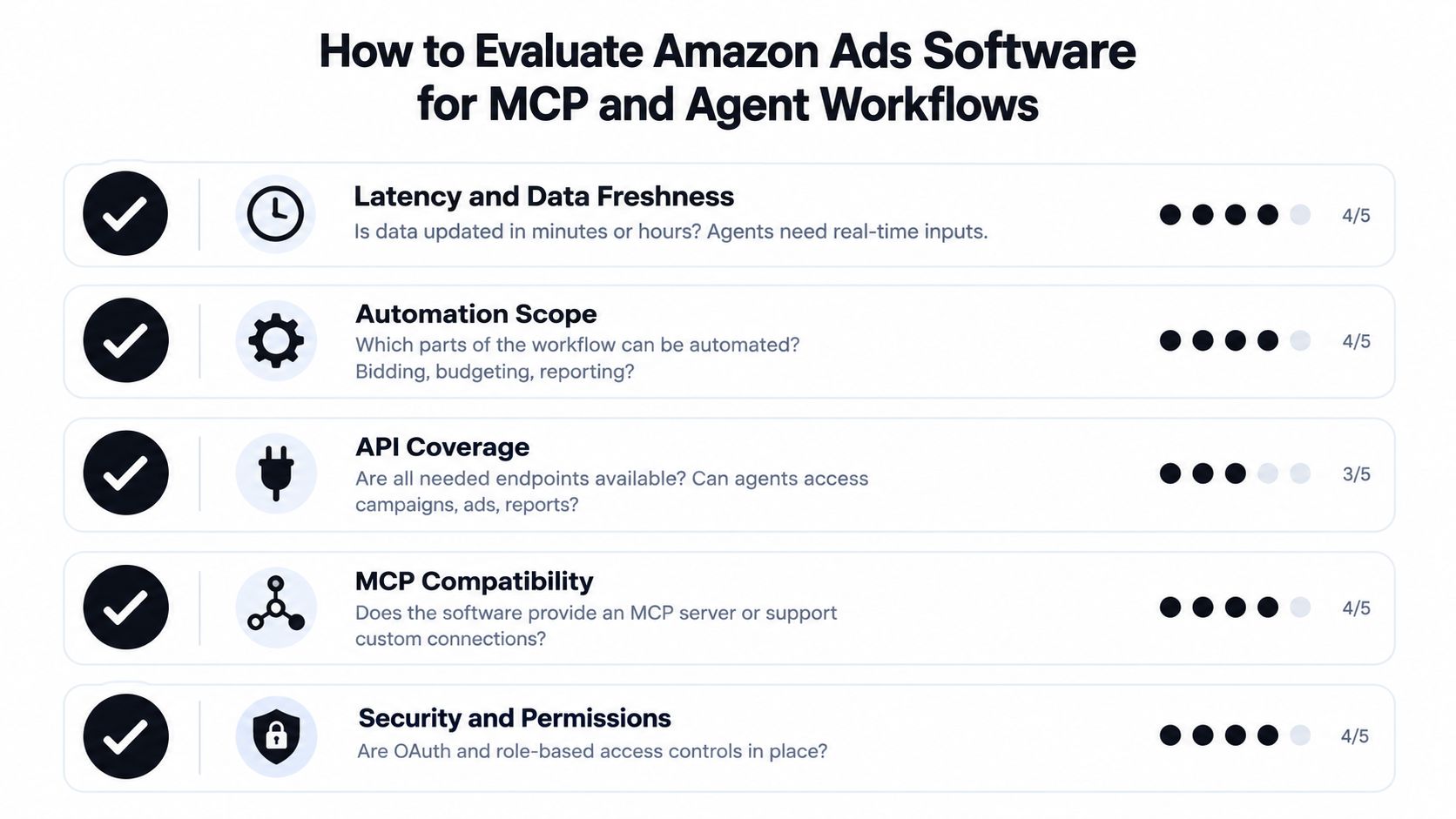
Five criteria expose the difference.
Latency and data freshness
The first question is whether a read returns from pre-materialized data or starts a new report job. Amazon Marketing Stream can provide hourly-grain traffic, conversion, and budget-usage data through the API, which suits pacing and monitoring workflows. Amazon describes these capabilities in its benchmark and reporting data update.
That still isn't equivalent to instant access to every field. An evaluation should record the source timestamp, ingestion timestamp, update cadence, and known lag for each metric. Agents need those timestamps so they can distinguish “no spend occurred” from “spend data has not arrived.”
Automation scope
Automation can mean scheduled reporting, bid changes, budget changes, creative operations, or a recommendation queue. Those functions carry different risks. A reporting tool can usually operate with read access, while a budget write needs scope limits, an approval path, and a record of the prior value.
The product boundary must remain explicit. A data layer returns facts, metrics, classifications, and source-provided fields. The agent or workflow decides what those facts mean and whether a change is justified.
Auditability and write guardrails
Every write should expose the requested action before execution, identify the account and object, show the before value, and record the after value. Idempotency protection matters when an agent retries after a timeout, because a repeated request must not create an unintended second change.
Practical rule: If an operator can't reconstruct who requested a change, which data supported it, and what value existed before execution, the workflow isn't ready for unattended writes.
Integrations and data coverage
Amazon Ads data becomes more useful when joined with Seller Central orders, inventory, catalog, finance, ranking, and fulfillment records. A campaign manager may be sufficient for a PPC-only question. It won't answer whether a high-spend product has enough stock to support continued demand without access to inventory and order context.
Coverage should be tested with real questions, not a feature checklist. Examples include “show spend by SKU beside gross sales,” “find campaigns driving products with low cover,” and “compare current pacing with retained historical periods.”
Access controls
Public Amazon applications use OAuth 2.0 through Login with Amazon, while private applications can self-authorize. Amazon says the process issues an LWA refresh token that must be renewed annually, and access tokens are short-lived credentials used in API calls, as documented in the SP-API onboarding overview.
A hosted MCP workflow should add its own controls, including scoped API keys, isolated datasets, revocable access, and separate read and write permissions. Agents shouldn't receive broader authority than the task requires.
Detailed Comparison of Amazon Ads Software Categories and MCP Tools
The useful comparison is between operating models, not logos. Traditional PPC managers, broad suites, first-party Amazon interfaces, and hosted MCP data layers solve different parts of the problem.
| Software Category | Latency and Freshness | Automation and Writes | Auditability and Guardrails | Data Coverage |
|---|---|---|---|---|
| Traditional Amazon Ads manager | Dashboard and report timing depend on Amazon's interfaces and report availability | Strong for human-directed campaign operations, varies for automated changes | Often centered on account history and user activity, write controls vary | Primarily advertising data |
| Full-suite PPC platform | May normalize multiple ad views, but freshness depends on connectors and sync jobs | Often supports bid, budget, targeting, and reporting workflows | Depends on approval, change history, and permission design | Broader PPC coverage, usually limited outside advertising |
| Amazon first-party Ads MCP Server | Direct access can still inherit API latency, report generation delays, event lag, and throttling | Can expose Ads operations to an agent, subject to API permissions and tool design | Requires explicit workflow controls around proposed and executed writes | Amazon Ads focused |
| Hosted seller data layer such as agentcentral | Pre-materialized reads and retained history can avoid repeated report polling for supported data | Structured reads plus guarded writes, previews, idempotency, and logged before-and-after values | Scoped keys, isolated datasets, revocable access, and audit logs | Amazon Ads joined with Seller Central, inventory, orders, catalog, ranking, finance, and fulfillment data |
Traditional campaign managers
A conventional Amazon Ads manager remains practical for operators who need visual control over campaigns, placements, search terms, budgets, and bids. It's often the right tool when a human reviews changes directly and the task stays inside advertising.
Its weakness appears when an agent needs many repeated reads across accounts or time periods. Manual exports and interface-specific history create an external data-engineering burden. The tool may show the right metric while offering no durable way to expose its provenance, freshness, or relationship to inventory and finance records.
Full-suite PPC platforms
A full-suite PPC platform can reduce the work of managing multiple advertising channels and standardize campaign operations. Its value is strongest when the team wants a familiar optimization workspace and cross-channel reporting.
That breadth shouldn't be confused with seller data coverage. A PPC suite may normalize ad data without carrying order, reimbursement, inventory, catalog, or fulfillment context. For an MCP workflow, the key question is whether the platform offers structured access to the required fields and supports agent-compatible permissions, not whether its dashboard contains many charts.
Amazon's first-party Ads MCP option
A first-party Ads MCP Server can provide direct access to Amazon Ads capabilities through an agent-facing interface. Direct access reduces one layer of abstraction, but it doesn't erase Amazon's API behavior. Report generation remains asynchronous, events can arrive later, and dynamic rate limits can return HTTP 429 responses.
This pattern suits a developer team that wants to own orchestration, storage, retries, validation, and audit design. It places more responsibility on that team to build pre-materialized tables, retain history, control report schedules, and prevent unsafe retries.
Hosted seller data layers
A hosted seller data layer such as agentcentral is designed around the repeated-read problem. It provides a hosted MCP server for structured access to Amazon Ads alongside Seller Central, inventory, orders, catalog, ranking, finance, and fulfillment data. Its stated operating model uses daily pre-sync, retained history from connection, scoped access, guarded writes, write previews, idempotency keys, and logged before-and-after values.
That model doesn't make the layer a recommendation engine. It returns facts and guarded operations, while the seller's agent or workflow decides whether a bid, budget, listing, or fulfillment action makes sense.
For campaign strategy and conventional operating guidance, Amazon Ads optimization workflows can sit beside the data-layer decision. The distinction matters: optimization software helps execute a strategy, while an MCP data layer determines whether an agent can inspect the evidence reliably before execution.
Use Cases That Determine the Right Amazon Ads Software Stack
The correct stack depends on the question an operator needs answered. Five workflows expose the differences quickly.
Intraday pacing
A pacing agent needs spend, impressions, clicks, conversions, and budget usage with a clear freshness timestamp. Amazon Marketing Stream supports hourly-grain traffic, conversion, and budget-usage data through the API, making it relevant for intraday monitoring. The agent still needs to label delayed fields and avoid treating absent events as zero activity.
A first-party API integration can work when a developer team owns stream consumption, storage, retry logic, and alerting. A hosted data layer is more suitable when the team needs an MCP endpoint without maintaining that infrastructure.
TACOS with financial context
TACOS analysis joins advertising cost with total sales. The Ads API alone can't establish the denominator, and a campaign dashboard won't automatically explain how sales, fees, reimbursements, or product-level profitability affect the conclusion.
The stack should therefore expose Ads and finance data through consistent product and date keys. Without retained history, the agent may answer a current-period question but fail to compare the same products across earlier periods.
Inventory-aware advertising
A bid decision can't be evaluated in isolation when inventory cover is constrained. The workflow needs advertising performance, orders, available stock, inbound units, and a defined cover calculation. The agent can then present the facts for a human-approved rule or a guarded workflow.
A PPC-only suite is often insufficient here. A seller data layer with inventory and fulfillment coverage reduces the number of disconnected calls and makes the joined result easier to validate.
Agency governance
An agency managing several seller accounts needs isolation between datasets, scoped keys, account-level permissions, and an audit log that records every write. Shared credentials and broad permissions create avoidable ambiguity when several operators or agents can act on the same portfolio.
The agency also needs retained history for client reporting. If historical data exists only in manually exported files, an agent can't reliably reproduce a prior decision or explain why a budget changed.
Developer-built MCP automations
A developer team may prefer direct Amazon APIs because it controls the architecture. That choice makes sense when the team wants to own data models, queues, backoff behavior, freshness checks, and approval services.
Teams that don't want to build those components can use a hosted MCP data layer instead. The meaningful comparison is not “custom versus hosted” in the abstract. It's who owns the operational burden when reports throttle, tokens expire, schemas change, or an agent retries a timed-out write.
Implementation Guide for Connecting Amazon Ads Software to AI Agents
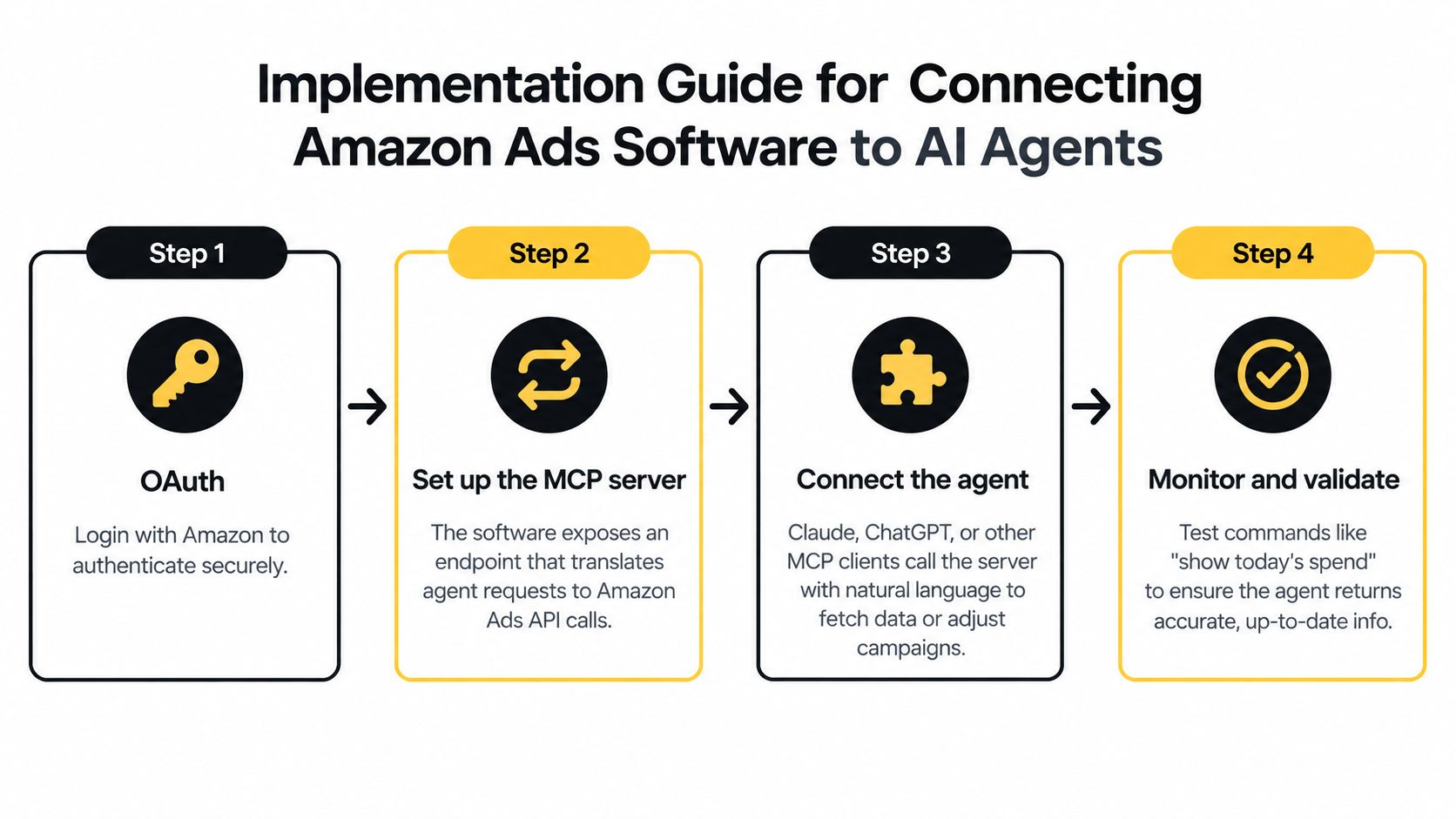
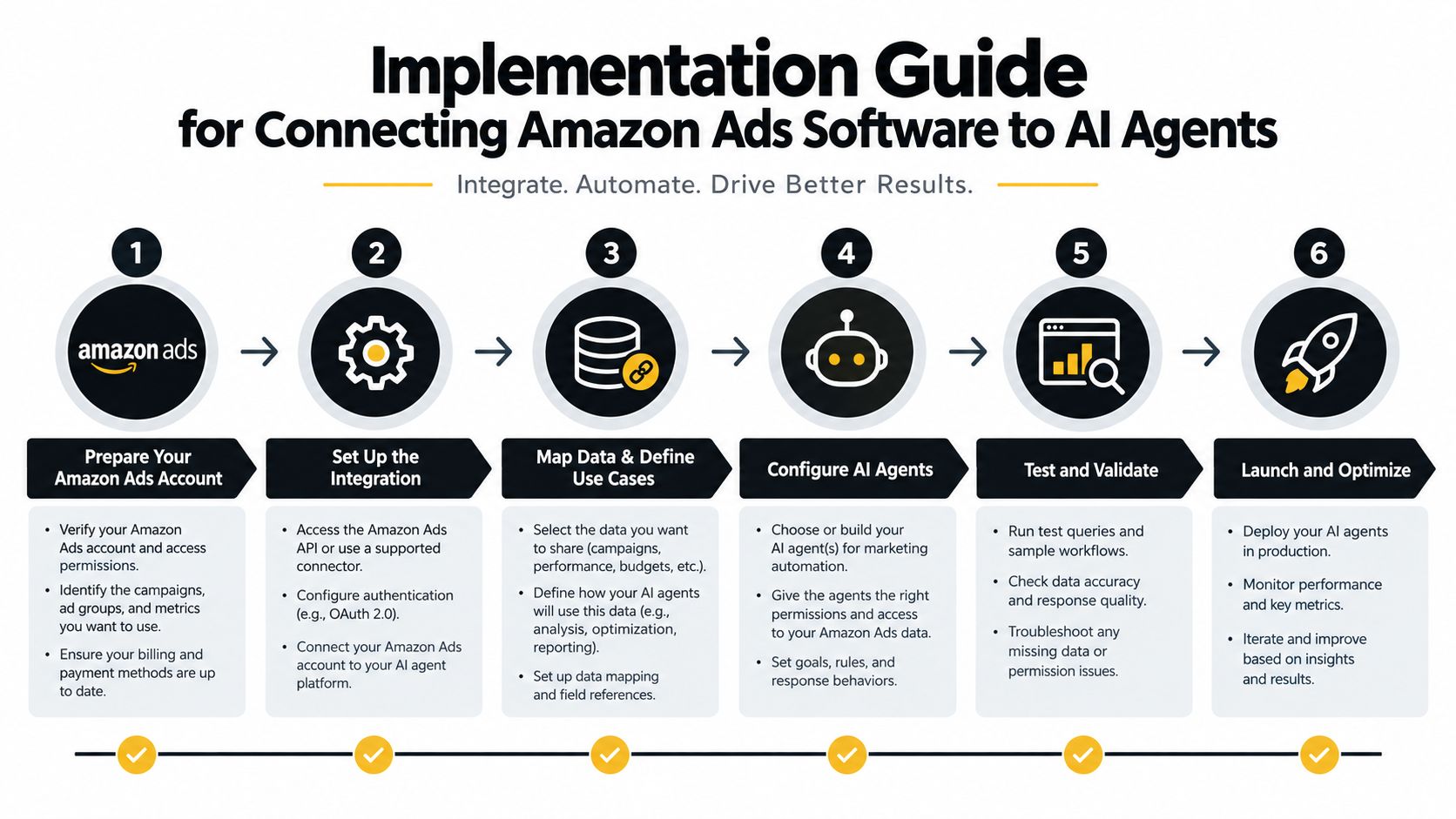
A safe implementation starts with authentication and ends with validation. The MCP connection is only one component of the operating design.
Authenticate with the narrowest practical scope
Use Login with Amazon OAuth for public applications or the appropriate private-application authorization path. Store refresh tokens securely, monitor renewal requirements, and issue short-lived access tokens for API calls. Amazon states that LWA refresh tokens require annual renewal, so token maintenance belongs in the runbook rather than in an afterthought.
Scoped API keys should separate accounts, environments, and read versus write access. An agent that only reports spend shouldn't receive permission to alter bids or budgets.
Expose structured tools through MCP
A hosted MCP endpoint translates an agent request into a structured data call. Tool descriptions should identify accepted filters, date semantics, freshness fields, pagination behavior, and whether a result comes from pre-materialized data or a live API request.
The client can be Claude, ChatGPT, OpenClaw, Cursor, or another MCP-compatible application. The interface should return structured records that workflows can validate, not prose that hides missing fields.
Pre-sync and retain the records agents repeatedly need
Daily pre-sync and retained history are valuable because repeated reads shouldn't regenerate the same asynchronous report. Historical retention also supports comparisons that Amazon's interface or a connector may not preserve conveniently.
Freshness must remain visible. A retained record is useful only when the agent knows its observation period and last synchronization time.
Put writes behind reviewable controls
A write workflow should produce a preview containing the account, object, requested field, current value, proposed value, and reason supplied by the user or workflow. Idempotency keys prevent retry loops from applying the same change more than once.
Before and after values should enter an audit log with the actor, timestamp, tool call, and source data references. That record lets an operator reverse-engineer a change when an agent times out after submission.
Write controls should assume that timeouts create uncertainty. A timeout means the client lacks confirmation, not that Amazon rejected the request.
Test reads before enabling writes
Start with deterministic checks such as “show today's spend,” “return budget usage by campaign,” and “list products with advertising spend and low inventory cover.” Compare results against the relevant Amazon interface or source report, and verify timestamps, account filters, currency treatment, and missing-value behavior.
The operational checklist described in Amazon Ads automation guidance should be treated as a control exercise, not merely a connection exercise. Writes belong in a later phase, after read accuracy and permission boundaries have been verified.
Recommendations for Choosing Amazon Ads Software by Team and Scale
Solo sellers usually need a reliable reporting path before they need complex bid automation. A conventional Amazon Ads manager may be enough for hands-on campaign work, while an MCP data layer becomes useful when the seller wants one agent to join Ads with orders, inventory, finance, and fulfillment.
Growing brands should prioritize retained history, freshness metadata, and cross-domain identifiers. A full-suite PPC platform can support campaign execution, but it shouldn't be selected as the sole operating layer if the agent must answer business questions outside advertising.
Agencies need isolation and accountability first. Scoped keys, account boundaries, approval-based writes, and before-and-after logs matter more than another optimization rule when multiple clients and operators share a workflow.
Developer teams should choose direct API ownership when they're prepared to operate queues, retries, schemas, token renewal, historical storage, and audit services. A hosted MCP data layer fits when the team wants structured access and guarded operations without building the synchronization and governance stack itself.
The product boundary stays important. agentcentral returns structured Amazon Ads and seller data, classifications, source-provided fields, and guarded write tools. It doesn't decide which bid to change or autonomously optimize an account. The user's agent or workflow makes that judgment.
Choose software by the failure it prevents: report polling, missing history, disconnected seller data, excessive permissions, or untraceable writes.
The decision checklist is short:
- Choose a PPC manager for direct human campaign control.
- Choose a full-suite PPC platform for broader advertising execution.
- Choose a first-party Ads MCP integration when the development team owns the data and safety infrastructure.
- Choose a hosted seller data layer when agents need fast repeated reads across Ads and Seller Central with scoped access and auditability.
agentcentral provides a hosted MCP server for structured Amazon Ads, Seller Central, inventory, orders, catalog, finance, ranking, and fulfillment data, with pre-materialized reads and guarded, logged writes. Teams evaluating Amazon Ads software for agent workflows can review the data-layer approach and connect through agentcentral to test whether their agents can return timely, auditable facts before any controlled action is enabled.
Related Agent Central pages
- Amazon Seller Central MCP server
Canonical hosted MCP overview for Seller Central, Ads, inventory, catalog, finance, and fulfillment data.
- Amazon seller data for AI agents
How Agent Central normalizes Amazon seller data before exposing it to AI clients.
- Connect Seller Central to Claude
Step-by-step path from Amazon OAuth to a Claude connector or MCP config.
- ChatGPT with Amazon seller data
ChatGPT-specific setup path for Amazon seller data through hosted MCP.
- Amazon Ads MCP server
Campaign, keyword, search term, budget, TACOS, and guarded ads-write tools.
- Ads tool reference
Parameter-level docs for Amazon Ads campaign, keyword, search term, budget, and TACOS tools.
Related reading
- Software for Amazon FBA: An Operator-Focused Guide
Software for Amazon FBA explained for sellers, agencies, and developers. Compare tool categories, evaluation criteria, MCP integration, and migration steps.
- Amazon Ads Optimization with MCP Agents: A Practical Guide
A practical guide to Amazon ads optimization with MCP agents, covering audits, bidding, experiments, and auditable writes for Claude and ChatGPT workflows.
- How Sponsored Amazon Ads Work
Compare Sponsored Products, Sponsored Brands, and Display ads, including targeting, reporting windows, Seller Central context, and guarded writes.
- AI Tools for Amazon Sellers: Operator's Guide
Compare AI tools for Amazon sellers across ads, inventory, pricing, and research, with practical criteria for data access, controls, and workflow fit.
Connect Amazon seller data to your AI client.
Agent Central gives Claude, ChatGPT, OpenClaw, Cursor, and other MCP clients structured access to Amazon Ads, Seller Central, inventory, orders, catalog, finance, and fulfillment data.