
PPC E Commerce Automation with MCP and AI Agents
Build automated PPC e commerce workflows using MCP. Connect Amazon Ads and Seller Central data to AI agents for faster, auditable campaign management.
Most ppc e commerce advice still treats manual keyword bidding as the main path to better performance. That assumption made sense when search terms and bid adjustments were the clearest controls available. It's less useful now, because Amazon advertising performance depends heavily on whether the right products are eligible, profitable, in stock, accurately represented in the catalog, and supported by reliable data.
The operational problem has shifted. An AI agent can review a catalog, compare advertising economics with inventory, and prepare controlled changes, but only when the underlying data layer handles Amazon's throttling, delayed reports, changing attribution, scoped access, and audit requirements. Without that foundation, automation just makes unreliable reads and unsafe writes happen faster.
Table of Contents
- The Shift from Keywords to Catalog Economics
- Overcoming Amazon SP-API Rate Limits and Data Lag
- Connecting Seller Central to MCP Clients
- Automating Budget Pacing with Inventory Data
- Guardrails for Agent-Initiated Bid and Budget Writes
- Transitioning to Exception-Based Campaign Management
The Shift from Keywords to Catalog Economics
Manual keyword work still has a place in Amazon PPC, especially for search-term discovery, query analysis, and diagnosing relevance. It shouldn't be treated as the primary operating model for a large catalog. Shopping-led advertising and automated campaign types make product eligibility, feed quality, price, margin, and inventory status more important than an isolated bid adjustment.
Retail advertising has already moved toward product-led systems. Google Shopping ads account for 85.3% of retail search ad clicks and 76.4% of retail search ad spending, according to paid search platform comparisons from Stackmatix. Those figures describe Google rather than Amazon, but the operational implication applies to marketplace advertising: the product record and catalog signal increasingly determine what the platform can match, serve, and learn from.
A retailer can lower a bid on an inefficient target and still lose money if the advertised ASIN has weak contribution margin, poor conversion assets, or insufficient stock. Conversely, a product with a higher click cost may deserve more exposure if its margin and inventory position support profitable demand capture.
The product eligibility question
The more useful question for catalog-scale PPC isn't “Which keyword should be bid up?” It's “Which products should be advertised under the current economics?”
A 2026 PPC trend analysis reports that 68% of online retailers exclude products from PPC campaigns based on profitability criteria, while 89% of those filters are price-based, as reported in Visionary Marketing's e-commerce PPC guide. The figures point to a practical operating pattern. Advertisers are increasingly deciding whether a product belongs in paid media before debating how aggressively to bid on it.
A catalog eligibility model can classify products using fields such as:
- Contribution margin: Exclude products whose current economics cannot absorb advertising cost.
- Inventory position: Reduce exposure when available stock is insufficient for expected demand.
- Catalog quality: Flag missing attributes, weak titles, suppressed listings, or incomplete images before increasing traffic.
- Commercial priority: Separate hero products, margin drivers, clearance items, and products that should remain organic-only.
- Marketplace status: Prevent spend on products that are unavailable, restricted, or not buyable.
This is also where product discoverability and structured information overlap with paid media. Teams evaluating how to optimize Amazon for AI search can apply the same discipline to advertising feeds, because clear product entities help both automated systems and human shoppers understand what a listing represents.
Why click metrics are incomplete
CPC and CTR remain useful diagnostics, but neither metric answers whether an ASIN should receive more budget. A low CPC can accompany weak conversion and poor margin. A high CTR can indicate curiosity rather than purchase intent. A rising ROAS can still conceal a product that contributes little profit after fees, discounts, fulfillment, and returns.
A practical PPC e commerce operating model therefore separates two decisions:
- Eligibility: Should the product be present in advertising at all?
- Allocation: Given eligibility, how much exposure should the product receive?
Keyword data supports the second decision. Catalog economics controls the first. Applying an AI agent before defining those rules is risky, because the agent may optimize the wrong objective with greater consistency.
Overcoming Amazon SP-API Rate Limits and Data Lag
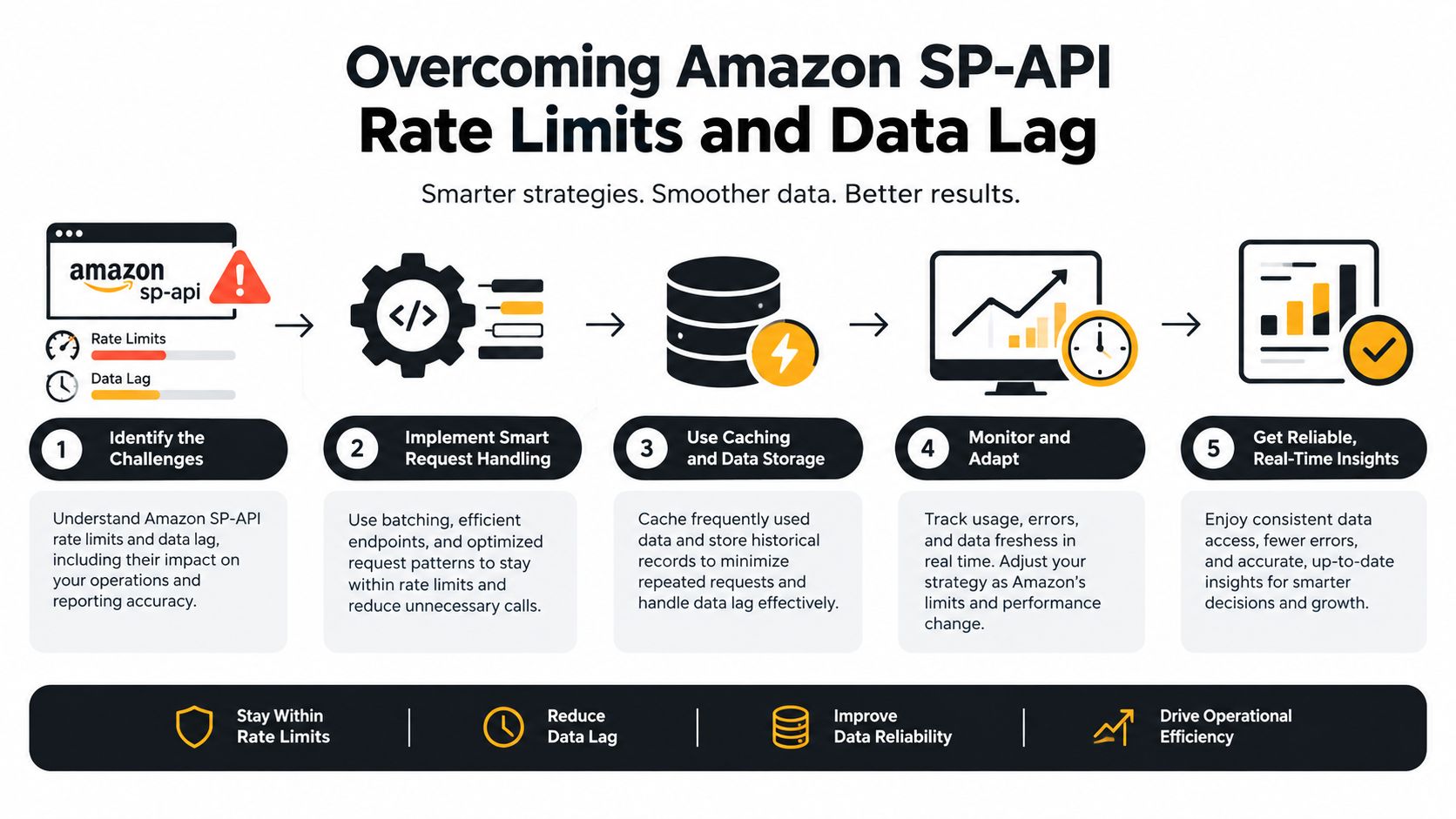
Direct API access looks attractive until an agent needs several reports across ads, orders, inventory, and finance at the same time. Amazon's reports workflow is asynchronous, and each stage has its own throttle. Amazon's SP-API rate-limit documentation lists getReports at 0.0222 requests per second with a burst of 10, createReport at 0.0167 requests per second with a burst of 15, getReport at 2 requests per second with a burst of 15, and getReportDocument at 0.0167 requests per second with a burst of 15.
That distinction matters. An agent that creates a report, polls its status, retrieves its document, and repeats the sequence for multiple marketplaces can hit separate limits during creation, polling, and download. A workflow may appear healthy in a small test and then time out when a seller asks for a catalog-wide comparison.
Why pre-materialized reads work better
A reliable MCP data layer treats report generation as a scheduled ingestion problem, not an interactive chat operation. It fetches source reports ahead of time, stores normalized records, retains source fields, and exposes fast reads from prepared datasets. The agent then queries a stable representation instead of waiting for Amazon to generate a new report for every question.
That architecture also supports historical comparison. A seller may need to compare spend, sales, inventory, and listing status across the same date range repeatedly. Re-running the entire report pipeline wastes quota and creates inconsistent snapshots. Caching and retaining prior pulls gives the agent a repeatable basis for analysis.
Teams dealing with catalog changes can also review practical guidance on how to sync product data to Amazon, particularly when feed accuracy affects downstream advertising decisions. The data layer should preserve the relationship between the product record, the ASIN, the campaign target, and the time at which each field was observed.
Freshness is part of the metric definition
Amazon Ads data isn't uniformly current. Amazon documents that some DSP reports have a 2-day data lag, while unified reporting has a 1-day lag, and some campaign management and dashboard views can still lag by up to 24 hours, as described in Amazon Ads reporting guidance.
Sponsored Products attribution also changes after the initial read. Conversion data is attributed to the click date rather than the purchase date, and Amazon forum guidance describes recalculation at the 1-day, 7-day, and 14-day marks in the reporting discussion on attribution timing. An auditable system must therefore preserve retrieval timestamps, attribution windows, and historical versions instead of treating the first result as final.
The internal SP-API reporting architecture guide provides a useful reference point for teams designing this separation between ingestion, normalization, and agent-facing reads. The core principle is simple: agents should read prepared data quickly, while the ingestion layer absorbs Amazon's timing and quota constraints.
Connecting Seller Central to MCP Clients
A hosted MCP connection should begin with access design, not with a prompt. Amazon sellers typically need different combinations of advertising, catalog, inventory, orders, finance, ranking, and fulfillment data. A single unrestricted credential makes troubleshooting and governance harder because every client can potentially reach every domain.
A controlled connection path
A practical setup follows this sequence:
- Authorize the seller account with OAuth. The seller grants the required Amazon permissions through the authorization flow. OAuth keeps credentials out of client prompts and gives the account owner a defined place to revoke access.
- Select operational scopes. An ads manager may need campaign performance, targets, budgets, and product context. An operations workflow may need inventory, orders, and fulfillment without access to advertising writes.
- Create a domain-scoped bearer token. The token should expose only the datasets and tools required by that workflow. Read-only access is the default for initial testing.
- Add the hosted MCP endpoint to the client. Claude, ChatGPT, OpenClaw, Cursor, and other MCP clients can use the endpoint as a structured tool source rather than receiving raw API credentials.
- Run a read-only verification. The agent should retrieve account identity, marketplace context, campaign records, and a small set of inventory fields before any write capability is enabled.
The OAuth sequence and permission model can be documented alongside the MCP OAuth setup guide. The important implementation detail is that an API key identifies a controlled access path, not a reason to bypass least-privilege design.
What the agent should receive
The client should receive structured fields with clear provenance. A campaign response might include campaign ID, status, budget, target, spend, sales, clicks, impressions, ACOS, ROAS, and the relevant date range. Product responses should identify the ASIN, SKU, availability state, price, inventory position, and any source-provided classification.
The response should also distinguish observed values from derived classifications. “Spend” can be a source field. “High spend with low inventory cover” is a classification produced by the workflow. That distinction lets operators inspect the rule and challenge it without confusing a calculation with an Amazon-provided value.
Teams working on broader answer engine readiness for stores should apply the same principle to product entities and structured data. AI clients perform better when the records they receive are explicit, consistent, and tied to identifiable source systems.
A hosted server removes the need for each agency, seller, or developer to maintain local pagination and report polling logic. It doesn't remove the need for scoped keys, isolated datasets, OAuth revocation, and an audit trail. Those controls remain operational requirements.
Automating Budget Pacing with Inventory Data
A campaign manager sees advertising spend in one interface and FBA inventory in another. An agent can join those records, but the join must be explicit. The reliable key is usually the ASIN or SKU relationship between the advertised product, the catalog record, and the fulfillment inventory record.
Consider a private-label seller with a profitable product that is receiving steady Sponsored Products spend. Sales velocity has increased, inbound units are delayed, and available FBA inventory is falling. A dashboard focused only on ACOS may classify the campaign as healthy. A cross-domain workflow sees a different risk: continued advertising could accelerate a stockout and interrupt organic momentum.
A deterministic pacing workflow
The agent should retrieve the relevant records in a fixed order:
- Campaign economics: Spend, attributed sales, clicks, conversion fields, budget, and target status for the selected period.
- Product identity: ASIN, SKU, variation relationship, current price, and listing status.
- Inventory state: Sellable units, reserved units, inbound units, and the source timestamp.
- Sales velocity: Recent unit movement using a clearly defined date range and a documented calculation.
- Commercial rules: Margin floor, minimum cover requirement, and whether inbound inventory counts toward the pacing decision.
The workflow can then classify each advertised product. A high-margin ASIN with ample cover may remain eligible. A low-margin ASIN with rising spend may be flagged for review. A product with critically low cover and no dependable inbound supply may trigger a proposed campaign pause or budget reduction.
The agent isn't the decision-maker in this model. It returns the facts, the classification, the rule that fired, and the proposed change. A human operator or a separately governed workflow decides whether to execute the action.
Practical rule: Inventory data must carry a timestamp and a definition. “Available stock” and “days of cover” are not interchangeable unless the workflow records how each value was calculated.
Where simplistic automation fails
A rule that pauses every campaign below a stock threshold can create new problems. It may ignore inbound shipments, suppress a product during a planned launch, or treat variations as independent when shoppers view them as one family. It can also divert spend toward products with better inventory but weaker margin.
The workflow should therefore combine inventory, velocity, inbound status, margin, and campaign economics. It should produce a reasoned classification such as “pause candidate because current cover is low, inbound is absent, and recent spend exceeds the configured margin allowance,” rather than a bare command.
For agencies, the same model can operate per account while preserving account isolation. For developers, the important design choice is to keep the calculation definitions and thresholds in configuration, not hidden inside an opaque prompt. That makes a budget-pacing result reproducible when a seller disputes it.
A guarded write can pause a campaign after approval, but a read-only deployment is sufficient to validate the classifications first. Reliable operators test the join, inspect edge cases, and compare the agent's output with the source systems before granting write access.
Guardrails for Agent-Initiated Bid and Budget Writes
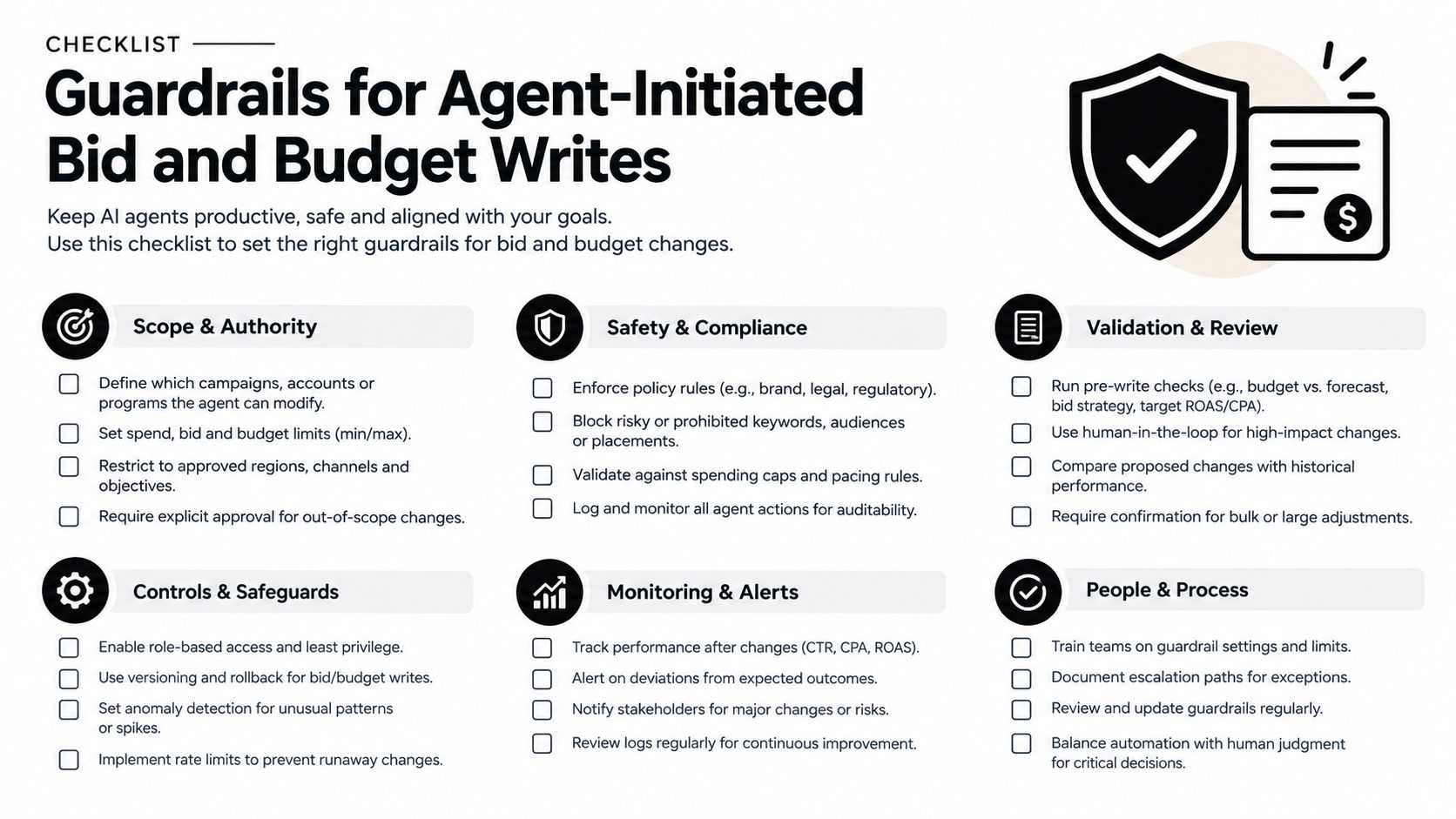
Reading campaign data and changing a live budget are different risk categories. A read can be stale or incomplete. A write can alter spend immediately, affect delivery, and create a financial incident. Any MCP workflow that permits bid or budget changes needs controls outside the language model's reasoning.
Preview before execution
Every proposed write should produce a preview containing:
- Target identity: Account, marketplace, campaign, ad group, keyword, or product target.
- Current value: The budget or bid returned from the source system.
- Proposed value: The exact replacement value.
- Reason: The data fields and rule that produced the proposal.
- Freshness: The timestamp of the values used.
- Scope: The number of objects affected and the permitted operation.
The operator should approve that preview rather than approve a vague statement such as “optimize the campaign.” A preview also exposes mapping errors. If an agent selects the wrong marketplace or confuses a campaign ID with an ad group ID, the before-and-after record makes the error visible before execution.
Idempotency prevents retry damage
Network failures create an awkward situation. The client may not know whether Amazon accepted a request before the connection failed. Retrying without an idempotency key can submit the same action twice, especially in workflows that adjust budgets or update multiple targets.
The write service should assign an idempotency key to each intended operation. A retry with the same key should return the original result or its current status rather than create a second mutation. The key should be tied to the account, object, operation, and intended value, with an expiration policy appropriate to the workflow.
The service should also reject ambiguous bulk writes. A request affecting several campaigns should carry an explicit object list and a clear partial-failure response. Silent best-effort execution makes later reconciliation difficult.
Audit logs are operational evidence
An audit log should record the requesting client, authenticated account, tool name, timestamp, source values, proposed values, approval event, execution result, and error response. Before-and-after values should be immutable. The log should remain available even if the campaign later changes through Seller Central or another advertising tool.
Access needs the same discipline. Read-only keys should be separate from write-capable keys, and revocation should be immediate. Agencies should be able to identify which client and account initiated an action without searching through chat transcripts.
The MCP governance guidance offers a useful framework for separating permissions, approvals, and evidence. The product boundary matters here: a data layer can expose guarded write tools and log the result, but it shouldn't be presented as a recommendation engine or an autonomous optimizer. The user's agent or workflow must remain responsible for the business decision.
Transitioning to Exception-Based Campaign Management
Daily dashboard review often hides the operating problem. Managers spend time collecting numbers from Ads, Seller Central, inventory reports, and catalog screens, then have limited time left to investigate the exceptions that affect margin and availability. A prepared MCP data layer changes the sequence by making routine reads available to the agent and reserving human attention for defined anomalies.
The operating model should start with an exception register, not a general instruction to “monitor performance.” Each exception needs a data condition, a priority, an owner, and a permitted response. The agent returns the underlying records so the operator can verify the alert rather than trusting a summary.
Useful exception classes
A seller may define alerts for:
- Profitability drift: An advertised product falls below its permitted margin after spend, fees, discounts, and fulfillment costs are considered.
- Inventory exposure: Spend continues while available cover declines and inbound units don't support expected demand.
- Listing suppression: A previously active product becomes unavailable, suppressed, or otherwise unable to convert traffic.
- Attribution change: Reported conversions or sales change after later attribution recalculation.
- Budget constraint: A campaign reaches its configured pacing boundary while its product remains commercially eligible.
- Data inconsistency: Ads, catalog, inventory, or finance records disagree on the product identity or reporting period.
The thresholds should be explicit and versioned. “Sudden ACOS increase” needs a comparison window and a baseline. “Low inventory” needs a cover calculation and a treatment for reserved and inbound units. “High-margin ASIN” needs a margin source and a rule for missing cost data.
Human review becomes more focused
Exception-based management doesn't eliminate operators. It gives them a narrower queue of decisions that require context, judgment, or approval. An agency can route account-specific alerts to the correct client team. An in-house manager can separate urgent stock protection from slower catalog-quality work. A developer can test each rule against historical snapshots before enabling a write.
The system should preserve both the alert and the evidence behind it. That includes the prepared data version, source timestamps, calculation rules, and any proposed mutation. If an operator rejects an alert, the rejection reason can help refine the rule without rewriting the underlying record.
The durable shift in ppc e commerce is from asking an agent to manage campaigns broadly to asking it to surface specific, auditable exceptions. Humans define commercial policy. The data layer supplies structured facts. The agent interprets those facts within the permitted workflow, and guarded tools execute only approved changes.
agentcentral offers a hosted MCP server that gives Claude, ChatGPT, OpenClaw, Cursor, and other MCP clients structured access to Amazon Ads, Seller Central, inventory, orders, catalog, finance, ranking, and fulfillment data. It pre-materializes account data for fast repeated reads and provides scoped access, write previews, idempotency keys, and logged before-and-after values, so teams building auditable Amazon PPC workflows can visit agentcentral and connect their seller operations to controlled agent workflows.
Related Agent Central pages
- Amazon Seller Central MCP server
Canonical hosted MCP overview for Seller Central, Ads, inventory, catalog, finance, and fulfillment data.
- Amazon seller data for AI agents
How Agent Central normalizes Amazon seller data before exposing it to AI clients.
- Connect Seller Central to Claude
Step-by-step path from Amazon OAuth to a Claude connector or MCP config.
- ChatGPT with Amazon seller data
ChatGPT-specific setup path for Amazon seller data through hosted MCP.
- Amazon Ads MCP server
Campaign, keyword, search term, budget, TACOS, and guarded ads-write tools.
- Ads tool reference
Parameter-level docs for Amazon Ads campaign, keyword, search term, budget, and TACOS tools.
Related reading
- Amazon Ads Software Compared for AI Agent Workflows
Compare amazon ads software for AI agents. Evaluate latency, automation, auditability and MCP integrations to choose the right stack.
- How Sponsored Amazon Ads Work
Compare Sponsored Products, Sponsored Brands, and Display ads, including targeting, reporting windows, Seller Central context, and guarded writes.
- Amazon SP-API Guide for Sellers and AI Agents
How the Amazon SP-API works for sellers and AI agents: authentication, domain APIs, rate limits, and where a hosted MCP data layer sits above it.
- MCP Server Hosting for Amazon Sellers
Learn how MCP server hosting connects Amazon sellers to AI agents. Covers architecture, security, performance, and setup with agentcentral.
Connect Amazon seller data to your AI client.
Agent Central gives Claude, ChatGPT, OpenClaw, Cursor, and other MCP clients structured access to Amazon Ads, Seller Central, inventory, orders, catalog, finance, and fulfillment data.