
Model Context Protocol Explained for Sellers
Model context protocol, explained: clients, servers, tools, OAuth, and how Amazon sellers use it for ads and Seller Central data.
The Model Context Protocol is an open client-server standard, introduced by Anthropic on 25 November 2024, that lets an AI client negotiate capabilities and then read resources or call tools on an external system over JSON-RPC. For Amazon sellers, it standardizes access, not permission to change an account.
What prevents a connected agent from turning a question about advertising spend into an unauthorized budget change? Connectivity alone doesn't answer that question. A useful MCP deployment needs a control plane around consequential work: account boundaries, separate read and write permissions, explicit consent, duplicate-submission protection, and evidence of what changed.
Table of Contents
- What the Model Context Protocol Is
- How Does MCP Differ From a Direct API Integration?
- Clients Servers Tools and Transports
- Capability Negotiation and User Consent
- Who Is Authorized to Touch the Account
- Is MCP Safe to Build On?
- Which Amazon Seller Questions Can a Hosted Server Answer?
- How Do You Connect a Hosted Server Before Any Write?
What the Model Context Protocol Is
Say an Amazon operator wants Claude to compare advertising spend with sales, while a developer wants the same records available in Cursor. Without a shared interface, each application may need its own connector, credential handling, and response format. A spreadsheet export can support an isolated analysis, but it doesn't provide a reusable connection.
MCP defines a common interface between compatible clients and servers. A server exposes available capabilities in a structured form. The client discovers those capabilities and requests the data or action needed for the conversation.
The original MCP announcement introduced and open-sourced the protocol on 25 November 2024, with specification version 2024-11-05, Python and TypeScript SDKs, local MCP-server support in Claude Desktop, and a repository of prebuilt servers. Its reference ecosystem included Google Drive, Slack, GitHub, Git, PostgreSQL, and Puppeteer. The intended use was secure, two-way communication with content repositories, business tools, and development environments.
A shared interface, not another assistant
MCP isn't a model, chat application, or Amazon API replacement. It defines how an AI application communicates with an external system that exposes contextual information and executable capabilities.
For seller workflows, the distinction matters:
- The AI client handles the conversation. Claude, ChatGPT, OpenClaw, or Cursor can interpret the operator's request.
- The MCP server exposes supported capabilities. It accepts structured requests and returns structured results.
- The underlying business system remains authoritative. Amazon still controls the records and operations available through its APIs.
The same pattern extends beyond commerce. For a workflow involving sending infrastructure, the mailX MCP server for email deliverability illustrates a separate, domain-specific connection. Connecting an email server doesn't grant Amazon access, just as connecting an Amazon server doesn't authorize email operations.
Practical distinction: A common connection format makes integrations reusable. It doesn't make every connected system equally trustworthy.
An Amazon seller can therefore use the same hosted server from several compatible clients rather than maintain a custom export path for each chat product. The important implementation questions concern the capabilities exposed, how messages travel, who consents, which credentials authorize the request, and what happens when an operation changes an account.
How Does MCP Differ From a Direct API Integration?
A direct API integration connects a program to an API through code the builder controls. That code handles authentication, pagination, retries, and errors. MCP adds a reusable client-server interface so compatible AI clients can discover and invoke the server's capabilities without each implementing the underlying Amazon integration.
A manual CSV export is different again. A person downloads data from Seller Central or an advertising report and uploads it into a conversation. The file carries a snapshot, not an authenticated path back to Amazon.
Three ways to get Amazon data into an AI client
| Approach | Connection effort | Reuse across AI clients | Write control |
|---|---|---|---|
| Manual CSV export | Person downloads and uploads each time | Re-uploaded in each chat session | None built into the file |
| Direct API integration | Developer builds one integration per API and client | Limited to the code that was built | Set by the builder's code |
| Hosted MCP server | Connect the account once, then add the connection to the client | Any compatible MCP client | Scoped keys, previews, confirmation, and audit logs |
The hosted-server row describes controls to evaluate, not protections that every MCP implementation automatically supplies. MCP compatibility isn't a security certification.
Choose the connection around the job
Use MCP when several AI clients need to ask the same Amazon questions through a consistent interface. Use a direct integration when an internal system must execute a tightly defined process unattended, with application code controlling every branch. A one-time export remains reasonable when a single analysis is the whole job.
The underlying API integration concepts still apply. A server that calls SP-API or Amazon Ads must respect the relevant API's permissions, request limits, and error behavior. MCP doesn't bypass those requirements or turn a reporting interface into an unrestricted transaction interface.
For repeated analysis, evaluate how the hosted server serves prepared account records. For writes, evaluate its permission checks and execution controls separately from how convenient the connection looks.
Clients Servers Tools and Transports
An MCP connection has distinct roles. The host is the application the person uses, such as Claude or ChatGPT. The client is the component inside that host that speaks MCP, while the server exposes capabilities backed by external systems.
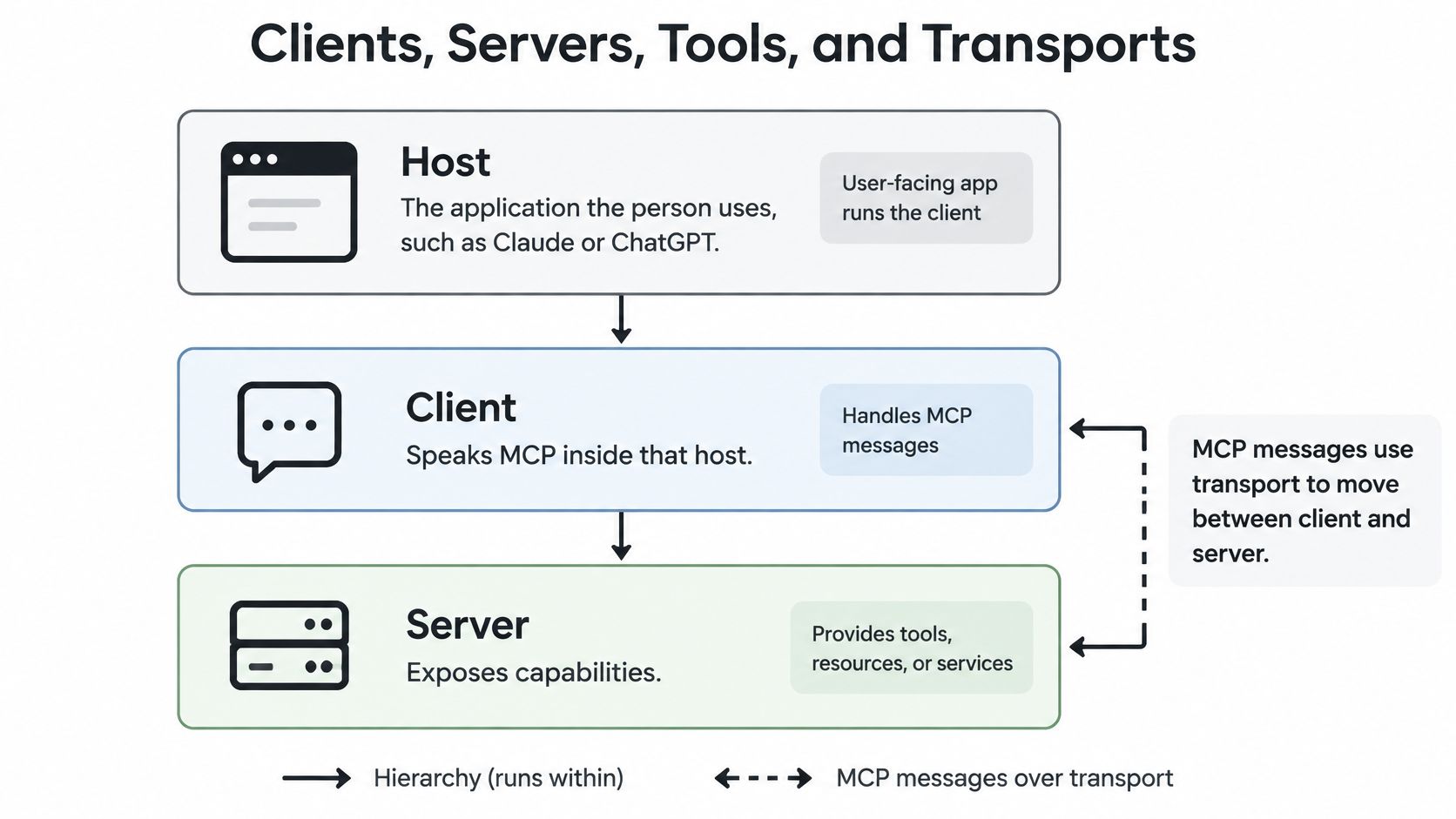
The MCP architecture specification describes messages built around JSON-RPC 2.0, with protocol semantics separated from transport. Protocol messages cover initialization, version and capability negotiation, resources, prompts, tools, and notifications; transport handles connection establishment, framing, authentication, and delivery.
Stdio suits local process integration through standard input and output. Streamable HTTP supports remote HTTP POST requests and optional Server-Sent Events for streaming, with credentials carried through mechanisms such as bearer tokens, API keys, and custom headers. OAuth is the documented approach for obtaining authentication tokens for remote connections.
MCP primitives and where they travel
| Piece | Job | Seller-shaped example | Typical transport |
|---|---|---|---|
| Resource | Read contextual data into the host | Prepared inventory, order, or settlement fields | Stdio or Streamable HTTP |
| Prompt | Reusable instructions with arguments | A dated TACOS comparison with fixed columns | Stdio or Streamable HTTP |
| Tool | Invoke an action with a schema | Read search-term spend or submit a confirmed bid change | Stdio or Streamable HTTP |
| Notification | Server message without a matching request | Notice that a scheduled account sync finished | Stdio or Streamable HTTP |
| Stdio transport | Local process, low overhead | A local bridge for a client that cannot call a remote URL | Local standard input and output |
| Streamable HTTP | Remote HTTP POST, optional SSE, bearer or API key | Hosted server for several seller accounts | HTTPS |
These are illustrative protocol uses, not a promise that every server implements every row. A server may expose inventory through a read tool rather than a resource, for example.
Read the interface without confusing its roles
A resource could supply prepared inventory or settlement fields for context. A prompt could establish comparison windows and required output columns, helping an agent avoid an ambiguous request such as compare recent performance.
A tool could retrieve search-term spend or submit a confirmed budget change. Both are tool calls, but they have different consequences. A notification could announce a completed scheduled sync if the server and client support that behavior.
A 2025 Zuplo survey found that 58% of MCP builders were wrapping existing APIs rather than building APIs from scratch. That fits an Amazon integration that exposes SP-API and Amazon Ads capabilities through MCP rather than inventing a replacement commerce API.
JSON-RPC does not isolate seller accounts. The hosted server must enforce HTTPS, credential scope, request authentication, authorization checks, and per-account data partitioning. A valid message format says nothing about whether the caller should receive a particular order record or change a particular campaign.
That leaves a separate requirement: the host must know what the server supports and obtain the appropriate consent before exposing data or invoking consequential capabilities.
Capability Negotiation and User Consent
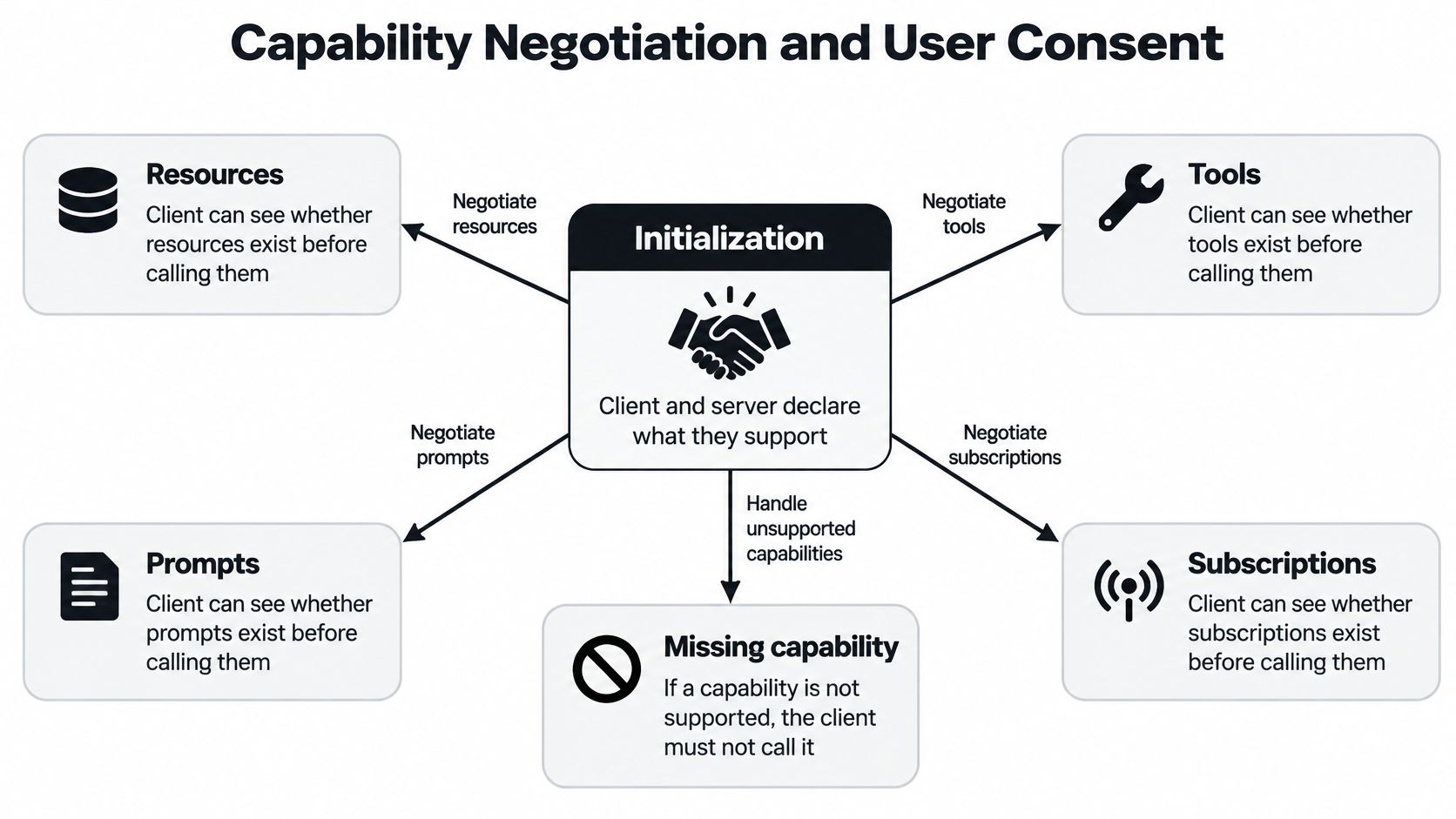
During initialization in an initialization-based MCP implementation, the client and server declare supported features. The client can determine whether resources, tools, prompts, subscriptions, or related behaviors are available before attempting to use them. A missing capability should produce a clear limitation, not an invented tool call.
The MCP specification's capability and consent guidance separates capability discovery from permission to expose data or execute tools. Implementers must pin the protocol version they support rather than assume every revision uses identical connection behavior.
A supported capability is not an approved action
A resource exposes contextual data to the host or model. A tool can expose arbitrary code execution or data-access paths. Neither should be treated as harmless just because the interface has a readable description.
Hosts must obtain explicit consent before exposing user data to servers and must not transmit resource data elsewhere without consent. Tool descriptions also require a trust boundary: text supplied by an untrusted server isn't an instruction the host should automatically obey.
Connect the smallest surface that answers the question, and treat every write as a separate consent.
Consider an operator investigating a suppressed listing. Permission to read catalog status and source-provided issue fields doesn't imply permission to rewrite the listing. The agent may identify a possible change, but the execution path needs its own authorization and confirmation.
The same applies to reading search-term spend. An advertising read scope must not silently become authority to change bids or budgets.
Put policy around execution
The MCP tools and security guidance recommends validating inputs and outputs, rate-limiting calls, confirming sensitive operations, and logging tool usage. Applied to seller operations, those controls should make the proposed account, marketplace, resource, and change explicit.
- Validate the request. Reject unsupported fields, malformed identifiers, and values outside the operation's accepted constraints.
- Separate read and write authority. Catalog analysis shouldn't enable price, quantity, or listing updates.
- Record the outcome. Preserve submitted inputs, execution results, and failures so operators can reconstruct the event.
Developers building these workflows also need to control what enters the agent's context. DevArmor's prompt context controls for coding agents provide a related security perspective for teams implementing connectors or execution code.
MCP supplies interoperability; the host and server enforce policy. A confirmation dialog cannot rescue a server that ignores account scope, and server-side restrictions don't remove the host's responsibility to obtain consent.
Who Is Authorized to Touch the Account
The confused-deputy problem appears when an intermediary uses its own access to perform an operation the caller wasn't entitled to request. A valid token doesn't prove that every employee, agency seat, marketplace, or action should be allowed.
The MCP HTTP authorization specification treats a protected MCP server as an OAuth 2.1 resource server and the client as an OAuth 2.1 client acting for the resource owner. The client obtains an access token and sends it using the Bearer scheme in the Authorization header.
Identity must survive every handoff
The authorization security requirements require PKCE and address token theft, authorization-code interception, open redirects, mix-up attacks, and intermediaries misusing third-party API access. Secure token storage and rotation matter, but business authorization still needs narrower account and action checks.
Discovery also has defined boundaries. The authorization-server discovery specification requires Protected Resource Metadata identifying at least one authorization server, either through a metadata endpoint or a resource_metadata value in a 401 response's WWW-Authenticate header. Clients must keep registration state, credentials, and tokens separate for each authorization server.
Amazon adds another authorization context. The AWS Amazon Ads OAuth documentation requires the access token, Amazon-Advertising-API-ClientId identifying the application, and Amazon-Advertising-API-Scope identifying the advertiser profile and marketplace.
Four boundaries on one Amazon MCP call
| Boundary | What is presented | What it limits | If it is missing or too broad |
|---|---|---|---|
| MCP client to server | Bearer token or scoped API key | The key's account, marketplaces, domains, and allowed actions | Overbroad permissions can expose unintended records or actions |
| Amazon account grant | Amazon OAuth authorization | The Seller Central and Amazon Ads accounts the seller approved | The server has no SP-API or Ads access to sync |
| Amazon Ads profile | Amazon-Advertising-API-Scope header, with the application identified by Amazon-Advertising-API-ClientId | One advertiser profile and marketplace | A hosted read may aggregate authorized profiles; a write needs an explicit profile |
| Write confirmation | Preview, explicit confirmation, idempotency key | One intended change, safe to retry | Duplicate submission or an unreviewed bid, price, or shipment change |
In Agent Central, responses are restricted to the key's account, marketplace, Ads profiles, and enabled domains. Passing profile_id filters advertising tools to one profile and is required for writes; omitting it queries across authorized profiles for the connected marketplace. That is hosted-tool behavior, not permission to omit a required header from a downstream Amazon Ads request.
The distinction between OAuth authentication and delegated authorization is operationally important. An agency analyst may be allowed to compare advertising performance across profiles while lacking authority to submit a change. Each seller account's records must remain separate, and every delegated write should be attributable to its requesting person or agent.
Is MCP Safe to Build On?
Teams can build durable workflows on MCP, but protocol continuity and deployment safety are different questions. Open governance helps with the former. The team operating the client and server remains responsible for the latter.
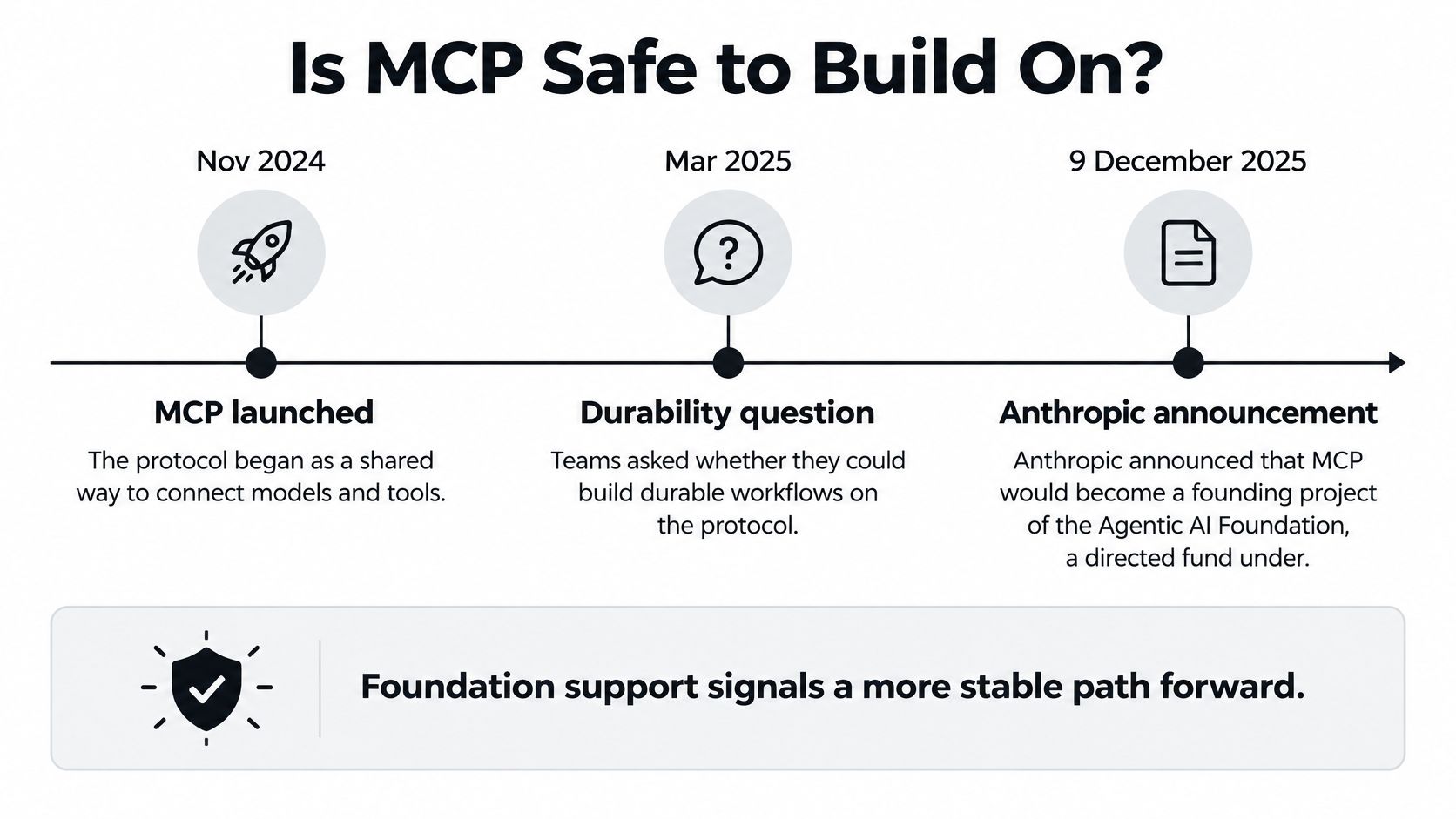
Following the protocol's public launch, the MCP foundation announcement stated on 9 December 2025 that MCP would become a founding project of the Agentic AI Foundation, a directed fund under the Linux Foundation. Anthropic, Block, and OpenAI co-founded the foundation, with support from Google, Microsoft, AWS, Cloudflare, and Bloomberg.
Stewardship is not a server audit
Maintainers retain autonomy over technical direction and day-to-day operations, while the foundation provides a neutral home and supporting infrastructure. Community input continues through the proposal process. This makes continuity more credible and reduces dependence on a single model provider, but it doesn't certify a server's Amazon permissions.
Before committing an operational workflow:
- Pin the supported specification version. Record what both client and server implement.
- Read that version's authorization requirements. Don't issue credentials based on assumptions from another revision.
- Test capability negotiation against the deployed server. Check missing capabilities, denied actions, and expired credentials.
AY Automate's discussion of the risks of AI coding agents is relevant when developers give implementation agents access to connectors or credentials. A separate MCP server security review should examine the actual execution boundary.
Foundation stewardship supports continuity. Scoped credentials and write guardrails protect the seller account.
Which Amazon Seller Questions Can a Hosted Server Answer?
Agent Central connects the AI an operator already uses to Amazon Seller Central and Amazon Ads through a hosted MCP server. Claude, ChatGPT, OpenClaw, Cursor, and other MCP clients can access advertising, inventory, orders, catalog, ranking, finance, and fulfillment data through that connection.
The useful question isn't how many tools are connected. It's whether the server returns the evidence needed for a specific decision while declining to make that decision itself.

Which SKUs fall below the operator's cover threshold?
An inventory workflow combines FBA stock, inbound units, and sales velocity. The operator supplies the cover threshold and the relevant sales window. Returned facts should identify the SKU, marketplace, inventory quantities, velocity inputs, and calculated cover.
Those figures support a replenishment discussion. They don't establish a reorder quantity without the team's lead times, incoming purchase orders, supplier constraints, and risk preferences. Agent Central returns the facts, not a reorder recommendation.
How did advertising change alongside sales?
An advertising comparison should name explicit current and prior date windows and return campaign, ad group, search term, spend, units, and sales at compatible levels of aggregation. TACOS compares advertising spend with total sales, so a useful response must identify the sales denominator rather than substitute advertising-attributed sales.
Agent Central syncs account data on a schedule and serves prepared records for repeated reads. A new account starts with 30 days of history that builds from there, and Amazon Ads history is kept while the account stays connected. Year-over-year comparisons work only where the required history exists.
Amazon's asynchronous reports involve requesting a report and retrieving the result after processing. A prepared-record workflow avoids requesting a fresh report for every conversational follow-up, but it doesn't make the underlying data real-time.
What exactly would this change submit?
For a supported budget, bid, price, seller-managed quantity, listing, MCF order, or FBA inbound change, Agent Central requires a preview, explicit confirmation, and an idempotency key before submission. Changes are logged with before-and-after values, allowing the team to inspect the intended transaction and its outcome.
- The server returns evidence. Facts, metrics, classifications, and source-provided fields remain distinct from advice.
- The agent or team decides. A returned result isn't authorization to execute the next operation.
- Coverage must match the question. An advertising-only connection needs another source for inventory, settlement, or fulfillment questions.
Before choosing Amazon's advertising MCP server or another advertising-focused connection, operators should compare its documented coverage with the actual workflow. Agent Central's cross-domain coverage is relevant when a question joins advertising performance with Seller Central operations, not merely because both connections use MCP.
How Do You Connect a Hosted Server Before Any Write?
A hosted MCP server fits workflows where the same seller questions must work across several clients and consequential changes must remain reviewable. Connection setup should begin with read access, not with a test transaction against a live campaign or listing.
The connection sequence is straightforward:
- Sign up at agentcentral.to. Establish the account that will hold the authorized Amazon connections.
- Connect Seller Central and Amazon Ads through Amazon's authorization. Approve only the intended business accounts.
- Add the connection to the AI client. The Claude quickstart documents that client's connection path.
Agent Central provides copy-ready MCP config JSON for every supported client. Claude, ChatGPT, OpenClaw, Hermes, or another supported client can connect to the remote MCP endpoint using an Authorization header or a signed Connector URL; Cursor can use the same hosted server through its supported MCP configuration.
Check the execution boundary first
Before enabling a write, the operator should verify:
- Credential scope. The key reaches only the account, marketplaces, profiles, domains, and actions the person needs.
- Submission controls. Every write requires a preview, confirmation, and an idempotency key.
- Audit evidence. The log records the values before and after the submitted change.
If an unnecessary domain remains accessible, narrow the key before allowing the agent to request a change. Keep credentials out of conversation text and use the client's supported connection mechanism.
Plans are priced by monthly Amazon order volume, with a 14-day free trial that needs no card; the pricing documentation lists current plans.
Agent Central offers a hosted MCP connection for Amazon seller facts and guarded, auditable changes, while the operator's agent or team retains the decision. Visit agentcentral to connect the intended Amazon accounts, validate a read-only workflow, and inspect the permission and confirmation boundaries before authorizing a write.
Related Agent Central pages
- Amazon Seller Central MCP server
Canonical hosted MCP overview for Seller Central, Ads, inventory, catalog, finance, and fulfillment data.
- Amazon seller data for AI agents
How Agent Central normalizes Amazon seller data before exposing it to AI clients.
- Amazon seller MCP servers compared
How hosted MCP services compare with official Ads MCP, local repos, connector tools, and automation platforms.
- Connect Seller Central to Claude
Step-by-step path from Amazon OAuth to a Claude connector or MCP config.
- ChatGPT with Amazon seller data
ChatGPT-specific setup path for Amazon seller data through hosted MCP.
Related reading
- Expense Management Automation for Amazon Sellers
Reconcile Amazon settlements, fees, and Ads data with structured reads while bank data, accounting policy, and journal entries stay in the accounting system.
- Role-Based Access Control for Amazon Seller Teams
Map Amazon seller roles to agentcentral tool scopes, isolate accounts, and document key ownership, review dates, rotation, and revocation.
- What Is Supply Chain Visibility for Amazon Sellers
Supply chain visibility for Amazon sellers connects inventory, inbound, order, and fulfillment data so operators can review exceptions before decisions expire.
- Amazon Back End Keywords: Limits and How to Check
Amazon back end keywords are hidden Search Terms under 250 bytes. Learn Seller Central limits, edit steps, and how to compare your own changes.
Connect Amazon seller data to your AI client.
Agent Central gives Claude, ChatGPT, OpenClaw, Cursor, and other MCP clients structured access to Amazon Ads, Seller Central, inventory, orders, catalog, finance, and fulfillment data.