
How to Choose the Best AI Agent for an FBM Business
How to choose the best AI agent for an FBM business: a step-by-step decision framework, evaluation checklist, and comparison matrix for FBM sellers.

A late seller-fulfilled order can trigger customer service work, inventory corrections, pricing decisions, and advertising questions before the operator has finished checking Seller Central. The best AI agent for an FBM business is the one that reads the right Amazon records, separates FBM from FBA, previews risky writes, supports the team's MCP client, and logs every approved change.
Table of Contents
- What an FBM Seller Should Look for in an AI Agent
- The FBM Workflows an Agent Has to Cover
- Reading and Writing Amazon Data the Right Way
- Read Versus Write, Preview Versus Autonomous
- Testing the Agent on Real FBM Scenarios
- Pricing, History, and Scale Considerations
- Evaluation Checklist and Decision Matrix for FBM Teams
What an FBM Seller Should Look for in an AI Agent
Choosing an AI agent for FBM is a procurement decision, not a chat-quality contest. The evaluation should focus on data fidelity, write safety, operational fit, and governance. A trustworthy agent returns values from structured Amazon records instead of filling gaps with plausible text, previews changes to seller-managed listings before execution, distinguishes FBM and FBA order lines, and protects access with scoped keys and audit logs.
Amazon's seller platform has moved toward structured automation for years. Amazon opened third-party selling in 1999, launched Marketplace in 2000, introduced the Seller Central-era merchant console around 2006, and launched Marketplace Web Service in 2009 for structured listing, order, and report exchange. Sponsored Products followed around 2012, and Brand Registry launched in 2017. That history supports a practical rule: an agent for serious FBM operations should connect to seller and advertising workflows through supported APIs, not depend on screen scraping or copied browser sessions. The timeline is documented in this history of Seller Central and Amazon seller automation.
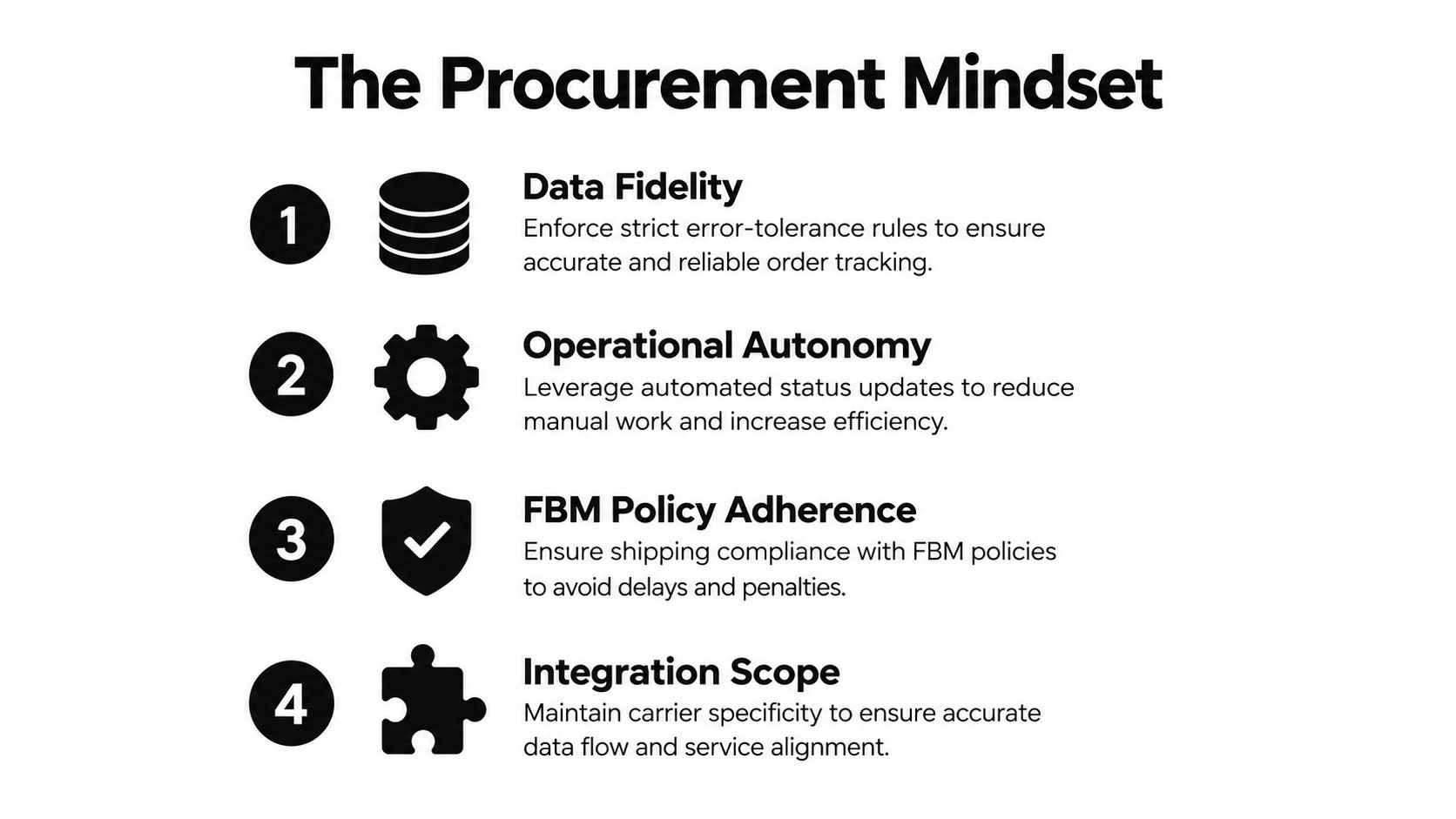
Four criteria that eliminate weak candidates
- Data fidelity: The agent should expose orders, line items, fulfillment channels, inventory, returns, prices, catalog fields, and relevant advertising records with their source context. If it can't tell whether a line is seller fulfilled or FBA fulfilled, it isn't ready for FBM execution.
- Write safety: Quantity changes, price updates, MCF order creation, and other account changes should produce a preview with the proposed values before anything is submitted.
- Operational fit: The agent should support the actual sequence from late-order detection to inventory response, not just answer isolated questions about listings.
- Governance: Each account needs separate authorization, narrowly scoped access, approval controls, duplicate-action protection, and an audit record showing before and after values.
The red flags are clear. A read-only agent may summarize a stockout without changing a seller-managed quantity. An unrestricted writer may change a price or inventory count without approval. A generic assistant may merge FBA and FBM order lines into one total. A connector that can't explain its MCP or SP-API access model leaves the operator unable to verify what the system can read or write.
Teams evaluating hosted agent infrastructure can also review Beam's cloud platform for agents as a broader reference point for deployment requirements. The relevant question remains Amazon-specific: can the selected system perform the required seller workflows with controlled access and observable outcomes?
The next tests should map each FBM workflow to its required reads, proposed writes, and failure consequences. That approach prevents a polished demonstration from hiding a missing fulfillment channel, return, or inventory capability.
The FBM Workflows an Agent Has to Cover
FBM work starts with exceptions and deadlines. The agent needs to identify seller-fulfilled order lines approaching their ship-by dates, compare them with available inventory, and surface the records that need operator attention. A summary that combines FBA and FBM orders is operationally unsafe because the seller may investigate the wrong fulfillment queue.
Inventory requires the same discipline. The agent should read seller-managed quantities by SKU and marketplace, compare them with open seller-fulfilled demand, and identify possible stockout or oversell exposure. The proposed quantity update must remain visible before submission. A tool that only reports low stock leaves the operator to copy values between systems, while a tool that changes quantities without a preview creates a different risk.
Returns add a classification problem. The agent should read return records and reason codes, distinguish refund and replacement cases according to the team's policy, and prepare the relevant facts for review. It shouldn't claim to have sent a buyer message or completed a refund unless the connected workflow supports and logs that action.
Prices need a wider input set. A useful workflow reads the current seller-managed price, Buy Box fields where available, competitive price signals, fees, and listing identifiers, then shows the proposed price change before execution. Advertising data can provide context, but the agent must not turn a metric into an unreviewed repricing decision.
MCF routing is another boundary test. The operator may need to compare seller-fulfilled inventory with FBA stock and create a Multi-Channel Fulfillment order when the business decides that FBA stock should serve an external channel or operational need. The agent must distinguish an MCF order from ordinary FBA and FBM order lines.
| FBM Workflow | Read Inputs | Previewable Write Actions | Failure If Missing |
|---|---|---|---|
| Ship-by triage | Orders, line items, fulfillment channel, ship-by fields, shipment status | Any supported shipment or order update | Late FBM orders remain mixed with irrelevant FBA work |
| Seller-managed inventory | SKU, listing, marketplace, fulfillable quantity, open orders | Quantity update on seller-managed listings | Overselling, false stock availability, or delayed stockout response |
| Returns | Return records, reason fields, order and line-item context | Policy-approved return or replacement workflow where supported | Refund and replacement cases receive inconsistent handling |
| Price control | Current price, listing, Buy Box fields, fees, relevant Ads context | Price update with before and after values | Margin or ranking changes occur without review |
| MCF routing | FBA inventory, FBM inventory, order context, destination details | MCF order creation after approval | The wrong fulfillment channel is used or duplicate fulfillment occurs |
A procurement lead can score vendors in three tiers. Tier one covers factual reads and channel separation. Tier two adds previewable writes and approval gates. Tier three supports auditable execution across inventory, prices, returns, and MCF without conflating records. Teams building repeatable publication-ready data workflows can use the same distinction between source records, transformations, and executed actions.
For a concrete order-management reference, the FBM order management automation guide shows why order reads, channel classification, and controlled actions belong in one test plan rather than separate feature demos.
Reading and Writing Amazon Data the Right Way
An FBM agent needs more than a conversational interface. It needs a permissioned connection to Amazon's Selling Partner API, Amazon Ads where advertising context matters, and a clear separation between live operational reads and asynchronous reporting.
Amazon SP-API uses roles to control access to operations, reports, feeds, and notifications. Each operation needs at least one matching role unless it is grantless, and developers must request and qualify for the roles that match the intended use. The Amazon SP-API roles documentation should be the starting point for checking whether a connector's permissions match its claims.
The reads that matter for FBM
The agent should retrieve order records and line-item details, then apply fulfillment-channel logic at the order and line level. It should read inventory for seller-managed listings, return records, catalog identifiers, price fields, and shipment-related fields needed for triage. Some endpoints expose useful fulfillment information directly, while other workflows require the agent to join records and classify them itself.
That classification should live in the agent's typed workflow, not only in a dashboard label. A dashboard can show a combined order total that looks correct while hiding the fact that one line is FBM and another is FBA. The operator needs the underlying identifiers, channel values, marketplace, SKU, quantity, and status.
Writes may involve listings, inventory, feeds, notifications, or fulfillment operations. The MCP server should expose those actions as typed tools with explicit scopes, clear input fields, and a preview path. OAuth authorization should identify the seller account and requested access, while API keys should be limited to the account and capabilities that the workflow needs.
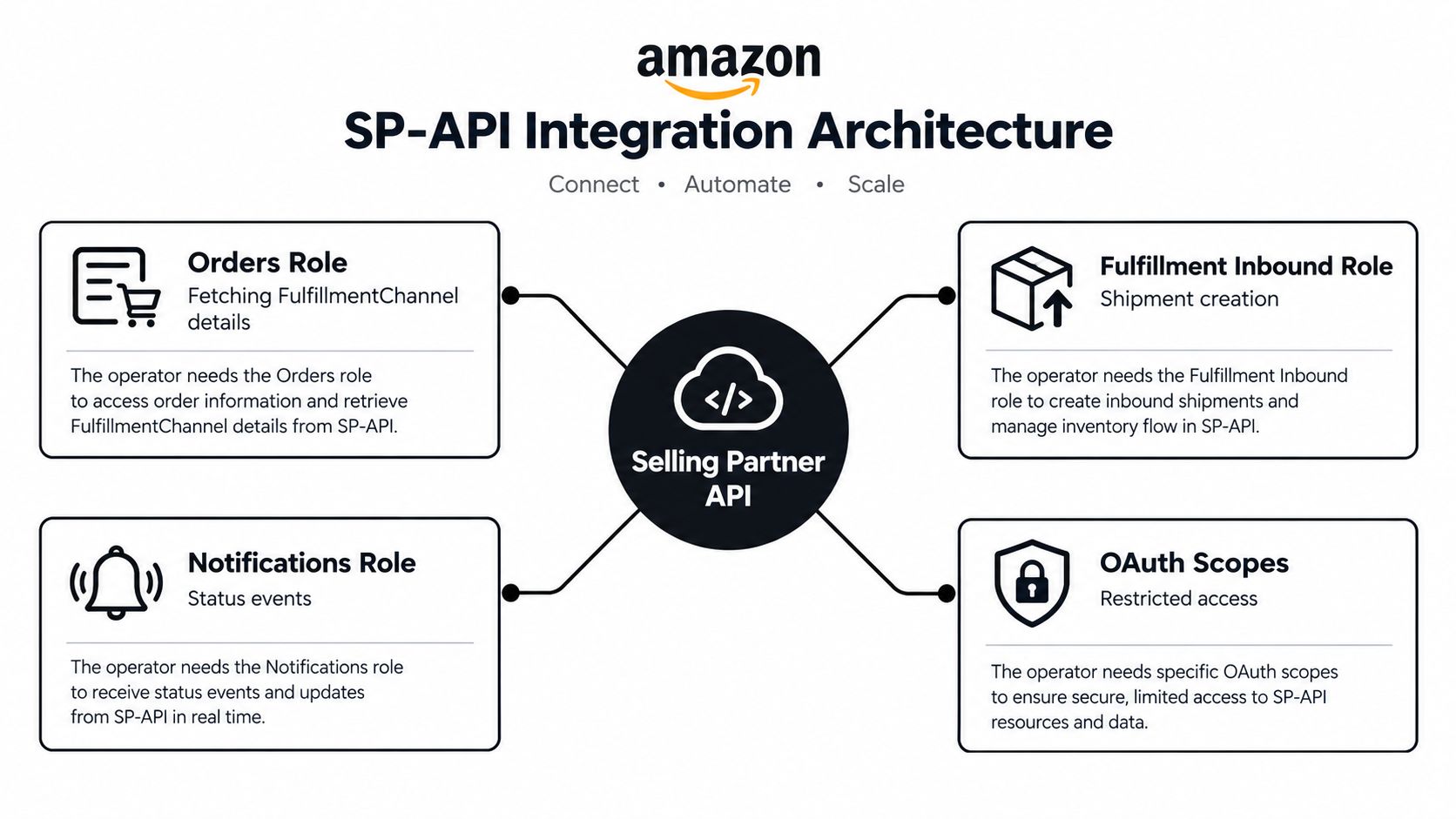
Amazon Ads has its own permission model. The Ads API authorizes requests according to the permissions of the user account that created the authorization grant, and a request returns 401 Unauthorized when that account lacks the required permission for the requested action. The Amazon Ads permissions guide explains why an agent that reads campaign data may still lack permission to change bids, budgets, or campaign state.
Reporting is not the same as operational access
Amazon's Reports API doesn't provide full parity with Seller Central. Amazon says Seller Central includes additional reports that aren't available through the Reports API, and report access depends on the appropriate roles for the report's content. Those limitations are documented in the Reports API FAQ.
That means a buyer should ask two separate questions. Can the agent retrieve the operational facts needed for a ship-by decision? Can it later reconcile those facts with the report surface used for finance, compliance, and historical analysis? A credible vendor should describe asynchronous report behavior plainly rather than presenting report output as a live order feed.
For teams using MCP clients, the MCP server integration guide provides a useful setup reference. Agent Central fits this model as a hosted MCP server that connects Claude, ChatGPT, OpenClaw, Cursor, and other MCP clients to structured Seller Central and Amazon Ads records. It returns facts, metrics, classifications, and source-provided fields. It doesn't decide what the seller should do.
Read Versus Write, Preview Versus Autonomous
The first hard buying question is whether the agent only reads Seller Central or can prepare and execute changes. For FBM, that distinction affects seller-managed quantities, prices, order handling, and MCF creation. A text answer can be useful without write access, but a production workflow needs a visible boundary between a proposed action and a submitted action.
Agent Central supports reads across FBM and FBA orders, line items, inventory, and returns. It can update quantities on seller-managed listings and prices with previews and an audit log, and it can create MCF orders. It doesn't buy shipping labels, confirm shipments, send buyer messages, or read account health metrics. Those boundaries matter because an operator must know which steps remain manual or require another approved integration.
The four safeguards
- Preview: The agent shows the target account, marketplace, SKU or order, current value, proposed value, and reason context before execution.
- Approval: A human or an explicitly authorized workflow approves the preview. The approval should be tied to the exact proposed action, not a broad instruction given earlier.
- Scoped access: The OAuth grant, API role, or key should expose only the account and operations needed for the workflow. Amazon's role model is the reference point for this control.
- Auditability: The system records the action, timestamp, account, source values, new values, actor, and result. Duplicate submissions should be blocked or clearly surfaced.
Practical rule: Any action that changes buyer money, seller-managed availability, fulfillment routing, or marketplace ranking needs all four safeguards before production execution.
A read-only connector is suitable for order triage, inventory questions, and return classification when a person performs every subsequent change. Preview-first execution is the safer default for price and inventory updates because it preserves speed without hiding the mutation. Autonomous execution can be appropriate for narrowly bounded, repetitive actions, but only after repeated dry runs show that the agent handles changing inputs and rejects ambiguous records.
MCP compatibility matters because the team may use Claude for one workflow, ChatGPT for another, or Cursor to develop a custom process. A typed MCP connector can preserve the same account scope and approval behavior across clients. A UI scraper usually can't offer the same transparency because it infers state from rendered screens and may break when Amazon changes the interface.
The guide to agentic automation is useful for separating tool calls from decision logic. The agent may decide which records deserve attention, but the connected system should return authoritative fields and enforce the write boundary.
| Safeguard | Read-only | Preview-first | Autonomous |
|---|---|---|---|
| Preview before change | Not applicable | Required | Required for initial policy setup |
| Human approval | Always manual execution | Required per action or approved batch | Replaced only by explicit policy |
| Scoped key or role | Required | Required | Required, with narrower limits |
| Audit log | Read access and query history | Before and after values | Every action, rejection, and duplicate attempt |
Testing the Agent on Real FBM Scenarios
A vendor demo usually uses clean records and a happy path. A useful trial uses changing inputs, mixed fulfillment channels, missing fields, duplicate prompts, and conflicting inventory signals. Independent enterprise benchmark design makes the same distinction between final task success and the quality of the path used to reach it. The AutomationBench methodology is a useful reference for testing business agents with realistic tool actions and guardrail checks.
Four scripts for a trial window
Late-shipment triage: Provide a set of orders containing both FBM and FBA lines, different ship-by dates, and at least one order needing escalation. The agent should identify only the seller-fulfilled lines, show the relevant order and shipment fields, and draft the operator's next step without claiming that a carrier update, refund, or buyer message was sent.
Stockout risk: Combine seller-managed fulfillable inventory with open FBM orders and separate FBA inventory. The agent should identify affected SKUs, preserve the distinction between available FBA stock and seller-managed stock, and flag candidates for MCF routing. Any MCF creation must remain a preview until approved.
Price dry run: Ask the agent to evaluate a seller-managed listing with a proposed price change. The output should show the current value, proposed value, marketplace, listing identifier, and relevant Buy Box or fee fields available to the connector. The system must not post the new price without approval.
MCF routing check: Give the agent order lines that represent FBM, FBA, and MCF contexts. The pass condition is correct classification and no duplicate fulfillment action. A fluent explanation isn't enough if the wrong record is selected.
Scoring the finalists
Score each script on pass@1, repeatability across three runs, response latency, and guardrail compliance. Pass@1 records whether the first attempt reached the correct final state. Repeated runs reveal whether the agent handles changed order status, inventory, or price inputs without relying on stale context.
Multi-step reliability matters because small error rates compound. If every step succeeds 95% of the time, a 20-step workflow has roughly 36% end-to-end success, a calculation discussed in this AI agent benchmark guidance. The same source describes performance falling from 60% on a single run to 25% over eight consecutive runs in one evaluation, which reinforces the need for repeated testing rather than a single impressive demo.
A simple weighted sheet works well:
- Final-state correctness, 40 points: The right records were selected and the output matched the source data.
- Repeatability, 25 points: The workflow passed across three runs with changed inputs.
- Guardrail compliance, 25 points: No write occurred without the required approval, and no duplicate action was submitted.
- Latency and tool efficiency, 10 points: The agent completed the task without unnecessary calls or excessive waiting.
A guardrail violation should fail the scenario even if the final business result looks correct. A system that changes the right quantity through an unauthorized path is still unsafe.
Pricing, History, and Scale Considerations
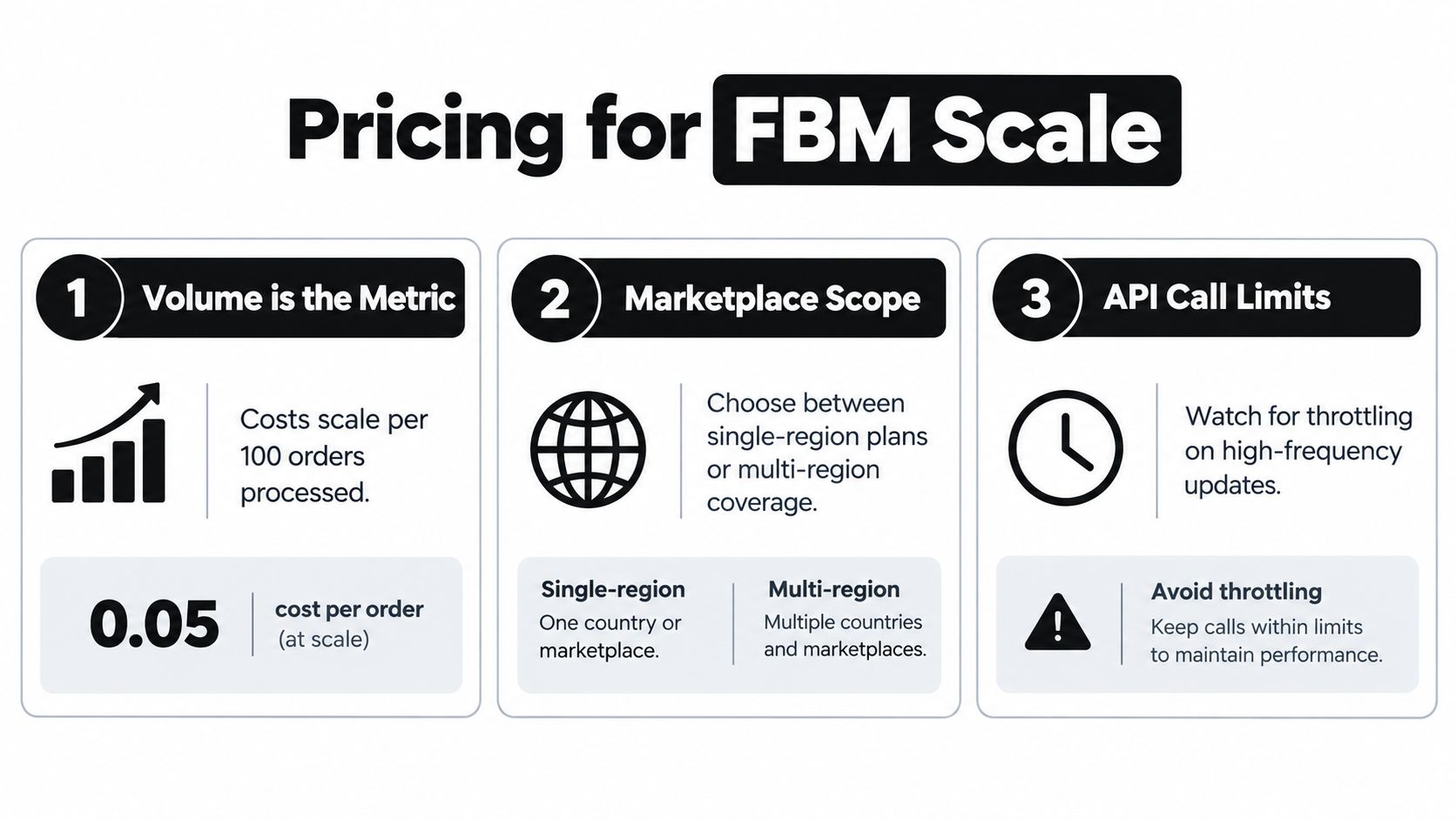
An FBM agent should be priced against the work it performs. For many sellers, the relevant operating unit is monthly Amazon order volume, not the number of seats. Ask whether the plan counts orders, shipments, records read, marketplaces, connected accounts, API calls, or a combination of these inputs. A low seat price may still become expensive if frequent inventory, order, or pricing reads are billed separately.
Marketplace coverage also changes the comparison. A US-only seller may need less regional support than an agency managing several marketplaces, but every account still requires clear separation, marketplace identifiers, and scoped authorization. Confirm which Amazon marketplaces are supported, whether one subscription covers them, and whether read, write, and audit behavior remains consistent across regions.
History determines how much operational context the agent can use after connection. Ask every vendor how much order and Ads history exists at connection time and how it accrues, because a connector cannot reconstruct records that predate the account link. The Agent Central pricing and plan documentation illustrates why retention and plan terms belong in the technical review, not only the commercial review.
What history changes for an FBM team
Late-shipment analysis needs enough prior order context to separate an isolated exception from a recurring fulfillment problem. Seasonality analysis is weaker when the agent sees only a narrow window. MCF routing decisions can also suffer when recent demand does not represent the broader selling pattern. Ask whether historical records include order lines, fulfillment channels, inventory, returns, and Ads data, rather than assuming that “history” covers every source.
Confirm whether Seller Central, Ads, inventory, catalog, finance, ranking, and fulfillment records are included in one plan or priced separately. The comparison becomes difficult when the vendor charges independently for each data source, marketplace, connected account, or high-frequency operation.
Plans priced by monthly Amazon order volume are easier to test against seasonal peaks than seat-based plans. Estimate ordinary monthly FBM orders, include headroom for the busiest expected period, and test the tier under that operating load rather than selecting it from a quiet month.
A buyer should request written answers to four questions:
- Volume definition: Which Amazon orders count, including FBA, FBM, and MCF?
- Marketplace scope: Are additional regions included, limited, or priced separately?
- History scope: How much order, inventory, return, and Ads history is available after connection?
- Throttle behavior: What happens when repeated reads or scheduled syncs reach an API limit?
Amazon reports run asynchronously, and Seller Central includes reports unavailable through the Reports API. A vendor that documents these boundaries gives an FBM team a more realistic basis for budgeting, workflow design, and capacity planning.
Evaluation Checklist and Decision Matrix for FBM Teams
A procurement document should turn vendor claims into observable tests. The following checklist can be completed during a trial or technical review.
Six blocks for the buyer
- Data access: The candidate returns order lines with fulfillment-channel fields, seller-managed inventory, returns, prices, catalog identifiers, and relevant Ads fields.
- Read and write scope: The vendor identifies which Amazon roles, OAuth permissions, and write operations are required.
- Preview and approval: A quantity, price, or MCF change shows current and proposed values before submission.
- Audit and security: Each seller account stays separate, keys are scoped, duplicate actions are blocked, and logs retain before and after values.
- Pricing: The buyer can calculate cost from monthly order volume, marketplace coverage, history, and connected data sources.
- Support: The vendor documents sync behavior, report limitations, failed writes, role changes, and escalation procedures.
For teams that need custom connectors or internal review tooling, Hire Developers can help source implementation support. The technical brief should still define Amazon roles, MCP behavior, test scripts, and audit requirements before development begins.
| FBM Workflow | Read Source | Write Destination | Preview Required | Approval Step | Audit Log Field |
|---|---|---|---|---|---|
| Ship-by triage | Orders, line items, shipment fields | Supported shipment or order action | Yes, where a write exists | Operator approval | Order, line, old status, new status |
| Returns adjudication | Returns, reasons, order context | Supported return or replacement action | Yes | Policy owner approval | Return ID, reason, decision, actor |
| Price changes | Listing price, Buy Box fields, fees | Seller-managed listing price | Yes | Pricing approval | SKU, marketplace, old price, new price |
| MCF routing | FBM and FBA inventory, order context | MCF order | Yes | Fulfillment approval | SKU, quantity, source, destination, result |
| Restock alerts | Seller-managed inventory, open orders | Seller-managed quantity update | Yes | Inventory approval | SKU, old quantity, proposed quantity, result |
Governance after selection
The winning agent should have a named owner for access review, a regular audit-log review, and a documented process for separating agency accounts from client accounts. Multi-account teams should never rely on a shared key whose scope can't be traced to one seller.
Amazon can change SP-API roles, report availability, or authorization requirements. The team should re-run the relevant test script whenever a role changes, a new MCP protocol capability is introduced, or the vendor changes its write behavior.
A one-week rollout is practical:
- Day one: Connect one non-critical seller account and confirm marketplace, history, and role scope.
- Day two: Run read-only order, inventory, return, and price tests.
- Day three: Run the four FBM scenarios with preview-only writes.
- Day four: Review logs, duplicate protection, and account separation.
- Day five: Approve one narrowly bounded write workflow.
- Day six: Train operators on rejection and escalation paths.
- Day seven: Review results and document the production policy.
The right agent isn't the one that produces the most confident answer. It is the one that returns the correct Amazon facts, keeps FBM and FBA operations distinct, exposes proposed changes, and leaves an audit trail when a human approves execution.
Agent Central connects Claude, ChatGPT, OpenClaw, Cursor, and other MCP clients to structured Amazon Seller Central and Amazon Ads data, including FBM and FBA orders, inventory, returns, prices, and MCF workflows with guarded writes and audit logs. Sellers and agencies can review the agentcentral workflow and start with a controlled account connection.
Related Agent Central pages
- Amazon Seller Central MCP server
Canonical hosted MCP overview for Seller Central, Ads, inventory, catalog, finance, and fulfillment data.
- Amazon seller data for AI agents
How Agent Central normalizes Amazon seller data before exposing it to AI clients.
- Connect Seller Central to Claude
Step-by-step path from Amazon OAuth to a Claude connector or MCP config.
- ChatGPT with Amazon seller data
ChatGPT-specific setup path for Amazon seller data through hosted MCP.
- Amazon seller MCP servers compared
How hosted MCP services compare with official Ads MCP, local repos, connector tools, and automation platforms.
Related reading
- MCP Server Configuration for Amazon Sellers and AI Agents
Master mcp server configuration for Amazon sellers. Set up OAuth, endpoints, security, and testing for Agent Central in minutes.
- What Is Amazon Seller Central and How It Works in 2026
What Is Amazon Seller Central. Learn what Amazon Seller Central is, how its dashboard works, and how sellers connect it to AI agents via MCP
- Amazon SP-API Guide for Sellers and AI Agents
How the Amazon SP-API works for sellers and AI agents: authentication, domain APIs, rate limits, and where a hosted MCP data layer sits above it.
- AI Automation Companies for Amazon Sellers
What AI automation companies do for Amazon sellers, how to evaluate vendors, and where a hosted MCP data layer like agentcentral fits in seller workflows.
Connect Amazon seller data to your AI client.
Agent Central gives Claude, ChatGPT, OpenClaw, Cursor, and other MCP clients structured access to Amazon Ads, Seller Central, inventory, orders, catalog, finance, and fulfillment data.