
Audit Logging Best Practices for MCP and AI Agents
Audit logging best practices for MCP servers and AI agents. Learn retention, tamper-evidence, idempotency and access controls for agentcentral workflows.

An Amazon seller's agent changes a sponsored-products bid, updates a listing, or creates a fulfillment action. Later, an operator needs to answer a simple question: what exactly did the agent see, who authorized the action, which tool executed it, and what changed afterward? A successful API response alone can't answer that. Without a defensible audit trail, a workflow can appear to have completed correctly while leaving no reliable evidence for troubleshooting, access review, or compliance.
For MCP-enabled Amazon operations, audit logging isn't passive telemetry. It's operational evidence across Ads, Seller Central, inventory, orders, catalog, ranking, finance, and fulfillment. The practical standard is clear: record the decision context, preserve the original event, restrict access to the record, and make failures visible.
Table of Contents
- Why Audit Logging Matters for MCP Servers and AI Agents
- What to Log for Every Agent Action and Tool Call
- How to Retain Centralize and Protect Audit Logs
- Making Writes Auditable With Previews Idempotency and Before After Values
- Access Controls and Pipeline Integrity for Trustworthy Logs
- Putting Audit Logging Best Practices Into Practice
Why Audit Logging Matters for MCP Servers and AI Agents
A conventional application log might show that a request reached an endpoint and returned a success response. An AI-agent workflow needs more. The agent may have made several reads, interpreted source-provided fields, requested a write preview, waited for approval, retried after a timeout, and then submitted a change. A useful trail must reconstruct that sequence without guessing.
Consider a bid adjustment. The seller may authorize an agent to inspect campaign performance and submit a guarded change, while the agent itself decides whether the observed facts support that action. A defensible record should connect the seller account, human or service identity, MCP client, session, tool call, authorization scope, input parameters, preview, idempotency identity, result, and before-and-after values. The log should show what changed, not merely that a request was sent.
Operational rule: An audit log should let a reviewer reconstruct the business action from the evidence alone.
This distinction matters because agentcentral is a data layer, not a recommendation engine. It returns facts, metrics, classifications, and source-provided fields. The user's agent or workflow decides what those facts mean and whether a guarded write should proceed. The audit trail therefore needs to capture both sides of the boundary, the data returned by the platform and the decision or authorization context supplied by the calling workflow.
NIST's long-standing audit-trail guidance emphasizes strict control over logs, while NIST SP 800-12 audit-trail guidance describes the need to connect activity to an individual or system action and limit access to those records. That principle applies directly to Amazon workflows. Seller data can be operationally sensitive, and write history can affect advertising spend, availability, customer orders, and financial reconciliation.
Generic application logging fails in predictable ways:
- A vague event:
tool succeededdoesn't identify the seller account, object, requested operation, or resulting state. - A missing decision context: the record can't show what facts were available before the agent acted.
- A mutable history: an application table or CSV export can be edited, overwritten, or disconnected from the original request.
- A hidden retry: duplicate attempts become difficult to distinguish from intentional repeated actions.
- An unlogged read: investigators can't establish which pre-materialized data informed the write.
The right question isn't whether an agent performed an action. It's whether the organization can prove who authorized it, what evidence supported it, how the tool handled it, and whether the resulting state matches the intended change. The practical distinction between a raw event and a reconstructable audit trail for MCP operations starts there.
What to Log for Every Agent Action and Tool Call
Every MCP interaction should produce a structured audit event with a stable schema. The same shape should work across Ads, inventory, orders, catalog, finance, ranking, and fulfillment, even when the underlying Amazon APIs return different fields.
Build a consistent event identity
Each record needs an event identifier and a timestamp in a consistent timezone. It should also include the trace ID, session ID, and, where applicable, an agent or workflow identifier. These values let an operator connect a sequence of reads, previews, approvals, retries, and writes without relying on log arrival order.
The actor fields should distinguish between the human principal, service account, agent, MCP client, and seller account. For Amazon seller workflows, the seller account context is essential. A request from the same application can behave differently across accounts because permissions, rate limits, marketplaces, and data scopes differ.
A practical core schema includes:
| Field group | Useful fields | Why it matters |
|---|---|---|
| Identity | event ID, timestamp, trace ID, session ID | Connects related events and establishes chronology |
| Actor | user or service identity, agent ID, MCP client, seller account | Shows who initiated and under which account context |
| Request context | source address, OAuth or key scope, authorization context | Explains access path and permitted action |
| Operation | tool name, operation type, endpoint or resource class | Identifies what the workflow attempted |
| Target | marketplace, campaign, SKU, ASIN, order, shipment, or report | Identifies the affected object |
| Inputs | normalized parameters, filters, approval reference, idempotency key | Preserves the requested intent |
| State | before value, preview value, after value, source-data timestamp | Supports verification and reconstruction |
| Result | success, rejection, failure, retry, error code, external request ID | Shows what actually happened |
AWS guidance recommends immutable audit-log storage, restricted access, fault-tolerant persistence, and logging access to the audit logs themselves. That means the audit event should include enough metadata to connect the operational record to the protected storage and access event, without copying secrets or unnecessary customer data into every record.
Separate audit records from application telemetry
Application logs answer questions such as whether a worker crashed, how long a request took, or which dependency returned an error. Audit logs answer who accessed or changed a resource and what outcome followed. Mixing both streams creates noise and makes retention, access, and search controls harder to apply.
The audit stream should use structured JSON rather than free-form sentences. AWS agentic logging guidance identifies fields such as timestamp, trace ID, agent ID, session ID, operation type, decision rationale, and outcome as useful elements for agent workflows. A log-coverage matrix should map every security-relevant action to the exact event emitted, including failed authorization, denied previews, rejected writes, and collector failures.
Avoid records such as inventory updated or bid tool called. They omit the object, actor, requested value, previous value, and result. A searchable event should make the before-and-after state explicit and preserve the decision rationale supplied by the calling workflow, while avoiding claims that the data layer made the decision itself.
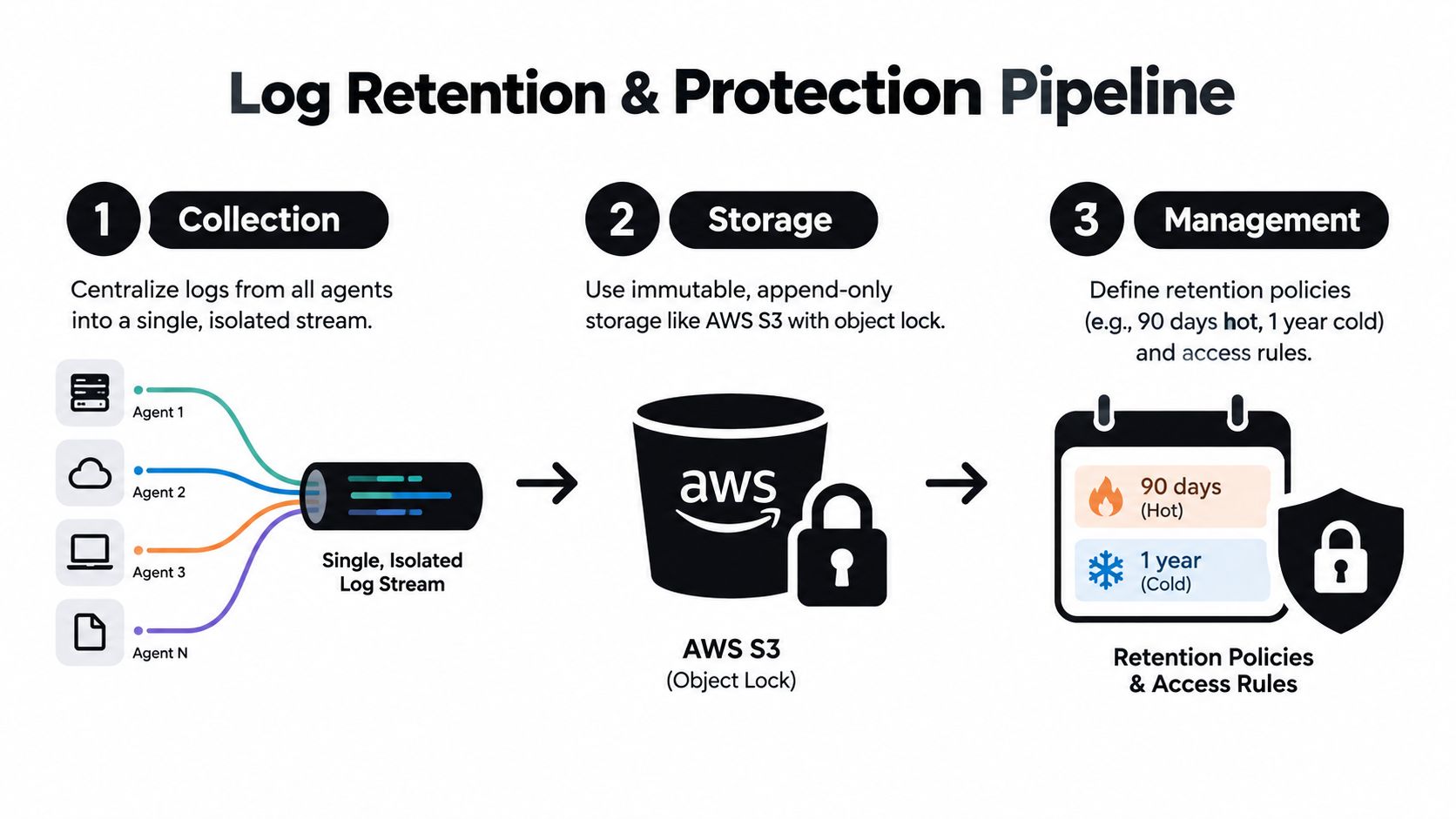
How to Retain Centralize and Protect Audit Logs
A good schema doesn't help if the collector stops, storage fills, or an administrator can rewrite the history. Retention and protection need their own operating design.
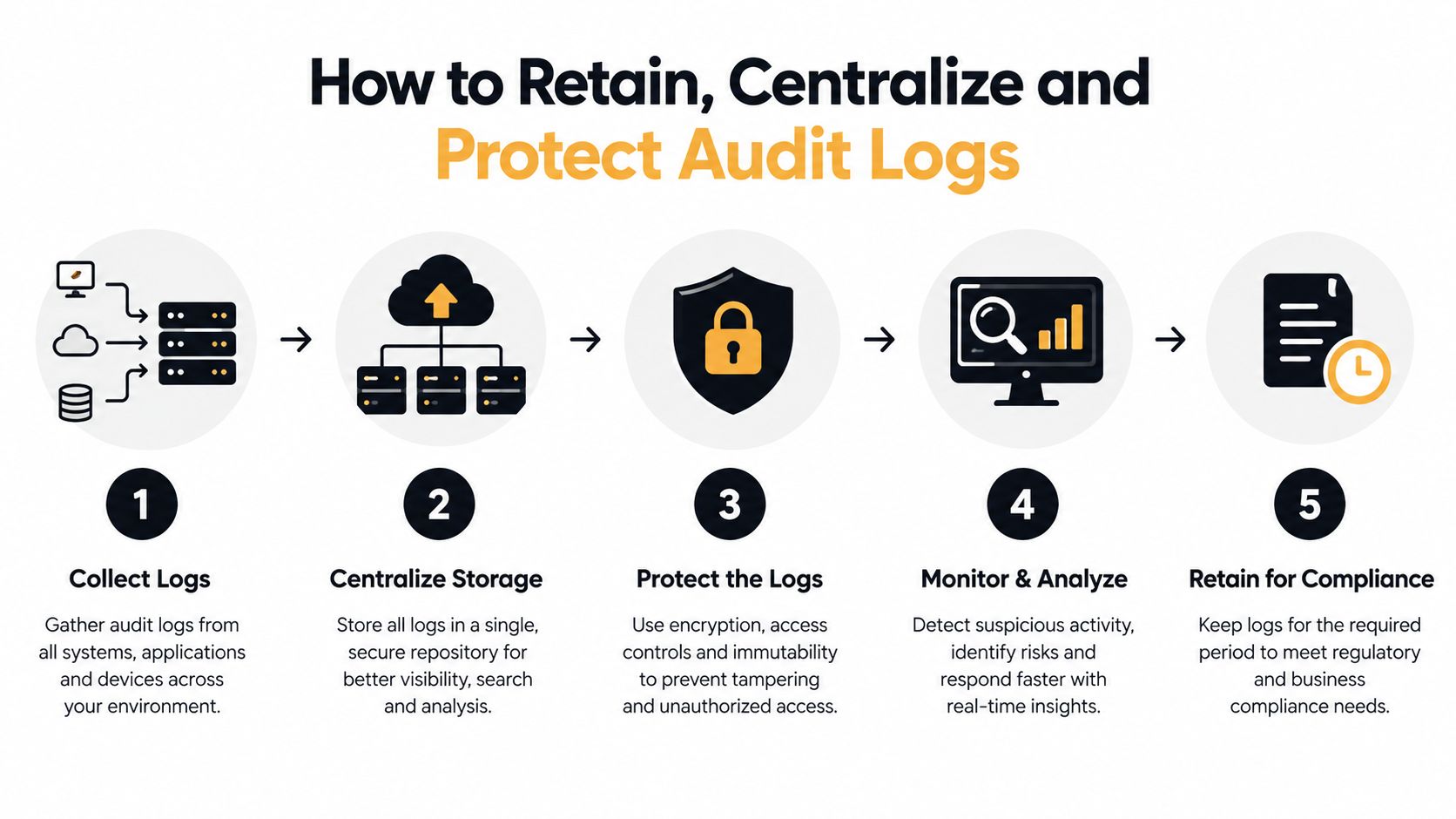
Centralize collection away from the application
Collect agent, MCP server, authorization, write-preview, external API, and storage-access events into a separate logging system. Mutable application tables and CSV exports are poor primary audit stores because they can be overwritten, lose field consistency, and don't naturally support SIEM or SOAR workflows.
The central pipeline should normalize events, enrich them with seller account and resource context, and route malformed records to a monitored failure path. Persistent storage must tolerate service interruption. If a collector stops or storage reaches capacity, the system needs an alert that identifies the gap, the affected source, and the recovery state. A silent logging failure is itself a control failure.
Use hot and cold retention deliberately
PCI DSS 4.0 Requirement 10 is commonly summarized as 12 months of retention, with at least 3 months immediately available for review. The PCI DSS 4.0 retention summary provides that 12-month and 3-month pattern and ties event logging to the broader need for investigation and compliance review.
For Amazon seller operations, recent write events and access events generally need fast search, while older history can move to colder immutable storage. Retention should be assigned by event class and regulatory need, not by convenience. AWS agentic guidance presents tiered windows of 30–90 days for operational logs, 1–7 years for compliance logs, and 7–14 days for debug logs. Those are design references, not universal policy. The applicable seller, agency, contractual, and regulatory requirements still determine the final schedule.
A workable control checklist includes:
- Collection: Centralize events from every MCP client, agent, service, and write path.
- Persistence: Deliver records to fault-tolerant storage that survives application or collector failure.
- Immutability: Use append-only or tamper-evident storage and monitor configuration changes.
- Availability: Keep the recent review window indexed and searchable, then archive older records without losing retrieval context.
- Access evidence: Log every privileged read, export, policy change, and retention change involving audit data.
Teams designing ownership, retention, and review procedures can also use this practical guide to audit trail management for DevOps. The important point is that log management belongs in the operating model, with named owners, tested alerts, documented retention decisions, and a recovery procedure.
Cloud logging guidance increasingly treats the pipeline itself as an attack surface. An attacker or over-privileged administrator may alter collection, forwarding, retention, or export settings without touching stored records. The controls described in MCP server security guidance should therefore be paired with independent checks that compare intended logging configuration with active configuration.
Making Writes Auditable With Previews Idempotency and Before After Values
Read operations and write operations require different evidence. A read can usually be reconstructed from the request, response metadata, and source-data timestamp. A write must also prove intent, authorization, execution, and resulting state.
Preview the requested change before submission
A write preview should show the target resource, current value, proposed value, account context, authorization scope, and any validation result. For an Ads workflow, that might mean recording the campaign or ad group, current bid, proposed bid, marketplace, source metrics used by the agent, and the workflow's rationale. For inventory or fulfillment, it might show the SKU, quantity, shipment or order target, and the proposed state transition.
The preview is not a recommendation. agentcentral returns structured data and guarded write tools. The calling agent or operator decides whether the proposed action is appropriate. The audit record should preserve that boundary by recording the facts returned, the decision context supplied by the caller, and the approval or execution event separately.
Make retries safe with idempotency
A network timeout doesn't prove that Amazon rejected a write. Retrying without an idempotency key can create duplicate actions, such as repeated shipment creation or repeated bid submissions. Each intended business action should carry a stable idempotency identity, and the audit record should show whether a later request was a new action or a retry of an existing one.
The event sequence should distinguish:
- Requested: the caller submitted an operation for a specific target.
- Previewed: the system calculated or validated the proposed change.
- Authorized: the permitted actor or workflow approved execution.
- Submitted: the external API accepted the request for processing.
- Observed: the resulting state or external status was read back.
- Closed: the operation completed, failed, or requires review.
Amazon Ads reporting isn't synchronous. The documented asynchronous generation time for both reports and snapshots is 15 minutes, as described in Amazon Ads API limits documentation. An audit trail should record report or snapshot request time, expected asynchronous status, polling or retrieval attempts, and the data timestamp used by the agent. Otherwise, a delayed report can look like a stale read or an unexplained retry.
SP-API throttling also needs account-specific context. The x-amzn-RateLimit-Limit response header can expose the limit for an account-application pair, according to the SP-API rate-limit documentation. Logging the calling application, seller account, response header when available, retry decision, and elapsed workflow state helps explain throttling without confusing it with authorization failure.
Before-and-after values complete the record. If a listing price, bid, inventory quantity, or fulfillment status changes, the audit event should retain the prior value, requested value, observed final value, and the source or request identifier associated with each state. Sensitive credentials and unnecessary personal data shouldn't be copied into the audit payload.
Access Controls and Pipeline Integrity for Trustworthy Logs
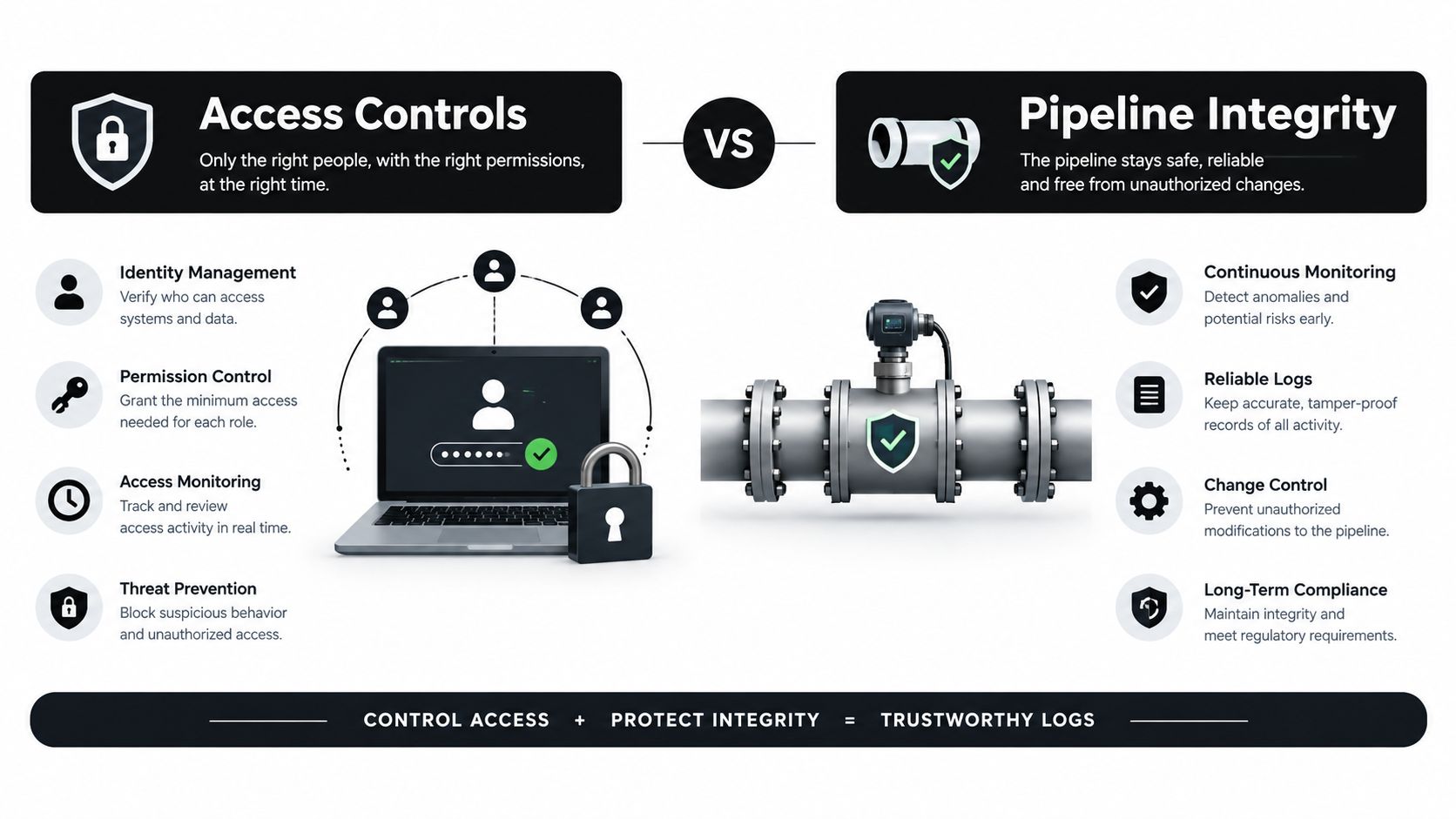
Log access and log administration are separate privileges. A developer may need to diagnose a failed collector without being allowed to read seller finance records. An auditor may need read-only search access without permission to change retention or forwarding. Treating both roles as one administrator role weakens the evidence.
Compare broad access with scoped access
| Control model | Operational benefit | Main weakness |
|---|---|---|
| Broad administrator access | Fast setup and fewer permission decisions | One identity can read seller data, alter collection, and remove evidence |
| Shared API key | Simple client configuration | Weak attribution and difficult revocation |
| Scoped API key | Limits tools, datasets, or accounts | Requires deliberate scope design and rotation |
| OAuth authorization | Connects access to an identifiable principal and consent flow | Needs expiry, revocation, and review procedures |
| Separate log administration | Protects collection and retention controls from ordinary data access | Adds operational ownership and change-review work |
For agencies and developers managing multiple seller accounts, the audit record should preserve the exact seller account context, client identity, scope, and authorization method. Isolated datasets reduce cross-account exposure, while revocable credentials limit the impact of a compromised client. A key that can read inventory shouldn't automatically be able to submit Ads or fulfillment writes.
Verify the logging pipeline itself
A protected bucket doesn't prove that the right events reached it. Configuration changes to collectors, filters, retention, exports, and ingestion routes should create their own audit events. Independent monitoring should test that expected event types continue to arrive and should alert when a source falls silent.
AWS recommends restricting audit-log access to privileged users, storing logs immutably, using fault-tolerant persistent storage, and logging access to the audit logs. The same principle applies to hosted MCP infrastructure. Log administrators should be separated from ordinary operators where practical, and changes to their privileges should receive their own review record.
Control boundary: The person who can change log collection shouldn't be the only person who can verify that collection still works.
Credentials should remain encrypted and absent from event payloads. Audit events can include a key identifier, OAuth client or principal identifier, scope, and authorization result, but not secret material. For broader operating guidance on ownership, policy enforcement, and review, cloud governance for engineering teams offers useful context beyond the logging implementation itself.
A role model should define read, write, preview, export, retention, configuration, and investigation permissions separately. Teams implementing this with MCP clients can use role-based access control for agent workflows as a reference point, then map each permission to seller accounts, tool groups, and business responsibilities.
Putting Audit Logging Best Practices Into Practice
The practical test is whether an operator can investigate a real event without contacting the developer who built the workflow. A coverage matrix should map each sensitive action, such as reading seller finance data, changing an Ads bid, updating a listing, creating a shipment, or managing an order, to its emitted audit event, required fields, retention class, and alert condition.
The routine should include three tests:
- Coverage test: Trigger approved reads, denied requests, previews, writes, retries, and failures. Confirm each produces the expected structured event.
- Integrity test: Verify that stored records are immutable or tamper-evident, and check that changes to collection or retention settings are themselves logged.
- Recovery test: Stop a collector or simulate storage exhaustion in a controlled environment. Confirm that alerts fire, events are handled according to policy, and the gap is visible to reviewers.
Structured JSON and separate audit streams make the records searchable across SIEM and SOAR tools. Pre-materialized reads also matter operationally for Amazon data workflows because they reduce dependence on slow, queued reporting paths. A data layer that retains history from the first connection can give an agent a stable record for comparison, while guarded writes preserve previews, idempotency identities, and state changes for later review.
The final verification shouldn't ask whether the system logs a lot. It should ask whether the logs prove the right things:
- Which seller account and principal were involved?
- Which client, agent, session, and trace initiated the action?
- What data did the workflow use?
- What resource and operation were targeted?
- Was the action previewed and authorized?
- What was the before state and observed after state?
- Did Amazon queue, reject, throttle, or complete the request?
- Can a privileged reviewer retrieve the record without being able to rewrite it?
These audit logging best practices connect daily Amazon operations with compliance verification. They also expose workflow defects early, before a duplicate write, stale report, missing event, or altered configuration turns into an incident.
agentcentral provides a hosted MCP data layer for Amazon Ads, Seller Central, inventory, orders, catalog, ranking, finance, and fulfillment, with pre-materialized reads and retained account history for fast repeated access. Teams can connect Claude, ChatGPT, OpenClaw, Cursor, and other MCP clients, then use scoped access, write previews, idempotency keys, and logged before-and-after values to make agent workflows auditable. Visit agentcentral to connect an Amazon seller account and evaluate the logging and guarded-write workflow.
Related Agent Central pages
- Amazon Seller Central MCP server
Canonical hosted MCP overview for Seller Central, Ads, inventory, catalog, finance, and fulfillment data.
- Amazon seller data for AI agents
How Agent Central normalizes Amazon seller data before exposing it to AI clients.
- Connect Seller Central to Claude
Step-by-step path from Amazon OAuth to a Claude connector or MCP config.
- ChatGPT with Amazon seller data
ChatGPT-specific setup path for Amazon seller data through hosted MCP.
- Amazon seller MCP servers compared
How hosted MCP services compare with official Ads MCP, local repos, connector tools, and automation platforms.
Related reading
- 7 Best MCP Servers for Amazon Sellers in 2026
Compare the best mcp servers for Amazon sellers, including hosted data layers, official tools, security, audit logs, integrations, and pricing.
- Amazon Ads Software Compared for AI Agent Workflows
Compare amazon ads software for AI agents. Evaluate latency, automation, auditability and MCP integrations to choose the right stack.
- What Is Mcp Server
What is mcp server. Learn what an MCP server is, how it works for Amazon sellers, and why hosted layers beat Amazon's first-party Ads server
- Setting Up OAuth with Agent Central for Amazon MCP Clients
Step-by-step guide to setting up OAuth with agentcentral for Claude, ChatGPT, and Amazon MCP clients, including scopes, tokens, and security.
Connect Amazon seller data to your AI client.
Agent Central gives Claude, ChatGPT, OpenClaw, Cursor, and other MCP clients structured access to Amazon Ads, Seller Central, inventory, orders, catalog, finance, and fulfillment data.