
How to Improve Profit Margins for Amazon Sellers
Learn how to improve profit margins with a data-driven framework for Amazon sellers. Optimize pricing, ads, inventory, and fulfillment using agentcentral.
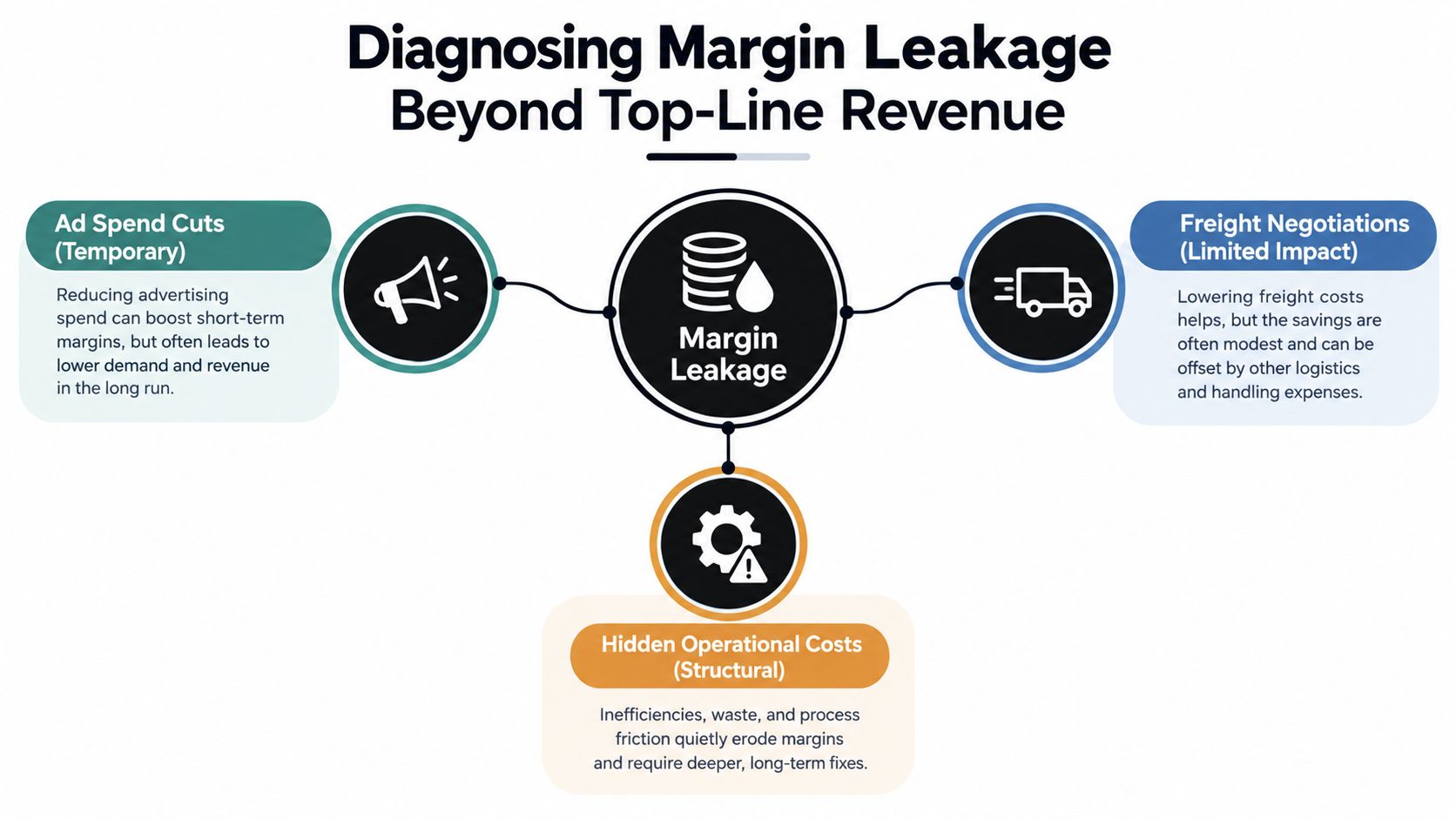
Cutting ad spend is the most popular answer to shrinking Amazon margins. It's also one of the easiest ways to hide the actual problem. A lower advertising bill can improve a reporting period while reducing sales velocity, weakening organic demand, and leaving freight, returns, storage, pricing overrides, and inventory errors untouched.
The more durable approach to how to improve profit margins is structural. Operators need to connect SKU economics with pricing, advertising, catalog quality, fulfillment, cash, and controlled execution. Historical evidence on operating margins supports that view: durable improvement tends to require changes that survive multiple years, rather than a single quarter of expense reduction, as described in this operating-margin analysis.
Table of Contents
- Diagnosing Margin Leakage Beyond Top-Line Revenue
- Implementing SKU-Level Pricing Architecture
- Controlling Advertising ROI and TACOS
- Optimizing Inventory Turns and Fulfillment Costs
- Catalog Health and Reimbursement Recovery
- Automating Margin Workflows with agentcentral
Diagnosing Margin Leakage Beyond Top-Line Revenue
Revenue growth doesn't repair a broken unit-economics model. A seller can increase orders while losing money on every incremental unit if discounts, advertising, fulfillment, returns, and working capital rise faster than pocket margin. The first task is to reconcile the movement from revenue to operating profit instead of treating the income statement as one undifferentiated result.
A useful margin bridge separates price, mix, volume, COGS, freight, labor, and overhead. The bridge should explain why profit changed between comparable periods and assign an owner to each unfavorable variance. If COGS includes inbound freight in one report but excludes it in another, the comparison is already unreliable. The definition must be reconciled before anyone acts.
Build the bridge at SKU and channel level
Start with a SKU ledger that joins selling price, units, Amazon fees, product cost, inbound freight, storage, advertising allocation, refunds, returns, and reimbursement recovery. Then calculate the metrics that reveal different forms of leakage:
- Gross margin by SKU: Revenue less the defined COGS, divided by revenue. This exposes product-cost, freight, and price pressure.
- Contribution margin by channel: Revenue less variable costs attributable to Amazon Ads, fulfillment, returns, and marketplace fees. This distinguishes a profitable product from a profitable channel mix.
- Cash conversion cycle: The time cash remains tied up in inventory and receivables, less supplier financing. A strong accounting margin can still create liquidity stress when stock sits too long.
- Pocket margin: The amount retained after discounts, rebates, freight absorption, refunds, and other deductions that don't appear in a simple list-price calculation.
A one-page weekly scorecard should show margin, contribution, service, and cash conversion cycle, with variance against the prior period and the accountable operator. A practical guide to profit margins for business owners is useful background for separating gross, operating, and net views, but Amazon operators need the same discipline applied at order and SKU level.
Prioritize structural deltas
The largest negative bridge item gets attention first. A freight negotiation might help, but it won't compensate for a product whose price floor is below its fully loaded cost. Cutting ads may lift contribution temporarily, yet it can also remove demand from a SKU that needs advertising to maintain rank. Better results come from repeatable pricing rules, cleaner inventory planning, conversion-rate improvement, and contribution-margin governance.
Amazon sellers handling large datasets can use Amazon sales data analysis to connect sales movement with operational causes. The purpose isn't to produce another dashboard. It's to identify whether margin leakage comes from price, mix, inventory, fulfillment, or a reporting definition that needs correction.
Implementing SKU-Level Pricing Architecture
Blanket markups are too blunt for marketplace economics. Every SKU has a different conversion pattern, competitive position, return exposure, storage profile, and advertising dependency. Pricing architecture should therefore define a floor price, a target price, and a ceiling price for each product.
The floor must cover the costs that move with the order. That normally includes product cost, inbound freight, marketplace fees, fulfillment, expected returns, advertising allocation, and any channel-specific deductions. The target price should produce the required contribution after those costs. The ceiling reflects willingness to pay, competitive positioning, and the point at which conversion loss outweighs the extra unit margin.
Set floors from pocket margin
A seller shouldn't approve a price change from the detail-page price alone. The control sheet should show:
| Field | Operating question |
|---|---|
| Fully loaded unit cost | What does one sellable unit really cost after inbound logistics? |
| Marketplace and fulfillment cost | What does Amazon retain or charge when the unit ships? |
| Expected return cost | Which return reasons create resale loss, disposal, or extra handling? |
| Advertising allocation | How much paid demand is required for this SKU and channel? |
| Floor contribution | Does the order remain economically viable at the proposed price? |
The calculation should be applied at customer, product, and channel level where the data supports it. A SKU may appear attractive on gross margin while losing pocket margin through freight absorption, rebate noncompliance, pricing overrides, or inventory write-offs. Directional guidance for physical-goods businesses often places gross margin around 40% to 60% and operating margin around 5% to 20%, but those ranges are only useful when the peer set is comparable, as explained in this product margin benchmark guide.
Test elasticity without gambling the catalog
Low-elasticity products are candidates for controlled price tests. The operator changes a small group of comparable SKUs, watches unit volume, conversion, contribution, and organic sales, then keeps or reverses the change according to predefined thresholds. The benchmark guidance specifically discusses testing 1% to 2% price increases on low-elasticity items, with the range documented in the industry margin improvement guide.
Bundling can raise order value without applying a heavy discount to every unit. A complementary bundle should be evaluated on combined contribution, additional fulfillment complexity, return behavior, and inventory availability. A bundle that increases revenue but adds slow-moving components or creates a new packaging problem isn't automatically profitable.
Pricing governance belongs in a weekly owner review. The scorecard should flag price changes outside the floor and ceiling, margin deterioration by SKU, competitor movement, and discount exceptions. Pricing power remains underused: Simon-Kucher's 2025 Global Pricing Study reports that sales volume remains the top profit driver over the next 24 months and that 68% of companies worldwide say they have pricing power. The practical implication is clear. Sellers should test price architecture before assuming every margin problem requires another cost cut.
Controlling Advertising ROI and TACOS
Advertising becomes dangerous when operators manage it by ROAS alone. A campaign can show acceptable ROAS while producing little incremental demand, or it can show weak direct ROAS while supporting profitable organic sales. TACOS, total advertising cost of sales, puts advertising spend against total sales and shows whether paid demand is consuming an expanding share of the business.
The correct question is not “Which campaign has the highest ROAS?” It's “Which spend produces acceptable contribution after product cost, Amazon fees, fulfillment, returns, and the organic sales effect?” That requires search-term, placement, SKU, inventory, and finance data to be read together.
Separate profitable demand from expensive demand
A useful audit groups campaigns into four operating states:
- Incremental growth: Paid traffic creates sales that would otherwise be unlikely, and the resulting contribution supports the spend.
- Organic defense: Advertising protects branded or high-intent demand, but the operator measures the defensive role rather than claiming all sales are incremental.
- Cannibalization: The campaign captures sales already likely to occur, making direct ROAS look better than total profit.
- Bleeding traffic: Queries generate clicks or orders that don't cover their full variable cost.
Search-term reports should be reviewed for irrelevant queries, weak conversion patterns, expensive placements, and products with inadequate stock. Negative targeting belongs in the control loop, not as a one-time cleanup. The operator should also compare advertising efficiency with return rate and catalog conversion, because poor listing quality can make a campaign appear inefficient when the underlying issue is content or offer quality.
Practical rule: A bid increase needs a margin reason, not just a click or ROAS reason.
Pre-materialized reads make this analysis more reliable than repeatedly requesting slow reports during a live decision. A workflow can join campaign spend, search terms, SKU contribution, sales velocity, and available inventory before the agent or manager reviews the result. The Amazon Ads optimization workflow provides relevant operating context for that type of analysis.
Creative quality still matters, but creative production shouldn't be separated from economics. A manager reviewing formats and messaging can use the MerchLoom ad creative catalog for practical examples, then evaluate each variation against conversion, contribution, and inventory constraints rather than treating engagement as the final objective.
When stock is constrained, bids should be throttled before a high-velocity SKU goes unavailable. When inventory is aging, demand generation may need to support a controlled sell-through plan, but only if the resulting contribution remains acceptable. Advertising is a variable cost, so the rule must change with price, stock, and margin, not remain fixed in a campaign template.
Optimizing Inventory Turns and Fulfillment Costs
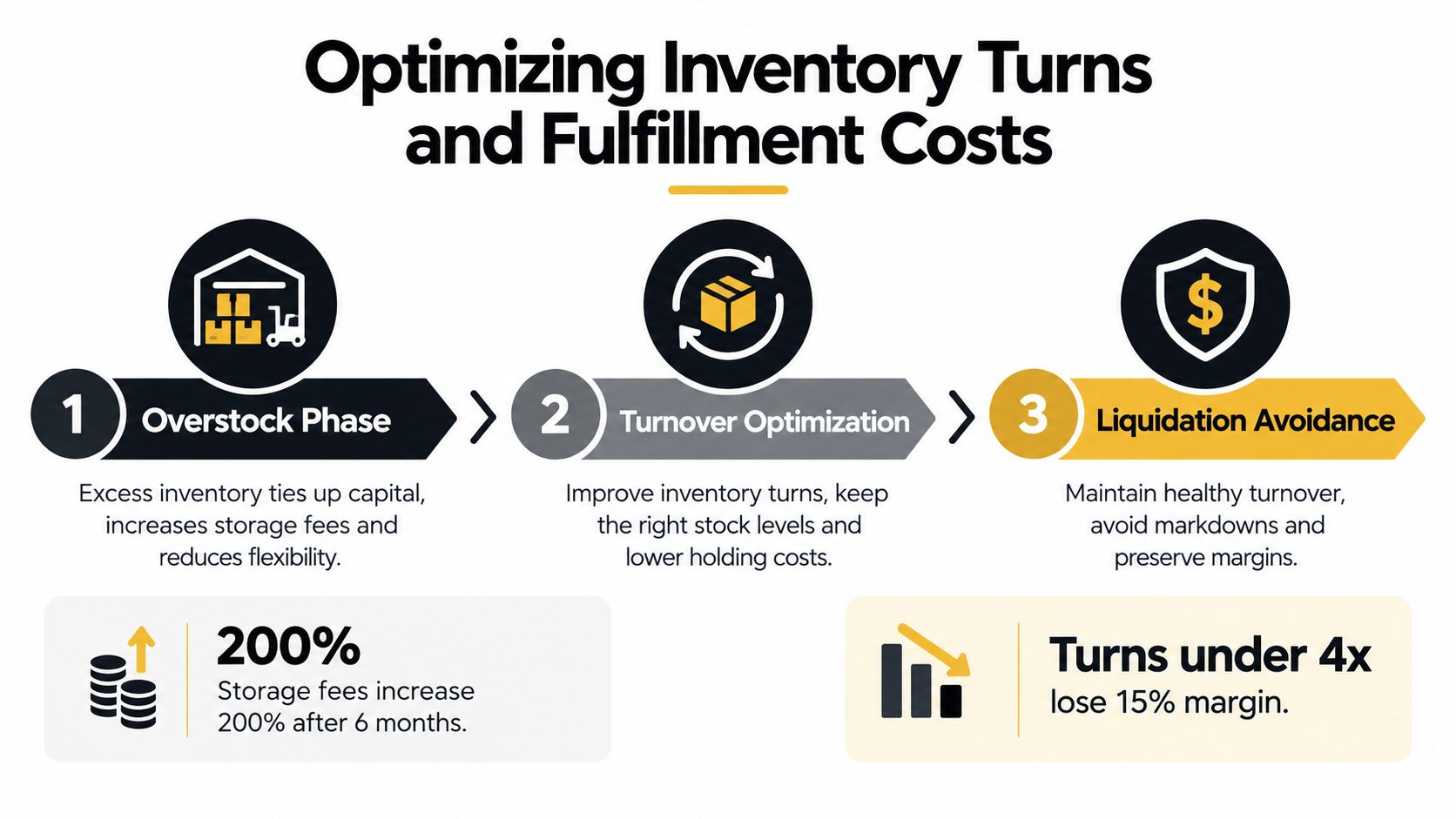
Excess inventory creates three separate problems: storage cost, trapped cash, and eventual value loss. The operator needs a days-of-cover calculation that combines sellable FBA stock, inbound units, reserved units where relevant, and a defensible sales-velocity window. Using only on-hand stock produces false confidence when replenishment is already in transit.
Amazon's 2026 U.S. FBA storage fee structure charges standard-size inventory about $0.78 per cubic foot from January through September and about $2.40 per cubic foot from October through December. Oversize inventory is charged about $0.56 per cubic foot in the first period and about $1.40 per cubic foot in the second, according to this Amazon seller fee breakdown.
Track aging before it becomes a charge
The current U.S. long-term storage model starts once inventory reaches 181 days in storage. The surcharge is roughly $0.50 per cubic foot at 181 to 270 days, $1.50 per cubic foot at 271 to 365 days, and $6.90 per cubic foot or $0.15 per unit at 365 days or more, whichever is greater, as detailed in this long-term storage fee explanation.
An inventory control table should expose aging by SKU, not only aggregate stock:
- Days of cover: Sellable units plus confirmed inbound, divided by the selected sales velocity.
- Aging exposure: Units approaching the 181-day threshold, multiplied by the applicable storage and handling risk.
- Cash at risk: Unit cost tied to stock that isn't expected to sell within the planned window.
- Exit path: Price test, bundle, removal, liquidation, alternate channel, or controlled advertising.
The decision should happen before the threshold. A removal order may preserve more cash than leaving inventory in FBA, while Multi-Channel Fulfillment or a third-party logistics provider may make sense when another channel can sell the stock without the same storage profile. Those choices depend on service requirements, handling charges, dimensional weight, and expected contribution.
The inventory turnover rate calculation should feed a recurring review rather than a static report. Alerts can identify low cover before replenishment becomes urgent and aging stock before storage exposure accelerates. The system should present the underlying facts, while a seller or workflow owner decides whether to replenish, transfer, remove, or liquidate.
Returns require the same discipline. U.S. ecommerce returns reached $890 billion in 2024, and returns can erase 20% to 65% of an item's original value, according to Spreetail's marketplace margin analysis. That makes fulfillment cost, packaging, dimensional weight, and return reason part of inventory economics, not separate operations metrics.
Catalog Health and Reimbursement Recovery
A catalog defect can look like an advertising problem. If the listing has an incorrect variation, weak images, missing attributes, suppressed content, or incomplete A+ Content, conversion can fall while the seller increases bids to preserve sales. The result is a higher acquisition cost attached to a product that still has the same underlying offer.
Catalog health belongs in the margin review because conversion changes the cost of demand. The operator should connect listing status, content completeness, sessions, conversion, advertising placement, and return reason codes at SKU level. That connection helps separate a traffic problem from an offer problem and an offer problem from a product problem.
Turn defects into financial work queues
The catalog audit should classify defects by financial consequence:
- Suppression defects: Prevent the product from receiving normal traffic or completing a sale.
- Variation defects: Split demand, confuse shoppers, or attach reviews and content to the wrong child.
- Content defects: Leave customers without information needed to make a confident purchase.
- Offer defects: Create a price, availability, fulfillment, or condition mismatch.
- Data defects: Misstate dimensions, attributes, pack counts, or other fields that affect discoverability and fees.
Return reason codes provide a second diagnostic layer. High returns caused by incorrect size, missing components, misleading images, or damaged packaging point to different remedies. A listing update may resolve one pattern, while a packaging redesign or supplier correction is required for another. Operators should measure the change in contribution after the defect is fixed, not just mark the ticket complete.
Recover money already earned
FBA reimbursement audits should compare shipped units, received units, customer returns, damaged inventory, removals, disposal records, and settlement transactions. A recovery workflow needs a source transaction, a reason classification, the amount expected under the applicable policy, and a record of the submitted claim or adjustment.
The same process should review fee discrepancies and inventory movements. Reimbursement recovery isn't a substitute for margin improvement, but it protects capital that belongs in the unit-economics model. Finance data becomes more useful when it can be reconciled to catalog and fulfillment events rather than reviewed as an isolated settlement export.
A seller should also watch whether a content change increases conversion but worsens returns. Higher order volume is not a win if customers receive an inaccurate promise and the product comes back unsellable. The profitable catalog is the one that converts the right customer, ships the right item, and produces a clean settlement trail.
Automating Margin Workflows with agentcentral
Manual margin analysis breaks down when operators need to repeat the same joins across many SKUs, marketplaces, campaigns, and inventory states. Amazon's Selling Partner API also imposes operation-specific limits. For example, the API returns an x-amzn-RateLimit-Limit header for many operations, and the value identifies the request rate for a specific account-application pair. The official SP-API rate-limit table lists getAccount at 0.5 requests per second with a burst of 30 and getMarketplaceParticipations at 0.016 requests per second with a burst of 15.
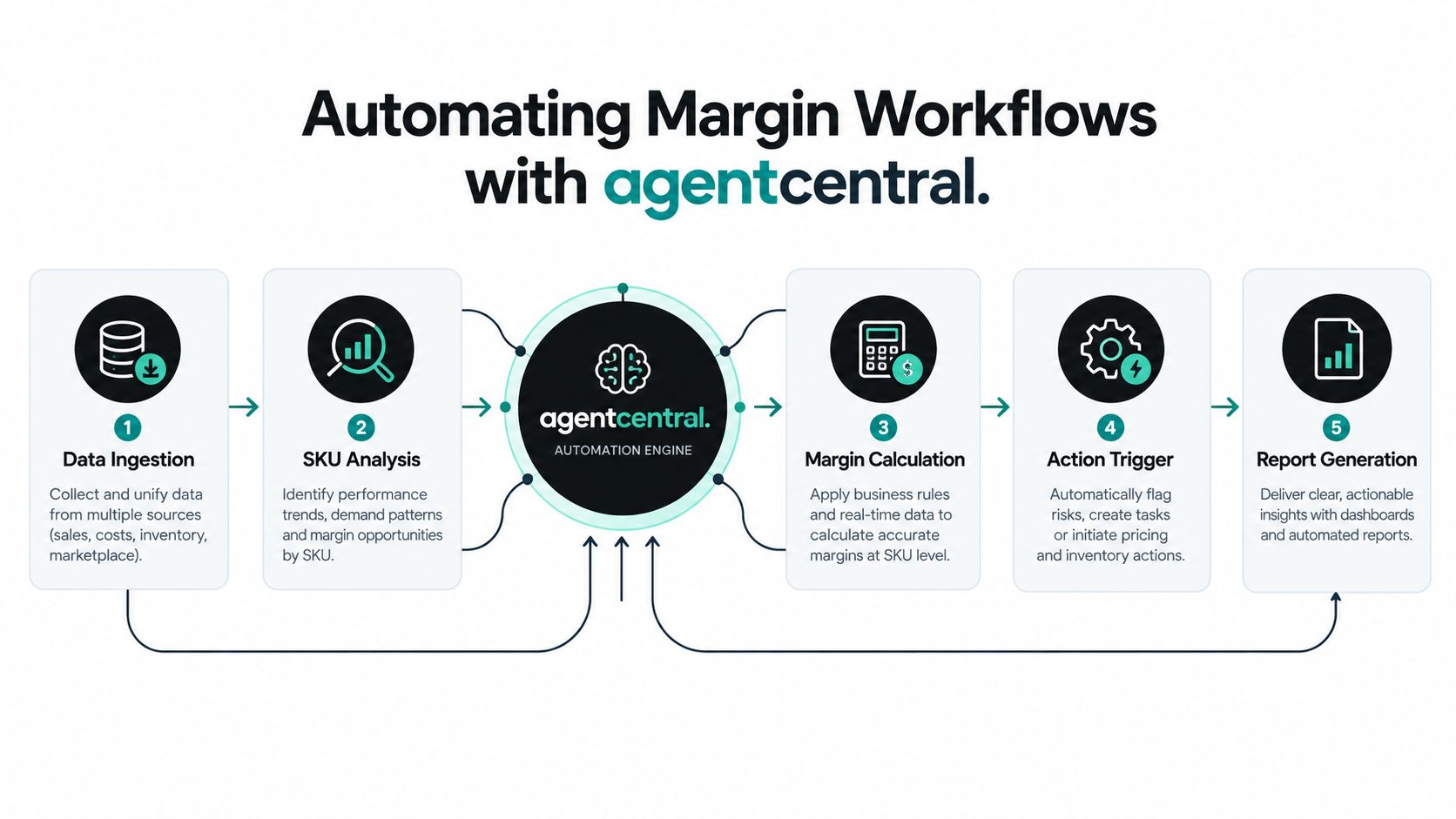
A reliable architecture therefore separates data ingestion from repeated analysis. Instead of asking every agent run to generate fresh asynchronous reports, the system retains normalized, pre-materialized reads for inventory, ads, finance, catalog, ranking, orders, and fulfillment. That reduces repeated API pressure and gives the operator a consistent point-in-time dataset for margin comparison.
Configure access around control boundaries
The setup should follow an explicit sequence:
- Authorize the account with OAuth. The seller grants the required Amazon access through an authorization flow rather than sharing credentials directly.
- Create scoped API keys. Access should match the dataset and operations the client needs. A reporting agent doesn't need unrestricted write access.
- Connect the MCP client. Claude, ChatGPT, OpenClaw, Cursor, or another MCP client can use the hosted server as the structured data interface.
- Define isolated datasets. Account separation prevents one seller's records from appearing in another seller's workflow, which matters for agencies and multi-account operators.
- Review writes before execution. Price changes, bid adjustments, listing updates, shipment creation, and MCF actions should expose a preview, an idempotency key, and before-and-after values.
- Retain audit logs. Every guarded write should record who or what initiated it, the intended change, the result, and the source values used.
agentcentral is a hosted MCP server and Amazon seller data layer for AI agents, not a recommendation engine. It returns facts, metrics, classifications, source-provided fields, and guarded write tools with audit logs. The seller's agent, manager, or workflow decides whether a price should rise, a bid should fall, or inventory should move.
A practical margin workflow can ask for SKUs below their contribution floor, identify aging units, classify bleeding search terms, and reconcile fee or reimbursement anomalies. The output should be a reviewable report with source fields and exceptions, not an unexplained autonomous action.
Control principle: Fast reads improve decision frequency, but write guardrails protect account integrity.
The product's stated offer includes a hosted connection to Amazon seller data for MCP clients, with OAuth authorization, scoped access, isolated datasets, pre-materialized reads, and logged guarded writes. Sellers evaluating the workflow should start with a narrow use case, validate the calculations against Seller Central and finance records, then expand only after the scorecard and audit trail agree.
agentcentral connects Amazon Ads, Seller Central, inventory, orders, catalog, ranking, finance, and fulfillment data to MCP clients through a hosted data layer. For margin work, sellers can use its pre-materialized reads and guarded, auditable write tools to review SKU economics, pricing, advertising, and inventory without rebuilding the same integrations for every workflow. Visit agentcentral to connect an Amazon account and test a controlled margin workflow.
Related Agent Central pages
- Amazon Seller Central MCP server
Canonical hosted MCP overview for Seller Central, Ads, inventory, catalog, finance, and fulfillment data.
- Amazon seller data for AI agents
How Agent Central normalizes Amazon seller data before exposing it to AI clients.
- Connect Seller Central to Claude
Step-by-step path from Amazon OAuth to a Claude connector or MCP config.
- Amazon seller MCP servers compared
How hosted MCP services compare with official Ads MCP, local repos, connector tools, and automation platforms.
- ChatGPT with Amazon seller data
ChatGPT-specific setup path for Amazon seller data through hosted MCP.
Related reading
- How to Handle Amazon Customer Complaints with AI
Use AI to triage Amazon customer complaints with verified order, shipment, return, refund, and fulfillment data—without giving agents inbox access.
- What Is Inventory List
What is inventory list. Learn what an inventory list is for Amazon FBA, how to structure fields, and how agents use it via agentcentral
- MCP Server Governance for Amazon Workflows
Practical mcp server governance for Amazon seller agents — scoped keys, audit logs, idempotency, and tenant isolation explained.
- MCP Server Integration for Amazon Sellers: A Complete How-To
Connect AI agents to Amazon seller data with this MCP server integration guide. Learn OAuth, scoped keys, write previews, and auditability for agents.
Connect Amazon seller data to your AI client.
Agent Central gives Claude, ChatGPT, OpenClaw, Cursor, and other MCP clients structured access to Amazon Ads, Seller Central, inventory, orders, catalog, finance, and fulfillment data.