
Private Label Amazon FBA Explained for Operators
Learn private label Amazon FBA from sourcing to ads and fulfillment, plus how agentcentral gives AI agents fast, auditable Amazon data via MCP.
A new seller usually reaches the same moment. The sample looks good, the supplier says production can start soon, and Seller Central is open in another tab. Then the questions show up. Is this a brand worth building, or just an expensive listing with a logo on it?
That tension is what Private Label Amazon FBA really is. It isn't just a sourcing tactic. It's a decision to own the brand, control the listing, fund inventory, and use Amazon's fulfillment network so the operator can focus on product, merchandising, ads, and inventory movement.
For readers at agentcentral, that decision also has a data layer. A private-label founder doesn't just need a product and a supplier. That founder needs clean reads across catalog, stock, ads, search rank, fees, and fulfillment timing, because the model breaks when those systems are managed from stale exports and delayed reports.
Table of Contents
- Introduction to Private Label Selling on Amazon FBA
- How Private Label Amazon FBA Actually Works
- Sourcing Branding and Launch Economics That Determine Viability
- Inventory Fulfillment and Fee Pressures Every Private Label Seller Faces
- Advertising and Ranking Strategy for Private Label Growth
- Adding AI Workflows with agentcentral Without Losing Control
- Deciding If Private Label Amazon FBA Is Worth It in 2026
Introduction to Private Label Selling on Amazon FBA
A first launch often starts with a simple idea. A seller finds a commodity product with clear demand, asks a manufacturer to produce a version under a new brand, sends units into FBA, and expects the listing to do the rest. That isn't how the business works in practice.
Private label selling on Amazon FBA is a brand and operations bet. The seller owns the brand identity, controls the product presentation, sets pricing, funds inventory, and carries the launch risk. Amazon stores, packs, and ships the units. That split matters because it changes what the operator does each week.
What the founder owns
In a private-label model, the seller is responsible for more than choosing a product.
- Brand control: The seller owns the trademark path, packaging choices, listing copy, image stack, and product positioning.
- Commercial risk: Cash is committed before demand is fully proven, so mistakes in demand planning or pricing can sit in FBA for months.
- Launch execution: Reviews, early conversion, ad efficiency, and stock flow decide whether the SKU becomes a real asset or dead inventory.
This model has become standard on Amazon. Jungle Scout's 2023 State of the Amazon Seller reporting found that 54% of Amazon sellers use the private-label model, and later industry summaries reported that roughly 92% of private-label brands rely on FBA (Jungle Scout private-label FBA overview).
Why operators choose it
Resellers compete on access and price. Private-label sellers compete on control. They can improve packaging, tighten the product spec, rewrite the listing, and build a catalog that customers associate with one brand instead of one SKU.
Practical rule: If the goal is to build equity, private label fits better than arbitrage or wholesale. If the goal is to turn inventory quickly with less upfront branding work, it may not.
Amazon itself showed how durable this model can become. Its private-label expansion began with Pinzon in August 2005 and later expanded into AmazonBasics around 2009. By 2022, Amazon had at least 118 private-label brands (CNBC coverage of Amazon private label). That matters because new sellers aren't entering a market where private label is novel. They're entering one where it is established, competitive, and operationally demanding.
How Private Label Amazon FBA Actually Works
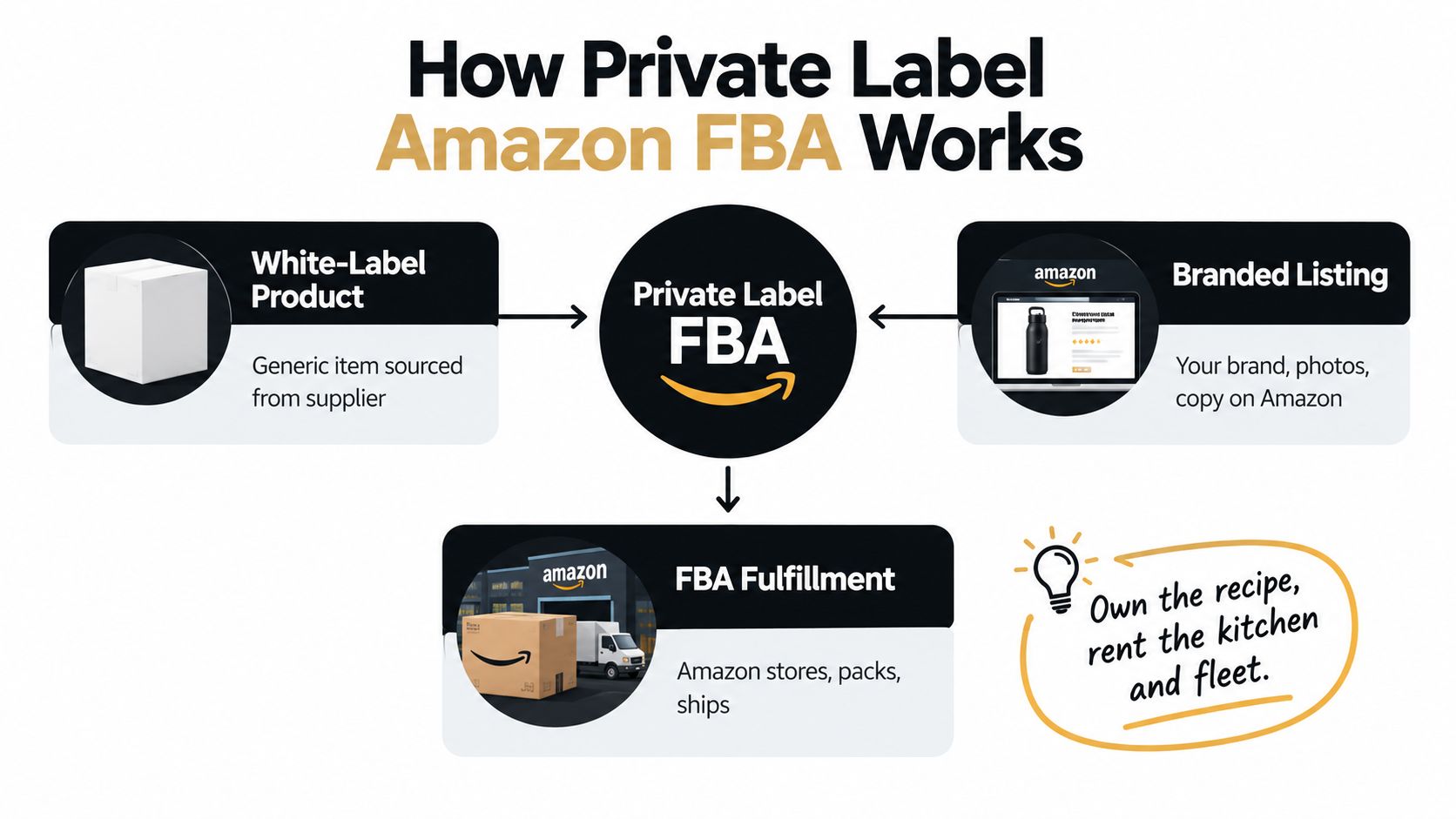
Private label Amazon FBA works best when it's separated into three layers. Product. Brand. Fulfillment. New sellers often mix them together and miss where the actual advantage sits.
Own the product identity, not the factory
The easiest analogy is this. The seller owns the recipe but rents the kitchen and delivery fleet. A manufacturer produces the item. The seller decides what brand goes on the unit, how the packaging looks, what features matter, and how the listing sells those features.
That is different from wholesale. In wholesale, multiple sellers may offer the same branded item. In private label, one seller is building the branded offer from the start.
The operational flow inside Amazon
Once the product is ready, the workflow usually looks like this:
- Create the listing in Seller Central. The seller builds the ASIN detail page with title, images, bullets, description, and brand presentation.
- Prepare inventory for FBA. Units are labeled and sent to Amazon fulfillment centers.
- Amazon receives and stores the stock. Inventory becomes available for Prime-eligible fulfillment.
- The listing starts competing for attention. Traffic comes from search, ads, and external demand.
- Orders route through FBA. Amazon picks, packs, ships, and handles the customer-facing delivery flow.
Why listing control matters
A private-label operator usually controls the detail page in a way resellers don't. That means better control over:
- Pricing logic: Margin discipline depends on price changes being deliberate, not reactive.
- Conversion inputs: Images, bullets, A+ content, and review profile all shape click-through and conversion.
- Catalog consistency: Parent-child variations, pack counts, and branded naming can be structured for growth instead of inherited from another brand.
A weak listing can make a good product look undifferentiated. A strong listing can make a familiar product feel branded and specific.
Where beginners get confused
The common mistake is thinking FBA is the business model. It isn't. FBA is the fulfillment layer. The business model is private label. That means the seller still has to make the product viable before Amazon's logistics become helpful.
A second confusion point is the Buy Box. New private-label sellers sometimes assume they won't need to think about it because they're the brand owner. In practice, stock availability, price, fulfillment status, and listing quality still shape whether the offer stays competitive and visible.
Sourcing Branding and Launch Economics That Determine Viability
A new private-label seller often reaches the same moment. The supplier quote looks workable, the sample seems fine, and the product idea feels promising. Then the spreadsheet starts, and the question changes from "Can I source this?" to "Can this SKU survive launch without draining cash before it earns rank?"
The launch budget starts before the first sale
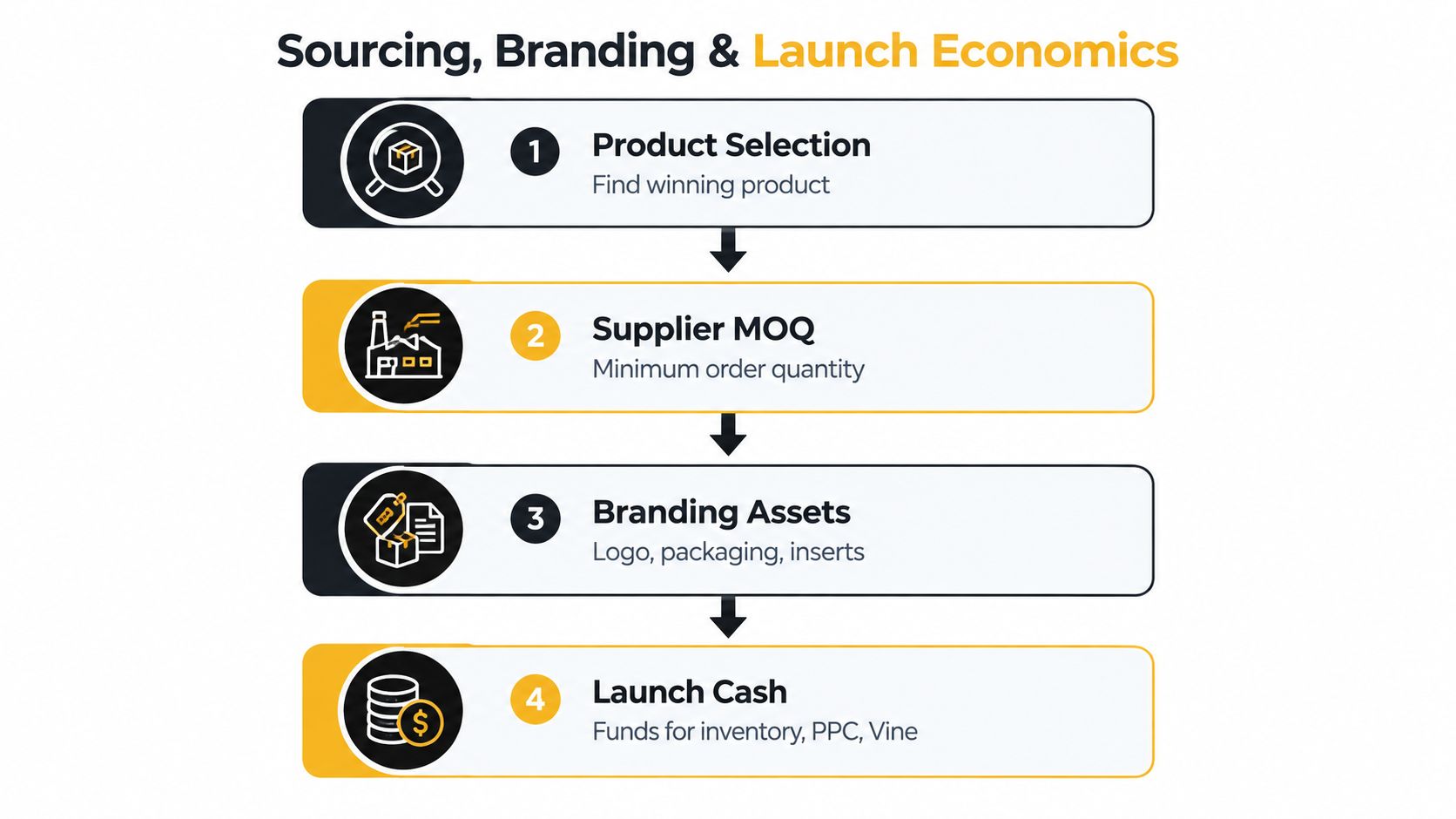
Unit cost is only one line in the model. An operator builds the launch budget around the full sequence of work: samples, packaging edits, trademark and brand asset costs, opening production run, freight, prep, and the ad spend needed to generate early clicks and orders.
That matters because private label is a cash conversion cycle before it becomes a sales engine. Money leaves the business weeks or months before Amazon pays the first settlement. If the seller misreads that timing, the product can look profitable on paper and still create a cash problem in practice.
The clean way to evaluate a SKU is to map the numbers in order:
- Landed product cost: unit cost plus freight, duties, and prep
- Branding cost per launch: packaging, inserts, photography, creative, and any setup work that does not repeat every order
- Launch acquisition cost: coupons, PPC, and review program costs tied to early conversion
- Expected reorder timing: how long cash stays tied up before the second PO is needed
That workflow is where a hosted MCP data layer can help the operator stay organized. It can pull supplier notes, margin assumptions, ad data, and inventory snapshots into one place. It does not decide what to launch. The seller still sets assumptions, checks category risk, and approves the order.
Reviews and inventory create a timing problem
Early launch economics are usually constrained by two things at once: trust and stock. A listing with no reviews struggles to convert. A listing with too little stock can lose momentum before the first batch of learnings is useful.
A recent launch guide notes that Amazon Vine charges a flat enrollment fee for up to 30 reviews on an enrolled ASIN, and that opening orders often require meaningful upfront inventory depending on size and unit cost. For a new seller, that means reviews are not only a social-proof question. They are part of the cash plan.
Three clocks are running at the same time:
- Review clock: how fast the listing can build enough proof to convert cold traffic
- Inventory clock: how much stock can support launch demand without creating expensive leftovers
- Cash clock: how long the seller can fund the SKU before sales proceeds support the next order
A weak launch usually breaks on one of those clocks first.
Branding has to show up in the listing, not just on the box
New founders often hear "differentiate the product" and picture factory changes only. Sometimes the differentiation is physical. Sometimes it is the bundle, the use case, the size, the instructions, or the way the listing explains the product.
Branding works like packaging around a commodity. Two sellers can source from similar factories and still produce very different customer responses. On Amazon, shoppers see that difference through the main image, title clarity, infographics, A+ content, comparison charts, and how clearly the copy answers a specific use case.
Sellers who build demand off Amazon run into the same discipline. Teams handling paid social often separate media execution from brand positioning, which is part of why frameworks like this guide to white label Facebook ads are useful. The lesson for Amazon is simple. Traffic is expensive when the message is generic.
Product selection needs a filter that includes launch math
A product idea is not viable just because search demand exists. The better filter is whether demand, conversion potential, and post-fee margin still hold after launch costs and reorder risk are included.
That is why experienced operators review a SKU the way a buyer reviews shelf space. They ask whether the product has room for visible differentiation, whether the price ceiling leaves enough contribution margin for ads, and whether the seller can carry the inventory long enough to learn. For examples of categories where demand may exist but competitive gaps still show up in listing quality or positioning, this agentcentral article on high-demand products with low competition is a useful starting point.
The key point is simple. Sourcing starts the business, but launch economics decide whether the business can keep going.
Inventory Fulfillment and Fee Pressures Every Private Label Seller Faces
After inventory reaches FBA, the business turns into a fee and timing problem. A seller can have a decent product and still lose margin through bad replenishment decisions.
Why overstock and understock both hurt
Amazon's FBA fee system doesn't punish only excess stock. Lean inventory can hurt too if it causes stockouts, unstable ad delivery, or emergency reorder decisions. Recent operator guidance notes that fee changes, storage charges, aged-inventory surcharges, inbound placement fees, and low-inventory penalties have made inventory forecasting a survival skill rather than a back-office task (NovaData guide on FBA margin pressure).
That pressure shows up directly in profit. Private-label Amazon FBA businesses commonly operate on net margins around 15% to 25% after product cost, fulfillment, and advertising, while seller-survey data showed 57% of Amazon sellers reporting margins above 10% and 28% above 20% (Bag Engine margin discussion). When margins are in that range, inventory mistakes aren't side issues. They become the whole result.
FBA cost triggers to watch
Amazon doesn't treat storage as a vague overhead line. It applies specific fee mechanics. The company states that it charges monthly inventory storage fees based on the calendar month and daily average volume, and in Canada says inventory stored for 181 days or more is charged an aged inventory surcharge in addition to storage fees (Amazon storage fee help page).
| Inventory State | Fee Trigger | Operator Impact |
|---|---|---|
| Freshly received stock | Monthly storage fees based on calendar month and daily average volume | Slow sales begin costing money even before the inventory becomes aged |
| Inventory held too long | Long-term storage fees can apply | Margin erodes while the seller waits for demand that may not come |
| Inventory aged past 181 days in Canada | Aged inventory surcharge in addition to storage fees | Old stock becomes more expensive to keep than many new sellers model |
| Inventory spread inefficiently | Placement and inbound fee exposure under newer FBA economics | Landed cost rises before the unit ever sells |
| Inventory too thin | Low-inventory penalties and ranking instability | The seller saves storage cash but risks lost momentum and awkward reorder timing |
Replenishment is an operating policy
MOQ isn't just a supplier term. It shapes the entire cash cycle. A supplier may want a larger run to lower unit cost, but a larger run can trap cash in stock that doesn't move fast enough.
Operators usually need a written replenishment policy that answers:
- When does the next PO trigger? Based on sales velocity, lead time, and inbound receiving delay.
- How much buffer is acceptable? Enough to protect rank and ad continuity, but not enough to age into fee-heavy storage.
- What happens if demand stalls? Price action, bundle changes, ad pullback, or removal planning should already be mapped.
Stock discipline matters more than launch enthusiasm. A seller can recover from a slow start more easily than from a warehouse full of slow units.
Advertising and Ranking Strategy for Private Label Growth
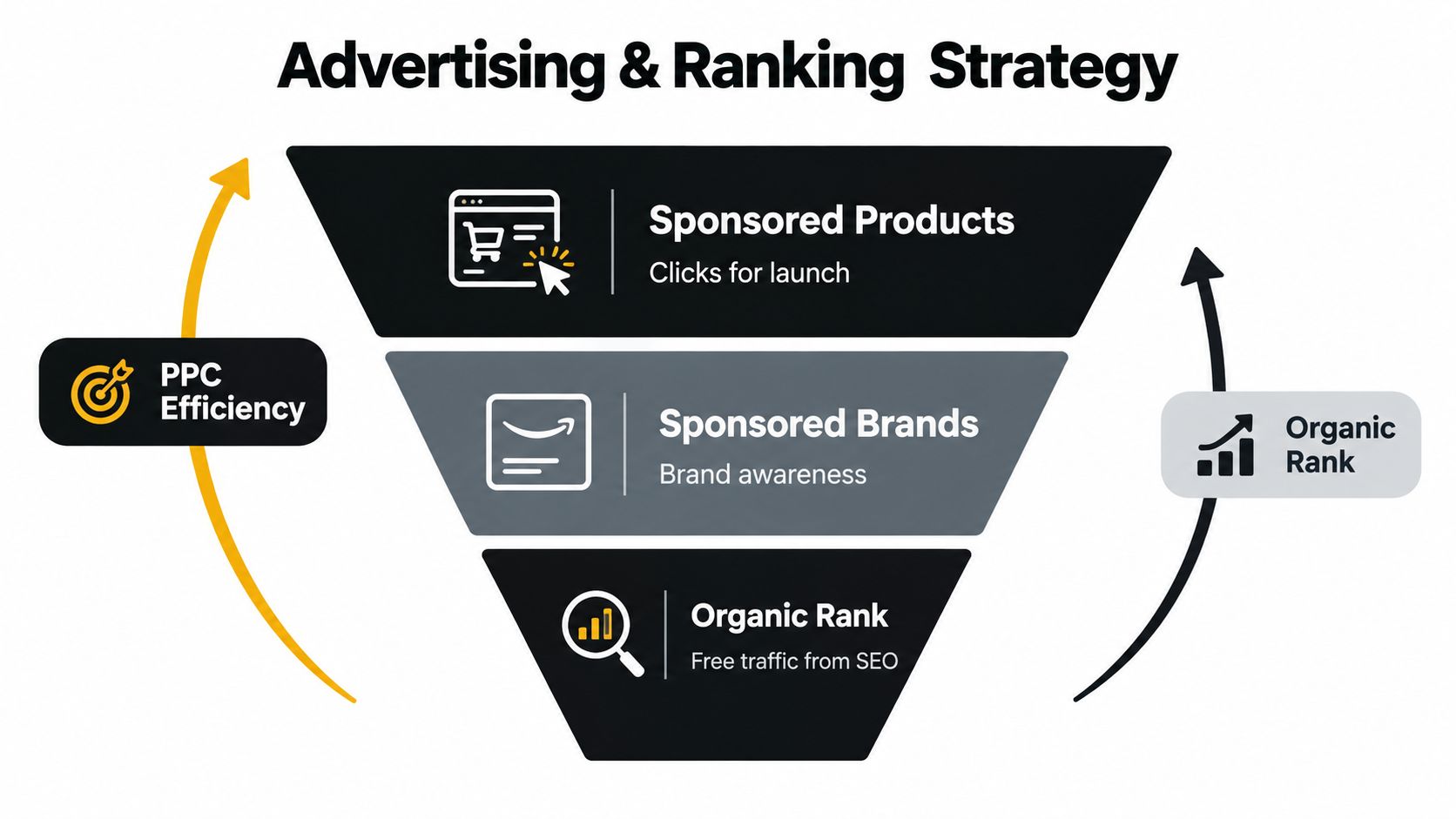
Private label growth comes from two systems working together. Paid traffic creates early visibility. Organic rank reduces dependence on paid traffic later. If either side breaks, the unit economics usually follow.
Private label ads are different from reseller ads
A reseller often advertises a product that already has market recognition. A private-label seller is advertising both the SKU and the brand promise at the same time. That changes how Sponsored Products, Sponsored Brands, and Sponsored Display tend to be used.
| Ad Type | Typical Role for Private Label | Why It Matters |
|---|---|---|
| Sponsored Products | Launch visibility and keyword testing | Usually the fastest way to learn which terms actually convert |
| Sponsored Brands | Branded search presence and catalog framing | Helps shape how shoppers see the brand, not just one item |
| Sponsored Display | Audience retargeting and broader visibility support | Useful when the operator wants to support remarketing or product adjacency |
TACOS is the better lens
Private-label sellers often get stuck watching campaign metrics in isolation. TACOS is more useful because it frames ad spend against total sales, not only ad-attributed sales. That matters when ads are helping organic rank, review velocity, and listing maturity.
A practical operator view looks like this:
- At launch: Higher ad dependence is normal because the product has limited organic history.
- During stabilization: The seller wants keyword coverage to tighten around search terms that create both direct sales and stronger rank signals.
- At maturity: Ads should still support the listing, but organic share should carry more of the unit volume.
Data latency changes daily workflow
A lot of ad management advice assumes live data. Amazon doesn't provide that through the Ads API. The official limits page states that impression and click events can take up to 12 hours to become available via API, that async report generation has a 15-minute P99 guarantee, and that report requests may be rate-limited during busy periods, with Amazon advising users to spread requests through the day (Amazon Ads API limits documentation).
That means intraday bid changes should be handled carefully. A manager looking at a dashboard at noon may not be seeing the full picture for the current day.
Ad data is often good enough for tactical review, not good enough for constant minute-by-minute steering.
Ranking inputs aren't only about bids
Better ranking usually comes from a combination of factors:
- Click relevance: Main image, price position, and title quality affect whether the impression earns the click.
- Conversion quality: The detail page has to match the keyword intent.
- Stock stability: Ranking gains don't help if the SKU goes unavailable during the climb.
Private label Amazon FBA usually wins when the operator treats ads, listing quality, and inventory continuity as one system rather than three separate dashboards.
Adding AI Workflows with agentcentral Without Losing Control
Most Amazon operators don't need a tool that tells them what to think. They need a system that returns the underlying facts reliably enough for an MCP client or internal workflow to act on them.
Why direct Amazon connections are brittle for agents
Seller Central and Amazon Ads data aren't structured for repeated conversational reads by default. Two limits matter immediately.
Amazon states that SP-API rate limits are exposed per account-application pair through the `x-amzn-RateLimit-Limit` response header, so clients need to inspect returned headers instead of assuming one fixed global quota (SP-API usage plans and rate limits). Amazon also documents strict authorization limits. Private apps allow 10 self-authorizations, public unlisted apps allow 25 seller OAuth authorizations before listing, and listed apps can have unlimited OAuth authorizations (SP-API authorization limits).
Those constraints are manageable for a purpose-built app. They are less friendly for loosely connected agent workflows that need repeated reads across inventory, finance, ads, catalog, fulfillment, and orders.
Where a hosted MCP layer fits
A hosted MCP layer sits between the agent client and Amazon systems. It doesn't decide the strategy. It returns structured data, source-provided fields, classifications, and guarded write actions that the user's workflow can evaluate.
That model is useful for private-label operators because the daily workflow crosses many surfaces:
- Ads: campaign reads, report access, budget checks, search term analysis
- Inventory: on-hand, inbound, stranded, aged, low-cover conditions
- Catalog: listings, variations, contribution data, SKU-level attributes
- Orders and finance: order flow, reimbursements, settlement context
- Fulfillment: inbound planning, stock movement, shipment status
In this category, agentcentral's AI agent workflow automation overview describes a hosted MCP approach for Amazon seller data with pre-synced reads, structured access, and guarded write tools. For private-label teams, that means an agent can fetch inventory, ads, ranking, finance, and fulfillment data from one layer without the operator relying on a chain of manual exports.
Setup and control for operator teams
The setup pattern is straightforward. The seller authorizes account access through OAuth, generates scoped API credentials, connects the MCP client, and limits access based on the workflow's real needs. Agencies can apply the same pattern across multiple accounts while keeping permissions segmented.
A useful design principle for these systems is documented well in this automated prompt architecture guide. Prompt quality matters, but access boundaries matter more. The seller should define what data the workflow can read, what write actions require preview, and how logs are retained.
What control should look like
For Amazon operators, good guardrails usually include:
- Scoped keys: limit access by account and capability
- Write previews: show the action before submission
- Idempotency handling: reduce duplicate writes in repeated runs
- Audit logs: retain before-and-after values for operational review
That keeps the role boundaries clear. The data layer supplies facts. The agent executes within scope. The operator still owns the decision.
Deciding If Private Label Amazon FBA Is Worth It in 2026
By 2026, the hardest private-label question isn't how to launch. It's whether the SKU deserves a launch at all.
When the answer is probably no
Private label Amazon FBA isn't a fit when the seller needs fast liquidity, low operational complexity, or forgiving margins. Recent coverage points to higher PPC costs, stricter review enforcement, and stronger Amazon-brand competition, while realistic first-launch budgets are often estimated in the $5,000 to $15,000 range and sustained profitability may require roughly 25% to 35% net margin after fees and ads (Seller Labs on 2026 launch conditions).
A seller should probably pause when:
- The category is crowded and undifferentiated: If the product looks interchangeable, ads often become the only lever.
- The margin only works on optimistic assumptions: If small fee or CPC changes break the model, the model is weak.
- The reorder cycle is too heavy for available cash: Inventory businesses fail when timing fails, not only when products fail.
- The data stack is fragmented: If the operator can't monitor stock, ads, rank, and fees cleanly, the business gets slower exactly when it needs speed.
A basic go or no-go checklist
A practical decision filter is short:
- Can the product support enough net margin after all Amazon costs and launch spend?
- Is there visible differentiation in the product, bundle, or positioning?
- Can the seller survive the first inventory cycle without overcommitting?
- Can the operator read ads, inventory, and fulfillment data quickly enough to adjust?
If the thesis depends on "launch first and figure out margin later," it isn't a thesis. It's a gamble.
For sellers who still see a path, the next step isn't more generic launch content. It's tighter modeling, narrower category selection, and cleaner operational visibility. For teams still deciding whether the economics make sense at all, this agentcentral analysis of whether Amazon FBA is worth it is a useful companion read.
agentcentral gives Amazon operators a hosted MCP data layer for Seller Central and Amazon Ads, with structured reads across inventory, orders, catalog, ranking, finance, and fulfillment. For private-label workflows, that means faster access to the facts behind launch math, stock decisions, and ad analysis, while keeping writes scoped, previewed, and logged so the operator stays in control.
Related Agent Central pages
- Amazon seller data for AI agents
How Agent Central normalizes Amazon seller data before exposing it to AI clients.
- Inventory tool reference
Inventory, orders, sales velocity, listing registry, days of cover, returns, and reimbursements.
- Amazon Seller Central MCP server
Canonical hosted MCP overview for Seller Central, Ads, inventory, catalog, finance, and fulfillment data.
- Fulfillment tool reference
MCF shipping previews, orders, order creation, tracking, and returns.
- Amazon Ads MCP server
Campaign, keyword, search term, budget, TACOS, and guarded ads-write tools.
- Ads tool reference
Parameter-level docs for Amazon Ads campaign, keyword, search term, budget, and TACOS tools.
Related reading
- How to Sell on Amazon FBA: Operator Guide
Learn how to sell on Amazon FBA as an operations system: setup, product validation, fee modeling, listing launch, inventory, ads, and agent-ready data.
- How to Start on Amazon FBA with AI & MCP Workflows
Learn how to start on Amazon FBA using AI agents and MCP. This guide covers setup, sourcing, ads, and automating operations with agentcentral's hosted Amazon MCP server.
- Seller Central Inventory Reference for AI Agents
A practical reference for seller central inventory fields, reports, FBA workflows, SP-API limits, and how agentcentral exposes this data to AI agents.
- 7 Best MCP Servers for Amazon Sellers in 2026
Compare the best mcp servers for Amazon sellers, including hosted data layers, official tools, security, audit logs, integrations, and pricing.
Connect Amazon seller data to your AI client.
Agent Central gives Claude, ChatGPT, OpenClaw, Cursor, and other MCP clients structured access to Amazon Ads, Seller Central, inventory, orders, catalog, finance, and fulfillment data.