
MCP Server Configuration for Amazon Sellers and AI Agents
Master mcp server configuration for Amazon sellers. Set up OAuth, endpoints, security, and testing for agentcentral in minutes.
An Amazon seller's agent can appear connected and still be operationally useless. A request for a Seller Central report starts, the agent waits on an asynchronous job, polling continues against an account-level limit, and the conversation eventually times out before the answer arrives. The same failure appears in ads, inventory, orders, and finance workflows when the MCP connection is treated as a simple endpoint instead of a production data path.
For Amazon operators, MCP server configuration is therefore a reliability decision. The configuration determines which account an agent can access, whether repeated reads return quickly, whether historical context exists, and whether a write can be traced and safely retried. This guide applies that operator perspective to hosted MCP access, OAuth, scoped keys, SP-API limits, pre-materialized data, and auditable write controls.
Table of Contents
- Why MCP Server Configuration Matters for Amazon Seller Operations
- Prerequisites and Environment Readiness Before You Configure
- Connecting agentcentral With OAuth Endpoints and Scoped Keys
- Security Controls Idempotency and Auditability for Seller Data
- Verification Testing and Troubleshooting Fast Reads
- Putting Your MCP Configuration Into Production
Why MCP Server Configuration Matters for Amazon Seller Operations
A direct integration often makes an agent behave like a developer script. The agent asks for campaign performance, the integration calls Amazon Ads or SP-API, a report is created, and the workflow waits for processing before it can interpret the result. Seller Central reporting is a separate access channel from programmatic SP-API access, and Amazon explicitly recognizes report-based access through the End User Data Report for authorized third parties in the EU as another path for seller data (Amazon's seller-data access documentation).
That distinction matters during live operations. An ads manager asking for a TACOS classification needs a stable response, not a chain of report creation, status polling, download, and parsing steps. An operations lead checking days of cover needs current structured inventory facts alongside retained history. An agency reviewing several accounts needs tenant boundaries that remain intact while agents issue repeated requests.
A hosted MCP data layer changes the shape of that workflow. Instead of making every conversational read trigger a fresh Amazon retrieval, the layer can expose normalized, pre-materialized data that is already available for fast queries. agentcentral provides that type of hosted access for Amazon Ads, Seller Central, inventory, orders, catalog, ranking, finance, and fulfillment data, while keeping the decision layer with the user's agent or workflow.
Practical rule: Configure the data path for the questions agents ask repeatedly, not only for the APIs that happen to be available.
Configuration is an operational boundary
The MCP protocol standardizes how compatible clients discover and use external tools and data. Anthropic publicly introduced MCP in November 2024, and the initial stable specification is marked 2024-11-05 on the protocol's specification history (MCP specification history). The initial release included Python and TypeScript SDKs plus reference servers for Google Drive, Slack, GitHub, Git, and Postgres, which made the configuration pattern concrete from the beginning.
Amazon environments add harder constraints than a local reference server. OAuth consent must map to the correct seller account, credentials must be scoped, and reads must respect operation-specific limits. Writes need explicit approval, predictable retry behavior, and records that show what changed.
Monitoring belongs in the same design conversation as connection setup. A resource such as server monitoring for MCP servers is useful for teams that need visibility into availability, failed requests, and operational behavior after the endpoint is live. A successful handshake only proves that a client can connect. It doesn't prove that account isolation, historical reads, or write controls work.
What the data layer does and doesn't do
agentcentral returns facts, metrics, classifications, and source-provided fields through an MCP interface. It can expose guarded write tools with audit logs, but it isn't a recommendation engine. The seller's agent or workflow decides whether a bid, listing, shipment, or replenishment action makes sense.
That boundary prevents a common configuration mistake: giving an agent broad access and assuming the server will make business decisions safely. Configuration should instead expose only the Amazon data and actions required for the workflow, then verify each permission before production use.
Prerequisites and Environment Readiness Before You Configure
A seller asks an agent for yesterday's order totals, but the client is holding a production credential, the OAuth grant belongs to another account, and the requested read exceeds an SP-API limit. The connection may still list tools. The result can be incomplete, stale, or tied to the wrong seller. Configuration therefore starts with a readiness gate, not an agent prompt.
Pass or fail prerequisites
Check these conditions before creating the client connection:
- Seller Central authority: Pass only when the person completing OAuth can authorize the intended seller application and account. If consent belongs to another account, stop and correct the ownership path.
- Client compatibility: Confirm that the target client, whether Claude, ChatGPT, Cursor, OpenClaw, or another MCP-compatible application, supports the selected remote transport and authorization method.
- Account scope: Record the seller account, marketplace coverage, Ads access, and operational domains the connection should expose. A multi-account agency should treat each authorization as a separate tenant boundary.
- Secret storage: Decide where the scoped API key or bearer credential will live before copying it. Keep it out of source code, shared prompts, screenshots, tickets, and unprotected configuration repositories.
- Environment separation: Keep local, staging, and production settings distinct. A staging client must not inherit a production key or account identifier.
- Startup validation: Check required values at boot and stop immediately when a mandatory setting is absent. MCP server implementation guidance recommends schema validation, environment-based configuration, production secrets managers, and fail-fast startup behavior.
Also define which reads can be pre-materialized before an agent requests them. Seller dashboards and recurring reports often work better from validated snapshots than from repeated live calls. Cache only data with an acceptable freshness window, record its retrieval time, and leave rate-limit headroom for interactive requests. A cached read should never conceal the account or marketplace it represents.
Missing variables and stale values often resemble Amazon permission failures. Environment drift can make the same prompt behave differently across machines. Startup failure narrows diagnosis to configuration, while explicit account and freshness metadata helps separate authorization errors from rate limiting or outdated data.
Prepare the authorization path
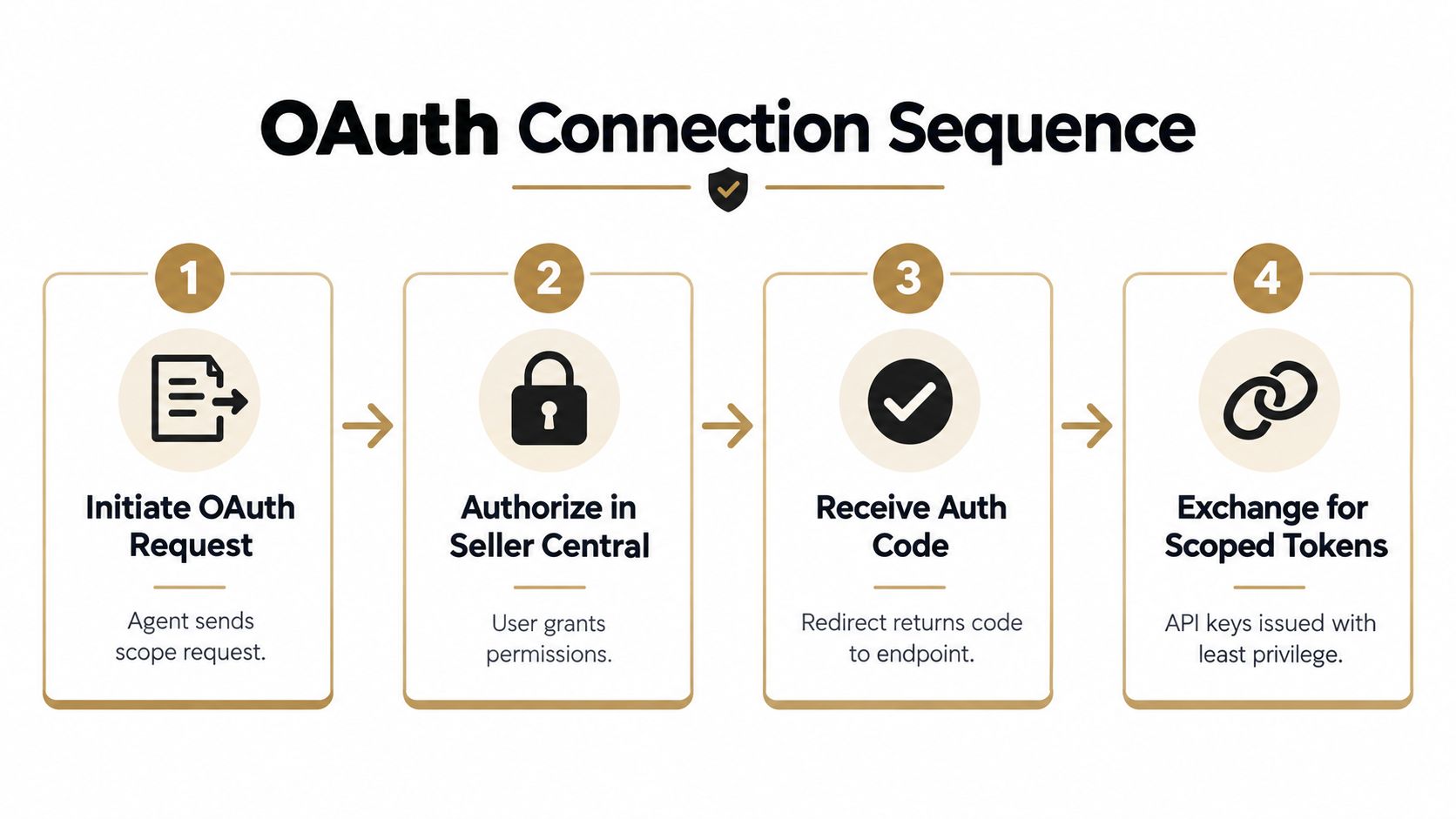
Treat OAuth as account mapping. The operator initiates the request, reviews the requested Seller Central scopes, grants only the permissions required for the workflow, and verifies that the redirect returns to the expected application. The resulting key must be associated with the intended tenant and environment.
Production authorization should use HTTPS URLs. MCP security guidance permits loopback HTTP for localhost-style development, while production authorization URLs should use HTTPS and require explicit user approval before a local server launches (MCP server build guidance). Apply the same control to remote seller data. The approval screen should identify the command, endpoint, account, and scopes.
Write down the test account and a read-only workflow before proceeding. Retrieve a known Amazon Ads, inventory, order, or finance view, confirm its account and freshness, and keep writes disabled. That baseline isolates permission, rate-limit, and data-preparation failures before production access is granted.
Connecting agentcentral With OAuth Endpoints and Scoped Keys
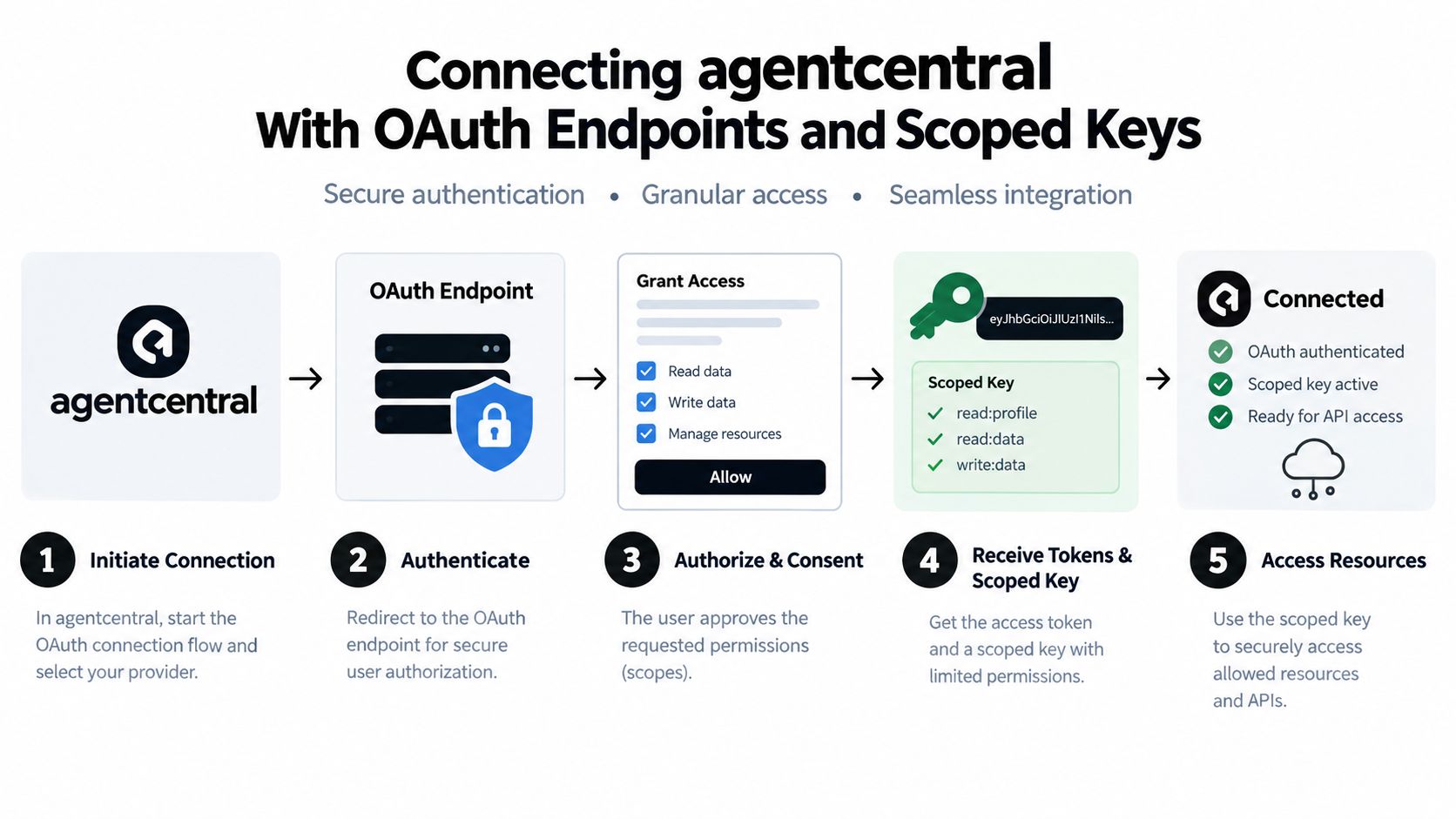
A connection can appear healthy while Amazon seller reads fail under load or return the wrong account. In production, four handoffs must agree: authorize the seller application, select the remote MCP endpoint, create a scoped credential, and verify the client's request headers. Missing one can leave the client showing tools while queries return incomplete, stale, or unauthorized data.
Complete OAuth before configuring the client
Start with the Seller Central authorization flow. Confirm the legal entity or seller account, review the requested access, and approve only the resources required for the workflow. An Ads manager may need campaign and performance reads. An operations workflow may require inventory, orders, fulfillment, or finance access. Broad permissions make later audits harder and increase the impact of a compromised credential.
Check the authorization result outside the agent conversation. The connection should identify the intended account and expose the expected Amazon data domains. A prompt cannot correct an incorrect OAuth grant. Revoke or replace the grant, then establish it again against the correct seller context.
The guide to setting up OAuth covers the client-specific connection sequence. Teams comparing client behavior can also use the docs for MCP server integration when the remote configuration format differs from the one shown in their client.
Select the endpoint and transport
The hosted endpoint for agentcentral is:
https://mcp.agentcentral.to/mcp
A remote client generally needs this endpoint and an authorization header containing the scoped bearer credential. Some integrations instead support a signed connector URL. Header placement depends on the client, so configure its remote MCP connection rather than applying a local STDIO pattern to an HTTP endpoint.
Transport choice affects failure handling. STDIO suits a local process, but stdout carries JSON-RPC traffic and must remain free of diagnostic output. Send logs to stderr or a file, following the protocol's transport guidance (MCP specification overview). A hosted HTTP endpoint removes the local stream collision, but it still requires TLS, authorization checks, timeouts, and request observability.
Amazon rate limits make this distinction operationally important. A server that starts a fresh report for every question can create avoidable delays and repeated API pressure. Pre-materialized reads, such as synchronized inventory, order, or performance views, give the agent a stable response path for repeated questions. Mark those reads with account and freshness metadata so an operator can distinguish cached history from current marketplace state.
Add the credential without leaking it
Create a key with the narrowest useful scope. Store it in the client's protected secret facility or an environment-specific secret store, then inject it into the authorization header. Do not paste a production key into shared JSON examples or commit it to a repository.
Review the configuration against three questions:
- Does the key identify one intended account or tenant?
- Does it grant only the read and write domains required by the workflow?
- Can the key be revoked or rotated without rebuilding the client integration?
The specification's stateless model also changes request routing. The protocol version, client identity, and capabilities travel in a _meta parameter with each request rather than remaining in a long-lived protocol session (MCP specification overview). For distributed deployments, this reduces reliance on session storage and lets requests reach an available server instance. Tenant-aware authorization remains necessary at the data layer.
Verify each boundary
After saving the client configuration, test the boundaries in order:
- Confirm that the client reaches the endpoint.
- Confirm that the server exposes the expected tools.
- Run one read for every approved data domain.
- Check that each response belongs to the intended account.
- Repeat an identical read and compare structure, freshness, and latency.
- Keep write tools disabled until read verification passes.
A repeated read should not automatically trigger a new asynchronous Seller Central report. Pre-synced daily data can serve common operational questions without adding unnecessary API calls, helping the server stay within SP-API rate limits. It is not universally real time, so workflows involving immediate marketplace changes must separate synchronized history from current transactional state. Logging the request, account, scope, response status, and freshness marker creates an auditable record before write access is considered.
Security Controls Idempotency and Auditability for Seller Data
A read-only connection limits damage, but Amazon workflows often move toward writes. Listing updates, bid changes, shipment creation, and order operations need controls that prevent an agent retry from becoming a duplicate action or an ambiguous account change.
Limit the blast radius
Security guidance for MCP treats tools as arbitrary code execution and requires strong access controls. Hosts should obtain explicit user consent before exposing user data, while production deployments benefit from narrow OAuth scopes, short-lived tokens, TLS, session binding, rate limits, and separation between sensitive and general-purpose servers (MCP specification).
For agencies, isolation must exist at more than the user-interface level. A credential for one client account shouldn't be reusable against another account, and a general reporting key shouldn't automatically grant write access. The configuration should make the permitted account and action scope visible to the operator before a tool runs.
Make writes reviewable and retry-safe
A write preview should show the target resource, supplied parameters, expected effect, and account context before execution. Explicit human approval is especially important for actions that alter bids, listings, inventory state, shipments, or orders.
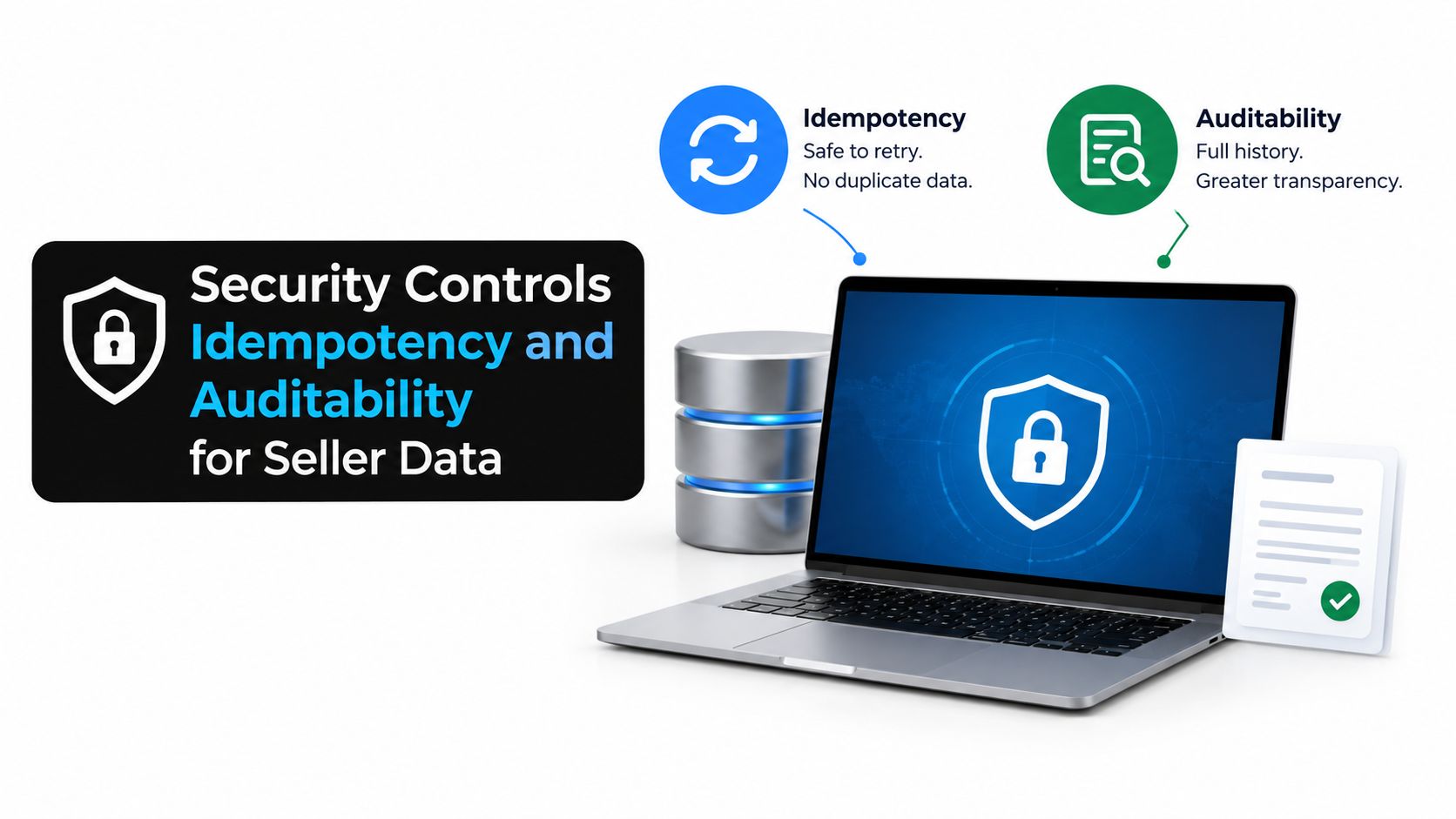
Idempotency keys protect against a different failure. If the client times out after sending a request, the agent may retry because it can't tell whether Amazon or the downstream service completed the action. A stable idempotency key lets the server recognize the retry as the same intended operation rather than treating it as a new write.
Audit records should capture the agent identity, tool name, parameters, timestamp, response status, and before-and-after values where the operation changes a resource. Independent MCP security guidance recommends authentication, least-privilege credentials, and logging those invocation details, with OAuth 2.1 and API-key validation included in audit checks (MCP authentication guidance). Teams implementing a broader review process can use these audit logging best practices as a reference point.
Keep protocol traffic clean
Local STDIO servers need strict separation between diagnostics and JSON-RPC output. A debug statement on stdout can corrupt the stream before authorization or tool execution is even evaluated. Remote deployments have different failure modes, including expired credentials, rejected scopes, missing consent, and incomplete tenant mapping.
A production control set should therefore include:
- Scoped credentials: Separate read and write permissions where the workflow allows it.
- Revocation: Maintain a clear process for disabling a compromised or obsolete key.
- Approval gates: Require a user confirmation for consequential writes.
- Idempotency: Attach a stable key to every retryable mutation.
- Audit detail: Record who or what invoked the tool, what parameters were sent, and what changed.
- Tenant isolation: Keep each seller account's authorization and dataset boundary explicit.
These controls don't decide whether a seller should change a bid or create a shipment. They ensure that the chosen action is attributable, constrained, and recoverable.
Verification Testing and Troubleshooting Fast Reads
A working handshake isn't a passing production test. Verification should exercise the same reads an Amazon operator will use, then test the failure paths that appear under repeated polling, expired authorization, and client retries.
Run a domain-by-domain smoke test
Use a small, known account and ask the connected agent for:
- Ads: A defined campaign performance view with a stated date range and marketplace.
- Inventory: Current stock facts and a retained view suitable for a days-of-cover check.
- Orders: A bounded order query that confirms the account and marketplace context.
- Finance: A settlement or transaction view that confirms the finance scope is present.
The expected response should contain structured fields, the requested account context, and a clear freshness indicator where available. Repeat a read that was already requested. A pre-materialized response should not require the agent to create and wait for a new report during every conversational turn.
Response behavior deserves its own test. The MCP query response time guide is relevant when a team needs to distinguish a slow client, an overloaded workflow, and a source-report delay. A fast repeated read is useful only if the returned data remains clearly labeled and operationally trustworthy.
Respect operation-specific rate limits
Amazon doesn't apply one universal Reports API quota. Limits are enforced per account-application pair and vary by operation, while the x-amzn-RateLimit-Limit response header can expose the current operation-specific limit when present (Amazon Reports API rate limits).
| Operation | Limit per Second | Burst |
|---|---|---|
getReports | 0.0222 | 10 |
createReport | 0.0167 | 15 |
getReport | 2 | 15 |
A polling workflow that treats these operations as interchangeable will behave badly. createReport and getReports are comparatively constrained, while getReport has a different published limit. Clients should read the response header when present, apply backoff, avoid parallel polling for the same report, and prefer retained or pre-synced data for repeated analytical questions. Amazon's usage-plan documentation also confirms that the header describes the limit for that specific account-application pair (SP-API usage plans and rate limits).
Diagnose the common failures
The client connects but tools fail. Check OAuth consent, account mapping, and scope coverage before changing prompts. A tool list proves discovery, not authorization for every data domain.
Reads are unexpectedly slow. Check whether the workflow is triggering asynchronous report creation instead of querying available materialized data. Then inspect repeated calls and rate-limit headers rather than increasing concurrency blindly.
The local server returns protocol errors. Inspect stdout for logs or debug output. Move diagnostics to stderr or files, then restart the process with a clean stream.
The behavior differs across environments. Compare environment variables and secret references. Stale values, hardcoded credentials, and environment drift are common causes of inconsistent startup and account selection.
A write appears duplicated after a timeout. Review the audit trail and idempotency key before retrying manually. A timeout means the client lacks confirmation, not that the operation definitely failed.
Putting Your MCP Configuration Into Production
Production readiness comes from treating configuration as ongoing account infrastructure. The endpoint is only one part of the system. Scope design, tenant mapping, data freshness, rate-limit behavior, approval gates, and audit records determine whether an agent remains safe and useful after the first successful query.
A sensible rollout starts read-only. Verify ads, inventory, orders, catalog, ranking, finance, and fulfillment access against the intended seller account, then establish a few repeatable workflows such as days-of-cover checks, TACOS analysis, and settlement reviews. Only after those reads are reliable should an operator enable guarded writes.
The maintenance routine should include key rotation, revoked-access checks, audit-log review, and monitoring for changes in consent or transport behavior. A hosted layer such as agentcentral can provide structured Amazon seller and Ads data to Claude, ChatGPT, OpenClaw, Cursor, and other MCP clients, with pre-materialized reads and guarded write tools. The agent still makes the operational decision. The configuration makes sure it has the right facts, permissions, and evidence to act safely.
Connect your Amazon seller accounts to agentcentral through OAuth, add the scoped key to the MCP client, and validate fast reads across Ads, inventory, orders, and finance before enabling writes. Use the hosted data layer to give your agent structured Amazon facts, retained history, and auditable guarded actions without building a separate polling and authorization path for every workflow.
Related Agent Central pages
- Amazon Seller Central MCP server
Canonical hosted MCP overview for Seller Central, Ads, inventory, catalog, finance, and fulfillment data.
- Connect Seller Central to Claude
Step-by-step path from Amazon OAuth to a Claude connector or MCP config.
- Amazon seller data for AI agents
How Agent Central normalizes Amazon seller data before exposing it to AI clients.
- Amazon seller MCP servers compared
How hosted MCP services compare with official Ads MCP, local repos, connector tools, and automation platforms.
- ChatGPT with Amazon seller data
ChatGPT-specific setup path for Amazon seller data through hosted MCP.
Related reading
- What Is Amazon Seller Central and How It Works in 2026
What Is Amazon Seller Central. Learn what Amazon Seller Central is, how its dashboard works, and how sellers connect it to AI agents via MCP
- Amazon SP-API Guide for Sellers and AI Agents
How the Amazon SP-API works for sellers and AI agents: authentication, domain APIs, rate limits, and where a hosted MCP data layer sits above it.
- AI Automation Companies for Amazon Sellers
What AI automation companies do for Amazon sellers, how to evaluate vendors, and where a hosted MCP data layer like agentcentral fits in seller workflows.
- AI Agent Data Analysis for Amazon Sellers
Learn how Amazon operators can connect agents to structured seller data for factual analysis, narrow access, reviewed writes, and durable audit records.
Connect Amazon seller data to your AI client.
Agent Central gives Claude, ChatGPT, OpenClaw, Cursor, and other MCP clients structured access to Amazon Ads, Seller Central, inventory, orders, catalog, finance, and fulfillment data.